A building project rarely starts with talk of evidence, defect attribution, or tribunal procedure. It starts with a plan. A renovation to finally fix the leaking balcony. A new home that should’ve been handed over months ago. An extension where the finish looked acceptable from the driveway, then the cracks, ponding, sticking doors, and unanswered emails started to add up.
By the time individuals look up information on building disputes, they’re already carrying a mix of frustration and fatigue. Homeowners feel ignored. Builders feel unfairly blamed for issues outside their control. Lawyers often inherit a file packed with photos and correspondence but very little material that proves the key points. That’s where disputes become expensive. Not only in money, but in time, stress, and lost momentum.
For anyone who manages property, that pattern will sound familiar beyond residential projects alone. Broader maintenance discipline often prevents arguments from hardening into claims, and a practical reference on landlord’s property upkeep in Croydon is a useful reminder that documentation, inspection history, and timely action matter long before a formal dispute begins.
Awesim’s work sits in that difficult zone where projects have gone off track and someone needs clear, technical, independent analysis. With 35+ years in building and construction and 15+ years providing litigation support, the focus is not on noise. It’s on site investigation, expert evidence, and documents that NCAT and lawyers can use.
When Your Building Project Becomes a Battleground
A dispute usually begins with something small. One party says the issue is minor. The other says it’s part of a bigger pattern. A cracked tile becomes a waterproofing concern. A delayed handover becomes an argument about variations, access, and unpaid invoices. Then everyone starts talking past each other.
In practice, the turning point is rarely the defect itself. It’s the moment confidence collapses. Once that happens, every conversation gets filtered through suspicion. Owners start photographing everything. Builders become careful about what they say on site. Strata managers try to separate defect complaints from maintenance complaints. Solicitors ask for a coherent chronology and discover there isn’t one.
Building disputes don’t usually fail because there was no issue. They fail because the issue was never framed properly and the evidence was assembled too late.
That’s why the practical approach matters. Before anyone talks strategy, someone has to answer basic but critical questions. What is the alleged defect? Where is it? When did it first appear? Is it workmanship, design, maintenance, movement, wear and tear, or a combination? What documents support that position?
The clients who move forward most effectively aren’t always the ones with the biggest folder. They’re the ones with the clearest issues and the best technical foundation.
Understanding Building Disputes in NSW
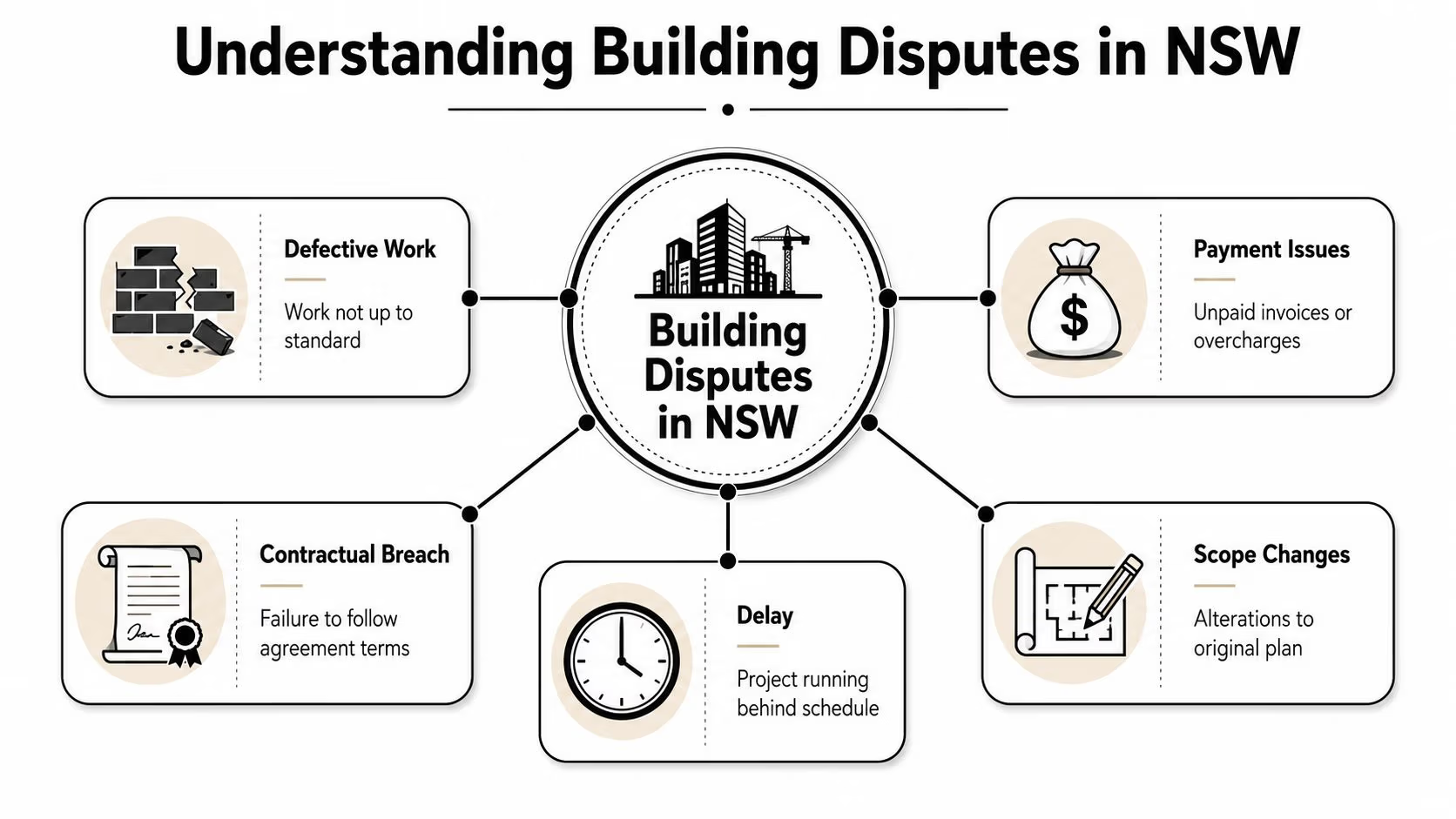
In New South Wales, a building dispute isn’t limited to a dramatic collapse or a major contractual fight. Most matters are more ordinary and more stubborn than that. They involve defective work, incomplete work, payment disagreements, delay allegations, disputed variations, and arguments about whether work complies with the contract, approved plans, Australian Standards, or statutory obligations.
The legal setting matters. Building and construction disputes in NSW are shaped heavily by statute, tribunal process, and documentary proof. The Home Building Act 1989 (NSW) sits at the centre of many residential claims, especially where workmanship, contractual scope, statutory warranties, and rectification are in issue.
What usually triggers a dispute
The common triggers are familiar on site:
- Defective workmanship such as poor finishes, non-compliant installation, water ingress, or movement that shouldn’t be present.
- Incomplete work where practical completion is disputed or promised items were never finished.
- Variations and scope drift where one side treats work as included and the other treats it as extra.
- Payment conflict involving unpaid claims, withheld progress payments, or disputes about overcharging.
- Delay and sequencing problems where the parties disagree on what caused slippage and who carries the cost.
- Communication breakdown where instructions were verbal, records are inconsistent, and site decisions were never confirmed in writing.
Why these matters escalate
Some disputes are caused by defective work. Others are driven by mismatched expectations and poor records. A contract may be brief. Drawings may be incomplete. The owner may assume a finish level that was never specified. The builder may rely on verbal approvals that can’t be proved later.
The NSW system sees a large volume of this sort of conflict. NCAT hears building disputes up to a monetary limit of AU$500,000, and NSW Fair Trading’s annual reporting consistently shows that building and construction issues are a top category for consumer and trade-related complaints according to NSW building dispute statistics.
That figure matters for one reason above all. It tells parties where many residential claims will be fought. If the matter falls within NCAT’s jurisdiction, the question becomes less about outrage and more about proof.
The language that helps your case
A useful shift happens when people stop saying “the whole job is defective” and start identifying specific issues. Tribunal work is far easier when the claim is broken into items such as waterproofing to ensuite shower, external paving falls, balustrade compliance, brickwork cracking, or incomplete electrical fit-off.
That level of detail does two things. It narrows the dispute and makes it possible for an expert to inspect, assess, and report on actual issues rather than general dissatisfaction.
Your Pathway to Resolution From Negotiation to NCAT
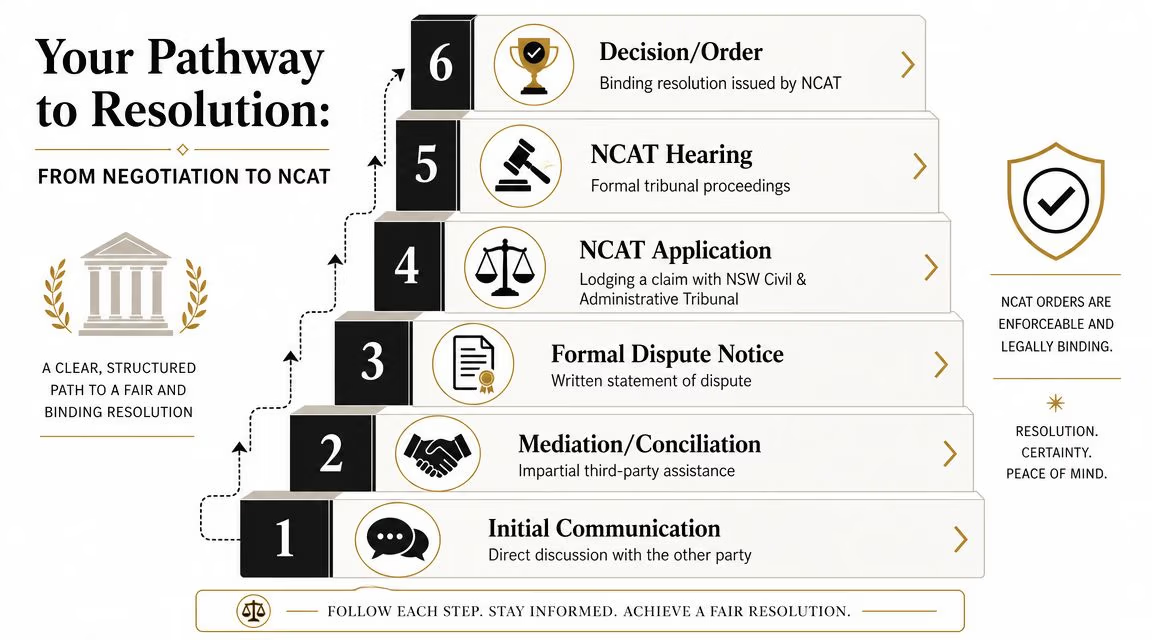
Most building disputes shouldn’t start with a hearing room. They should start lower down the ladder, where the cost of fixing the problem is still less than the cost of fighting about it. The strongest pathway is usually staged. Raise the issue clearly, test whether it can be resolved early, then escalate only when the other side won’t engage or the technical issues require a formal decision.
A practical benchmark in construction disputes is a tiered resolution pathway that prioritises early, expert-led determination before arbitration or court, with modern contracts often setting out these steps to reduce procedural ambiguity and keep the dispute focused on evidence-backed issues, as outlined in this construction dispute resolution overview.
Here’s the pathway in visual form.
Step one is direct engagement
Early communication still matters. Not because it solves every dispute, but because it often reveals what kind of dispute you have. If the builder says, “I’ll inspect and make good,” that’s very different from “that’s owner maintenance” or “that work was outside scope.”
A useful first notice is short and specific. Identify the issue, location, date observed, and what you want done next. Avoid pages of accusation. They rarely help.
Mediation and conciliation have a place
Mediation works best when both parties accept that there is a genuine issue and the core argument is over responsibility, scope of rectification, or timing. It works badly when one side denies the existence of any defect at all and there is no credible technical material on the table.
For many matters, NSW Fair Trading or similar early intervention can be worthwhile. It’s less formal and often quicker than filing straight away. But parties should be realistic. If the dispute turns on waterproofing failure, structural movement, or competing technical explanations, conciliation without proper expert input can just delay necessary work.
The embedded video below gives a useful procedural overview.
NCAT is where loose claims get exposed
Once a matter reaches NCAT, broad complaints stop carrying much weight. The tribunal wants structure. It wants itemised issues, responses, evidence, and a chronology that makes sense. That’s why many parties end up seeking specialist assistance with NCAT building disputes before the hearing date gets too close.
Practical rule: Escalate only after you’ve identified the actual issues and gathered the documents needed to prove them.
NSW building dispute resolution pathways compared
| Pathway | Typical Cost | Estimated Timeline | Formality | Outcome |
|---|---|---|---|---|
| Direct negotiation | Lower than formal proceedings | Can be short if both parties engage | Low | Agreed rectification, payment, revised scope, or no resolution |
| Mediation or conciliation | Moderate compared with a hearing | Often quicker than tribunal litigation | Medium | Negotiated settlement, partial agreement, or impasse |
| Formal dispute notice | Low to moderate | Depends on contract response periods and party conduct | Medium | Clarifies issues and preserves position before escalation |
| NCAT application and hearing | Higher due to preparation, filing, experts, and representation | Can extend over months in contested matters | High | Orders for rectification, money, dismissal, or other tribunal directions |
| Court proceedings | Typically more expensive and more procedurally complex | Often longer than tribunal pathways | Very high | Binding judgment and formal court orders |
Where a matter sits on that ladder depends on the claim, the contract, and the evidence. Some disputes should settle early. Some should never have been filed. Some only become clear once an independent expert has inspected the work.
The Power of Evidence Expert Reports and Scott Schedules
The biggest mistake in building disputes is thinking that strong feelings make a strong case. They don’t. The tribunal and the lawyers need something much more useful. They need evidence that identifies each issue, explains why it matters, and ties the conclusion to observable facts, standards, documents, and site conditions.
That’s where Expert Witness Reports and Scott Schedules become central.
What an expert report actually does
An expert report isn’t a complaint letter with technical language added. It is a structured, independent assessment. It should identify the alleged defect, describe the relevant construction element, record observations from inspection, consider available documents, and explain whether the issue is consistent with poor workmanship, incomplete work, design limitation, movement, maintenance, or ordinary wear.
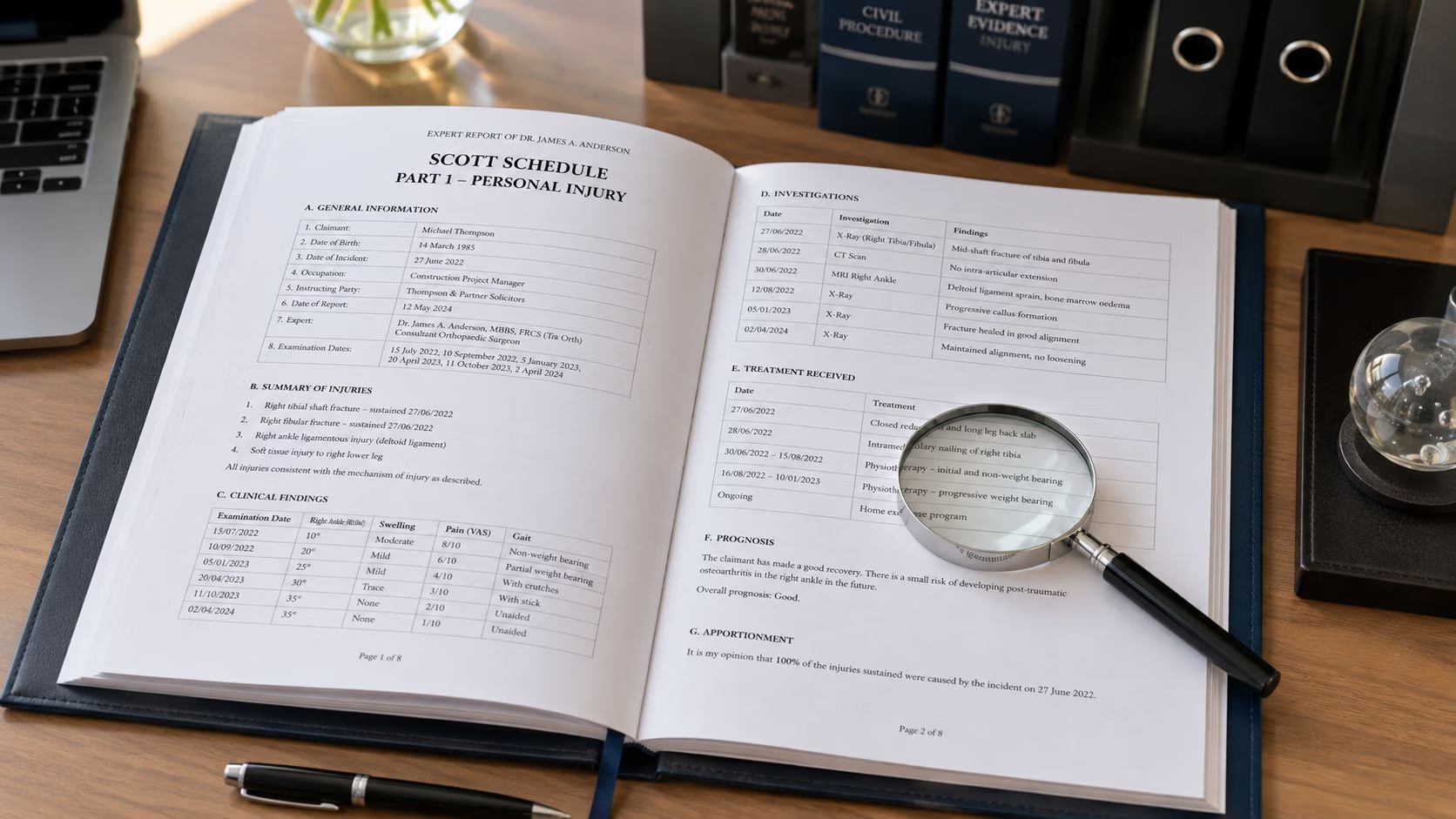
That independence matters. A report prepared to advocate rather than analyse usually shows its weakness quickly. It overstates. It strays beyond the observable facts. It ignores competing explanations. In cross-examination or tribunal scrutiny, that kind of report doesn’t hold up well.
A sound expert report usually addresses:
- Defect identification with location, extent, and description.
- Causation so the reader can understand why the issue occurred.
- Responsibility where the material allows that conclusion.
- Compliance assessment against contract documents, approved plans, Australian Standards, or accepted construction practice.
- Recommended rectification framed in practical terms.
- Costing or scope implications where that falls within the report’s brief and expertise.
Defect versus maintenance is often the real fight
One of the hardest parts of building disputes is not showing that something looks wrong. It’s proving why it is wrong. A stained wall may reflect a waterproofing failure, but it may also be a maintenance issue, poor ventilation, or later water entry from another source. A cracked path may be defective work, reactive soil movement, tree impact, or post-construction settlement outside the builder’s control.
That distinction is becoming even more important in NSW. From 1 April 2025, NCAT’s new Procedural Direction 3 requires more structured documentation such as Scott Schedules, increasing the need for clear, expert-led defect attribution rather than generic complaint narratives, as discussed in this note on dispute documentation and Scott Schedules.
If you can’t separate workmanship issues from maintenance, wear and tear, or later damage, the dispute usually stalls or fragments.
Why Scott Schedules matter so much
A Scott Schedule is the working document that organises the dispute item by item. It is one of the most useful tools in a building case because it forces clarity. Instead of arguing in broad themes, the parties address each alleged defect in a structured table. One item per issue. One response per issue. Often one expert view per issue.
A properly prepared Scott Schedule usually includes:
The defect item
A precise description, not “poor quality throughout bathroom.”Location and complaint
Where it is and what is said to be wrong.Claimant position
The alleged breach, defect, or non-compliance.Respondent position
Admission, denial, alternate cause, or partial agreement.Expert comment
The technical view, ideally linked to inspection findings and documents.Rectification and cost position
What work is said to be required and, where relevant, the claimed amount.
The Schedule becomes the battle map. It tells the tribunal what is being decided. It also exposes weak items early. If a party can’t describe the defect clearly enough to place it in the Schedule, that issue probably isn’t ready for hearing.
For a fuller explanation of format and use, this guide on what is a Scott Schedule in a building dispute NSW guide is worth reading.
What works and what doesn’t
What works:
- Contemporaneous photos with dates and clear locations
- Inspection access before damage is concealed or altered
- A narrow brief to the expert focused on actual disputed issues
- Document packs in order with contract, plans, variations, emails, and defects list
- Issue-by-issue pleading rather than general allegations
What doesn’t work:
- Massive email bundles with no chronology
- Reports written like submissions
- Photos with no date, scale, or location
- Repair claims with no defect identification
- A Scott Schedule filled with vague descriptions
Awesim Building Consultants provides site investigations, Expert Witness Reports, and Scott Schedules for NSW building disputes where parties need independent, NCAT-focused evidence rather than general commentary.
Your Dispute Preparation Checklist
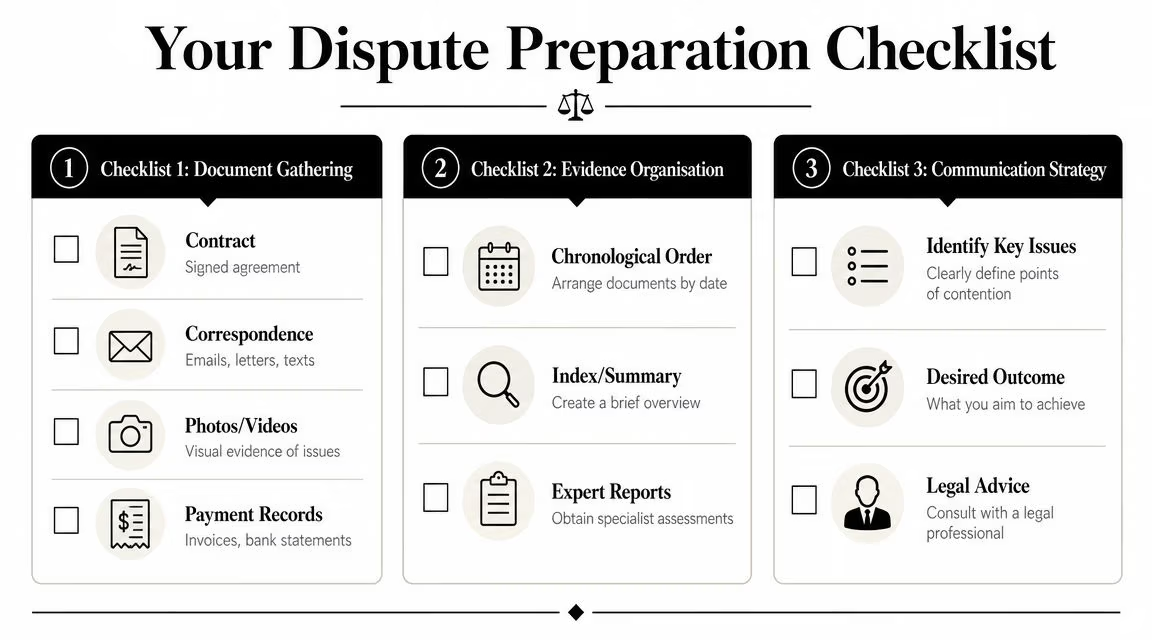
Most weak cases don’t collapse because there was no problem. They collapse because the preparation was scattered. People keep too much irrelevant material, miss the critical documents, and fail to frame the issues properly. In Australian building disputes, success often depends more on the quality of issue framing and defect classification in the evidence than on the sheer volume of correspondence, with recent NSW procedural changes favouring clear and independently prepared expert input, as noted in this practical discussion of dispute preparation.
Use the checklist below as a working file structure, not just a reading exercise.
For homeowners
Start by building a timeline. Don’t rely on memory. Create a dated sequence from contract signing through progress claims, key site meetings, complaint notices, attempted rectification, and current status.
Then gather the core documents:
- Signed contract and scope including plans, specifications, and inclusions.
- Variation records whether approved, disputed, or only discussed by email.
- Photos and videos taken over time, not only after the relationship deteriorated.
- Payment records including invoices, bank transfers, and receipts.
- Complaint notices showing when the builder was first told about the issue.
Homeowners should also sort defects by type. Keep waterproofing separate from tiling, drainage separate from cracking, and incomplete items separate from defective ones. That makes expert review faster and more reliable.
For builders
Builders often damage their own position by treating the dispute as purely emotional when the file could support them well. Site diaries, delivery records, variation requests, weather interruptions, access limitations, and subcontractor communications often explain a lot.
Focus on records that show what happened, when, and why:
- Site diary entries that identify labour, attendance, weather, and notable events.
- Instructions from owners or consultants especially late changes or selections.
- Delay-related records such as revised sequencing, unavailable materials, or denied access.
- Subcontractor scopes so responsibility can be traced properly.
- Defect response history showing inspections, offers to rectify, and any declined access.
A builder who can produce orderly site records is in a far stronger position than a builder who only says the owner was difficult.
Builders should also resist the urge to answer every allegation with a blanket denial. It’s often smarter to concede minor items, contest the unsupported ones, and focus attention on causation, scope, and access where those are the actual issues.
For lawyers
Lawyers usually need the file reduced, not expanded. A good brief to an expert is targeted. It identifies the pleaded issues, the live questions for opinion, the critical documents, and any assumptions that need testing on site.
A strong litigation support brief should include:
The dispute matrix
What issues are admitted, denied, or unclear.The pleading or draft claims
So the expert stays within the issues in dispute.Indexed document set
Contract, plans, correspondence, variations, prior reports, and photos.Specific questions for opinion
For example, whether observed cracking is consistent with poor workmanship, movement, or maintenance neglect.Procedural requirements
Including timetable, report format, and whether a Scott Schedule is required.
One simple organising method
If the file is chaotic, use four folders only:
| Folder | What goes in it | Why it helps |
|---|---|---|
| Contract | Contract, plans, specifications, variations | Defines the promised work |
| Chronology | Dated events, emails, notices, site meetings | Shows sequence and notice |
| Defects | Photos, inspection notes, defect lists, prior repairs | Isolates the technical issues |
| Money | Invoices, claims, receipts, rectification quotes | Links liability to outcome |
That system is basic, but it works. Most tribunals and experts don’t need a dramatic story. They need a file that allows them to understand the dispute quickly and accurately.
Navigating Timelines Costs and Potential Outcomes
One of the hardest parts of building disputes is uncertainty. People can cope with bad news more easily than they can cope with not knowing how long the process might drag on, what it may cost to prepare properly, or what sort of result is realistically available.
Timelines are driven by complexity, not just procedure
A small dispute with a narrow issue can move quickly if both parties cooperate. A multi-issue matter involving waterproofing, structural cracking, incomplete finishes, delay allegations, and competing scope arguments will take much longer because each issue needs to be identified, inspected, and answered.
Delay claims are a good example. In construction disputes, the burden isn’t only to say the job was late. The technical task is to prove a defensible cause-and-effect chain using independently validated source materials and accepted programme analysis protocols, as explained in this research on delay claim evidence. If that material doesn’t exist, parties often spend months arguing over a delay claim that was never properly provable.
What costs usually attach to a dispute
The actual cost isn’t limited to an application fee or a lawyer’s letter. It usually includes a combination of:
- Early advice and review to test whether the claim is properly framed
- Site inspection costs where expert evidence is needed
- Expert report preparation for defects, scope, cause, or rectification
- Scott Schedule preparation where itemised dispute management is required
- Representation and hearing preparation if the matter proceeds to NCAT
- Time cost to the parties in gathering records, attending inspections, and responding to directions
For strata and community schemes, broader governance resources can also help boards separate repair planning from dispute posture. An essential guide for HOA boards is useful reading where maintenance obligations, contractor management, and defect complaints overlap.
Potential outcomes are narrower than people expect
Many parties walk into a dispute wanting vindication. The system usually delivers something more practical. The likely outcomes are generally one or more of the following:
- Rectification orders requiring work to be fixed
- Money orders for loss, damage, or cost to complete
- Dismissal of unsupported claims where the evidence doesn’t establish liability
- Partial success where some defect items are proved and others fail
- Settlement before hearing once the technical issues are finally clarified
The strongest settlement leverage usually comes after the issues are narrowed and the evidence is organised, not before.
That’s the part many people miss. Better preparation doesn’t always lead to a hearing. Often it leads to a more realistic negotiation because both sides can finally see the strengths and weaknesses of the file.
Expert Help for Your Building Dispute
Three questions come up constantly.
Can I represent myself at NCAT
Yes, many people do. But self-representation only works tolerably well when the issues are narrow and the evidence is organised. If the dispute involves multiple defects, technical causation, or a contested Scott Schedule, a self-represented party can struggle to present the case clearly. The problem usually isn’t speaking at the hearing. It’s preparing the material in a form the tribunal can use.
How early should I engage a building consultant
Earlier than commonly assumed. The best time is when the dispute has become concrete but before the site conditions change, repairs are carried out, or the correspondence becomes a substitute for actual evidence. Early inspection helps preserve observations, identify the core issues, and stop parties wasting time on allegations that won’t survive scrutiny.
What if the builder has gone into liquidation
That changes strategy, but it doesn’t make evidence irrelevant. You still need to identify the defects properly, document condition, and understand causation. Depending on the circumstances, that evidence may matter for insurers, other responsible parties, or later recovery steps. Even when the builder is gone, the technical groundwork still needs to be done carefully.
Building disputes are stressful because they mix law, construction, money, and disappointment. People want simple answers, but the matters that resolve well usually depend on detailed site investigation, disciplined reporting, and issue-by-issue analysis. That’s especially true when NCAT directions require more structure and less narrative.
If you’re dealing with a live building dispute and need technical evidence that can stand up under scrutiny, Awesim Building Consultants can assist with site investigations, Expert Witness Reports, and Scott Schedules across NSW. For practical support, email admin@awesim.com.au or call 1800 293 746.