
Best Steps for Resolving Building Disputes Early
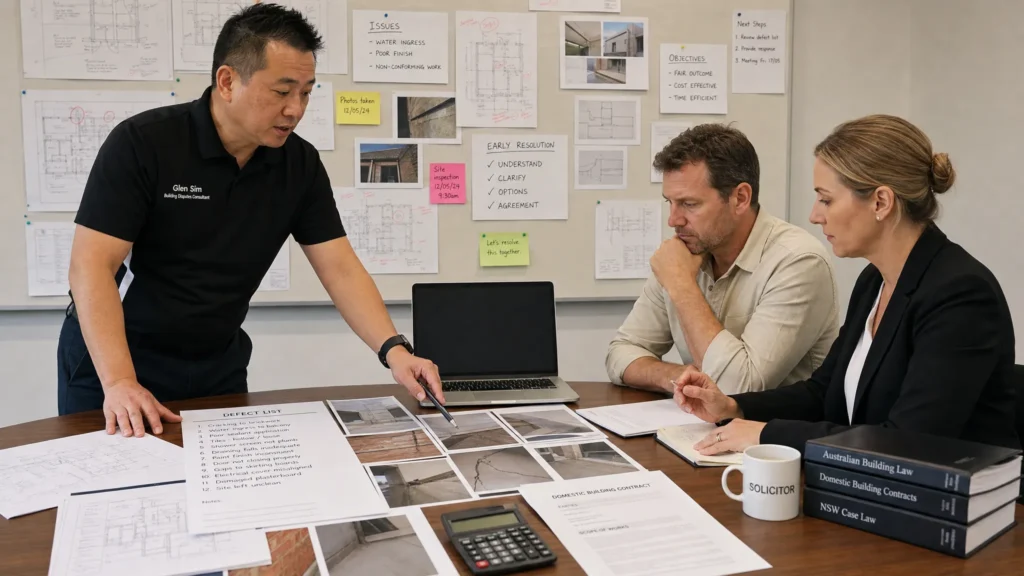
Building disputes rarely begin as legal disputes. They usually begin as a practical problem: a defect is noticed, a payment is withheld, a variation is questioned, or work stops before the parties agree on why.
The best time to deal with that problem is before each side becomes locked into a position. Early action can preserve relationships, reduce legal costs, and keep the focus on what actually needs to be fixed, paid, or proven.
For homeowners, builders, and solicitors in New South Wales, resolving building disputes early depends on three things: clear evidence, calm communication, and independent technical input at the right time. Glen Sim, owner and director of Awesim Building Consultants, approaches building disputes from that practical foundation. Before a matter becomes an NCAT or court fight, the key question is often simple: what are the facts on site, and can they be organised clearly enough for a sensible resolution?
Why early resolution matters in building disputes
A building dispute can quickly become expensive because construction issues often overlap. A homeowner may see cracked tiles or water ingress and assume poor workmanship. A builder may say the issue was caused by design, owner changes, lack of access, or unpaid progress claims. A solicitor may then receive a file full of photos, emails, invoices, and site notes, but no clear technical structure.
Early resolution is not about rushing into compromise. It is about identifying the real dispute before time and money are spent arguing about the wrong issue.
A clear early process helps parties:
- Separate defects from incomplete work, variations, delays, and payment disputes.
- Preserve evidence before rectification work changes the site conditions.
- Understand whether an issue is technical, contractual, legal, or a mix of all three.
- Avoid making admissions or allegations that later complicate the matter.
- Prepare better material if NSW Fair Trading, NCAT, adjudication, or court proceedings become necessary.
If a building dispute is already moving toward a formal pathway, it is worth understanding the broader NSW building dispute pathway so early decisions do not undermine later steps.
Step 1: Identify the actual dispute, not just the frustration
The first step is to define the dispute with precision. Many building matters escalate because the parties use broad language such as defective work, poor quality, or non-payment without breaking down what is actually in dispute.
A homeowner should avoid simply saying the work is unacceptable. A builder should avoid simply saying the owner is refusing to pay. A solicitor should avoid relying on a general chronology without a technical schedule of issues.
Instead, reduce the dispute into categories such as:
- Alleged defective work.
- Incomplete contracted work.
- Variations and disputed instructions.
- Delay, access, or sequencing issues.
- Payment claims, set-offs, or back charges.
- Rectification scope and cost.
This distinction matters because each category may require different evidence. A waterproofing defect may require inspection photos, standards, product information, and rectification methodology. A variation dispute may turn on emails, plans, marked-up drawings, site directions, and whether a price was agreed. A payment dispute may need progress claim records, invoices, contract milestones, and an assessment of work completed.
Glen Sim’s practical approach is to isolate the technical questions first. Once the building issues are clearly separated, legal representatives and parties can make better decisions about liability, quantum, negotiation, and escalation.
Step 2: Preserve evidence before the site changes
Evidence is easiest to collect early and hardest to recreate later. Once work is covered up, demolished, repaired, or completed by another contractor, it can become much harder to prove what was present at the time of the dispute.
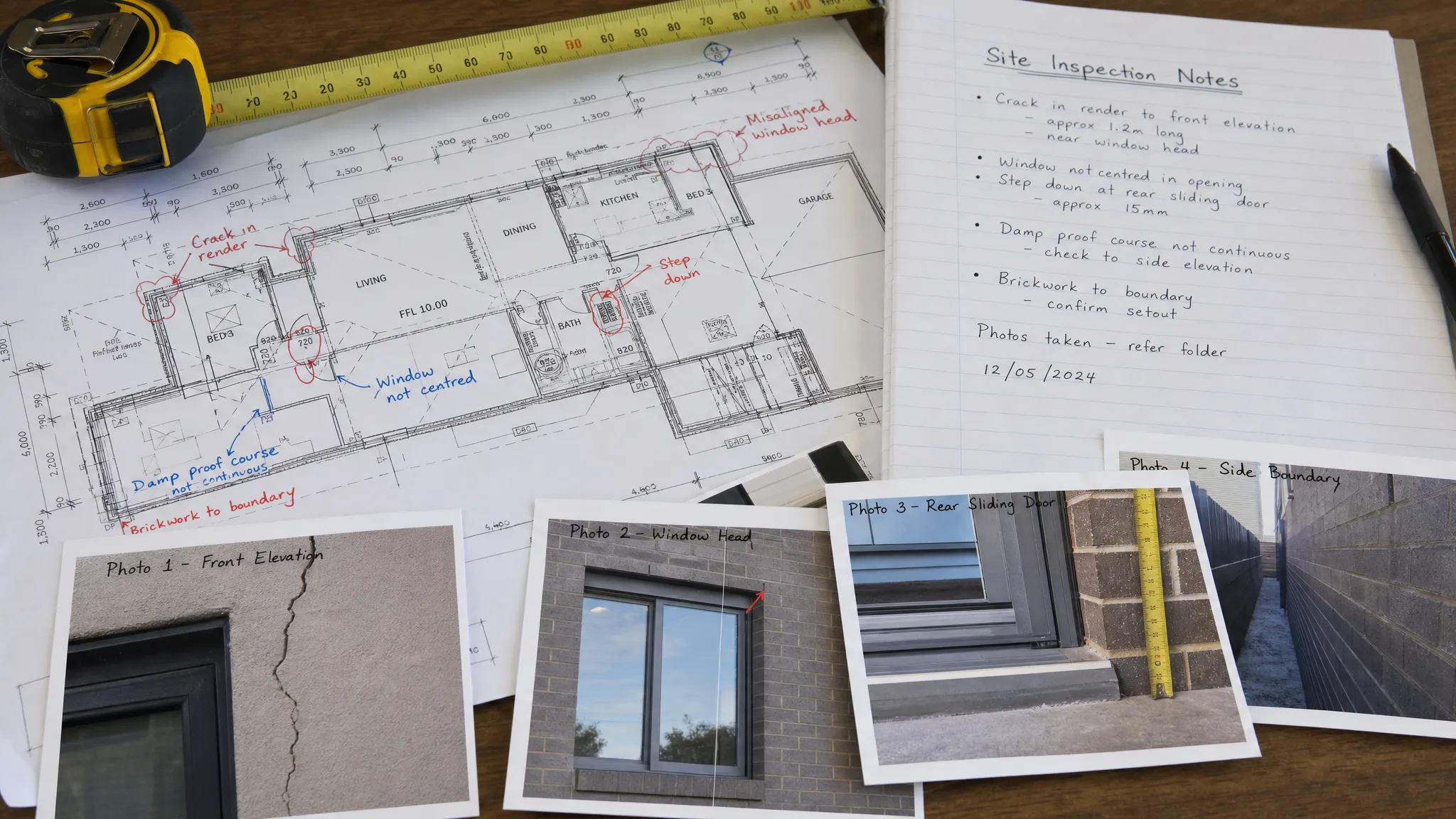
Good early evidence usually includes dated photographs, videos, plans, specifications, contract documents, invoices, emails, text messages, site diaries, inspection reports, and any written notices exchanged between the parties. Photos should show both close-up detail and wider context. For example, a close-up photo of cracking is useful, but a wider photo showing the location of that cracking within the room or structure is often more helpful.
For homeowners, this does not mean taking hundreds of random photos. It means recording the issue methodically. For builders, it means keeping site records that show what work was done, when it was done, what instructions were received, and what conditions affected the work.
For solicitors, early evidence preservation can be decisive. A well-ordered evidence bundle allows an expert to form a clearer opinion and reduces the risk of an expert report being delayed by missing documents.
| Early evidence | Why it helps | Common mistake to avoid |
|---|---|---|
| Dated site photos | Shows the condition before changes are made | Taking close-ups with no location context |
| Contract and scope documents | Identifies what was actually agreed | Relying only on memory or verbal discussions |
| Emails and text messages | Records instructions, concerns, and responses | Deleting or selectively saving messages |
| Invoices and payment claims | Helps quantify payment and completion issues | Mixing disputed and undisputed amounts |
| Plans and specifications | Allows comparison between design and built work | Using outdated plan revisions |
Step 3: Communicate in writing, but keep the tone controlled
Early communication can either reduce the dispute or inflame it. A written record is important, but aggressive language, threats, and assumptions can make settlement harder.
The best early communication is specific, factual, and solution-focused. A homeowner might identify the issue, refer to the location, attach photos, and ask the builder to inspect and respond by a reasonable date. A builder might respond with their position, identify any required access, explain whether the issue is disputed, and propose a practical next step.
A useful early message often includes:
- What the issue is.
- Where it is located.
- When it was observed.
- What documents or photos are attached.
- What response or action is requested.
- A reasonable deadline for reply.
Avoid exaggeration. Words like every, always, never, illegal, and fraudulent can create unnecessary hostility unless they are accurate and supported. The aim is to create a record that would still look reasonable if read later by a tribunal member, adjudicator, judge, solicitor, or expert.
Step 4: Check time limits, notices, and contract requirements
Early resolution should never mean ignoring deadlines. In NSW building disputes, different pathways may have different time limits and procedural requirements. Residential building disputes may involve statutory warranties under the Home Building Act 1989 (NSW), while payment disputes may involve contract provisions or the Building and Construction Industry Security of Payment Act 1999 (NSW).
The key point is simple: do not let informal negotiation consume the time available to protect your position.
Check the contract for notice requirements, dispute resolution clauses, variation procedures, extension of time provisions, and payment claim processes. If you are unsure how those clauses operate, get legal advice early. This is especially important where a party has received a formal notice, a termination threat, a payment claim, a defects list, or a solicitor’s letter.
NSW Fair Trading provides information on residential building complaints and dispute resolution, and NCAT publishes guidance about its home building jurisdiction. These resources can help parties understand the formal framework, but they are not a substitute for tailored legal and technical advice.
Step 5: Arrange an independent building assessment before positions harden
An independent building assessment can be one of the most effective early steps, especially where the parties disagree about workmanship, compliance, causation, or rectification cost.
A building consultant does not replace a solicitor. The consultant’s role is technical: inspect the work, consider relevant documents, identify defects or incomplete items, and explain the likely scope of rectification. In formal matters, that work may develop into an expert witness report, Scott Schedule, or quantum assessment.
This is where Awesim Building Consultants often assists homeowners, builders, and legal teams. Under Glen Sim’s direction, Awesim provides independent building dispute support across NSW, including expert witness reports, Scott Schedules, quantum meruit reports, NCAT dispute reports, and building defect assessments. The value is not just in saying whether something is defective. It is in organising technical evidence so the dispute can be understood and, where possible, resolved.
An early consultant assessment is particularly useful when:
- The parties disagree about whether work is defective or incomplete.
- Rectification cost is being used as a reason to withhold payment.
- A builder says the issue arises from design, materials, access, or owner instructions.
- A solicitor needs a technical foundation before drafting pleadings or evidence.
- The matter may proceed to NSW Fair Trading, NCAT, or court.
You can learn more about how independent building consultant services support dispute resolution when technical evidence is needed.
Step 6: Quantify the dispute, not just the complaint
Many building disputes remain unresolved because the parties argue about principle but never quantify the issue properly. Early quantification helps everyone understand the commercial reality.
For a defect dispute, quantification may involve identifying the reasonable rectification scope and estimated cost. For incomplete work, it may involve assessing what remains to be completed under the contract. For a variation dispute, it may involve determining whether the work was instructed, whether it was outside the original scope, and what reasonable value should be attributed to it. For a payment dispute, it may involve separating amounts genuinely due from amounts disputed because of defects or incomplete work.
This is also where quantum meruit issues can arise. In broad terms, quantum meruit concerns payment for the reasonable value of work where a fixed contract price or valid variation agreement may not clearly apply. These matters can become complex, so they should be considered with appropriate legal advice and technical support.
The earlier the disputed amount is quantified, the easier it is to assess whether settlement is commercially sensible. A dispute over a $15,000 rectification item should not be managed the same way as a dispute involving major structural defects, extensive delay claims, or termination.
Step 7: Use a Scott Schedule to organise the dispute
A Scott Schedule is often seen as a litigation document, but its structure can be useful much earlier. It forces the parties to list each disputed item, state each side’s position, and identify the amount claimed or allowed.
For example, instead of arguing generally about bathroom defects, a schedule can separate waterproofing, falls to floor waste, tile lippage, cracked grout, shower screen installation, and painting. Each item can then be assessed on its own facts.
A clear schedule can help homeowners, builders, experts, and solicitors avoid confusion. It can also make negotiation more productive because the parties may discover that some items are agreed, some are minor, and only a few require expert determination.
If the building dispute is likely to move toward NCAT or court, understanding what a Scott Schedule does in a building dispute can help parties prepare evidence in a more organised way from the beginning.
Step 8: Consider mediation, Fair Trading, NCAT, or court only after the evidence is organised
Not every building dispute can be resolved privately. Some require formal intervention. However, escalation works best when the evidence has already been organised.
In NSW, early pathways may include direct negotiation, site meetings, expert conferences, NSW Fair Trading involvement, mediation, NCAT proceedings, adjudication for payment disputes, or court proceedings depending on the type and value of the claim.
The right pathway depends on the dispute. A residential defect claim may follow a different route from a commercial payment dispute. A small list of incomplete items may be suitable for direct negotiation, while serious structural issues or large unpaid claims may require legal proceedings.
Before escalating, ask these questions:
- Have the disputed issues been listed clearly?
- Is the contract scope understood?
- Has the site evidence been preserved?
- Has an independent technical opinion been obtained where needed?
- Is the amount in dispute quantified?
- Are any limitation periods or notice deadlines approaching?
If the answer to several of these questions is no, escalation may still be necessary, but it may be less efficient and more expensive.
Step 9: Make settlement offers that are evidence-based
Settlement is more likely when an offer is anchored in evidence rather than emotion. A homeowner’s offer might be based on an expert’s rectification scope. A builder’s offer might include agreed defect rectification, a revised payment schedule, or a proposal to complete remaining work by a certain date. A solicitor’s offer might be framed on a without prejudice basis where appropriate.
Evidence-based settlement also helps preserve credibility. If a matter later proceeds to NCAT or court, a party that made reasonable attempts to identify issues, obtain expert input, and propose practical resolution may be in a stronger position than a party that ignored correspondence or made unsupported allegations.
The best early settlement offers are usually specific. They identify what will be done, who will do it, when it will be done, what will be paid, what will be released, and what happens if the agreement is not performed.
Common mistakes that make building disputes worse
Early dispute management is often about avoiding avoidable damage. The following mistakes commonly turn manageable construction disagreements into entrenched disputes:
- Continuing work without clarifying disputed scope or payment.
- Rectifying or demolishing disputed work before it is inspected or photographed.
- Ignoring contract notice requirements.
- Making broad allegations without technical evidence.
- Refusing site access without a clear reason.
- Treating every issue as equally important.
- Waiting until a hearing is approaching before engaging an expert.
The earlier these risks are addressed, the better the chance of resolving building disputes without unnecessary escalation.
Frequently Asked Questions
What is the first step in resolving a building dispute early? The first step is to define the dispute clearly. Identify whether the issue concerns defects, incomplete work, variations, delay, payment, or rectification cost. Once the issue is categorised, the right evidence and resolution pathway become much clearer.
Should I get a building consultant before contacting a solicitor? It depends on the dispute. If the matter involves technical issues such as defects, compliance, incomplete work, or rectification scope, an independent building consultant can provide valuable evidence. If formal notices, termination, payment claims, or proceedings are involved, legal advice should also be obtained promptly.
Can a Scott Schedule help before NCAT proceedings start? Yes. A Scott Schedule can be useful before proceedings because it organises each disputed item, each party’s position, and the claimed amount. This can make negotiation more productive and may reduce the number of issues that need formal determination.
What should builders do when an owner raises defects? Builders should respond in writing, ask for access to inspect, record their position, and avoid dismissing the complaint without assessment. If the defect allegation is disputed, the builder should preserve evidence and consider independent technical input.
What should homeowners avoid doing during an early building dispute? Homeowners should avoid withholding all communication, arranging rectification before evidence is preserved, making unsupported allegations, or allowing limitation periods to pass while negotiating informally. A calm, documented approach is usually more effective.
Need independent support to resolve a building dispute early?
Early action can make the difference between a dispute that is clarified and a dispute that becomes costly litigation. If you are a homeowner, builder, or solicitor dealing with defects, incomplete work, variations, payment issues, or rectification claims, independent technical evidence can help you make better decisions.
Awesim Building Consultants provides NSW-wide building dispute support, including expert witness reports, Scott Schedules, quantum meruit reports, NCAT dispute reports, and building defect assessments. Led by Glen Sim, owner and director, Awesim focuses on clear, independent reporting that helps parties understand the technical issues and prepare for resolution.
To discuss support for a current building dispute, contact Awesim Building Consultants and take the next step with evidence that is organised, practical, and fit for purpose.

Related Posts

Schedule of Rates in Construction: How Disputes Arise in NSW
A Schedule of Rates contract prices construction work by unit rates applied to measured quantities, so the final cost varies
Read More »
NCAT Consumer Division: Steps From Lodgement to Hearing
Most people who end up at the NCAT Consumer and Commercial Division do not arrive there by choice. They arrive
Read More »
Statutory Warranty NSW: What Builders Must Fix and for How Long
Statutory warranty NSW obligations exist precisely for the moment a builder stops returning calls. A crack appears in the render.
Read More »