
Claim for Quantum Meruit in NSW Building Disputes
You've finished the work, the owner says the paperwork is “all sorted”, and then the money stops. The variation was never signed, the contract is now disputed or terminated, and the only thing left on site is a pile of photos, texts, and unpaid invoices. That's the point where a claim for quantum meruit stops being a legal phrase and becomes a recovery problem.
In NSW building disputes, that problem usually starts the same way. A builder keeps going on an oral instruction, the owner benefits from the extra work, and later the owner argues there was no valid agreement for that part of the job or no payment obligation at all. A practical guide to practical completion from Flascon Construction Group on practical completion helps put that stage into context, because once a project is in dispute, the issue is often not whether work was done, but whether it was requested, accepted, and properly valued.
That's why this topic matters in residential work. The dispute is rarely about an abstract doctrine. It is about whether the person who paid for the slab, framing, tiling, or extras can still recover the reasonable value of work performed when the bargain has collapsed.
When a Builder Gets Paid Nothing After the Contract Falls Apart
A common NSW scenario is painfully ordinary. The builder finishes the rough-in, the owner asks for extra work by text message, the site keeps moving, and by the time the job turns sour the original contract is either disputed or terminated. The builder has done real work, but the owner says the extra items were never approved, never priced properly, or were already covered by the original scope.
That is where a claim for quantum meruit becomes relevant. Australian courts treat it as a restitutionary claim for the reasonable value of services, not a claim to enforce the contract price or capture hoped-for profit. The remedy commonly comes up where parties proceed on oral instructions, undocumented variations, or incomplete termination scenarios, which is why it appears so often in residential building disputes. The practical focus is not on what the builder wanted to earn. It is on what the owner received and retained.
Why the dispute feels so personal
Most owners think in terms of “we never agreed to that extra amount”. Builders think in terms of “you asked for it and got the benefit”. Both can be partly right, which is why these matters turn on evidence, not frustration. The case file has to show the path from instruction to execution to acceptance, because that chain is what gives the claim traction.
Practical rule: if the work can't be traced from request to acceptance, the claim usually becomes much harder to prove.
The other trap is timing. Builders often wait until the relationship has completely broken down before they organise their records. By then, emails are scattered, site photos are buried, and the oral directions are hard to reconstruct. A strong recovery case starts much earlier than the letter of demand.
What Quantum Meruit Means in Building Law
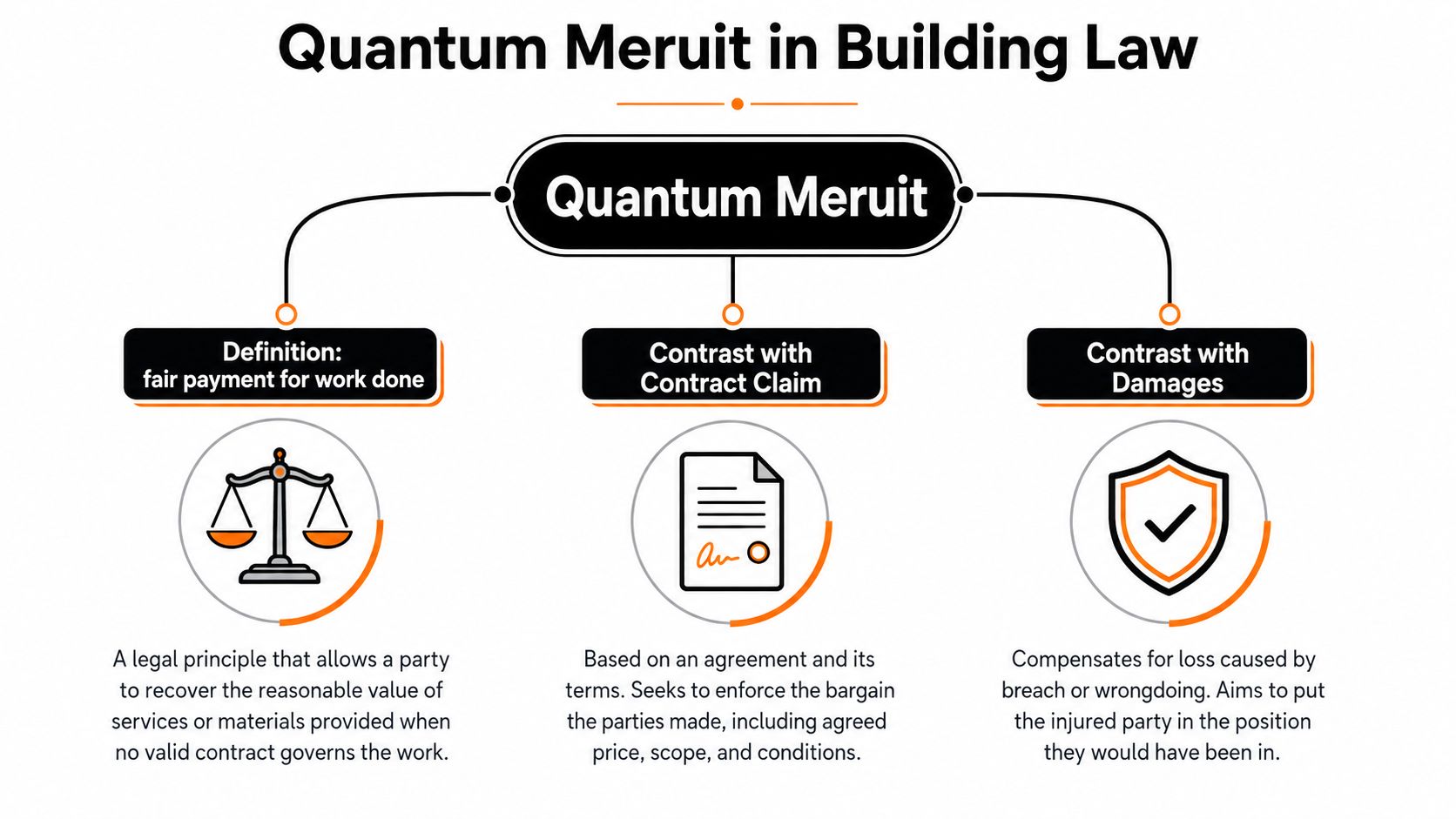
Quantum meruit is a claim for reasonable payment for work accepted. It arises where the work was carried out, the other side took the benefit, and payment was expected for that work. The court then looks at unjust enrichment, which means examining what the owner received, what the builder supplied, and whether the circumstances point to an obligation to pay.
The three things that usually matter
The first question is whether the other party requested, accepted, or knowingly retained the work. That request may appear in a site instruction, an email, a marked-up plan, an inspection sign-off, or conduct on site showing the work was allowed to proceed. The second question is whether the owner received a real benefit. The third is whether the claimant had a reasonable expectation of payment for the extra work or materials.
A practical way to frame it is simple. The builder proposes the work, the owner authorises or permits it, the builder carries it out, and the owner keeps the result. When that chain is documented, a quantum meruit claim can still stand even if the formal contract machinery has broken down.
The file is stronger when it shows who asked for the work, what changed on site, and how the owner responded once the work was complete.
Contemporaneous records carry most of the weight. Site directions, SMS messages, delivery dockets, progress claims, timesheets, marked-up drawings, and photographs do more than fill out a chronology. They show that the work was not incidental, accidental, or volunteered without expectation of payment.
Why Mann v Paterson Changed the Game for NSW Builders
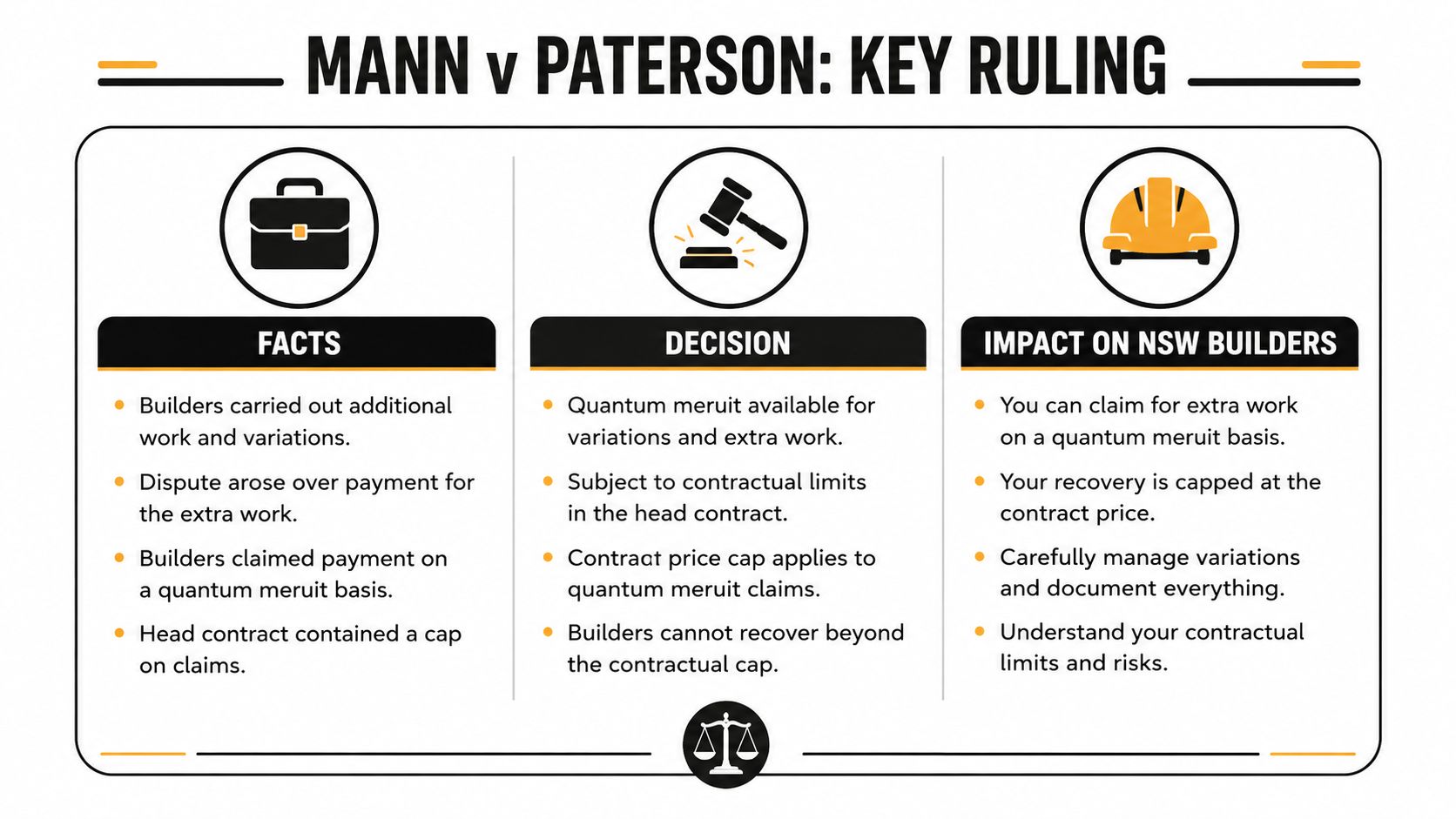
The High Court's decision in Mann v Paterson Constructions Pty Ltd (2019) changed the commercial shape of many NSW claims. The key point is straightforward, a builder's quantum meruit recovery for variations under a terminated residential building contract is capped by the contractual price and cannot exceed the amount that would have been payable under the contract for the relevant work. That is a major shift for anyone who assumed quantum meruit was a way around the contract.
The cap matters more than many people expect
Before that decision, some parties treated quantum meruit as if it were a clean reset button. It isn't. The court made clear that the claim is a value-based remedy tied to enrichment, not profit, and the contract price now matters as an important ceiling unless applying it would be unconscionable. In practical terms, that means a claimant can't throw out the contract and rebuild the claim from scratch at a more favourable rate.
The value of the work still has to be proved, but the valuation has to respect the commercial structure that already existed between the parties. Progress-payment structure, contractual pricing principles, and proof of the owner's enrichment all matter. That is where many self-prepared claims go wrong, because they price the work as if the contract never existed at all.
What survives after Mann v Paterson
What survives is the ability to recover for work done, where the evidence shows the owner requested, accepted, or retained that work. What doesn't survive is the idea that quantum meruit is a shortcut to a better commercial outcome. A strong claim still needs a disciplined valuation, and it needs to fit within the contractual ceiling.
Pursuing a Claim in NSW and NCAT
The first question is always procedural. In NSW, a claim for quantum meruit has to be pursued in the correct forum and within the relevant limitation period under the Limitation Act 1969, because late claims can fail before the merits are even argued. The right forum depends on the size and nature of the dispute, and many residential building matters end up in NCAT or in the Local or District Court, depending on the value and the type of relief being sought.
The records that usually make or break the file
A verbal variation is hard to enforce unless the paper trail shows how it became an accepted job. The strongest files usually include:
- Site directions, because they show who instructed the work and when.
- Emails and SMS messages, because they often capture informal approval in real time.
- Marked-up plans, because they separate the disputed work from the original scope.
- Inspection sign-offs, because they show acceptance on site.
- Dayworks and timesheets, because they help prove labour spent.
- Delivery dockets and invoices, because they support the material and supply component.
- Progress claims, because they show the work was being billed as the job advanced.
- Dated photographs, because they help match the physical work to the instruction.
A claim that starts with “we did the work” and ends there usually struggles. A claim that shows the instruction, the performance, the benefit, and the unpaid balance gives a tribunal member or judge something usable.
For matter selection and forum strategy, the NSW tribunal process is explained on the NCAT information page for building and civil disputes, which is useful when you're deciding whether the dispute belongs in a tribunal setting or a court file.
Bring the documents together before the story gets argued over. Once the chronology is built, the dispute becomes easier to test and harder to distort.
How Reasonable Value Is Calculated
A claim for quantum meruit rises or falls on proof. In practice, the tribunal or court is not interested in a neat label, it wants to see what work was accepted, what it was worth, and whether the figure sits inside the limits set by the contract and Mann v Paterson. If the file cannot connect the work to a request, an acceptance, and a defensible cost base, the valuation will be vulnerable from the start.
What a defensible trade breakdown looks like
A sound valuation breaks the job into parts that can be tested. Labour is separated by trade and by task, materials are tied back to invoices and delivery records, and plant, hire equipment, deliveries, and both on-site and off-site costs are shown separately. That gives the decision-maker a clear picture of what was used on the project and what sits in the contractor's wider overhead.
That structure matters because a lump sum invites attack. A trade breakdown shows how the number was built, which entries relate to the disputed work, and where the figure comes from. It also helps deal with the Mann v Paterson ceiling, because the valuation still has to sit within the contractual framework, even where the claim is framed in restitution rather than contract.
In practice, the question is whether the expert can explain the value line by line without relying on a broad assumption. In a contested matter, that is often the difference between a report that survives cross-examination and one that falls over as soon as the other side starts asking where the number came from. If the file needs that sort of valuation discipline, the analysis usually belongs with a specialist report such as Awesim's guide on when a quantum expert is needed in building matters.
Awesim Building Consultants, with over 35 years of estimating building and construction costs, prepares this kind of trade-based analysis in matters where the evidence needs to survive NCAT or court scrutiny. Their work includes site investigations and reports that break labour, materials, hire equipment, deliveries, and on-site and off-site costs into a format that can be tested line by line.
| Cost Category | What It Includes | Typical Evidence |
|---|---|---|
| Labour | Trade labour by task or stage | Timesheets, dayworks, site diaries |
| Materials | Products and consumables used on the job | Invoices, delivery dockets, purchase records |
| Hire equipment | Plant and hired tools used on site | Hire dockets, account statements |
| Deliveries | Transport and freight tied to the work | Delivery notes, supplier records |
| On-site costs | Site-related direct costs | Photos, site diaries, progress claims |
| Off-site costs | Pre-site or support costs linked to the work | Records, job logs, consultant notes |
For a technical report that goes to the heart of valuation, the relevant service page is Awesim's quantum meruit report page. If the valuation needs to stand up in a contested hearing, the detail in the breakdown is usually more important than the headline number.
Common Defences and How Claimants Beat Them
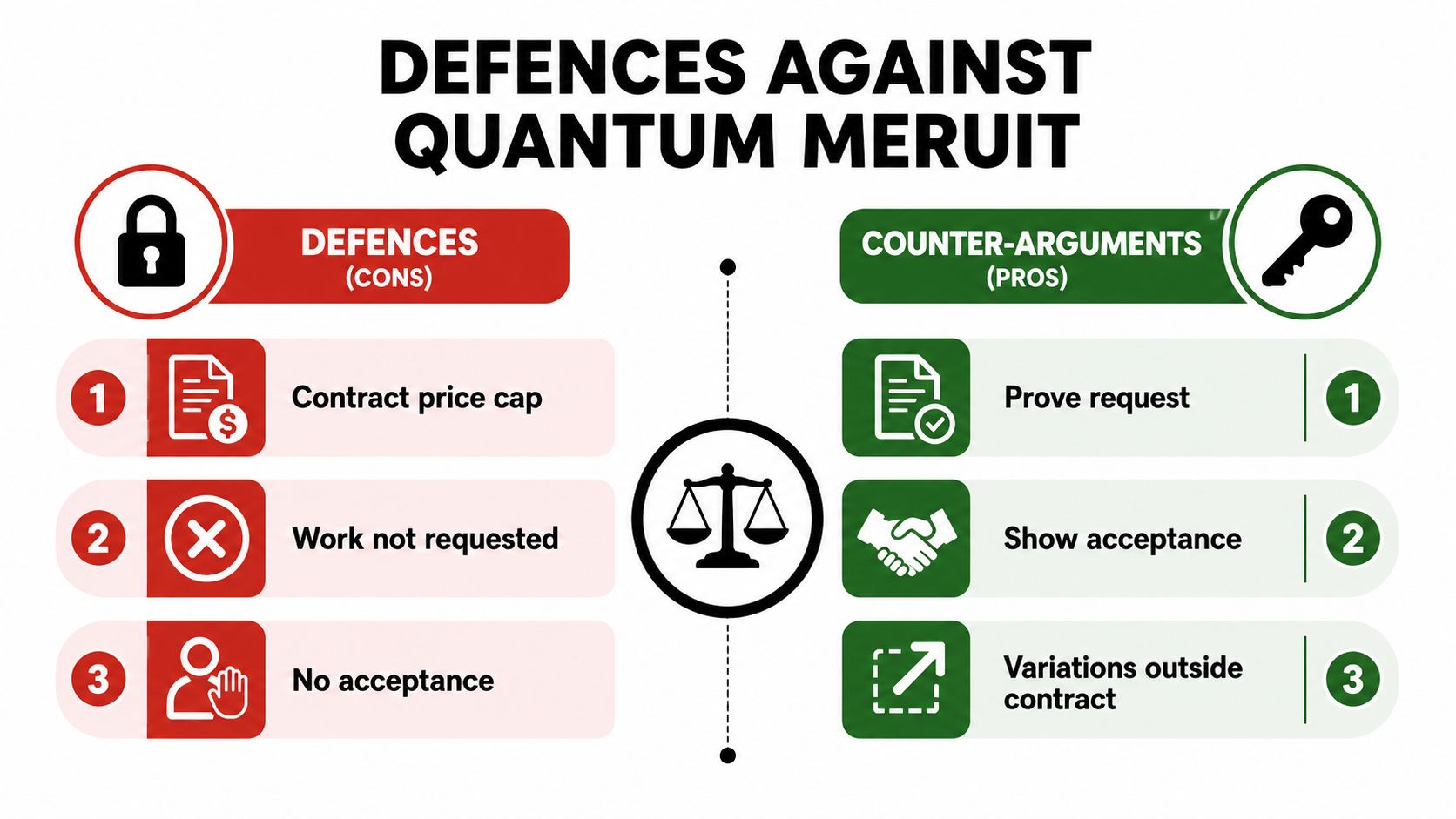
The defence often starts with the contract price cap from Mann v Paterson. That argument is not fatal by itself, but it forces the claimant to price the work correctly and stop pretending the contract never existed. If the valuation respects the ceiling and the evidence shows the work fell outside the original scope or was done after a failure of the agreed variation mechanism, the cap becomes a limit, not a complete answer.
The other arguments are usually factual, not clever
If the owner says the work was not requested or accepted, the response is usually in the documents. Site directions, texts, marked-up plans, photos, and sign-offs can show the owner knew exactly what was happening and allowed it to proceed.
If the owner alleges the work was defective, that usually turns into a valuation issue rather than a complete defeat. Defects can reduce the recoverable amount, but they don't automatically erase the fact that work was done and benefit was retained.
If the owner says there was no notice that payment was expected, the claimant needs to show the opposite. Progress claims, emails chasing payment, and ordinary commercial conduct often prove that the owner knew the work was not being supplied as a gift.
- Cap argument: show the valuation sits within the contract price structure.
- No acceptance argument: prove request, conduct, or post-work retention.
- Defect argument: separate value of work done from the cost of rectifying defects.
- No notice argument: point to billing history, messages, and the obvious commercial context.
The strongest reply is never a slogan. It is a file that traces the work, the benefit, and the unpaid balance with enough precision that the defence has to argue the evidence, not the narrative.
Where an Expert Witness Report Fits In
A claim for quantum meruit gets much stronger when the law, the records, and the valuation are all pulled into one expert report. That report is not there to write advocacy in disguise. It is there to give the NCAT Member or court a clear breakdown of what was done, what was accepted, and what the work is reasonably worth on the evidence.
Awesim Building Consultants fits that role because the practice is grounded in over 35 years of estimating building and construction costs and more than 15 years providing litigation support to homeowners, builders, and lawyers. Their reports typically include site investigations, defect analysis, and a trade breakdown that separates labour, materials, hire equipment, deliveries, and on-site and off-site costs into a format that can be tested.
That kind of report is useful when the claim is otherwise tangled in oral instructions, incomplete variations, or arguments about scope. It can also help settlement discussions because the parties can see where the number comes from, rather than just argue over the final figure. Awesim's building expert witness report service is set out at this report page, and it is the sort of document that turns a disputed site history into something a tribunal can follow.
Your Next Step If You Are Considering a Claim
Start with the file, not the label. A claim for quantum meruit only holds up if you can show the work was requested or accepted, the contract position has broken down, and the value can be tied back to actual trades and actual site records. In a NSW building dispute, that means building the instruction-to-acceptance chain first, then checking whether the Mann v Paterson cap may cut across part of the claim, then testing whether the numbers can survive cross-examination.
If the records are thin, the claim usually becomes a guessing exercise. That is where many matters fall apart in NCAT. Oral instructions without corroboration, vague variation notes, and lump-sum costings rarely carry enough weight on their own. A proper trade breakdown gives the tribunal something concrete to test, item by item, against the work that was done and the benefit that was received.
Awesim Building Consultants provides site investigations, Building & Construction Expert Witness Reports, and Scott Schedules for NSW building disputes, including matters involving disputed variations and no-contract recovery claims. If you need a claim for quantum meruit prepared properly, review the service details on Awesim's quantum meruit report page and speak with the team about the records you already have.
If you are dealing with a disputed variation, unpaid work, or a collapsed residential building contract, Awesim Building Consultants can assess the site, prepare a trade breakdown, and produce an NCAT-ready report that supports a claim for quantum meruit. Visit Awesim Building Consultants to discuss your matter, or call 1800 293 746 or email admin@awesim.com.au to arrange a consultation.

Related Posts
Waterproof Membrane Failure: How Inspectors Find the Cause
Waterproof membrane failure is diagnosed by tracing the water entry point, reviewing design documents, exposing the membrane for visual inspection,
Read More »
Cornice Cracking: How to Tell If the Damage Is Serious
Cornice cracking is one of the most common concerns Australian homeowners raise, and the hard part is not spotting the
Read More »
Digital Construction Consultant Australia: What They Do
A digital construction consultant in Australia manages the technology-driven side of building projects: BIM coordination, clash detection, asset data handover,
Read More »