Ever found yourself drowning in a messy pile of emails, quotes, and angry text messages trying to make sense of a building dispute? It’s a recipe for chaos, and it’s nearly impossible for a Tribunal Member to follow.
This is where a building dispute Scott Schedule comes in. It’s the official, structured document designed to cut through the noise.
What Is a Scott Schedule in a Building Dispute?
Think of a Scott Schedule as a detailed "dispute ledger" for your building case. It’s essentially a specialised table that transforms a jumbled argument into a clear, side-by-side comparison of claims. This isn’t just a helpful suggestion; in many cases, it’s a formal requirement.
In NSW, for instance, the Civil and Administrative Tribunal (NCAT) often mandates its use under Procedural Direction 3 to keep building dispute matters efficient and easy to follow.
Each row in the schedule tackles a single, specific defect—whether it’s a leaking shower, cracked brickwork, or faulty wiring. The columns then allow each party to state their case on that one item, respond to the other side, and attach their evidence.

This simple but powerful format brings much-needed order to what can otherwise be an incredibly stressful process.
The Core Purpose of the Schedule
At its heart, a Scott Schedule is all about creating clarity. It forces both the person making the claim (usually the homeowner) and the person responding (the builder) to be incredibly precise. Vague complaints like "the whole job is a mess" simply won't fly. Instead, you have to present itemised, evidence-backed claims that can be addressed one by one.
To get a clearer picture, here’s a quick rundown of what it achieves for everyone involved.
Quick Overview of a Scott Schedule's Purpose
| Function | How It Helps Your Case |
|---|---|
| Itemises Defects | Forces you to list every single problem individually, ensuring nothing gets missed. |
| Organises Evidence | Links specific evidence (photos, reports, quotes) directly to each disputed item. |
| Clarifies Positions | Provides a clear, side-by-side view of what the claimant wants and how the respondent replies. |
| Quantifies Costs | Assigns a specific cost to fix each defect, making the financial stakes clear. |
| Identifies Agreements | Quickly shows the Tribunal which items are agreed upon and which still need a ruling. |
This structured approach is more critical than ever. With a staggering 3,596 construction firms collapsing nationwide in the 2026 financial year, disputes over defective work are on the rise. Many of these cases end up in NCAT, where a professionally prepared Scott Schedule is your best tool for a strong case.
By creating a single, comprehensive document, the Scott Schedule streamlines the entire dispute resolution process. It encourages early negotiation on agreed items and focuses the formal hearing only on the points of genuine disagreement.
Ultimately, preparing this document is the first step toward presenting a credible and professional case. It shows you're organised, serious, and have the facts to back up your claims. This is where our 35+ years in Building & Construction, with over 15 years providing litigation support to home owners, builders and lawyers, makes a real difference, ensuring your schedule isn't just compliant, but compelling.
Want to learn more? Check out our detailed guide on what a Scott Schedule is and its critical role in disputes.
Why a Scott Schedule Is Essential for Your NCAT Case
When you're caught in a building dispute, it's easy for things to get heated and messy. A building dispute Scott Schedule is the tool that cuts through the noise. It’s much more than a simple to-do list; it’s a powerful document that forces the conversation to shift from broad, emotional complaints to a structured, point-by-point discussion based on hard facts.
For a homeowner, it’s the difference between saying "the whole job is a mess" and presenting a clear, itemised claim. For a builder, it provides a specific list of allegations they can actually investigate and respond to, getting rid of the frustrating "he said, she said" arguments that lead nowhere.
Think of the Scott Schedule as the single source of truth for your NCAT case. It's the master document that the Tribunal Member relies on to make sense of multiple, complex defects. It forces both sides to be specific and grounds the entire dispute in real, measurable issues.
This isn't just about ticking boxes for the Tribunal. It's the framework that can steer your dispute towards a fair resolution, often long before you ever see the inside of a hearing room.
From Vague Complaints to Concrete Claims
Let's be honest, trying to resolve a dispute based on a general feeling of frustration is impossible. A homeowner might say, "The bathroom renovation is terrible," but the builder thinks it looks fine. You're at a stalemate from the get-go.
A Scott Schedule completely changes the game by breaking that general complaint down into specific, testable items:
- Item 1: Shower screen leaks at the base when in use.
- Item 2: Floor tiles have excessive lipping, exceeding the 2mm tolerance in the Australian Standards.
- Item 3: Grout around the basin is cracked and actively falling out.
Suddenly, the builder has precise issues to address. This creates a clear path forward for negotiation or, if it comes to it, gives the Tribunal Member specific points to rule on. It professionalises the entire argument.
Demonstrating Credibility and Encouraging Settlement
Walking into NCAT with a detailed, well-organised Scott Schedule shows you're serious. It proves you've done your homework and can back up what you're saying. When that schedule is supported by a comprehensive expert witness report, its impact is amplified tenfold.
With 35+ years in Building & Construction and over 15 years providing litigation support, we at Awesim Building Consultants know what it takes to build this credibility. An expert-backed schedule signals to the other side—and the Tribunal—that your case is built on solid evidence. This alone can dramatically shift the dynamic in your favour.
This is more important than ever. NCAT's caseload is under immense pressure, with residential building disputes jumping by 28% in 2025-26. Our analysis of decisions from that period revealed that a well-drafted building dispute Scott Schedule helped resolve an estimated 55% of cases under $100,000 without a full hearing. This proves just how effective they are at driving early resolutions. For more insights, you can review how structured documents streamline NCAT cases.
The Strategic Advantage for All Parties
When you get down to it, a good Scott Schedule makes the process more efficient and focused for everyone involved.
- For the Homeowner: It guarantees every single defect is logged, costed, and addressed. Nothing gets forgotten or swept under the rug.
- For the Builder: It offers a fair chance to respond to each specific claim with their own evidence, instead of trying to defend against vague, unsupported accusations.
- For Lawyers and the Tribunal: It creates a central roadmap for the entire case. This simplifies case management, highlights points of agreement, and narrows the hearing down to only the issues that are genuinely in dispute.
By demanding specifics and evidence, the schedule often illuminates a clear path to settlement. When one party sees the itemised strength of the other's case, they’re far more likely to come to the table and negotiate. This saves everyone the time, money, and stress of a drawn-out NCAT hearing.
A Column-by-Column Breakdown of a Scott Schedule
At first glance, a building dispute Scott Schedule can look pretty intimidating. It’s a formal document, after all. But it’s best to think of it as a highly organised spreadsheet—a single source of truth where every part of the argument has its own designated box.
Understanding this structure is the key to using it effectively. It’s not a legal maze; it’s a tool designed for absolute clarity. Each column plays a specific role in building a clear, logical narrative for the NCAT Tribunal, turning a messy dispute into a point-by-point conversation.
Let's break down what goes where and why it matters.
The Claimant's Case vs. The Respondent's Reply
A Scott Schedule is a document of two halves. The first half is filled out by the Claimant (the party making the claim, like a homeowner). This is where you lay out your case, item by item.
Once that’s done, the schedule is sent to the Respondent (the party defending the claim, usually the builder). They then fill out their half, responding to each of the Claimant’s points directly. This back-and-forth structure is what makes the document so powerful.
Here’s a detailed look at what each column is for and the kind of information that goes into it.
Scott Schedule Column Breakdown and Purpose
| Column Title | Purpose and Key Information | Pro Tip |
|---|---|---|
| Item Number | A simple, sequential number (1, 2, 3…) assigned to each specific defect. This unique ID makes it easy for everyone—the Tribunal, lawyers, and experts—to reference the exact same issue without confusion. | Keep the numbering simple and don't reuse numbers. If a defect is removed, just note it as "deleted" rather than renumbering everything. |
| Description of Defect | This is where the Claimant details the problem. It needs to be a clear, factual, and technical description. | Avoid vague complaints like "bad paint job." Be specific: "Paint on the living room ceiling is peeling and flaking in three distinct areas, exposing the undercoat." |
| Claimant's Evidence | The Claimant must point to the proof backing up their claim. This means citing specific pages in an expert report, referencing photos ("See Photo 12"), or naming clauses from the National Construction Code or Australian Standards. | Don't just say "see expert report." Provide the exact page or paragraph number. The easier you make it for the Tribunal Member to find your evidence, the stronger your point becomes. |
| Claimant's Cost to Rectify | A specific dollar amount to fix the defect. This isn't a guess—it must be a justifiable figure backed by a quote from a qualified tradesperson or a cost estimate from an expert building consultant. | Always get a formal quote or a detailed cost breakdown from a professional. A round number without any supporting documents will be easily challenged and may be dismissed. |
| Respondent's Response | The Respondent's turn to state their position on each defect. The standard responses are "Admit," "Deny," or "Do not admit." If they deny the defect, a brief but clear explanation is required. | Blanket denials look unreasonable. A good response might be: "Deny. The hairline crack is minor settlement shrinkage compliant with AS 2870 and does not constitute a defect." |
| Respondent's Evidence | If the Respondent disputes the claim, they must provide their own evidence. This could be their own expert's report, product installation manuals, or site diaries showing work was completed to standard. | Just like the Claimant, the Respondent needs to be specific. Referencing a manufacturer's guide that proves an installation method was correct is far more powerful than simply disagreeing. |
| Respondent's Cost to Rectify | If the Respondent admits the defect but disagrees with the repair cost, they must provide their own estimate. | For example, if the Claimant quotes $1,200 to replace a door, the Respondent might agree it needs replacing but argue it can be done for $500, providing a competing quote to back it up. |
Getting these columns right is foundational. For the Claimant, it builds a rock-solid, evidence-based case. For the Respondent, it’s the opportunity to methodically address each claim and demonstrate reasonableness to the Tribunal.
Seeing a completed document can make all this click into place. We’ve put together a resource to show you exactly how these columns work together in a real-world format.
You can download a comprehensive Scott Schedule template and see a completed example on our website. This will give you a much clearer picture of what a properly drafted schedule looks like.
How to Prepare an NCAT-Compliant Scott Schedule
Putting together a Scott Schedule that ticks all of NCAT's boxes is a very structured task. It’s not the place to air grievances; instead, think of it as creating a clear, factual, and evidence-based roadmap of the dispute for the Tribunal. A properly prepared schedule is a powerful piece of evidence, and you need to follow a strict process for it to be effective.
The work starts long before you even think about opening a spreadsheet. First, you need a complete "master list" of every single potential building defect, no matter how minor it seems. This list becomes the foundation of your claim, making sure nothing gets missed. From there, every step requires precision and, crucially, expert input.
This diagram breaks down the core elements of the schedule, showing the simple, logical flow from identifying a defect, to costing its repair, and finally, to the other party’s response.
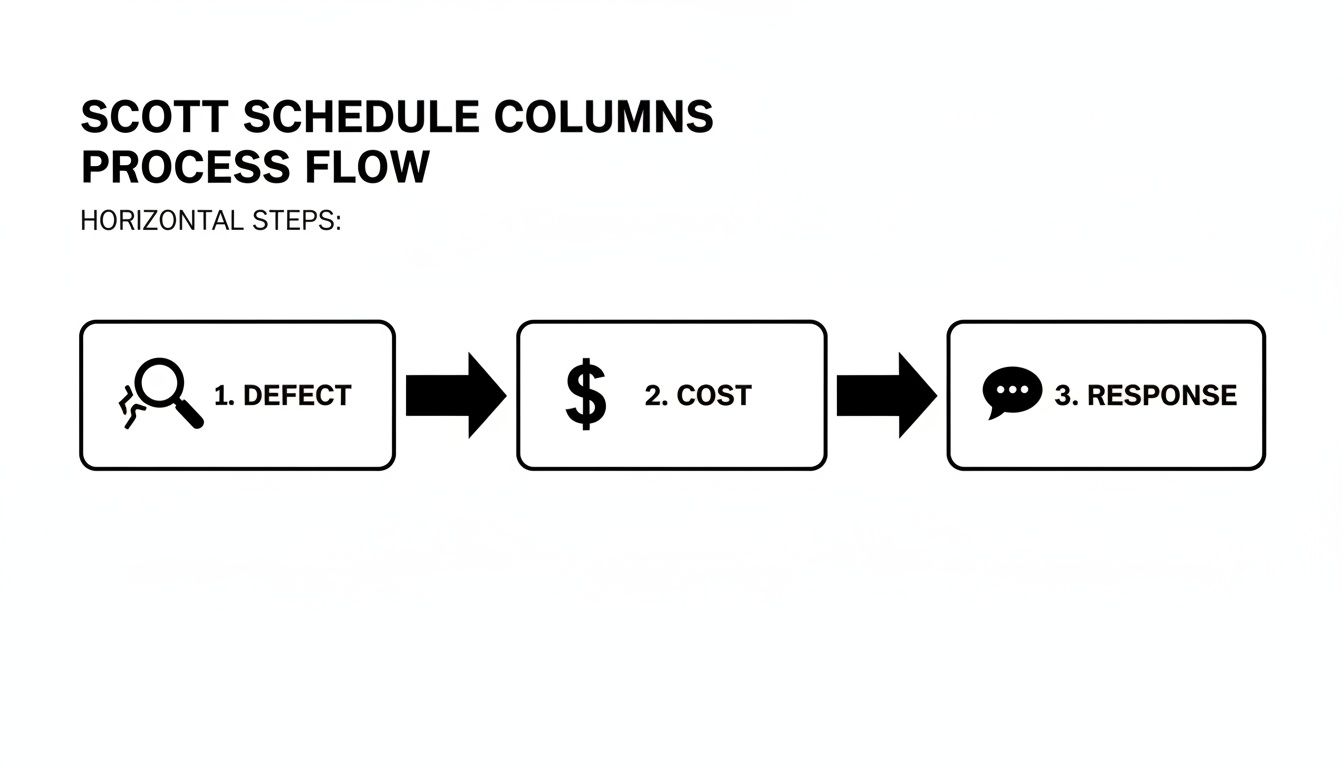
The process from 'Defect' to 'Response' shows how each item on your list becomes its own self-contained point of argument within the document.
Engage a Building Expert Early
As soon as you have your initial list of defects, your next move is vital: bring in a qualified expert building consultant. This is not a step you want to skip. An expert provides the objective, technical assessment that gives your claims the weight and credibility they need to be taken seriously by the Tribunal.
This is exactly where our 15+ years of litigation support experience at Awesim Building Consultants makes a real difference.
Our role in this stage typically involves:
- Conducting a thorough, on-site inspection of every single alleged defect.
- Preparing a comprehensive expert witness report that assesses each issue against the National Construction Code, relevant Australian Standards, and the builder’s statutory warranties.
- Providing independent, evidence-based costings to rectify each proven defect.
An expert report is the backbone of your Scott Schedule. Without it, your claims are just opinions. With it, they become substantiated facts that the Tribunal can rely on to make a decision.
Translate the Expert Report into the Scott Schedule
With the expert report complete, the next phase is to meticulously transfer its findings into the specific format of a building dispute Scott Schedule. This is a detailed data entry task where absolute accuracy is key. Every defect identified in the expert’s report gets its own row in the schedule.
You have to systematically fill in each column for every single item:
- Item Number: Give each defect a unique number so it can be easily referenced.
- Description of Defect: Copy the precise, technical description directly from the expert report.
- Claimant's Evidence: Note the exact page number, paragraph, or photograph in the expert report that supports that specific claim.
- Claimant's Cost: Enter the exact rectification cost provided by your expert for that item.
Transferring the information this way creates a clear, unbreakable line of evidence connecting the physical defect to the expert's opinion and, ultimately, to the final claim presented in your schedule.
Once the Scott Schedule is fully drafted, it must be formally served on the other party, adhering to the strict timelines set by the Tribunal. Following these steps helps you avoid common procedural mistakes and ensures your building dispute Scott Schedule becomes a powerful and persuasive tool in your NCAT case. For more specific advice, our team can help with both expert reports and dispute resolution strategies.
Common Mistakes to Avoid When Drafting Your Schedule
A poorly drafted building dispute Scott Schedule can cripple your case before it even gets a hearing at the Tribunal. In our 15+ years of providing litigation support to homeowners, builders, and lawyers, we’ve seen how simple, avoidable errors can turn a rock-solid claim into a weak argument that’s easily picked apart.
Getting this document right isn't just about filling in a spreadsheet. It's a strategic exercise that demands precision, objectivity, and a solid grasp of construction standards. Getting it wrong is a costly mistake in both time and money.

Vague and Emotional Defect Descriptions
One of the most common mistakes we see is using subjective or emotional language. The Tribunal needs cold, hard facts, not frustrated complaints. Your schedule is a technical document, and every description has to be precise enough for a builder to understand and for a Tribunal Member to make a ruling on.
Think about the difference here:
- Weak: "The deck is wrong." This is just an opinion and gives no one anything to work with.
- Strong: "Decking boards fail to meet the minimum 5mm gap requirement as per AS 1684.2, Clause 7.3.2." This is specific, measurable, and points directly to a breach of the Australian Standards.
The second example has real power. It’s objective and backed by a building code, leaving no room for argument.
Failing to Link Defects to Specific Breaches
Just pointing out a problem is only half the job. You have to explain why it's legally a defect. Every single item in your building dispute Scott Schedule must be tied to a specific breach.
This could be a failure to comply with:
- The National Construction Code (NCC)
- A relevant Australian Standard (AS)
- The manufacturer's own installation guide
- The statutory warranties under the Home Building Act 1989
Without that direct link, the other party can easily claim the issue is just your opinion or a minor cosmetic issue, not a genuine, non-compliant defect that requires fixing.
A defect description without a cited standard is just a complaint. A defect description with a cited standard is evidence.
Using Unsubstantiated Costings
Another classic blunder is pulling rectification costs out of thin air. The figures you put in your schedule must be backed by a credible source, like a formal quote from a licensed tradie or a detailed cost estimate from an expert building consultant.
Plucking a round number like "$5,000" out of nowhere will be challenged instantly. The respondent will question it, and the Tribunal might throw it out completely. This forces you to go back and get proper evidence, causing major delays. Good preparation hinges on understanding the importance of meticulous documentation in dispute resolution, where every dollar is accounted for.
Common Procedural and Formatting Blunders
Beyond the content itself, simple procedural slip-ups can weaken your position by making you look unprepared and frustrating the Tribunal.
Watch out for these key blunders:
- Incorrectly Referencing Evidence: Don't just write "see expert report." You need to direct the reader to the exact page, paragraph, or photo number that supports that specific defect.
- Missing NCAT Deadlines: The Tribunal is very strict with its timetables for filing documents. Missing a deadline can have serious consequences, like having your evidence rejected.
- Poor Formatting: A messy, disorganised schedule is a nightmare to read and doesn't do your case any favours. Make sure your item numbering is sequential and all the columns are filled out clearly and correctly.
Avoiding these common pitfalls is essential. It’s exactly why getting professional help from a firm with deep building and litigation experience, like Awesim Building Consultants, is a smart investment in the outcome of your case.
How Our Experts Strengthen Your Building Dispute Case
Preparing a building dispute Scott Schedule isn’t just about filling in a spreadsheet. It’s a strategic exercise that can make or break your case. This is where our unique blend of 35+ years in Building & Construction and over 15 years in dedicated litigation support really comes into its own. We don't just complete a form; we build your argument from the ground up, backed by real-world technical authority.
At Awesim Building Consultants, we serve two vital functions. First, we act as your independent Expert Witness. We get on-site, conduct thorough inspections, and produce technically solid defect reports. These reports become the bedrock of your evidence, identifying every problem and linking it directly to the specific Australian Standards or National Construction Code clauses that have been breached.
From Expert Report to A Winning Schedule
With the facts established in our report, we then use that deep technical insight to meticulously draft an NCAT-compliant Scott Schedule for you. This is where our practical experience is crucial. We make sure every item listed is defensible, clearly explained, and supported by hard evidence, turning complex building faults into straightforward entries that leave no room for misinterpretation.
Our process focuses on:
- Defensible Descriptions: We describe every defect with technical precision, stripping out any subjective or vague language.
- Evidence Cross-Referencing: Each point on the schedule is tied directly to specific pages, photos, and clauses in our expert report.
- Accurate Costings: We provide detailed and justifiable costs for rectification, so they aren’t easily dismissed as simple "guesstimates."
The Awesim Advantage: Credibility and Authority
This seamless combination of expert assessment and document drafting gives your case a layer of credibility that’s invaluable in tribunal proceedings. When you're putting a Scott Schedule together, the strength of your claims hinges on the quality of your evidence, so understanding what constitutes a credible source is key to building an undeniable case. A schedule prepared by our experts signals to the other side—and the Tribunal—that your claims are serious, well-documented, and founded on genuine industry expertise.
When you engage Awesim Building Consultants, you're not just getting a document. You're bringing a strategic partner on board whose involvement shows a commitment to a factual, evidence-based resolution. This authoritative approach helps homeowners, builders, and strata managers achieve better outcomes, often encouraging a fair settlement long before a hearing becomes necessary.
To see how our dual-service approach can fortify your position, learn more about our role as a dispute resolution expert and how we can assist in your case.
Your Scott Schedule Questions Answered
When you're caught in a building dispute, the process can feel overwhelming, and it's natural to have questions. Here are some straightforward answers to the most common queries we get about Scott Schedules in NSW.
Can I Prepare a Scott Schedule Myself?
Legally, yes. In reality, it’s a bad idea. A building dispute Scott Schedule isn’t just a list of complaints; it's a formal, evidentiary document that needs to be completely objective and align with NCAT's strict procedural rules.
Even a hint of subjective language, a simple omission, or an error in referencing the National Construction Code can gut your schedule's credibility. The Tribunal expects facts, not feelings. An expert from Awesim Building Consultants brings the technical know-how, precise terminology, and independent costings that give the document its weight and authority.
What Does a Professional Scott Schedule Cost?
The cost for a professionally prepared Scott Schedule really depends on the scale of the dispute—how many defects are we talking about, and how complex are they? The fee covers the time for a thorough site inspection, the drafting of a comprehensive expert witness report, and the meticulous work of compiling the schedule itself.
Think of it as a crucial investment. A robust, professionally drafted schedule significantly strengthens your hand for a favourable settlement or a successful outcome at an NCAT hearing, potentially saving you a great deal more in the long run.
What Happens After the Schedule Is Filed?
Once it’s filed with NCAT, the Scott Schedule becomes the single source of truth for the entire case. It's the core document used in mediation and conciliation to quickly tick off what both parties agree on and isolate the items still in dispute.
This simple act dramatically narrows the focus. If you do end up in a formal hearing, the Tribunal Member will rely on that schedule to steer the proceedings, hear evidence on each contested point, and make their final, binding decisions based on the facts laid out within it.
Don't go into a building dispute unprepared. With 35+ years in Building & Construction and 15+ years in litigation support, Awesim Building Consultants provides the expert reports and NCAT-compliant Scott Schedules you need to build a powerful case. Secure the professional support your case deserves by visiting us at https://www.awesim.com.au.