
Concrete Spalling Repair: Causes, Costs, and Your NSW Rights
- What Concrete Spalling Actually Is
- Common Causes of Concrete Spalling in NSW Buildings
- How Concrete Spalling Repair Works
- What Concrete Spalling Repair Costs in NSW
- Who Pays for Concrete Spalling Repairs in NSW?
- Getting the Evidence Right Before You Pursue a Claim
- Practical Steps: From Spalling Discovery to Dispute Resolution
- Frequently Asked Questions
- Act Before the Problem Grows
Concrete spalling repair should start with an assessment of the damage and its cause. Keep people clear of areas where concrete may fall and seek appropriate professional advice. This guide covers investigation, repair scope, cost considerations and the evidence that may be needed for a NSW building dispute.
This article covers what causes spalling, what a proper repair actually involves, what it costs in NSW, and what rights you have if the defect traces back to poor workmanship or a builder's failure to act.
What Concrete Spalling Actually Is
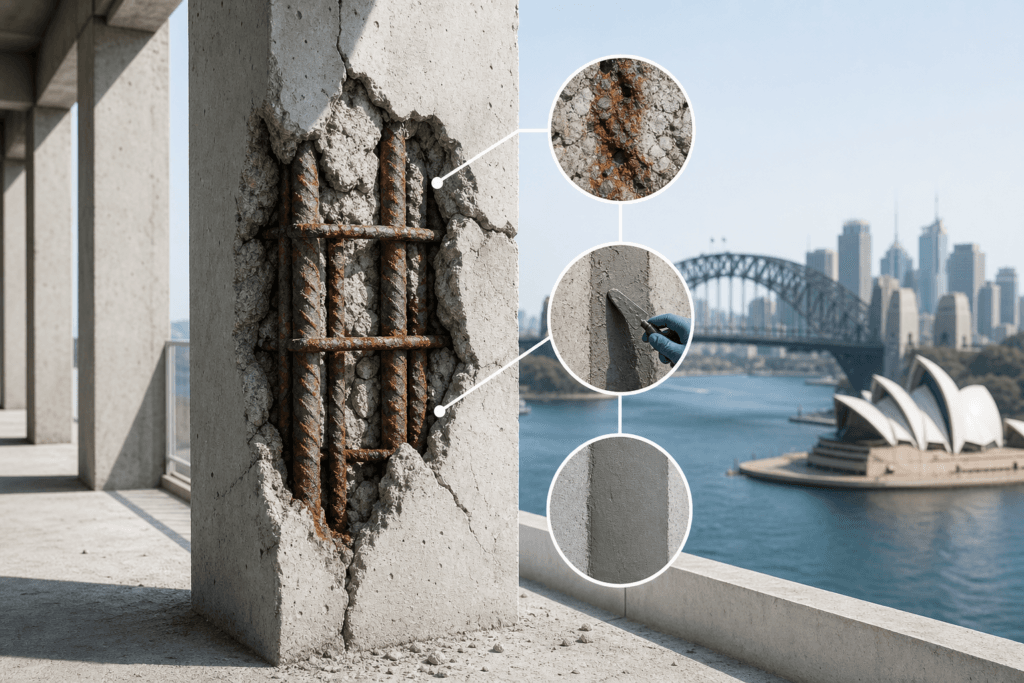
Spalling is the progressive fracturing and loss of concrete from a surface or structural element. It presents as flaking, pitting, cracking, or chunks breaking away. In severe cases, exposed steel reinforcement becomes visible, often with rust staining spreading across the surrounding concrete face.
It is not a cosmetic issue. Once the concrete cover over reinforcement is compromised, the underlying steel corrodes faster, expands as it rusts, and drives further cracking. Without intervention, the cycle accelerates.
Common Causes of Concrete Spalling in NSW Buildings
Reinforcement Corrosion
The most common cause in NSW, particularly in coastal and high-humidity areas. When moisture and oxygen reach the steel reinforcement, oxidation begins. Rust occupies roughly three times the volume of the original steel, generating internal pressure that fractures the concrete from within. Insufficient concrete cover, poor compaction during the original pour, or cracking that allows water ingress all contribute.
Chloride Penetration
Buildings within a few kilometres of the coast face accelerated chloride attack. Salt-laden air penetrates the concrete matrix over time, reaching the reinforcement and triggering corrosion even where the surface appears intact. This is why spalling in Sydney's eastern suburbs, the northern beaches, and coastal areas around Newcastle and Wollongong often appears in clusters rather than isolated spots.
Carbonation
Carbon dioxide in the atmosphere reacts with concrete's alkaline compounds over time, reducing the pH level that normally protects reinforcement from corrosion. Older buildings with lower-grade concrete mixes are most vulnerable. Carbonation progresses inward from the surface, and once it reaches the depth of the steel, corrosion begins.
Poor Original Workmanship
Inadequate concrete cover, improper mix design, insufficient curing, and poor compaction during the original pour all reduce the concrete's ability to resist moisture and chemical attack. In NSW, spalling in buildings less than ten years old is frequently a workmanship defect — not simply age-related deterioration.
Thermal Cycling
Repeated expansion and contraction from temperature changes introduces fatigue stresses over time. In exposed elements such as balconies, roof slabs, and car park decks, this effect compounds other deterioration mechanisms.
How Concrete Spalling Repair Works
Surface patching alone rarely solves the problem. A durable repair addresses the cause, not just the symptom.
Investigation First
Before any repair scope is written, a competent investigation should identify the extent of delamination, the depth of carbonation or chloride penetration, the condition of the reinforcement, and whether the original concrete cover meets the design specification. Tapping surveys, cover meters, carbonation depth tests, and half-cell potential measurements are standard tools.
Skipping this step produces scopes that underestimate the work — and scopes that underestimate the work produce quotes that blow out on site.
Repair System Selection
Repair systems range from cementitious mortars for localised patches to full saw-cut and replace sections for structural elements. The right choice depends on the depth of deterioration, the structural role of the element, and the exposure classification of the building's location.
A 2005 Texas Transportation Institute study identified 10 spall repair materials then in use by TxDOT maintenance engineers, covering cementitious, polymer, and epoxy-based systems. The breadth of that list reflects how much the right material choice depends on site conditions, cure time requirements, and the structural demands of the element being repaired. The same principle applies in NSW: there is no universal patch product.
Preparation and Application
Concrete repair standards require thorough substrate preparation. That means removing all delaminated, carbonated, or contaminated concrete to a sound base, cleaning and treating exposed reinforcement, applying bonding agents where required, and placing the repair material in lifts that match the product specification. Cutting corners on preparation is the most common reason patch repairs fail within a few years.
Protective Coatings
For elements in aggressive environments, a protective coating or sealer applied over the repaired area reduces future moisture and chloride ingress. This is particularly relevant for car park decks, balconies, and any element with ongoing water exposure.
What Concrete Spalling Repair Costs in NSW
Cost varies considerably depending on the extent of spalling, the accessibility of the element, the repair system specified, and whether scaffolding or swing stages are required.
For localised defects, a Sydney-based defect rectification guide published by atomicprojects.com.au puts typical building defect rectification in a range starting from around $5,000 to $20,000 for contained work. The same source notes that a repair left unaddressed for two years can escalate from $15,000 to $150,000 as the damage spreads and structural elements become involved.
Those figures are not specific to concrete spalling, but they reflect a pattern building consultants see regularly: the cost of delay almost always exceeds the cost of early action.
For building-wide spalling in a strata complex — particularly one with multiple balconies or a large car park structure — the scope can run into hundreds of thousands of dollars once investigation, scaffolding, repair, and protective coating are included. Getting an accurate scope before tendering work is essential to avoid cost blowouts.
Who Pays for Concrete Spalling Repairs in NSW?
This is where many disputes begin.
In Strata Buildings
Liability depends on whether the spalling affects common property or lot property. In most strata schemes, structural elements — including the building's concrete frame, balcony slabs, and car park structures — are common property. The owners corporation is responsible for their maintenance and repair.
Where a lot owner's actions caused or accelerated the damage, such as failing to maintain waterproofing that allowed water to penetrate a structural slab, the liability question becomes more complex.
Disputes between lot owners and owners corporations over spalling repair liability are regularly heard at NCAT. The owners corporation's obligation to maintain common property in good repair is established under the Strata Schemes Management Act 2015, but the extent of that obligation — and who bears the cost in specific circumstances — is frequently contested.
Where a Builder Is Responsible
Where spalling results from defective residential building work, statutory warranties may be relevant. The usual periods under the Home Building Act 1989 are six years for major defects and two years for other defects, subject to the Act’s rules. Spalling is not automatically a major defect: the element affected, cause and actual or likely consequences must be assessed against the statutory test. Obtain advice about the deadline for your claim.
Pursuing a builder requires evidence. An independent expert witness report that documents the defect, identifies its cause, and links it to the original construction is the foundation of any successful claim.
Getting the Evidence Right Before You Pursue a Claim
Whether you are an owner, a strata committee, or a solicitor advising a client, the quality of your technical evidence shapes the outcome at NCAT or in court.
A proper expert witness report for a spalling defect should document the location and extent of each defect, identify the likely cause or causes, reference the applicable Australian Standards and building code requirements, and provide a scope of remedial works with a cost estimate. It must also comply with Schedule 7 of the Uniform Civil Procedure Rules, which sets out the expert witness code of conduct for NSW proceedings.
Reports that do not meet Schedule 7 requirements are rejected or given little weight by tribunals. A report that is technically sound but procedurally non-compliant is nearly as damaging as having no report at all.
Awesim Building Consultants provides independent defect assessments, expert witness reports and Scott Schedules across NSW. Glen Sim brings over 35 years of construction experience and more than 15 years of litigation support experience. For an assessment before concrete spalling repair, read our expert report briefing checklist or call 1800 293 746 for a free initial consultation.
Practical Steps: From Spalling Discovery to Dispute Resolution
- Document what you can see. Photograph every affected area with a scale reference. Note dates and any changes in extent.
- Get an independent inspection. Do not rely on a repair contractor's quote as your technical evidence. A building consultant with no financial interest in the repair scope will give you a more reliable picture of the problem and its cause.
- Establish liability before tendering repairs. If the defect may be the builder's responsibility or a strata common property issue, clarify that before spending money on repairs. Carrying out work without establishing liability can complicate a later claim.
- Commission a compliant expert witness report. If you are heading to NCAT or court, the report needs to meet Schedule 7 requirements. Get this right from the start.
- Use a Scott Schedule to organise the claim. Where multiple defects are in dispute, a Scott Schedule structures each defect, the alleged cause, the remedial scope, and the cost in a format the tribunal can work with efficiently.
- Act promptly. Limitation periods apply. For major defects under the Home Building Act 1989, the six-year period runs from completion. Delays in pursuing a claim reduce your options.
Frequently Asked Questions
What is concrete spalling and how do I know if I have it?
Spalling is the fracturing and loss of concrete from a surface. Signs include flaking or pitting on concrete faces, cracks running parallel to the surface, rust staining near reinforcement, or visible chunks that have broken away. Exposed steel reinforcement means the defect is already at an advanced stage.
What causes concrete spalling in NSW buildings?
The most common causes are reinforcement corrosion driven by moisture and oxygen reaching the steel, chloride penetration in coastal areas, carbonation of older concrete, and poor original workmanship including insufficient concrete cover or improper mix design. In newer buildings, workmanship defects are frequently the primary cause.
Who is responsible for paying for spalling repairs in a strata building?
In most strata schemes, structural elements are common property and the owners corporation is responsible for their repair. If a lot owner's actions contributed to the damage, liability may be shared or disputed. Where the defect traces to original construction, the builder may be liable under the Home Building Act 1989 statutory warranties.
Do I need an expert witness report for a spalling claim?
Independent technical evidence can help explain the cause, necessary repairs and reasonable costs. The extent of evidence required depends on the dispute and the orders made. An expert report should address the applicable NCAT or court requirements.
How long do I have to claim for defective concrete work?
The applicable deadline depends on the legal basis of the claim, completion date, defect classification and other circumstances. Seek legal advice promptly. Do not assume that spalling or inadequate concrete cover automatically qualifies for the six-year major-defect period.
What is the difference between a concrete spalling repair scope and an expert witness report?
A repair scope describes what work needs to be done and how. An expert witness report is a formal document prepared for legal or tribunal proceedings that identifies the defect, establishes its cause, references applicable standards, and provides an independent opinion on remedial works and cost. An expert witness report may include a repair scope, but its primary purpose is to provide technical evidence for a dispute.
Can a building consultant help me get an accurate repair cost estimate before I tender the work?
Yes. An independent building consultant can prepare a detailed scope of works based on a thorough inspection, giving contractors a consistent basis for quoting. This reduces the risk of widely varying quotes caused by contractors pricing different assumptions about the extent of the work.
Act Before the Problem Grows
Concrete spalling rarely stays contained. The physics of reinforcement corrosion mean that once moisture reaches the steel, the damage spreads — and the cost of repair grows with it. In a strata context, the liability questions add another layer of complexity that is best resolved with clear technical evidence rather than contractor opinions.
If you are dealing with a spalling defect in NSW, whether as a homeowner, a strata committee member, a solicitor, or a builder, the quality of your technical documentation will shape the outcome. Start with an independent inspection and get advice from a consultant who understands both the building science and the requirements of NSW proceedings.

Related Posts
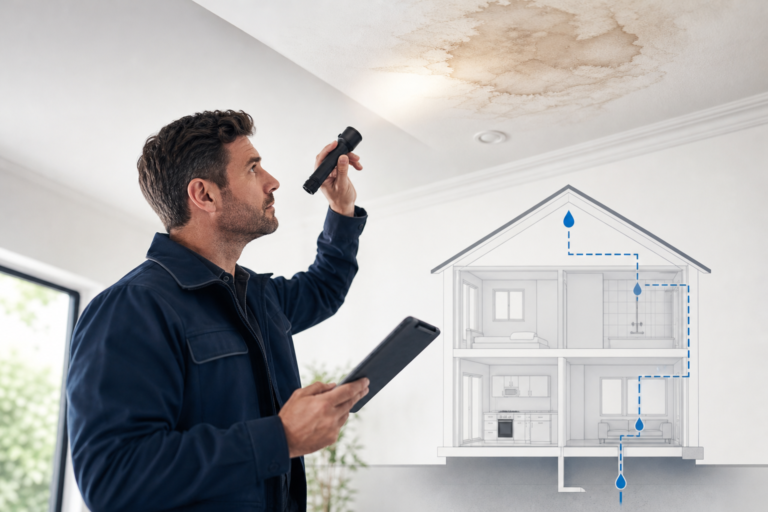
Water Damage in Homes: How to Track Down the Source
Water damage in a home rarely announces itself at the source. A stain on the ceiling, a musty smell in
Read More »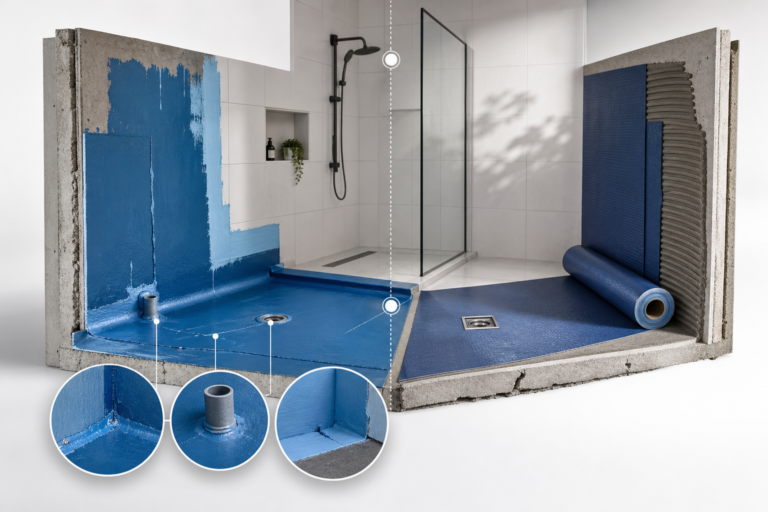
Waterproofing Membrane Types: Which Fails Most in NSW Bathrooms
Waterproofing failure is the single most common serious defect found in NSW apartments, and the type of membrane used, along
Read More »
Building Certifier NSW: Role, Limits, and When You Need More
A building certifier in NSW is a registered professional who issues construction certificates, conducts critical stage inspections, and grants occupation
Read More »