
Expert Witness Duty to the Court: What Schedule 7 Means for a Building Consultant in NSW

The expert witness duty to the court requires an impartial technical opinion within the expert’s expertise. This guide explains how that duty affects a building investigation, the written reasoning and a response to another expert.
What is Schedule 7?
Schedule 7 of the Uniform Civil Procedure Rules 2005 contains the expert witness code for relevant NSW court proceedings. The Council of Chief Justices’ guidance identifies the NSW code and acknowledgement requirements, including the court’s power to order otherwise. Check the current rules, practice requirements and orders for the proceeding.
Apply independence to the investigation
Report findings that support or challenge the allegation
An expert should assess the evidence without a predetermined result. If an alleged defect is not established, an alternative cause remains possible or another expert’s analysis is persuasive, the report should explain that position.
Match the opinion to the expert’s knowledge
Identify the training, study or experience relevant to each technical issue. General construction experience does not establish expertise in every engineering, hydraulic, electrical or costing question. Discuss any specialist input needed before finalising the brief.
Use the applicable reporting requirements
Give the expert the code, questions and orders at the outset. Confirm the required acknowledgements and report contents with the legal representative. A template helps organise the material but does not establish compliance by itself.
Explain uncertainty
Concealed work, missing records and later repairs may limit the investigation. Explain what can be concluded, what remains uncertain and what further information would help. For example, moisture staining alone may not establish the path by which water entered a wall.
Make the reasoning available for examination
A useful technical report allows the reader to trace an opinion to observations, documents, assumptions and relevant construction requirements. It should explain why one cause or rectification method is preferred where alternatives exist.
Review the purpose of an existing inspection report
A pre-purchase report may contain relevant observations. Whether more evidence is needed depends on its scope, the questions in dispute and the requirements of the proceeding. Ask the expert and legal representative whether a supplementary report or further inspection is appropriate.
From inspection to written opinion
Record the investigation
Identify the inspected areas, dates, observations, measurements, tests and access limits. Label photographs by location and item. Record who undertook any investigation and identify the source of material supplied by others.
Explain the technical assessment
Compare the evidence with the relevant contract, drawings, specifications and construction requirements. Identify the applicable document or standard version rather than assuming today’s provisions governed earlier work.
Connect findings and recommendations
For each item, explain the observation, technical significance, reasoning and limitations. Where requested, set out the proposed rectification and the basis of the cost opinion. Separate these questions so agreement on a defect is not mistaken for agreement on every proposed repair or price.
NCAT uses its own expert evidence direction
For NCAT, check Procedural Direction 3 and the orders. Its code and application provisions should not be replaced with a blanket statement that court rules govern every NCAT matter.
Choose relevant experience and a clear scope
Ask how the consultant’s experience relates to the particular defect, investigation or cost question. Prior attendance at court does not, by itself, show that every opinion was accepted. Assess the proposed reasoning process and the person’s relevant expertise.
Glen Sim brings more than 35 years of construction experience and more than 15 years of litigation support. Awesim’s expert witness report service explains the work available for NSW building matters.
Keep the Scott Schedule consistent
A Scott Schedule summarises item-by-item positions and references the evidence. The report explains the detailed technical reasoning. Any expert opinion in the schedule should retain its qualifications and reflect the applicable expert duties and case directions.
Questions before engagement
Can an expert be instructed to reach a particular result?
Instructions should identify the questions and material to consider. The expert must form their own technical opinions.
Does a declaration alone make a report suitable?
No. Review the scope, relevant expertise, evidence, reasoning and procedural requirements as well as the formal acknowledgement.
Can an existing report be reused?
Review it against the current issues, available evidence and directions. Confirm any supplementary work with its author rather than assuming it is either automatically sufficient or unusable.
Provide the brief and deadline
Contact Awesim with the orders, issue list, property address, relevant reports and delivery date so the required investigation and reporting can be assessed.

Related Posts
![Businessman in a suit analyzes a 3D building model on blueprints with a hard hat nearby and a crane in the background, conveying construction planning and law.]](https://awesim.com.au/wp-content/uploads/2026/10/2ba440c4-9d47-4802-adf1-8b6f241eb8ff-768x512.png "2ba440c4-9d47-4802-adf1-8b6f241eb8ff - Awesim Building Consultants")
Construction Claims Experts and Witness Reports
Last updated: 8 November 2026 A construction expert witness provides an independent opinion on technical questions in a building dispute.
Read More »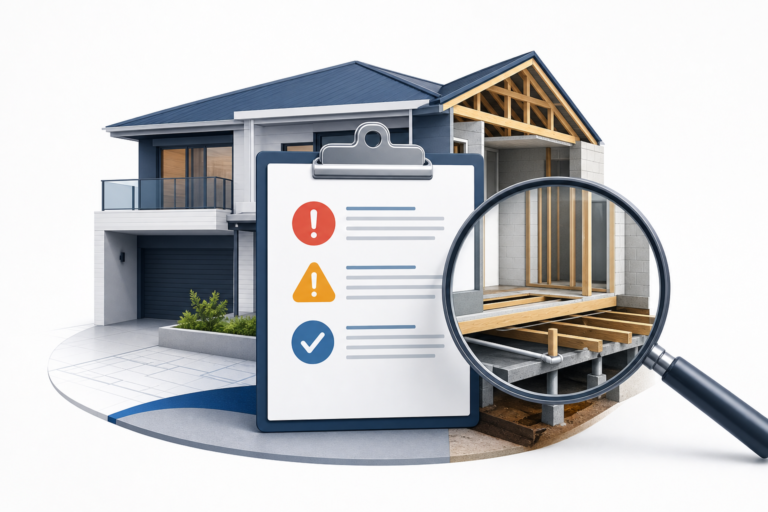
Building Inspection Reports and Expert Evidence
Updated October 29, 2026 You've received a building and inspection report and you're not sure what to do with it.
Read More »
Waterproof Membrane Failure: How Inspectors Find the Cause
Waterproof membrane failure is diagnosed by tracing the water entry point, reviewing design documents, exposing the membrane for visual inspection,
Read More »