
Dilapidation Reports in NSW: What They Record, When You Need One, and How They Support a Defect Claim

- What a Dilapidation Report Actually Is
- When You Need a Dilapidation Report in NSW
- What a Dilapidation Report Records
- How a Dilapidation Report Supports a Defect Claim
- Who Should Prepare a Dilapidation Report
- Common Mistakes That Undermine a Dilapidation Report
- Dilapidation Reports and Strata Properties
- When a Dilapidation Report Is Not Enough
- FAQs
Dilapidation reports in NSW record a property’s visible condition at a particular date, often before nearby construction starts. Dated photographs, locations and measurements create a baseline for later comparison. This guide explains what the inspection should cover and how the record can assist if damage is later alleged.
This article explains what a dilapidation report actually records, the situations that call for one, and how it connects to a formal defect claim or court proceeding.
What a Dilapidation Report Actually Is
A dilapidation report records a property’s condition at the inspection date. Comparing it with a later inspection can help identify changes. The comparison alone does not prove who caused the damage; causation may require further investigation and expert analysis.
The report typically includes photographs, written descriptions, and measurements. A thorough one will note cracking in walls and ceilings, the condition of footpaths and driveways, the state of fences and retaining walls, and any pre-existing defects that might otherwise be blamed on the construction activity next door.
Without that baseline record, a property owner who discovers cracking after a neighbour's excavation has no objective way to prove the damage is new. The builder or developer can simply point to the absence of evidence and argue the cracks were always there.
When You Need a Dilapidation Report in NSW
The most common trigger is proximity to a construction project. If excavation, piling, demolition, or heavy machinery work is planned near your property, a dilapidation report should be commissioned before the first day of activity — not after.
Before Neighbouring Construction Begins
In NSW, the need for a dilapidation survey is often flagged in development consent conditions. Councils in Sydney and surrounding areas frequently require the developer to commission reports on adjoining properties before work starts. If you are the adjoining owner, you have a strong interest in ensuring that report is thorough and independent — not prepared by someone engaged by the developer.
If no report is required by the consent conditions, you can commission your own. That report, prepared by an independent consultant, gives you an objective record that is yours to rely on.
Before You Start Your Own Construction
Property owners undertaking significant works — extensions, underpinning, or major excavations — should consider commissioning a dilapidation survey of their own property and any adjoining structures before they begin. This protects you from claims by neighbours who may later allege your works caused damage that was already present.
When a Defect Dispute Is Already in Progress
A dilapidation report can also play a role after the fact, though its value is more limited at that stage. If a dispute is already underway and you need to establish what condition a structure was in at an earlier date, a consultant may be able to draw on photographic records, council inspection notes, or other contemporaneous evidence to reconstruct a condition timeline. It is a more difficult exercise than a prospective survey, but sometimes necessary when litigation has begun without prior documentation.
What a Dilapidation Report Records
The scope of a dilapidation report depends on the type of construction activity and the nature of the structures involved. A well-prepared report will typically cover the following categories.
Structural Elements
Walls, columns, beams, and foundations are examined for existing cracking, movement, or displacement. The width, length, and orientation of any cracks are recorded, along with whether they appear active or dormant. This level of detail matters because crack width and pattern are used by engineers to assess whether subsequent damage is consistent with vibration or ground movement from construction.
Internal Finishes
Ceilings, internal walls, cornices, and floor finishes are documented. Fine hairline cracking in plasterwork is common in older buildings and needs to be on record so it cannot later be attributed to construction impact.
External Surfaces
Driveways, footpaths, kerbs, retaining walls, fences, and landscaping features are all included. These elements are particularly vulnerable to damage from heavy vehicles and ground movement, and they are frequently the subject of disputes between neighbours and developers.
Services and Drainage
Where accessible, the condition of stormwater drainage, gutters, and downpipes may be noted. Blocked or damaged drainage can be a source of water ingress that gets conflated with construction-related damage in later disputes.
How a Dilapidation Report Supports a Defect Claim
A dilapidation report is evidence. Its value in a dispute depends entirely on how it was prepared, by whom, and whether it is objective and comprehensive enough to withstand scrutiny.
Establishing a Before-and-After Comparison
The core function of the report in a legal context is to create a documented before-and-after comparison. When new damage appears after construction, the pre-construction report becomes the baseline against which the new condition is measured. If the damage is not recorded in the pre-construction report, it is presumed to be new.
That comparison can be presented in a Scott Schedule format, which itemises each defect or item of damage, its location, the estimated cost of rectification, and the party responsible. A Scott Schedule is a standard document used in NCAT and court proceedings to organise competing claims about defects and costs in a way that allows a tribunal or judge to assess them item by item.
Supporting an Expert Witness Report
If a dispute proceeds to NCAT, the District Court, or the Supreme Court, an expert witness report is typically required to give the tribunal or court an independent technical assessment of the damage and its likely cause. The dilapidation report feeds directly into that expert witness report by providing the baseline evidence the expert needs to form an opinion.
An expert witness preparing a report for NSW proceedings must comply with Schedule 7 of the Uniform Civil Procedure Rules 2005, which sets out the code of conduct governing expert evidence. That code requires the expert to state the facts and assumptions on which their opinion is based. A pre-construction dilapidation report is one of the most important factual inputs an expert can rely on when attributing damage to a specific cause.
Awesim Building Consultants provides independent inspection and expert witness services across NSW. For a dispute, the report scope should address the technical questions, relevant evidence and applicable NCAT or court requirements.
Waterproofing Defects and Dilapidation Evidence
Waterproofing is one area where dilapidation evidence is particularly useful. If a neighbouring excavation or construction project has disturbed the ground around a building, it can compromise existing waterproofing membranes or drainage paths. Proving that the waterproofing was intact before the works began — and that the failure is attributable to the construction activity — requires exactly the kind of baseline documentation a dilapidation report provides.
Forensic waterproofing inspections that document the nature and extent of waterproofing failures are a distinct service from a dilapidation survey, but the two types of evidence often work together in disputes involving water ingress following construction activity.
Who Should Prepare a Dilapidation Report
The report needs to be prepared by someone with the technical knowledge to identify and describe building defects accurately, and the independence to produce a document that will not be challenged on the grounds of bias.
In NSW, dilapidation reports are typically prepared by building consultants, structural engineers, or other qualified construction professionals. The key question is whether the person preparing the report has the credentials and independence to stand behind their findings if the matter proceeds to litigation.
If there is any realistic chance the dispute will end up at NCAT or in court, it is worth engaging a consultant who also has experience preparing expert witness reports and Scott Schedules. That way, the dilapidation report is prepared with litigation in mind from the start — using the same standards of documentation and objectivity that a court-ready report requires.
A consultant who only prepares dilapidation reports as a standalone product may not structure the document in a way that integrates cleanly with expert witness evidence. A litigation-support specialist will approach the task differently, anticipating how the document will be used if the matter escalates.
Common Mistakes That Undermine a Dilapidation Report
Several errors regularly reduce the value of a dilapidation report in a dispute context.
Commissioning it too late. The report must be done before construction activity starts. Once work has begun, the baseline is compromised and new damage cannot be cleanly separated from pre-existing conditions.
Using a report prepared by the developer's consultant. A report commissioned by the party whose works may cause the damage has an obvious conflict. Adjoining owners should commission their own independent report, or at minimum review the developer's report carefully for omissions.
Inadequate photography. Written descriptions without photographic evidence are difficult to rely on. A thorough report uses dated, geotagged photographs that clearly show the condition of each element.
Missing elements. A report that covers internal walls but omits the driveway, retaining wall, or drainage infrastructure leaves gaps that can be exploited in a dispute.
No follow-up inspection. The full value of a dilapidation report is only realised when a post-construction inspection is conducted using the same methodology. The two reports together create the before-and-after record. A pre-construction report without a corresponding post-construction survey is only half the picture.
Dilapidation Reports and Strata Properties
Strata properties present particular complexity. When construction activity affects a strata building, the damage may affect common property, individual lots, or both. The owners corporation is responsible for common property, and individual lot owners are responsible for their own lots — but the boundaries are not always clear in practice.
A dilapidation report for a strata building needs to document both common property elements — including the building envelope, structure, and shared services — and any lot-specific elements that are at risk. Strata managers dealing with common-property defect disputes will often need to engage a building consultant who understands both the technical and legal dimensions of strata ownership in NSW.
When a Dilapidation Report Is Not Enough
A dilapidation report establishes the condition of a property at a point in time. It does not, by itself, prove causation, quantify the cost of rectification, or constitute expert evidence for court purposes.
If you are preparing a claim for NCAT or a higher court, you will also need an expert witness report that provides an independent technical opinion on the cause and extent of the damage, and typically a Scott Schedule that itemises the defects and their associated rectification costs. These documents work together: the dilapidation report provides the baseline, the expert witness report provides the technical analysis, and the Scott Schedule organises the claim in a format the tribunal or court can work through.
Understanding how these documents fit together before you commission any of them will save time and avoid the situation where a report prepared for one purpose turns out to be inadequate for another.
FAQs
What is a dilapidation report in NSW?
A dilapidation report is a documented record of a property's condition at a specific point in time, typically prepared before neighbouring construction or demolition activity begins. It records existing defects, cracking, and surface conditions so that any new damage can be identified and attributed after the works are complete.
Who pays for a dilapidation report in NSW?
In most cases, the party undertaking the construction activity — usually the developer or builder — is responsible for commissioning dilapidation reports on adjoining properties. This is often required as a condition of development consent. Adjoining owners can also commission their own independent report at their own cost.
Is a dilapidation report legally required in NSW?
There is no single law that universally requires dilapidation reports in NSW, but they are frequently required by council development consent conditions, particularly for projects involving excavation, demolition, or piling near existing structures. Even when not required, they are strongly advisable.
Can a dilapidation report be used as evidence in NCAT?
It may provide useful factual evidence of the condition at the inspection date. Its weight depends on the quality and relevance of the record. Expert opinions must address the applicable expert evidence requirements and case directions.
What is the difference between a dilapidation report and an expert witness report?
A dilapidation report records the condition of a property at a specific time. An expert witness report provides an independent technical opinion on a matter in dispute — such as the cause of damage or the standard of workmanship. In a construction dispute, the dilapidation report often provides the baseline evidence that the expert witness report draws on.
How long does a dilapidation inspection take?
It depends on the size and complexity of the property. A single residential property can typically be inspected in a few hours. A strata building or large commercial site will take longer. The report itself, once the inspection is complete, may take several days to prepare to a standard suitable for use in legal proceedings.
What happens if there is no dilapidation report before construction starts?
Without a pre-construction dilapidation report, proving whether damage is new or pre-existing becomes significantly harder. A property owner claiming damage caused by neighbouring construction will need to rely on other evidence — photographs, council inspection records, or witness statements — to establish the baseline condition. It is a more difficult and uncertain position than having a properly prepared independent report.
Awesim’s Sydney and Tamworth offices support inspections across NSW. Glen Sim has over 35 years of construction experience and more than 15 years of litigation support experience. For related guidance, see our dilapidation report checklist or call 1800 293 746 for a free initial consultation.

Related Posts

Waterproof Membrane Failure: How Inspectors Find the Cause
Waterproof membrane failure is diagnosed by tracing the water entry point, reviewing design documents, exposing the membrane for visual inspection,
Read More »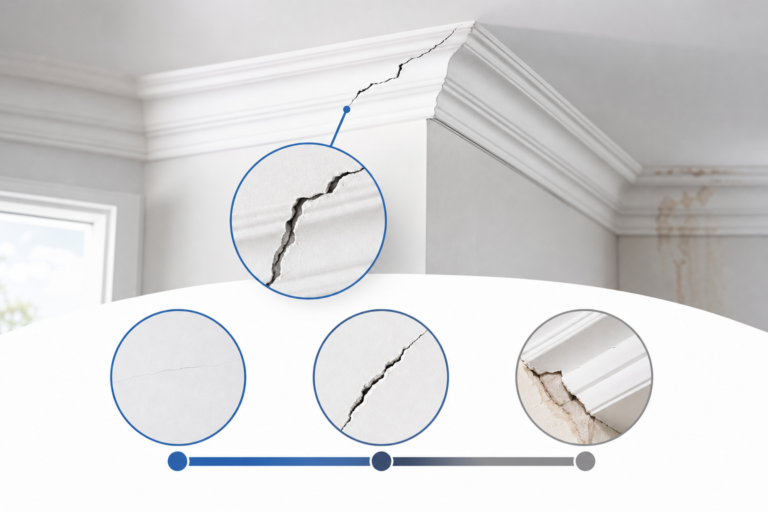
Cornice Cracking: How to Tell If the Damage Is Serious
Cornice cracking is one of the most common concerns Australian homeowners raise, and the hard part is not spotting the
Read More »
Digital Construction Consultant Australia: What They Do
A digital construction consultant in Australia manages the technology-driven side of building projects: BIM coordination, clash detection, asset data handover,
Read More »