
How to Prepare an NCAT Scott Schedule That Holds Up
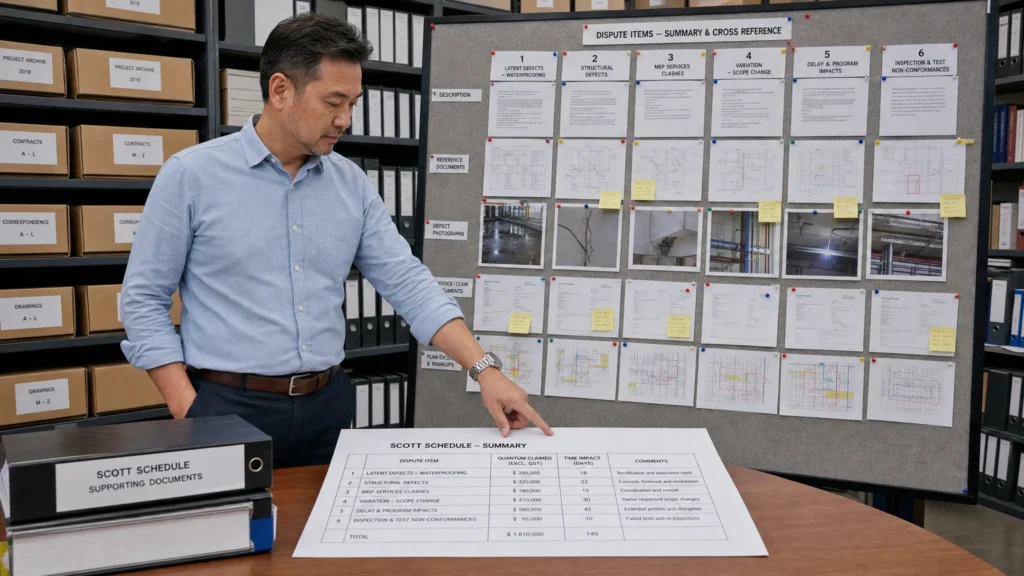
A Scott Schedule can make or break the way an NCAT building dispute is understood. It does not decide the case on its own, but it often becomes the document everyone keeps coming back to: the owner, the builder, the experts, the solicitors and the Tribunal Member.
The problem is that many schedules are prepared as a quick list of complaints or invoices. They may contain broad descriptions, missing evidence, duplicated defects, unclear costs or responses that do not match the expert reports. In NCAT, that can create confusion, delay and credibility problems.
A strong NCAT Scott Schedule is different. It is structured, factual, properly cross-referenced and capable of being tested. It helps the Tribunal identify what is agreed, what is disputed, what evidence supports each item and what amount is claimed or denied.
Glen Sim, owner and director of Awesim Building Consultants, approaches Scott Schedules as an expert document that must stand up to scrutiny, not just as an administrative table. For homeowners, builders and lawyers, the goal is the same: make each item clear enough that someone unfamiliar with the project can follow it without guesswork.
If you need a broader refresher before preparing your own schedule, Awesim has also explained what a Scott Schedule does in a building dispute. This guide focuses on the next step: how to prepare one that holds up.
What “holds up” means in an NCAT Scott Schedule
An NCAT Scott Schedule holds up when it remains useful throughout the dispute process. It should survive review by the other party, comparison against expert reports, questions from lawyers and scrutiny at hearing.
That does not mean every claimed item will succeed. It means the schedule is prepared in a way that allows each item to be understood, tested and determined.
A robust schedule usually has five qualities:
- It identifies each defect, incomplete item, variation or payment issue separately.
- It links every item to evidence, such as photos, contracts, plans, reports or invoices.
- It explains the rectification or claimed work in practical construction terms.
- It separates entitlement, liability and cost rather than blending them together.
- It is consistent with the expert report, pleadings, application, response and Tribunal directions.
This matters because NCAT is designed to resolve disputes efficiently. The Tribunal’s official guidance on home building disputes makes clear that parties need to present their material in a way that supports the issues being decided. A disorganised schedule makes that harder.
Start with the Tribunal directions, not the spreadsheet
Before opening a template, read the NCAT orders or directions carefully. The directions may specify when the schedule is due, which party must prepare the first version, how the other party must respond and what evidence must be served with it.
This is where many disputes go off track. A party prepares a schedule that looks complete, but it does not answer the specific directions. It may include categories not requested, omit response columns, fail to separate defects from variations or use numbering that does not match the expert report.
Your first task is to identify:
- Who is responsible for preparing the initial schedule.
- Whether the schedule must include both parties’ positions.
- Whether cost estimates must be attached or referenced.
- Whether the items must match a building expert report.
- The deadline for service and filing.
If a solicitor is involved, the schedule should also align with the legal issues in the proceedings. A building consultant can assist with technical clarity, but legal strategy and submissions should remain with the legal representatives.
Define the claim before you define the columns
A Scott Schedule should not be treated as a dumping ground for every frustration on a project. It needs to reflect the actual issues in dispute.
For homeowners, that may include defective work, incomplete work, overcharging, delay-related rectification items or disputed variations. For builders, it may include unpaid progress claims, completed work denied by the owner, variations performed without payment or responses to alleged defects. For lawyers, the schedule needs to translate the dispute into a form that can be managed with evidence.
A useful way to begin is to group the dispute into categories before drafting individual line items. For example:
| Category | Typical issue | Evidence usually needed |
|---|---|---|
| Defective work | Work alleged to fall below required standard | Expert report, photos, plans, specifications |
| Incomplete work | Work included in the contract but not finished | Contract scope, progress photos, inspection notes |
| Variations | Work added, changed or disputed outside original scope | Written instructions, emails, quotes, invoices |
| Payment dispute | Amounts claimed, withheld or disputed | Contract, payment schedule, invoices, receipts |
| Rectification cost | Cost to fix or complete work | Expert opinion, quotations, quantity assessment |
This step keeps the schedule disciplined. It also reduces the risk of double counting, which is a common issue in building disputes.
Use item numbers that never change
Once items are added to a Scott Schedule, give each line a unique item number and keep it stable. If item 12 is later deleted, do not reuse item 12 for a different defect. If an item needs to be split, use a logical numbering system such as 12A and 12B.
Stable numbering is not just neat formatting. It allows the parties, experts and Tribunal to refer to the same issue consistently across reports, photographs, submissions and hearing preparation.
This is particularly important where a building expert report contains numbered observations. If Glen Sim prepares or reviews a schedule for a dispute, one of the key checks is whether the schedule numbering and the expert evidence can be followed without confusion. A schedule that says “see report” without a clear item reference forces the reader to hunt for the evidence.
Write each item as a testable allegation
A vague Scott Schedule entry is difficult to answer and even harder to prove. The best entries are specific enough to be inspected, responded to and costed.
Consider the difference:
| Weak entry | Stronger entry |
|---|---|
| Bathroom waterproofing defective | Ensuite shower waterproofing alleged defective at wall and floor junction, with moisture staining observed to adjacent skirting, refer photos P12 to P15 and expert report item 4.2 |
| Poor painting | Internal paint finish to living room south wall contains visible roller marks and patching under natural light, refer photo P21 and contract specification clause 8 |
| Builder did not finish kitchen | Kitchen rangehood ducting not connected to external discharge point, refer site inspection note dated 14 May and plan A203 |
A testable allegation normally identifies the location, the element, the alleged problem and the evidence. It avoids emotional wording. It does not use phrases such as “terrible workmanship” or “completely unacceptable” unless those words are tied to a specific technical standard or expert conclusion.
Separate evidence from opinion
A schedule should make it easy to see what is evidence and what is opinion. Photographs show a condition. A contract shows an obligation. A report may provide expert opinion on whether the work is defective and what rectification is required.
Do not blur those roles. A photo of cracking may show that cracking exists, but it does not necessarily prove the cause, seriousness or rectification method. That is where expert evidence may be needed.
For NCAT building disputes, an independent inspection can be critical because the schedule often depends on technical findings. Awesim’s guide to NCAT independent building inspections in NSW explains why an expert witness report is different from a general building inspection report.
The schedule should refer to the evidence precisely. Instead of writing “see photos”, use “Photos P03 to P06, taken 3 March 2026”. Instead of “see contract”, use the relevant clause, drawing number, specification section or variation document if available.
Cost each item carefully and consistently
Costing is one of the most scrutinised parts of a Scott Schedule. A rectification amount should not be guessed simply to make the claim look complete. It should have a reasonable basis, whether that basis is an expert estimate, contractor quotation, invoice, quantity assessment or other supporting material.
Where possible, the schedule should distinguish between the cost to rectify defective work and the cost to complete work that was never done. These are different concepts. The same applies to variations, where entitlement to payment may depend on the contract, instructions, acceptance of work and other factual matters.
For disputed payment claims, a quantum meruit report may be relevant where work has been carried out but the price or contractual entitlement is disputed. Awesim provides quantum meruit reports, but whether that type of evidence is appropriate depends on the particular claim and should be considered in context.
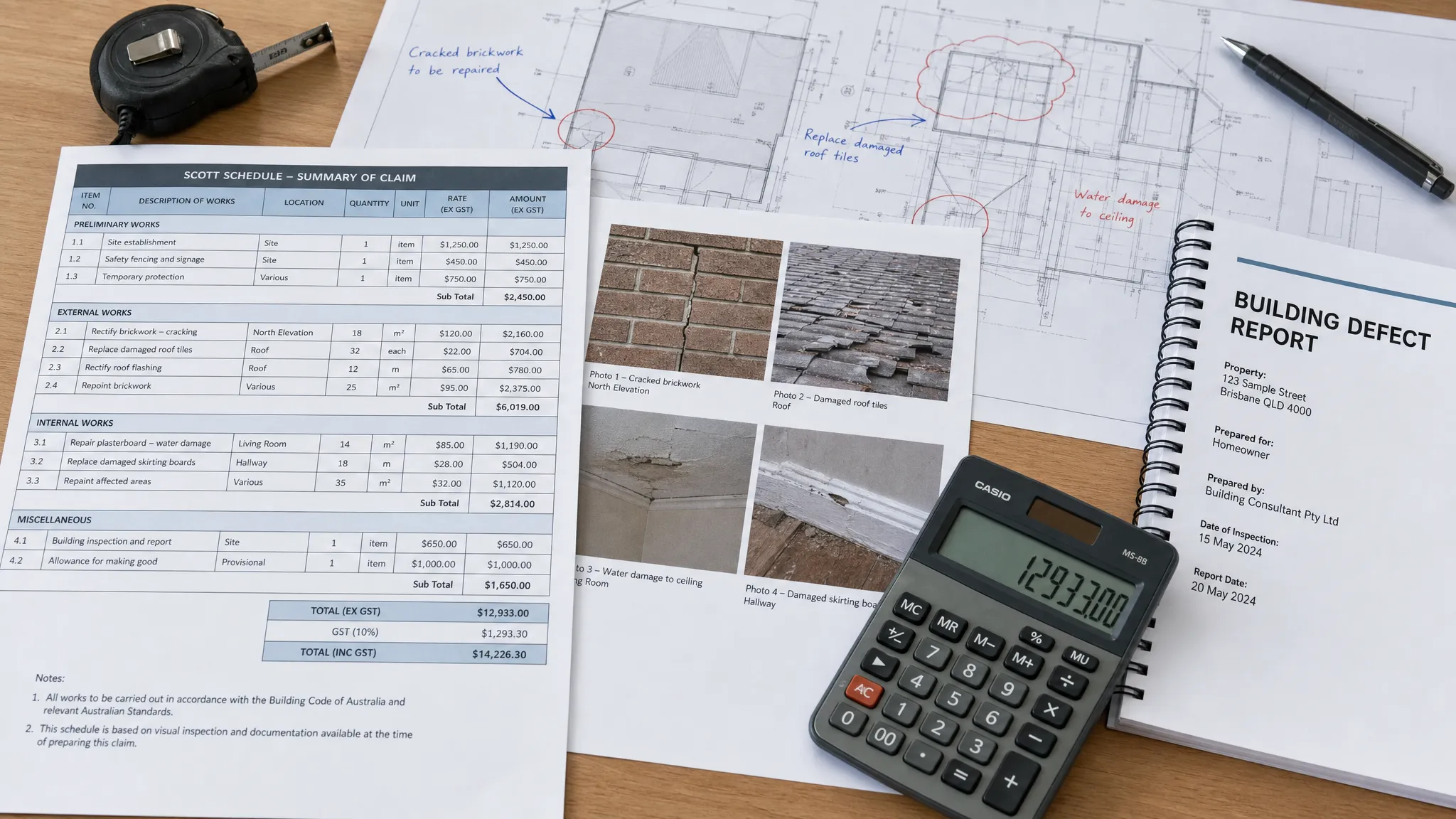
A practical costing column might include:
| Cost field | What it should show | Why it matters |
|---|---|---|
| Claimed amount | The amount sought for that item | Identifies the financial claim clearly |
| Basis of cost | Quote, expert estimate, invoice or calculation | Allows the amount to be tested |
| Rectification method | What work is proposed to fix or complete the issue | Connects cost to scope |
| GST treatment | Whether the amount is inclusive or exclusive of GST | Avoids ambiguity in totals |
Be careful with global sums. A single quote for “rectification works” may not help if the schedule has 25 separate defects. If the quotation cannot be broken down, the Tribunal may have difficulty assessing individual items.
Make the response columns meaningful
A Scott Schedule is not only for the claiming party. It is also a tool for identifying the responding party’s position.
A builder responding to an owner’s defect claim should avoid one-word answers such as “denied” where more detail is needed. An owner responding to a builder’s payment claim should also explain what is admitted, disputed or set off.
Strong response columns often address:
- Whether the item is admitted, denied or partly admitted.
- Whether the alleged defect exists.
- Whether responsibility is disputed.
- Whether the proposed rectification method is disputed.
- Whether the amount claimed is disputed and why.
For example, a builder might accept that a minor paint defect exists but dispute the claimed full repainting cost. An owner might accept that a variation was performed but dispute the amount claimed because there was no agreed price or because the work is alleged to be defective.
The best schedules narrow the dispute. If 10 items are admitted and 15 remain contested, the hearing can focus on the contested issues. If every response says “denied” without explanation, the schedule does very little.
Align the Scott Schedule with the expert report
A schedule that contradicts the expert report can undermine the party relying on it. If the report says the likely rectification cost for an item is $2,500, but the schedule claims $8,000 without explanation, expect questions.
The schedule does not need to copy the expert report word for word. In fact, it should not become a second report. But it should accurately reflect the expert’s findings, especially on technical defects, causation, scope of rectification and estimated cost.
Where Glen Sim is engaged as an expert, his role is to assist with independent technical opinion within his area of expertise. That independence matters. An expert is not there to inflate a claim or argue a party’s case. The strength of the schedule often comes from disciplined, evidence-based presentation.
For parties still learning how NCAT matters progress, Awesim’s guide to winning NCAT building disputes in NSW provides helpful context on the broader process.
Avoid the most common Scott Schedule mistakes
Many schedules fail not because the underlying claim is weak, but because the presentation creates avoidable problems.
The most common mistakes include:
- Combining multiple defects in one line item.
- Claiming the same cost under different headings.
- Using unclear locations such as “throughout the house”.
- Referring to missing evidence or unlabelled photos.
- Changing item numbers between versions.
- Including legal submissions inside technical columns.
- Using emotional language instead of factual descriptions.
- Failing to update the schedule after expert evidence changes.
A particularly damaging mistake is inconsistency between documents. If the application, expert report, quotes and Scott Schedule all describe the same issue differently, the other party may use that inconsistency to challenge credibility or quantum.
Another common issue is overstating certainty. If the cause of a defect has not been confirmed, the schedule should not pretend that it has. It is better to say the defect is observed and refer to the expert’s opinion on likely cause than to make a technical conclusion without support.
Keep version control tight
Scott Schedules often move through several versions. The owner may prepare the first version, the builder may add responses, experts may comment, lawyers may refine the issues and the Tribunal may require an updated version before hearing.
Every version should be dated and clearly labelled. Avoid sending files called “final”, “final updated” and “new final”. Use a simple format such as “Applicant Scott Schedule dated 19 June 2026” or “Joint Scott Schedule version 3 dated 19 June 2026”.
If changes are made, record them carefully. Do not silently delete important items without instructions or explanation. If a dispute later arises about what was included, the version history may matter.
Prepare it as if the Tribunal Member is reading it for the first time
This is one of the simplest tests for whether a Scott Schedule holds up. Imagine the Tribunal Member opens the document shortly before a directions hearing or final hearing. Can they understand the dispute without reading hundreds of pages first?
A well-prepared schedule should answer these questions quickly:
| Tribunal question | What the schedule should reveal |
|---|---|
| What is the item? | A clear description and location |
| What does each party say? | Concise claim and response columns |
| What evidence supports it? | Specific report, photo, contract or quote references |
| What amount is claimed? | A clear figure and basis |
| What remains disputed? | Liability, scope, cost or all of the above |
If the schedule cannot answer those questions, it may need more work.
When to get expert help
Not every Scott Schedule requires the same level of expert input. A simple dispute about a small number of incomplete items may be manageable with careful documentation. But expert support becomes more important when there are technical defects, competing opinions, substantial rectification costs, waterproofing issues, structural concerns, complex variations or allegations involving compliance with the Building Code of Australia, Australian Standards or contractual specifications.
For solicitors, expert input can also help convert a broad client narrative into a structured technical document. For builders, it can help separate genuine defects from maintenance issues, owner-supplied problems or disputed scope. For homeowners, it can help identify which complaints are technically supportable and how rectification should be described.
Awesim Building Consultants provides independent building dispute support across New South Wales, including expert witness reports, Scott Schedules, NCAT dispute reports, building defect assessments and quantum meruit reports. Glen Sim’s role is to bring construction expertise and disciplined reporting to disputes where clarity matters.
Final review checklist before serving your NCAT Scott Schedule
Before filing or serving the schedule, complete a final review. This is not just proofreading. It is a technical and evidentiary check.
Ask whether each item has a clear location, a specific allegation, a reference to supporting evidence and a cost basis if money is claimed. Confirm that the totals add up, GST is treated consistently and item numbers match the expert report. Check that the schedule complies with NCAT directions and that no privileged or inappropriate material has been included without legal review.
Most importantly, ask whether the schedule helps narrow the dispute. A good Scott Schedule does not overwhelm the reader. It organises the dispute so the real issues can be identified and determined.
Frequently Asked Questions
What is an NCAT Scott Schedule used for? An NCAT Scott Schedule is used to organise disputed building items, such as defects, incomplete work, variations and costs, so each party’s position and evidence can be compared in one document.
Does NCAT require a Scott Schedule in every building dispute? Not always. Whether a Scott Schedule is required depends on the Tribunal’s directions and the nature of the dispute. If NCAT orders one, the parties should follow the directions carefully.
Can I prepare a Scott Schedule without an expert report? You can prepare a basic schedule without an expert report, but technical defect claims often need expert evidence to support the allegation, rectification method and cost.
Should a Scott Schedule include legal arguments? Usually, the schedule should focus on the item, evidence, response and cost. Legal submissions are generally better kept separate unless the Tribunal’s directions or legal representatives require a specific format.
What makes a Scott Schedule weak? A weak schedule uses vague descriptions, missing evidence, unclear costs, duplicated claims, inconsistent numbering or responses that do not explain what is admitted or disputed.
Can Awesim help with an NCAT Scott Schedule? Yes. Awesim Building Consultants assists with Scott Schedules, expert witness reports, NCAT dispute reports, building defect assessments and related building dispute support across NSW.
Need a Scott Schedule that can withstand scrutiny?
If your NCAT building dispute depends on defects, variations, incomplete work or disputed rectification costs, the quality of your Scott Schedule matters.
Glen Sim and Awesim Building Consultants provide independent, practical building dispute support for homeowners, builders and solicitors across NSW. For help preparing or reviewing an NCAT Scott Schedule, expert witness report or related dispute document, visit Awesim Building Consultants.
Related Posts

Waterproof Membrane Failure: How Inspectors Find the Cause
Waterproof membrane failure is diagnosed by tracing the water entry point, reviewing design documents, exposing the membrane for visual inspection,
Read More »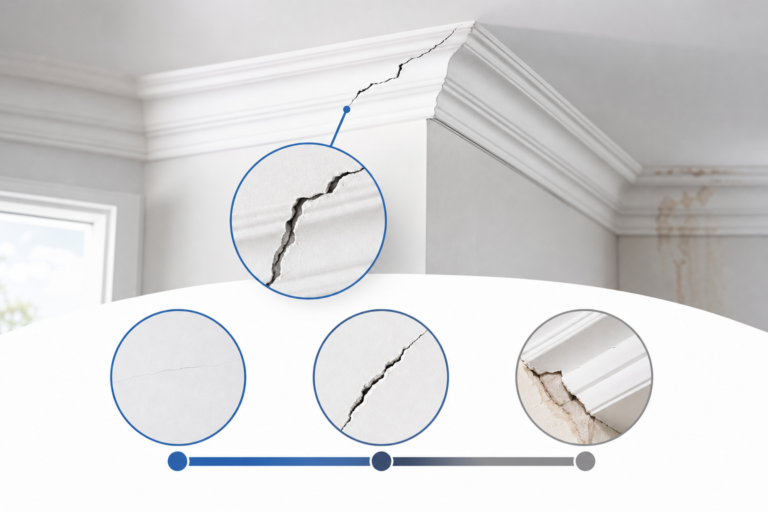
Cornice Cracking: How to Tell If the Damage Is Serious
Cornice cracking is one of the most common concerns Australian homeowners raise, and the hard part is not spotting the
Read More »
Digital Construction Consultant Australia: What They Do
A digital construction consultant in Australia manages the technology-driven side of building projects: BIM coordination, clash detection, asset data handover,
Read More »