
How to Use a Scott Schedule Template Correctly
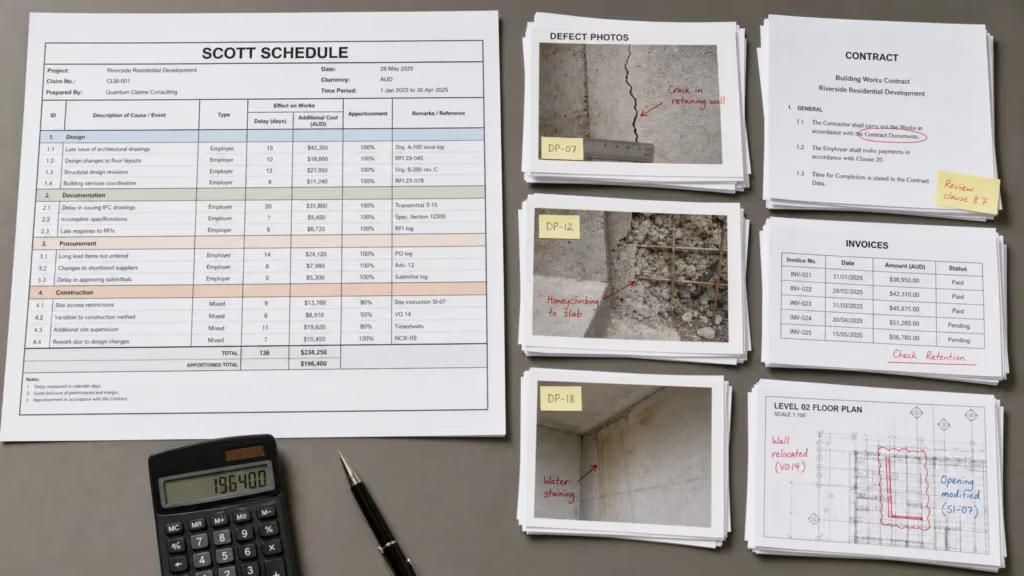
Using a Scott schedule template correctly is less about creating a neat spreadsheet and more about building a disciplined map of the dispute. In a home building matter, a well-prepared Scott Schedule can help homeowners, builders, lawyers, experts and decision-makers see what is actually in issue, what evidence supports each item, what the response is, and what amount is being claimed.
Used poorly, it can do the opposite. Vague defect descriptions, missing evidence references, duplicated costs and changing item numbers can make a dispute harder to resolve and harder to present at NCAT or in court.
This guide explains how to use a Scott schedule template properly in NSW building disputes, including what columns to include, how to describe defects or incomplete works, how to reference expert evidence, and what mistakes to avoid. It is general information only, not legal advice.
What is a Scott Schedule in a building dispute?
A Scott Schedule is a structured table used to organise disputed items. In building matters, it is commonly used for defects, incomplete works, variations, rectification costs and other issues where the parties need to compare claim, response and evidence item by item.
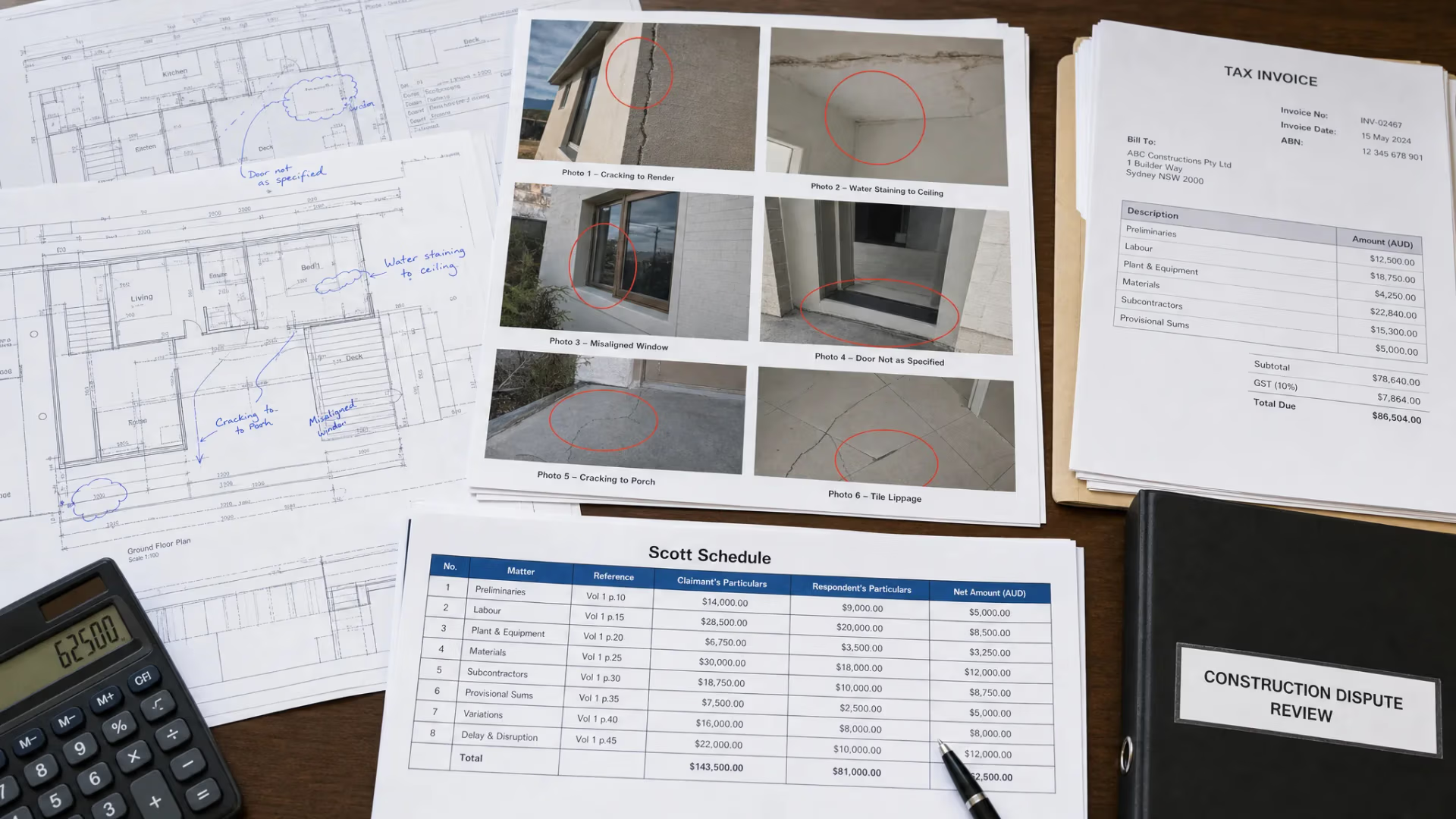
The schedule is not usually the evidence itself. It is a navigation tool that points to the evidence. That evidence might include an expert witness report, photographs, contract documents, invoices, emails, site notes, plans, specifications or a quantum meruit report.
For NSW home building disputes, Scott Schedules are often used alongside expert reports and tribunal directions. NCAT deals with home building matters through its home building jurisdiction, and the relevant rights and time limits often arise under the Home Building Act 1989 (NSW). If you are unsure what forum or process applies, it is worth getting legal advice early.
A good Scott Schedule should make the dispute clearer. It should not become a second set of pleadings, a long written submission, or a place to argue every legal point in full.
When should you use a Scott schedule template?
A Scott schedule template is useful when a building dispute involves multiple issues that need to be separated and answered. This is common in residential building disputes because the claim might include many rooms, trades, dates, documents and cost categories.
Typical situations include defective workmanship, incomplete works, disputed variations, alleged overcharging, unpaid progress claims, water ingress, cracking, non-compliant work, and disputes about the reasonable value of work performed.
For homeowners, the schedule can turn a confusing list of complaints into a structured claim. For builders, it provides a clear way to admit, deny or qualify each allegation. For lawyers and solicitors, it helps align the evidence with the issues that need to be proved. For experts, it helps connect opinions and rectification costs to specific items.
If your matter is already in NCAT or court, always check the orders, directions or procedural requirements before choosing a format. A template is only useful if it complies with what the tribunal or court has directed.
The core columns in a good Scott schedule template
There is no single universal Scott Schedule that suits every dispute. The right format depends on the type of claim, the stage of the matter and any directions made. However, most building dispute schedules need the same basic building blocks.
| Column | What to include | Why it matters |
|---|---|---|
| Item number | A stable number for each issue | Keeps references consistent across reports, submissions and hearings |
| Location or area | Room, elevation, level, unit, lot or site area | Helps the reader identify exactly where the issue is located |
| Alleged defect or issue | A clear description of the complaint | Defines what is being claimed |
| Contract, standard or obligation | Relevant contract clause, specification, plan, NCC requirement or standard, if applicable | Links the issue to an alleged duty or benchmark |
| Evidence reference | Photo number, report paragraph, invoice, email, plan or annexure | Shows where the supporting material can be found |
| Rectification or remedy sought | The proposed repair, completion work or adjustment | Clarifies the outcome being requested |
| Amount claimed | Cost estimate, invoice amount, allowance or calculation | Identifies the quantum for that item |
| Respondent’s response | Admit, deny, partially admit, alternative explanation or alternative amount | Narrows what remains disputed |
| Expert comment | Independent opinion on cause, compliance, scope or cost | Helps the decision-maker assess technical issues |
| Status or outcome | Agreed, not agreed, withdrawn, resolved or determined | Tracks progress and avoids rearguing settled items |
For simple matters, fewer columns may be enough. For complex litigation, more columns may be needed, particularly where there are multiple experts, cross-claims, alternative scopes of work or separate liability and quantum issues.
A practical Scott schedule template structure
Below is a simplified structure that can be adapted. In a real matter, your solicitor, expert or tribunal directions may require additional columns or different wording.
| Item | Location | Alleged issue | Evidence | Rectification sought | Amount claimed | Response | Expert comment or status |
|---|---|---|---|---|---|---|---|
| 1 | Main bathroom, shower recess | Water escaping from shower screen junction and damaging adjacent skirting | Photos P1 to P4, expert report paragraphs 18 to 24 | Remove affected sealant, investigate junction, rectify waterproofing or screen junction as required, make good finishes | $X | To be completed by respondent | To be completed by expert or parties |
| 2 | Kitchen, splashback | Tile lippage alleged to exceed acceptable tolerance | Photos P5 to P8, contract specification, expert report paragraph 31 | Remove and replace affected splashback tiles | $X | To be completed by respondent | To be completed by expert or parties |
| 3 | External wall, western elevation | Cracking alleged around window opening | Photos P9 to P11, engineer or building expert reference if available | Investigate cause, repair substrate and finishes | $X | To be completed by respondent | To be completed by expert or parties |
The amounts should be supported by a proper basis. That might be a quotation, invoice, expert cost estimate, quantity surveyor input, or another document that explains how the figure was reached. If GST, contingency or access costs are included, make that clear.
How to use a Scott schedule template correctly
Start with the directions and the actual claim
Before filling in the template, check what the dispute is really about. In NCAT or court, the application, points of claim, defence, reply, orders and expert directions may define the issues. Your schedule should not introduce a new claim by accident or omit a claim that is already pleaded.
If the tribunal or court has ordered a Scott Schedule, read the order carefully. It may state who must prepare the first version, when the other party must respond, what columns are required and whether expert comments are needed.
Separate every issue into its own line
One of the most common mistakes is grouping several complaints into one row. For example, bathroom defects might include waterproofing, falls to waste, tile lippage, cracked grout and a leaking screen. Those are different issues and may have different causes, evidence and rectification costs.
A separate row for each issue makes it easier for the other party to respond. It also helps the expert assess each issue independently. If several items share one rectification method, that can be explained, but the alleged defects should still be clear.
Use precise factual descriptions
The schedule should say what is wrong, where it is, and why it matters. A vague entry like poor workmanship in bathroom is not enough. A useful entry identifies the location, observable issue, alleged non-compliance and evidence reference.
| Weak entry | Better entry |
|---|---|
| Kitchen defective | Kitchen splashback tiles above cooktop have uneven lippage, as shown in photos P5 to P8 and discussed at expert report paragraph 31 |
| Bathroom leaks | Main bathroom shower recess shows water escape at screen junction, staining to adjacent skirting and moisture readings recorded in expert report paragraphs 18 to 24 |
| Builder overcharged | Variation claim V03 for additional excavation is disputed because no signed variation approval has been located and the claimed quantity is not supported by the site records provided |
The goal is not to make the wording longer. The goal is to make it testable.
Cross-reference every important document
A Scott Schedule becomes powerful when it points the reader to the right evidence quickly. Instead of writing see photos, identify the photo numbers. Instead of writing see report, identify the report section or paragraph. Instead of referring generally to emails, list the date or annexure reference.
This is especially important for lawyers preparing hearing material. Decision-makers should not have to search through a large bundle to understand each item. If the schedule is properly cross-referenced, it becomes a practical index to the dispute.
Keep liability and quantum clear
In building disputes, liability and quantum often get mixed together. Liability concerns whether a party is responsible for the issue. Quantum concerns the amount claimed to fix, complete or value the work.
A builder might accept that a minor defect exists but dispute the proposed rectification method or cost. A homeowner might accept that work was performed but dispute whether the amount claimed is reasonable. The Scott Schedule should allow these distinctions to be recorded clearly.
Where the dispute concerns the reasonable value of work rather than a fixed contract price, a quantum meruit assessment may be needed. In that situation, the schedule should align with the valuation evidence rather than simply listing figures without explanation.
Do not turn the schedule into submissions
A Scott Schedule should be concise. It is not the best place for lengthy legal argument, history, commentary about credibility or emotional language. Save detailed legal submissions for the document or stage where they belong.
Use neutral, specific wording. For example, write no written variation approval provided in documents reviewed rather than the builder clearly fabricated this variation. The first version helps identify an evidentiary issue. The second version creates unnecessary heat and may distract from the point.
Preserve item numbers and version control
Once a Scott Schedule has been exchanged, avoid renumbering items unless all parties agree or the tribunal directs it. If an item is withdrawn, mark it as withdrawn rather than deleting it without explanation. If an item is resolved, mark it as resolved.
Use version dates in the file name and at the top of the document. For example, Scott Schedule, Applicant version, 14 July 2026. This reduces confusion when lawyers, experts and parties are working from multiple drafts.
How homeowners should approach the schedule
Homeowners should focus on clarity and evidence. Start by listing what you can actually observe, then connect each item to photos, reports, contracts and invoices. Avoid exaggerating. A smaller, well-supported schedule is often more persuasive than a long list of poorly explained complaints.
It is also useful to distinguish between inconvenience and recoverable building issues. For example, a delayed project may have caused stress, but the Scott Schedule should usually focus on the specific work, defect, cost or contractual issue being claimed.
If you have an expert report, make sure the schedule follows the expert’s item descriptions and paragraph references. If your expert has not addressed an item, that may be a sign that more evidence is needed before the claim is advanced.
How builders should respond to a Scott Schedule
Builders should respond item by item. Do not give one general denial at the bottom of the schedule and assume that is enough. Each alleged defect or cost should be admitted, denied, partially admitted or answered with a clear explanation.
A strong response identifies whether the issue is disputed on fact, responsibility, scope, causation, cost or all of those matters. For example, a builder may say that the work was performed by another trade, that the alleged defect is maintenance-related, that the proposed rectification is excessive, or that a lower-cost repair is appropriate.
Builders should also cross-reference their own evidence. Relevant material might include contract documents, variation approvals, site diaries, photographs, subcontractor invoices, emails, occupation certificates, product information and maintenance instructions.
How lawyers and solicitors can make the schedule more useful
For lawyers, the Scott Schedule should be consistent with the pleaded case, expert evidence and hearing strategy. It should help identify what needs to be proved, what can be conceded and what can be resolved before hearing.
The schedule can also expose evidentiary gaps. If an item has no evidence reference, no contractual basis and no cost support, it may need further work before it is relied on. If the same cost appears under multiple items, the claim may need to be revised to avoid double counting.
Lawyers should also consider expert independence. In NSW court proceedings, expert witnesses are commonly expected to comply with the Expert Witness Code of Conduct where applicable. Even outside formal court rules, expert evidence is more useful when it is independent, reasoned and properly connected to the issues.
Common Scott Schedule mistakes to avoid
A Scott Schedule usually becomes difficult to use when it is vague, overcomplicated or disconnected from the evidence. The table below summarises common problems and practical fixes.
| Mistake | Why it causes problems | Better approach |
|---|---|---|
| Combining multiple defects in one row | The respondent cannot answer each issue clearly | Use one row per issue or defect |
| Using vague descriptions | The expert and decision-maker cannot identify the complaint | Include location, nature of defect and evidence reference |
| Missing evidence references | The schedule becomes an unsupported assertion | Refer to photos, report paragraphs, invoices and annexures |
| Changing item numbers between versions | Creates confusion in responses and expert reports | Keep numbers stable and mark items withdrawn or resolved |
| Claiming lump sums without explanation | The amount may be hard to verify | Break down cost basis or cross-reference a quote or report |
| Duplicating the same cost under several rows | Can overstate the claim | Group shared rectification costs carefully and explain them |
| Including long argument in each cell | Makes the schedule hard to read | Keep the schedule concise and put submissions elsewhere |
| Ignoring the other party’s response | Fails to narrow the dispute | Use the response column to identify what remains in issue |
How expert reports and Scott Schedules work together
In a building dispute, the expert report and the Scott Schedule should support each other. The expert report provides the reasoning. The schedule organises the issues.
For example, an expert report may explain why a waterproofing defect exists, what evidence was observed, what standard or requirement is relevant, and what rectification is reasonable. The Scott Schedule should then summarise that item and point to the exact paragraphs of the report.
This is where independent building consultants can add significant value. A consultant who understands defect assessment, rectification scope and dispute presentation can help ensure that technical opinions are presented in a way that is useful to lawyers, parties and the tribunal.
Awesim provides independent building dispute support across New South Wales, including expert witness reports, Scott Schedules, quantum meruit reports, building defect assessments, litigation support and NCAT dispute reports. The key is to ensure the schedule reflects the evidence, rather than forcing the evidence to fit a template.
A final checklist before you file or exchange it
Before sending a Scott Schedule to the other party, your lawyer, expert or the tribunal, review it carefully. The following checks can prevent many avoidable problems.
- Each item has a stable number, precise location and clear issue description.
- Each claimed item points to supporting evidence, such as photos, report paragraphs or invoices.
- Amounts claimed are supported and not duplicated elsewhere.
- The schedule matches the current pleadings, application or tribunal directions.
- Withdrawn, resolved or agreed items are clearly marked.
- The latest version is dated and easy to identify.
If the schedule is difficult for you to follow, it will probably be difficult for everyone else too. Simplify the wording, improve the references and remove unnecessary argument.
Frequently Asked Questions
Is a Scott Schedule mandatory in every NCAT building dispute? Not always. A Scott Schedule may be directed or requested where it will help organise the issues, especially in disputes involving multiple defects, incomplete works or cost items. Always check the specific directions in your matter.
Can I use a spreadsheet as a Scott schedule template? Yes. Spreadsheets are commonly used because they allow sorting, filtering, adding responses and updating status. The important point is that the format remains readable and complies with any tribunal or court directions.
Who should prepare the Scott Schedule? It depends on the matter. A homeowner, builder, solicitor or expert may contribute. In many disputes, the legal team manages the format while the building expert helps with technical descriptions, rectification scope and cost references.
Does a Scott Schedule replace an expert report? No. The schedule usually summarises and organises issues. The expert report provides the technical reasoning, observations, opinions and supporting detail.
How detailed should each item be? Detailed enough that the other party can understand and respond to the issue. Each item should identify the location, alleged problem, evidence reference, remedy sought and amount claimed where relevant.
Can a Scott Schedule be updated? Yes, but updates should be controlled. Keep item numbers stable, date each version and clearly mark items that are resolved, withdrawn or amended.
What is the difference between a Scott Schedule and a quantum meruit report? A Scott Schedule organises disputed items. A quantum meruit report addresses the reasonable value of work or services where that type of valuation is in issue. In some matters, both documents may be needed.
Need help preparing or reviewing a Scott Schedule?
A Scott schedule template is only as good as the evidence and expert input behind it. If you are dealing with a NSW building dispute, a clear and independent assessment can help narrow the issues, support settlement discussions and prepare the matter for NCAT or court.
Awesim assists homeowners, builders and lawyers across New South Wales with expert witness reports, Scott Schedules, quantum meruit reports and building defect assessments. To discuss independent support for your matter, visit Awesim Building Consultants.

Related Posts

Water Damage in Homes: How to Track Down the Source
Water damage in a home rarely announces itself at the source. A stain on the ceiling, a musty smell in
Read More »
Waterproofing Membrane Types: Which Fails Most in NSW Bathrooms
Waterproofing failure is the single most common serious defect found in NSW apartments, and the type of membrane used, along
Read More »
Building Certifier NSW: Role, Limits, and When You Need More
A building certifier in NSW is a registered professional who issues construction certificates, conducts critical stage inspections, and grants occupation
Read More »