
Waterproofing Membrane Types: Which Fails Most in NSW Bathrooms
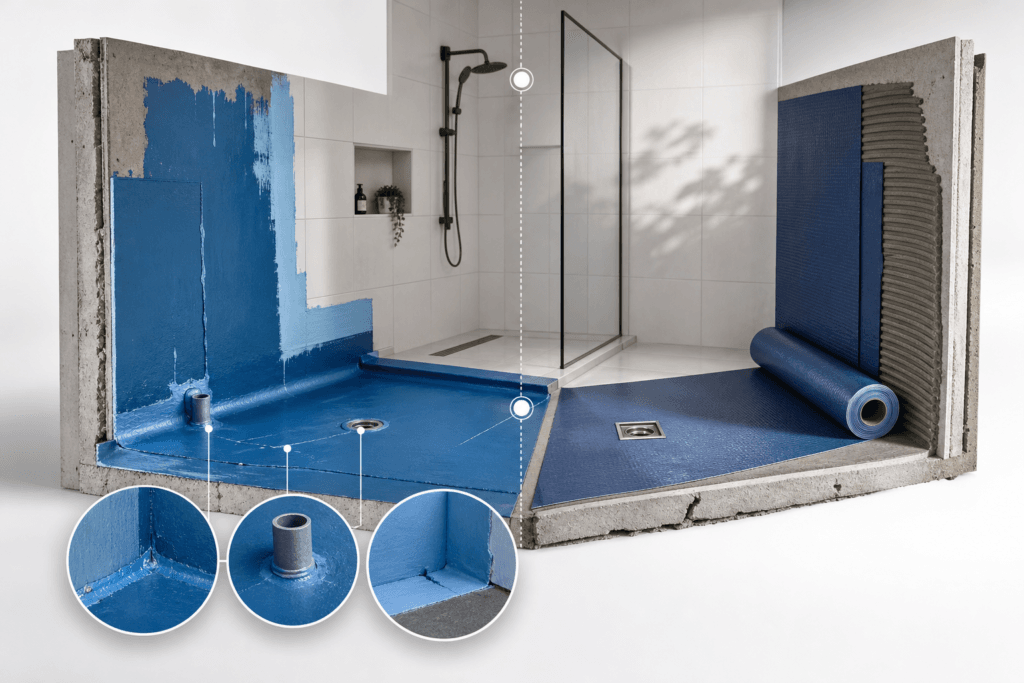
Waterproofing failure is the single most common serious defect found in NSW apartments, and the type of membrane used, along with how it is applied, determines whether a bathroom holds water or generates a costly dispute. Liquid-applied membranes fail most often in NSW bathrooms, not because the product is inferior, but because incorrect dry film thickness, missed penetration seals, and unbonded wall-floor junctions are the leading causes. Sheet membranes fail less frequently overall but are harder to install correctly around complex shapes. Both types must comply with AS 3740 Waterproofing of Domestic Wet Areas and the NCC 2022 (formerly the Building Code of Australia).
What Are the Main Waterproofing Membrane Types?
Three broad categories cover the waterproofing membrane types used in Australian bathrooms: liquid-applied membranes, sheet membranes, and hybrid systems that combine elements of both.
Liquid-applied membranes are polymer-based coatings applied wet by brush, roller, or spray. They cure in place to form a continuous, unjointed film directly bonded to the substrate. Because they conform to any shape, they suit the complex angles and penetrations typical of residential bathroom construction. They are the most widely used type in NSW domestic wet areas.
Sheet membranes arrive on site as pre-manufactured rolls or panels, typically of modified bitumen, polyethylene, or thermoplastic polyolefin (TPO). Installers bond or mechanically fix them to the substrate and lap the joints. Factory-controlled thickness is a defining feature of this category, removing one variable from the installation process.
Hybrid systems pair a sheet membrane at the floor with a liquid-applied product at junctions and penetrations, or vice versa. They are less common in domestic bathrooms but appear in larger or more complex wet area assemblies.
The table below summarises the three types at a glance.
| Type | Form | Typical substrate bond | Common use |
|---|---|---|---|
| Liquid-applied | Wet-applied coating | Fully bonded | Residential bathrooms, shower recesses |
| Sheet membrane | Pre-manufactured roll or panel | Bonded or mechanically fixed | Commercial, exterior, complex substrates |
| Hybrid | Combined liquid and sheet | Mixed | Large or complex wet area assemblies |
According to Dura Group, liquid-applied membranes used in bathrooms typically require a total dry film thickness of 1 mm to 1.5 mm, a figure Dura Group records as 1mm to 1.5mm. That narrow tolerance is why application quality matters so much, and why this category generates the most defect disputes in NSW.
How Liquid-Applied Membranes Work in Bathroom Waterproofing
A liquid-applied membrane starts as a viscous polymer compound, usually acrylic, polyurethane, or a modified bitumen emulsion. The applicator brushes or rolls it onto a prepared, dry substrate in multiple coats. Each coat must reach a specified wet film thickness and then cure fully before the next coat goes on. The finished membrane must achieve a dry film thickness of 1 mm to 1.5 mm across the entire coated surface, consistent with the 1mm to 1.5mm figure Dura Group records.
That curing sequence is where things most often go wrong. If a second coat goes on before the first has dried, the two layers do not bond correctly and the membrane can delaminate under hydrostatic pressure. If the applicator spreads the product too thinly, or applies too few coats, the dry film thickness falls short and the membrane cannot perform as tested.
Liquid-applied products dominate residential bathroom use in NSW for practical reasons. They can be applied directly over complex substrate geometry, including internal angles, curved walls, and irregular penetration positions, without cutting, folding, or lapping material. There are no seams to fail. A correctly applied liquid membrane forms a continuous, fully bonded film that moves with the substrate during normal building movement.
The common failure points, however, are predictable. Wall-floor junctions require a bond breaker or backing rod so the membrane can flex rather than tear when the structure moves. Penetrations such as floor wastes and tap outlets need purpose-made puddle flanges or collars, not just an extra coat of membrane brushed around the pipe. And the membrane must extend to the correct height on all walls within the wet area, not just the shower recess floor.
These are not material failures. They are application failures. A liquid-applied membrane that is correctly prepared, applied to the right thickness, and detailed at every junction and penetration will perform for the life of the building. The product is not the problem. The process is.
What Is Sheet Membrane Waterproofing and When Should You Use It?
Sheet membrane waterproofing uses a pre-manufactured material, cut and laid on site, rather than a product that cures in place. The most common materials are modified bitumen, polyethylene, chlorinated polyethylene (CPE), and thermoplastic polyolefin. Each arrives at a consistent, factory-controlled thickness, which removes the dry film tolerance problem that affects liquid-applied systems.
For wall applications, sheet products are more common in commercial construction and external settings where the substrate is flat and regular. A waterproofing membrane for exterior walls benefits from the UV resistance and puncture resistance that some sheet products offer. In those settings, consistent thickness and the ability to inspect laps before the membrane is covered are genuine advantages.
In domestic bathrooms, sheet membranes are less common, and for a specific reason: bathrooms are not flat. Shower recesses have internal corners, pipe penetrations, step-downs, and changes in plane. Every one of those features requires the sheet to be cut, folded, or lapped, and every cut edge or lap joint is a potential failure point. A membrane sheet for waterproofing performs well on a flat floor slab or a simple wall plane, but the detailing required around penetrations and junctions demands a high level of installer skill.
For most NSW residential bathrooms, liquid-applied systems remain the practical default. Sheet membranes suit large, flat substrates where UV or mechanical protection is needed and where consistent, independently tested thickness is a specification requirement. That is a different set of conditions from a domestic shower recess, not a reason to rank one product above the other.
Which Waterproofing Membrane Fails Most in NSW Bathrooms?
Liquid-applied membranes account for the majority of waterproofing defects found in NSW bathrooms. That is not a reflection on the product category. It is a direct consequence of two facts: liquid-applied systems dominate residential installation, and their performance depends entirely on what happens during application.
According to NSW Building Commission research cited by The Good Builder, 42 per cent of apartment buildings with serious defects had waterproofing issues, making it the most prevalent defect category across the sample. That figure covers all waterproofing types, but in domestic wet areas, the failure pattern is consistent: the membrane was either applied too thinly, left unbonded at critical junctions, or had penetrations that were never properly sealed.
The three failure points appear in nearly every defect matter involving a liquid-applied system.
Insufficient dry film thickness is the most common. In practice, applicators often spread product across a larger area than the coverage rate supports, or skip a coat to save time. The membrane looks complete. It is not.
Unbonded wall-floor junctions are the second major failure point. Where the floor plane meets the wall, the substrate can move independently during normal building settlement. Without a bond breaker at that junction, the membrane bridges the angle rigidly and tears when movement occurs. Water then tracks directly into the substrate.
Missed or inadequate penetration seals account for the third pattern. Floor wastes, tap outlets, and mixer penetrations are high-risk points. A brush coat of membrane material around a pipe is not a seal. Purpose-made puddle flanges and collars are required, and they must be set into the membrane system, not applied over the top of it.
Sheet membranes fail less frequently in domestic bathrooms, but when they do fail, the cause is almost always a lap joint that was not properly bonded, or a cut edge at a penetration that was left unsealed. The geometry of a typical bathroom works against sheet systems at exactly those points.
Industry modelling for the building code review estimated the typical cost to rectify a failed internal wet area at approximately 19,000 dollars, per The Good Builder's 2026 report. That figure is a modelling estimate, not a fixed quote, but it reflects the scope of work involved: stripping tiles, removing the failed membrane, preparing the substrate, re-waterproofing, and reinstating finishes.
The membrane type is rarely the cause of failure. The application is.
NSW Compliance Requirements: AS 3740 and NCC 2022 Explained
Both AS 3740 Waterproofing of Domestic Wet Areas and the NCC 2022 (formerly the Building Code of Australia) set out the minimum requirements for waterproofing in NSW residential construction. They work together: the NCC mandates that wet areas be waterproofed, and AS 3740 provides the technical standard that defines how that waterproofing must be achieved.
AS 3740 covers membrane system selection, substrate preparation, required coverage areas within different wet area types, and detailing obligations at junctions and penetrations. It applies to shower recesses, bathrooms, laundries, and other domestic wet areas. Critically, it applies to both new construction and renovation work, so a builder refitting an existing bathroom is held to the same standard as one building from slab.
The NCC 2022 ties waterproofing performance to the broader building consent process. Non-compliant waterproofing is a breach of the building approval, not merely a workmanship issue. In NSW, that distinction matters because it affects the liability framework under the Design and Building Practitioners Act 2020 (DBPA). The DBPA introduced statutory warranties for residential building work, placing obligations on developers and builders to ensure work complies with the approved plans and relevant standards. Where waterproofing is found to be non-compliant, those warranty provisions can support a claim for rectification.
For homeowners trying to understand whether their bathroom waterproofing meets the required standard, the detail of what AS 3740 and the NCC require at specific junctions, penetrations, and coverage areas is covered in depth on Awesim's bathroom waterproofing and waterstops resource.
The compliance baseline matters because it sets the benchmark for any defect assessment. A membrane applied in good faith but falling short of AS 3740 requirements is a defect, regardless of whether it is currently leaking. By the time water appears at a ceiling below, or a skirting board begins to swell, the non-compliance has usually been concealed under tiles for months or years.
How to Apply a Waterproofing Membrane Correctly: Step-by-Step
Correct application follows a fixed sequence. Skipping or reordering any step creates the failure points described above. The following process applies to liquid-applied systems in domestic bathrooms, which represent the most common installation type in NSW.
Waterproof shower recesses by coating floors and walls to at least 1,800 mm above the floor. This height requirement applies to all wall surfaces within the shower recess. Stopping the membrane at tile height or at the showerhead position is a common shortfall and a non-compliance under AS 3740.
Apply the membrane to the entire bathroom floor area, including spaces under vanities and toilets. The membrane is not limited to the shower recess floor. The full floor area must be covered, including areas that will be concealed by fixtures after installation.
Install a bond breaker at the wall-floor junction to allow the membrane to flex during building movement. A bond breaker, typically a foam backing rod, prevents the membrane from bonding rigidly into the internal angle. Without it, normal structural movement tears the membrane at that junction. This step must be completed before the membrane coats are applied.
Seal all penetrations, such as floor wastes, taps, and mixers, using puddle flanges or specialised collars. Each penetration through the membrane plane requires a purpose-made fitting that integrates with the membrane system. Applying additional membrane material around a pipe without a flange does not constitute a seal.
Each coat of liquid-applied membrane must reach the specified wet film thickness and cure fully before the next coat is applied. Inspecting the membrane before tiling is the only opportunity to identify and rectify any shortfall before it is concealed.
When a Waterproofing Defect Becomes a Legal Dispute in NSW
Waterproofing defects become formal disputes when rectification is refused, liability is contested, or the scope and cost of repair cannot be agreed. In NSW, those matters proceed through NCAT, the District Court, or the Supreme Court, depending on the amount claimed and the complexity of the issues.
At that point, the quality of the technical evidence determines the outcome. Awesim Building Consultants is an Australian building consultancy operating across NSW since 1996 that prepares independent Expert Witness Reports, Forensic Waterproofing Inspection reports, and Scott Schedules for use in formal proceedings. For homeowners, builders, and strata managers facing a waterproofing dispute, a forensic inspection report that maps defects against AS 3740 and NCC 2022 requirements is the foundation of any credible claim. For further guidance on navigating a waterproofing matter, the Waterproofing Disputes NSW guide sets out the process in detail.
FAQs
What should I look for when inspecting bathroom waterproofing before tiling?
Check that the membrane covers the full floor area and extends to the correct height on all walls within the shower recess. Look for visible thin spots, pinholes, or areas where the coating appears patchy or uneven. Confirm that puddle flanges or collars are fitted at every floor waste and pipe penetration, and that a bond breaker is in place at the wall-floor junction. Once tiles go down, none of these details can be inspected without destructive investigation.
Does AS 3740 apply to both new builds and renovations in NSW?
Yes. AS 3740 Waterproofing of Domestic Wet Areas applies to both new residential construction and renovation work. A builder refitting an existing bathroom is held to the same standard as one building from slab. This means that a renovation waterproofing installation that falls short of AS 3740 requirements is a defect, regardless of the age of the property or whether the bathroom was previously compliant.
How long should a waterproofing membrane last in a bathroom?
A correctly applied waterproofing membrane in a domestic bathroom should remain effective for the life of the building, provided the substrate is stable and the membrane is not physically disturbed. In practice, failure tends to occur not because the membrane degrades over time, but because it was applied incorrectly at the outset. Junctions that were never properly detailed and penetrations that were never properly sealed will begin to fail within a few years, often long before the membrane material itself reaches the end of its service life.
Can a homeowner claim rectification costs from a builder under the DBPA 2020?
Yes, in many matters. The Design and Building Practitioners Act 2020 introduced statutory warranties for residential building work in NSW, placing obligations on developers and builders to ensure work complies with approved plans and relevant standards. Where waterproofing is found to be non-compliant, those warranty provisions can support a claim for rectification costs. The strength of that claim depends on the quality of the technical evidence, including a forensic inspection report that maps the defects against AS 3740 and NCC 2022 requirements.
What is the difference between a bond breaker and a backing rod at a wall-floor junction?
A backing rod is the physical component: typically a closed-cell foam rod pressed into the internal angle at the wall-floor junction before the membrane is applied. A bond breaker is the function it performs, preventing the membrane from bonding rigidly into the angle so it can flex when the structure moves rather than tearing under tension. The terms are often used interchangeably on site, but the distinction matters when specifying or inspecting the assembly. Both refer to the same installation requirement.
Conclusion
Liquid-applied membranes fail most often in NSW bathrooms because they dominate residential installation and their performance depends entirely on application quality. Insufficient dry film thickness, unbonded wall-floor junctions, and unsealed penetrations are the three failure points that appear consistently in defect matters. Sheet membranes fail less frequently in domestic settings, but lap joints and cut edges at penetrations carry the same risk when detailing is poor. Neither waterproofing membrane type fails because of the product itself.
If you suspect a waterproofing defect, the first practical step is to determine whether the membrane was applied in accordance with AS 3740 and NCC 2022 requirements. A forensic waterproofing inspection will identify whether the membrane meets the compliance baseline and, if not, document the scope of rectification required. That documentation is what makes a defect claim actionable.

Related Posts
Waterproofing Membrane Types: Which Fails Most in NSW Bathrooms
Waterproofing failure is the single most common serious defect found in NSW apartments, and the type of membrane used, along
Read More »
Building Certifier NSW: Role, Limits, and When You Need More
A building certifier in NSW is a registered professional who issues construction certificates, conducts critical stage inspections, and grants occupation
Read More »
Schedule of Rates in Construction: How Disputes Arise in NSW
A Schedule of Rates contract prices construction work by unit rates applied to measured quantities, so the final cost varies
Read More »