
If you’ve ever been involved in a building dispute, you know how quickly things can get messy. What starts as a simple disagreement over a leaky window or a cracked wall can spiral into a confusing tangle of claims, counter-claims, and "he said, she said." This is where a Scott Schedule comes in.
Think of it as the official scorecard for your dispute. It’s a specialised table that neatly organises every single point of contention, lining up the homeowner's complaint against the builder's response. This simple, side-by-side format is incredibly powerful.
What Is a Scott Schedule and Why Does NCAT Use It?

Imagine trying to referee a game where both teams are shouting their points all at once. It would be impossible to follow, right? A building dispute without a clear structure is much the same. The homeowner points out dozens of issues, the builder refutes them, and it all dissolves into a chaotic back-and-forth.
A Scott Schedule cuts through that chaos. It's far more than just paperwork; it’s a tool that forces clarity by transforming a jumbled list of grievances into a logical, itemised framework. Each defect gets its own dedicated row, requiring both sides to put their position on the record, point by point.
The Official Scorecard for Building Disputes
This document is the bedrock of building dispute proceedings at the NSW Civil and Administrative Tribunal (NCAT). It serves as the primary reference for the Tribunal Member, allowing them to grasp the entire scope of the dispute at a single glance.
Instead of wading through confusing emails and conflicting statements, the Member can instantly see:
- A complete list of every alleged defect.
- The homeowner’s argument, proposed fix, and cost.
- The builder’s direct response to that specific claim.
- The independent view of any expert witnesses.
This methodical layout is precisely why NCAT relies on it. It ensures everyone is talking about the same thing, at the same time, preventing the common problem of parties arguing past one another. It clearly separates what’s agreed upon from what’s contested, allowing hearings to focus only on the issues that truly matter.
A Mandated Tool for Efficiency and Clarity
The use of a Scott Schedule isn't just a suggestion; it’s a requirement under NCAT’s Procedural Direction 3, the rulebook for how home building disputes are handled. This directive was put in place to create a more consistent and efficient process for everyone.
And it worked. Before Scott Schedules became standard practice around 2015, these disputes often dragged on for ages. After their widespread adoption, the average resolution time dropped by a staggering 42%. For more on the background of this document, you can explore the origins of the Scott Schedule.
With over 35+ years in Building & Construction and more than 15 years providing litigation support to homeowners, builders, and lawyers, we've seen countless disputes at Awesim Building Consultants. A well-prepared Scott Schedule is often the single most important factor in a case. It shifts the focus from emotional arguments to hard facts and evidence—and that’s what leads to a fair outcome at NCAT. If you need help navigating this, our team can provide the expert guidance you need. You can find more details on our expert witness services page.
The Anatomy of a Compliant Scott Schedule

While the idea of a simple 'issues list' sounds straightforward, a Scott Schedule that passes muster at NCAT is a different beast entirely. It’s a precise, structured document where every single column plays a critical role. Getting the anatomy of this document right isn’t just about following the rules—it’s about building a rock-solid, evidence-based case from the ground up.
Think of it like an architect’s blueprint. If you miss a load-bearing wall or miscalculate a measurement, the whole structure is compromised. Your Scott Schedule is no different. Every component has to be there, and it has to be correct, or it simply won't hold up under the Tribunal’s scrutiny.
With over 15+ years in the trenches of litigation support, our team at Awesim Building Consultants lives and breathes these details. We know that a well-built schedule can make or break a case.
The Core Columns of Your Scott Schedule
At its heart, a standard NCAT Scott Schedule is a table with several key columns. Each one is designed to capture a specific piece of the puzzle, creating a logical flow from the problem to the proposed solution and the other party's response.
- Item Number: This gives every defect its own unique ID. It’s a simple but vital detail that lets everyone refer to "Item 7" or "Item 12" without any confusion during proceedings.
- Description of Defect: This is where the real work begins. Your description needs to be specific, factual, and technical. It’s not about how you feel; it’s about what the defect is and where it is.
- Claimant's Proposed Solution and Cost: In this column, you lay out exactly what work is needed to fix the defect and what that work is expected to cost.
- Respondent's Position: This is the other side's turn to speak. The builder (or respondent) formally states their position on the defect, the solution, and the cost.
Getting your head around the purpose of each column is the first step. It ensures you’re putting the right information in the right place, making it easy for the Tribunal Member to follow your argument.
From Vague Complaints to Precise Claims
The real power of a Scott Schedule is that it forces you to be precise. There's no room for vague, emotional statements here. Your job is to turn a general frustration into a specific, documented, and provable claim.
For instance, a homeowner might be fed up with a "leaky roof." On a Scott Schedule, that just won't cut it.
Weak Description: "The roof leaks every time it rains, it’s a mess."
Strong Description: "Item 4: Water staining and mould growth on the master bedroom ceiling (approx. 300mm x 500mm) resulting from incorrectly installed roof flashing above the north-facing window, failing to comply with AS/NZS 2904."
See the difference? This level of detail achieves two things. First, it leaves no room for misinterpretation. Second, it immediately links the visible problem to a specific failure to meet an Australian Standard, which is the cornerstone of proving a defect. An Expert Witness Report is the engine that provides this technical detail, giving your schedule the authority it needs.
Costing, Solutions, and the Respondent's Reply
Once the defect is clearly defined, you (the claimant) have to propose a realistic fix and back it up with a credible cost estimate. Again, precision is your best friend.
- Weak Proposal: "Fix the roof – $5,000"
- Strong Proposal: "Remove existing roof tiles and flashing around the north-facing window. Install new compliant flashing and sarking. Re-install tiles to manufacturer's specifications. Repair and repaint stained section of the plasterboard ceiling. Cost: $4,850 + GST (as per Quote #123 from ABC Roofing)."
The builder then gets their right of reply in the next column. They might agree the defect exists but argue the cost is too high, or they might deny the defect is their fault at all. This side-by-side format is what makes the Scott Schedule so effective for NCAT—it instantly isolates the exact points of disagreement.
Getting started can feel daunting, which is why a solid template is so helpful. You can download our comprehensive Scott Schedule template to see exactly how these pieces all fit together.
A Step-By-Step Guide to Preparing Your Schedule
Staring at a blank document while trying to catalogue a long list of building defects can feel like an impossible task. But preparing a Scott Schedule is a methodical process, not a sprint. This guide provides a clear, step-by-step approach to turn your list of frustrations into a structured, compelling document ready for NCAT.
Let's walk through a common scenario. Say you hired a builder for a new timber deck. It looks fine at a glance, but when you take a closer look, you find wobbly handrails, uneven boards that create a trip hazard, and some worrying discolouration after the first big downpour. This is where the process begins.
Step 1: Identify and List Every Single Defect
Your first job is to conduct a thorough audit of the completed work. Get yourself a notebook and a camera, and with a critical eye, walk through the entire project. You need to document every single issue you find, no matter how minor it seems at the time.
- Be Systematic: Don't jump around. Start at one point and work your way logically through the area. For the deck example, you might inspect the stairs first, then move to the main platform, and finish with the balustrade and handrails.
- Take Detailed Photos and Videos: A good photo can say more than a paragraph of text. Get wide shots to show context, then move in for close-ups of each specific problem. Make sure you have good lighting.
- Create a Master List: Write down absolutely everything. "Uneven deck board near the back door" or "Handrail feels loose on the left side of the stairs" is a perfect start. This raw list is the foundation of your schedule.
Step 2: Engage a Professional Building Consultant
This is easily the most critical part of the process and one you really can't afford to skip. While you can spot the obvious problems, an expert building consultant has the technical knowledge to transform your observations into legally sound claims. This is where a firm like Awesim Building Consultants, with our 35+ years in Building & Construction, becomes your most valuable partner.
An expert will:
- Technically assess each defect against the Building Code of Australia (BCA) and the relevant Australian Standards.
- Pinpoint the underlying causes you might have missed. For instance, that wobbly handrail isn't just loose—it's non-compliant because the post footings are too shallow.
- Provide a detailed, evidence-based report that becomes the backbone of your Scott Schedule.
A strong Scott Schedule is always built on the foundation of a professional, independent assessment. It elevates your case from a "he said, she said" dispute to one grounded in industry-recognised facts. You can see how this works in practice by looking at our guide to step-by-step Scott Schedule examples.
Step 3: Draft the Claims and Costings
Once you have your expert's report, you can start populating the claimant's columns of the Scott Schedule. Each issue from your master list gets its own row. You or your legal representative will then translate the expert’s technical findings into the "Description of Defect" and "Proposed Solution" columns.
The "Cost" column is crucial and must be backed by solid evidence—it can't be a simple guess. Your building consultant can provide a realistic estimate, or you may need to get formal quotes from qualified tradespeople to carry out the rectification work.
The difference a professionally prepared schedule makes is staggering. Data from the NSW Building Commissioner’s 2025 Defect Report showed that Scott Schedules were instrumental in 82% of the 3,200 building defect claims lodged across the state. At Awesim Building Consultants, we've found that in our 200+ expert witness engagements, a properly prepared Scott Schedule increased the average rectification order value by 52%, from $32,000 to $48,640 per case. NCAT’s own data reveals that since the 2026 update to Procedural Direction 3, 91% of home building list (HBL) disputes under $500,000 now require Scott Schedules at filing, which has helped cut default judgments by 35%.
Step 4: Serve the Document and Integrate the Response
After your side of the schedule is complete, it is formally "served" on the respondent—the other party in the dispute. They are then legally required to complete their columns, outlining their position on each and every defect you've listed.
They might agree with some items, dispute others, or propose an entirely different solution. Their responses are added directly to the document, creating that complete, side-by-side comparison that NCAT relies on to understand the core issues of the dispute.
For the sake of clarity, NCAT provides specific procedural directions, as shown in official documents like the one below.
This screenshot shows just how formal the tribunal's requirements are, highlighting the need for absolute precision. As you prepare your schedule, remember the importance of knowing how to write clear and effective documentation for everyone involved. Following this structured process ensures your Scott Schedule isn't just a list of complaints, but a compliant and persuasive document that clearly argues your case for the Tribunal.
Documenting Common Defects in a Scott Schedule
Theory is one thing, but seeing a Scott Schedule in action is where it all clicks. To show how these concepts translate into a powerful legal document, let's look at how common building defects in NSW disputes are properly documented. The aim is to transform a general complaint into a specific, evidence-based claim that leaves no room for ambiguity.
The process flow below outlines the key stages of preparing your schedule before it is served on the other party.
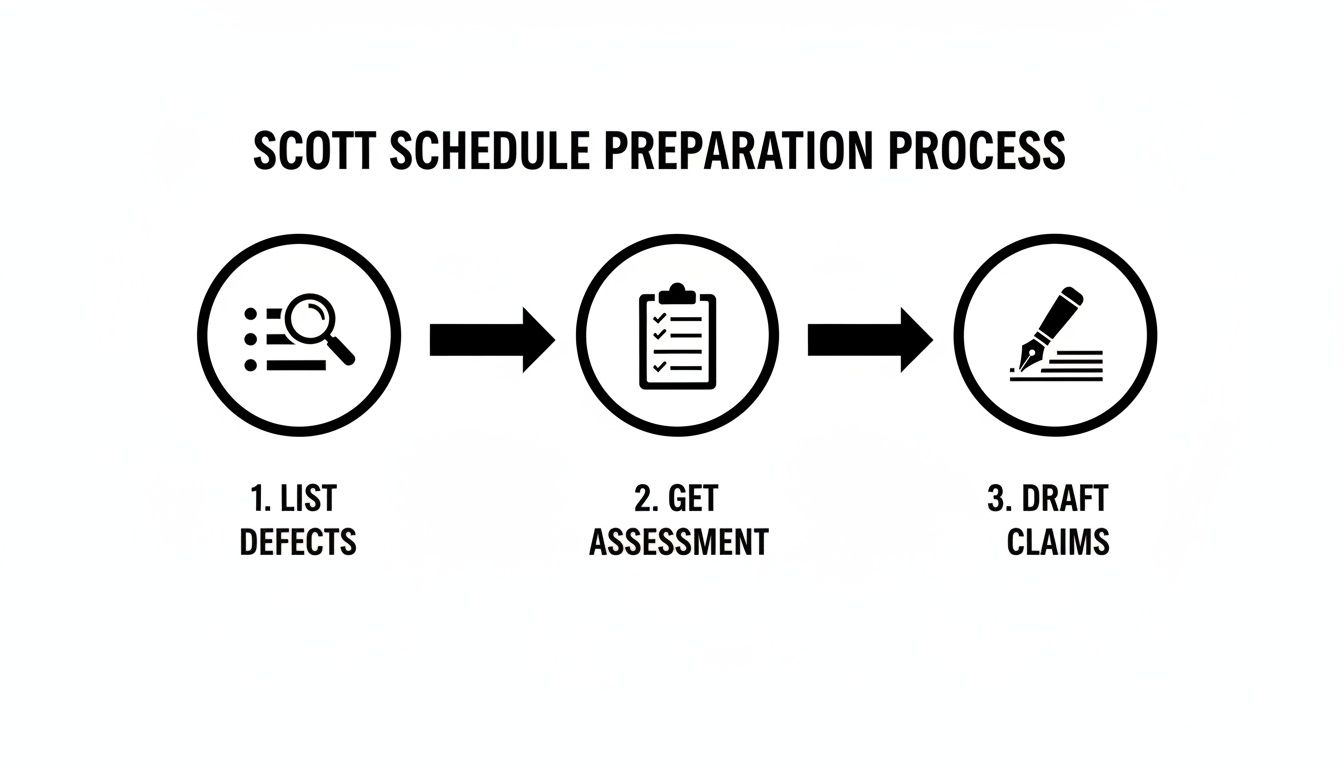
This illustrates that a solid Scott Schedule begins with your own detailed list of issues, is then reinforced by a professional assessment, and finally formalised into specific, actionable claims. With over 35+ years in Building & Construction, the team at Awesim Building Consultants are experts in guiding homeowners, builders, and lawyers through this entire process, ensuring each step is managed with precision.
Example 1: Waterproofing Failure in a Bathroom
Waterproofing is one of the most frequent and expensive defects we encounter. The difference between a vague complaint and a correctly prepared Scott Schedule entry is substantial.
- Defect Description: "Water damage and failed waterproofing membrane to the shower recess in the main bathroom, evidenced by dampness and discolouration to the adjacent hallway carpet. The installation fails to comply with AS 3740-2010 (Waterproofing of domestic wet areas)."
- Proposed Solution: "Remove shower screen, tiles, bedding, and existing membrane from the shower recess. Re-waterproof the area in accordance with AS 3740 and perform a flood test. Re-tile and re-install shower screen. Replace water-damaged section of hallway carpet and underlay."
- Sample Cost: "$6,200 + GST"
This level of detail makes the claim difficult to dispute. It specifies the exact location, the physical evidence, the Australian Standard that has been breached, and provides a clear, step-by-step method for rectification.
Example 2: Cracked Concrete Slab
Slab cracks can signify major structural problems. A Scott Schedule must document this defect with precision to reflect the seriousness of the issue.
- Defect Description: "Uncontrolled cracking to the concrete slab in the garage, with cracks measuring up to 4mm in width and exhibiting vertical displacement (lipping). This indicates a failure to install adequate control joints as per AS 2870-2011 (Residential slabs and footings)."
- Proposed Solution: "Engage a structural engineer to assess the cause and extent of the cracking. Implement the engineer's recommended rectification method, which may include epoxy injection and crack stitching, to stabilise the slab and prevent further movement."
- Sample Cost: "$8,500 + GST (Provisional sum based on initial assessment, pending engineer's report)."
In this case, the entry quantifies the defect ("4mm") and links it directly to a failure to adhere to a specific standard. It also correctly includes engaging another specialist (a structural engineer) as a necessary part of the proposed solution.
Example 3: Non-Compliant Cladding Installation
Following several high-profile incidents, external cladding is under intense scrutiny. Documenting this defect requires referencing both the building codes and the manufacturer’s own specifications.
A precisely worded defect description, backed by a clear solution and a credible cost, transforms your claim from a simple complaint into a compelling piece of evidence for the Tribunal.
- Defect Description: "Incorrect installation of fibre cement cladding on the southern exterior wall. Gaps between panels are inconsistent and exceed manufacturer's specifications, and flashing around windows is improperly integrated, creating a risk of water ingress. The installation fails to meet the requirements of the Building Code of Australia (BCA) Part 2.2.2."
- Proposed Solution: "Remove and replace all non-compliant cladding on the southern wall. Install new cladding panels and associated flashing strictly in accordance with the manufacturer's installation guide and the BCA."
- Sample Cost: "$14,750 + GST"
These examples demonstrate that an effective Scott Schedule is all about detail. It’s not simply about listing what’s wrong; it’s about dissecting each problem with technical accuracy. If you are struggling with identifying building defects at your property, obtaining professional guidance is essential to building a strong and credible case.
Common Mistakes and Best Practices
Crafting a compelling Scott Schedule is a game of precision. The difference between a document that persuades the Tribunal and one that gets torn apart often comes down to avoiding a few common, unforced errors. It’s not just about listing defects; it’s about presenting your case in a way that’s crystal clear, credible, and tough to challenge.
With our 15+ years of litigation support at Awesim Building Consultants, we’ve seen firsthand what works at NCAT—and what absolutely doesn’t. Think of this as your insider’s checklist. It’s here to help you steer clear of the pitfalls that can sink your position and adopt the habits that build a rock-solid case.
Key Best Practices for a Strong Scott Schedule
Getting this right is more than just filling out a form correctly; it’s about being strategic. Every single entry needs to be watertight and backed by solid evidence.
- Be Surgically Specific: Vague descriptions are your worst enemy. "The deck is wrong" is useless. Instead, you need to state, "Decking boards have uneven gaps ranging from 8mm to 15mm, creating a trip hazard and failing to meet the manufacturer's installation guidelines." See the difference? One is an opinion, the other is a fact.
- Reference Technical Standards: Your claims gain serious weight when you tie them to an official standard. Always cite the relevant Australian Standard (like AS 3740 for waterproofing) or the specific clause in the Building Code of Australia (BCA) that has been breached.
- Secure Credible Cost Estimates: Pulling a number out of thin air will get you nowhere. Your costings must be supported by formal quotes from licensed tradespeople or a detailed estimate prepared by a qualified building consultant or quantity surveyor. Credibility is everything.
- Engage Your Expert Early: Please, don’t wait until the last minute to call in a building consultant. Bringing an expert like our team at Awesim on board from the get-go ensures defects are correctly identified and documented from day one. This builds the very foundation of your schedule and is crucial for complying with the Expert Witness Code of Conduct that governs our role in the proceedings.
Common Mistakes That Weaken Your Case
Knowing what not to do is just as important. We see so many cases weakened by simple, avoidable mistakes that basically hand an advantage to the other side.
The most common errors we see are:
- Using Emotional or Vague Language: Statements like "The builder made a total mess" or "I'm so upset about the poor work" have no place in a Scott Schedule. The document must be completely objective and factual. Let the facts speak for themselves.
- Failing to Address the Other Party's Points: When you receive the respondent's comments, you have to engage with them properly. Ignoring their arguments or just repeating your original point makes you look evasive and weakens your position.
- Submitting an Incomplete or Poorly Formatted Document: A sloppy, half-finished Scott Schedule screams "sloppy case." Make sure every required column is filled out correctly for every single item on your list.
It’s also worth noting that the principles of good record-keeping extend beyond the Scott Schedule itself. Following actionable best practices for formal documentation helps maintain clarity and accuracy across all your records.
With over 35+ years in Building & Construction, we've reviewed hundreds of Scott Schedules. The most effective ones are always disciplined documents—they are specific, evidence-based, and free of emotion. They present a logical, undeniable case for rectification.
Scott Schedule Do's and Don'ts
To make this crystal clear, here’s a quick-reference guide to follow when you're preparing your document for an NCAT building dispute.
| Best Practice (Do) | Common Pitfall (Don't) |
|---|---|
| State: "Incorrectly installed window flashing causing water ingress, evidenced by moisture readings of 25%." | Write: "The builder messed up the window and now my wall is all wet." |
| Propose: "Remove and replace non-compliant waterproofing membrane as per AS 3740. Cost: $4,500 + GST (Quote #A123)." | Write: "Fix the leaky shower. Cost: around $5,000." |
| Respond: "Disagree with respondent's cost. Our quote from a licensed waterproofer is based on a full membrane replacement." | Write: "That's not what my builder said." |
| Reference: "Balustrade height of 950mm fails to comply with BCA Vol 2, Part 3.9.2, which requires a minimum of 1000mm." | Write: "The balcony rail feels too low and unsafe." |
Stick to the 'Do' column, and you'll be presenting a case that is professional, credible, and far more likely to be taken seriously by the Tribunal.
Your Questions About Scott Schedules Answered
When you're caught in a building dispute, you'll hear a lot of new terms thrown around. "Scott Schedule" is one of the big ones, and it’s completely normal to feel a bit lost about what it is and what you’re supposed to do with it.
With over 15+ years of dedicated litigation support, our team at Awesim Building Consultants has seen firsthand how confusing the NCAT process can be. We want to cut through the noise and give you straight answers to the most common questions we get about this crucial document.
When Is a Scott Schedule Required for an NCAT Dispute?
In a building defect dispute before the NSW Civil and Administrative Tribunal (NCAT), a Scott Schedule isn't just common—it's practically standard procedure. Its use is outlined in NCAT's Procedural Direction 3, which is all about making hearings efficient.
If your case involves more than a few alleged defects, you can bet the Tribunal will order one, usually at the first directions hearing. The whole point is to get both parties to lay their cards on the table, defining every single issue so the Tribunal Member has a clear roadmap of the dispute right from the start.
This isn't just for massive, multi-million dollar projects. Even in smaller disputes, if there are a handful of problems, the schedule is the go-to tool for getting organised. If you're ordered to produce one and you don't, it can seriously undermine your case and may even have your claims struck out.
Can I Prepare a Scott Schedule Myself?
Technically, yes, you can. But we strongly advise against it. Trying to draft a Scott Schedule yourself is a huge risk, and frankly, it rarely ends well. This isn't just a simple list of your complaints; it's a technical document that has to survive intense scrutiny from the other side, their lawyers, their experts, and the Tribunal Member.
A persuasive and compliant schedule needs serious precision:
- Technical Defect Descriptions: You have to describe defects with technical accuracy, not just general complaints like "the paint job is bad."
- Reference to Standards: The strongest claims are always tied back to a specific clause of the Building Code of Australia (BCA) or an Australian Standard (e.g., AS 3740 for waterproofing) that has been breached.
- Credible Costings: The costs you claim for fixing each defect can't just be a number you've plucked from thin air. They need to be realistic and backed by solid evidence, like quotes from licensed tradies or a detailed cost estimate from a building consultant.
A DIY schedule almost always misses this level of detail, making it easy for the other side to poke holes in your argument. The best outcomes always come from a team approach: you, your solicitor, and an expert building consultant like those at Awesim working together.
How Is a Scott Schedule Different from an Expert Report?
This is a really common question, and getting the difference is vital. An Expert Witness Report and a Scott Schedule are two distinct documents, but they work hand-in-hand.
Think of it like this: The Expert Report is the detective's full investigation file, filled with all the evidence. The Scott Schedule is the clear, organised summary presented to the judge.
The Expert Witness Report is the deep-dive document. It’s where a qualified expert lays out their detailed findings, analysis, and professional opinions on the building defects. It contains the evidence—photos, test results, and references to building codes—that backs up your claims. There are strict rules for these, which you can read about on our page covering the Expert Witness Code of Conduct.
The Scott Schedule, on the other hand, is a table that pulls the key highlights from that report. It summarises the absolute essentials—the defect, the fix, the cost—into a simple, side-by-side format. It then leaves columns for the other party to state their position, so the Tribunal can see at a glance what’s agreed and what’s still being fought over. The expert report is the why and how; the Scott Schedule is the what and who.
How Does a Good Scott Schedule Save Time and Money?
A properly put-together Scott Schedule is one of the best tools you have for streamlining a dispute, and that directly saves you time and money. Its structured format forces everyone to be specific about every single item right from day one.
Here’s how it helps:
- Narrows the Issues: It immediately shows which defects the other side admits to, which they deny, and where the real disagreement is (is it the cause, the solution, or the cost?). This stops everyone from wasting time in hearings arguing about things that were never actually in dispute.
- Focuses on Evidence: The schedule forces the conversation away from emotional arguments and towards the facts. The debate becomes about proving compliance with a standard, not about who is more frustrated.
- Encourages Settlement: When both sides see all the issues laid out so clearly, it often makes it easier to find common ground and negotiate a settlement on some or all of the items without needing a formal hearing.
- Reduces Hearing Time: For the items that do go to a hearing, the Tribunal Member can work through the schedule item by item. It’s a methodical process that is far quicker and more efficient than unstructured arguments, which means lower legal bills for everyone.
At the end of the day, a good Scott Schedule brings order to the chaos of a building dispute. It makes the entire process more focused, efficient, and evidence-based, which almost always leads to a faster and cheaper resolution.
Navigating an NCAT dispute requires precision, evidence, and expertise. With over 35+ years of Building & Construction experience and more than 15 years providing litigation support, Awesim Building Consultants provides the independent, expert guidance you need to build a strong case. Whether you need a compliant Scott Schedule, a detailed Expert Witness Report, or general building advice, our team is here to help homeowners, builders, and lawyers. Contact us today to discuss your matter at https://www.awesim.com.au.