
Cornice Cracking: How to Tell If the Damage Is Serious
Last updated: 8 November 2026
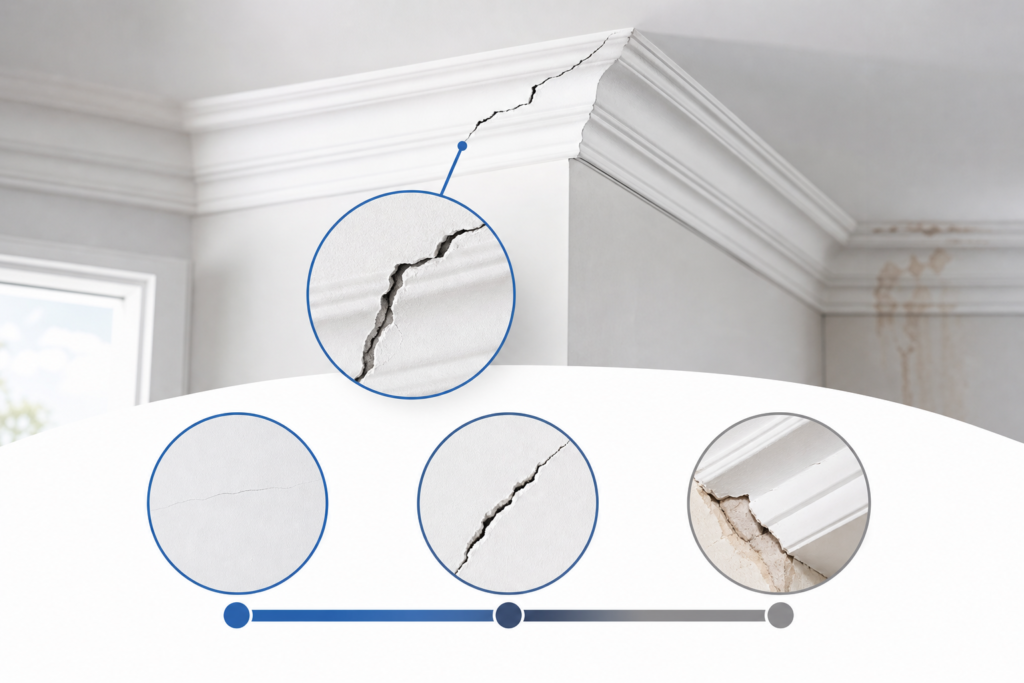
Cornice cracking can involve the decorative moulding, its joints or the adjoining wall and ceiling linings. Some cracks need only a local finish repair; others warrant investigation of attachment, moisture or building movement. Width alone does not establish the cause or whether overhead material is secure.
Start by looking for the warning signs below from a safe position. If material is dropping or appears liable to fall, keep people clear and arrange urgent assistance. Otherwise, record what you can observe safely and use the findings to decide what assessment is needed.
What Causes Cornice Cracking?
Possible contributors include movement between adjoining materials, problems with the cornice bond or supporting lining, moisture damage and movement elsewhere in the building. More than one factor may be involved.
An inspection should distinguish a gap at the wall or ceiling junction from a crack through the moulding, a failed joint between lengths, or damage to the ceiling itself. The location, history and surrounding construction help guide that investigation.
For moisture concerns, record staining, known leaks and previous repairs. Gyprock’s plasterboard maintenance guidance stresses keeping its products dry and checking for damage. A stain or crack alone does not identify the source of water.
Avoid assigning a cause solely because a crack is straight, diagonal or repeated in several rooms. Those observations should be considered with the other evidence.
How to Measure a Cornice Crack and What the Width Tells You
Record width as one observation alongside location, length, changes over time and associated damage. Do not use 3 mm or 5 mm as a stand-alone boundary between safe and unsafe cornices.
Where access is safe and the material is secure, photograph the crack with a millimetre scale beside it, without pushing into the gap. Record where each measurement was taken. If it cannot be measured safely, take photographs from floor level and leave close inspection to a suitable practitioner.
Workmanship tolerances and immediate safety are separate questions. A tolerance does not establish that overhead material is securely attached. The QBCC Standards and Tolerances Guide, for example, distinguishes cornice assessment by the age of the work and applies in Queensland. Use the requirements applicable to the particular project rather than treating a general threshold as a national rule.
For related reading, see hairline cracks in new homes and when to worry.
Visual Warning Signs That Cornice Cracking Is Serious
Western Australia’s building regulator identifies ceiling-stress warning signs including cracking sounds, sagging or dropping sheeting or cornice, and rows of fixing blisters. Arrange prompt assessment if these appear.
Also record:
- New or increasing separation at the cornice or adjoining lining.
- Water staining, visible dampness or changes following a leak.
- Cracks that widen, extend or return after repair.
- Related changes elsewhere, such as sticking doors or cracks in other building elements.
These signs help identify what needs investigation; they do not establish a particular diagnosis. Do not press, pull or flex suspect cornice or ceiling material to test it.
For related reading, see signs of structural defects in new homes.
How to Check Whether a Cornice Crack Is Growing
A dated record can help an assessor compare conditions. Monitoring is appropriate only where it does not delay assessment of warning signs or require unsafe access.
A useful record includes:
- The room and exact location, with an overview photograph and a closer image where safely possible.
- The date, approximate dimensions and measurement positions.
- Repeat photographs from comparable positions, keeping the original files.
- Notes about new cracks, leaks, repairs and changes in nearby doors, walls or ceilings.
Agree the monitoring method and interval with the inspecting practitioner where movement is suspected. They may recommend suitable gauges or further investigation.
Masking tape is not a calibrated movement gauge: intact tape cannot establish that a crack has remained unchanged, and torn tape does not quantify movement. Nor does a 90-day observation period certify stability or safety. Report new warning signs when they arise instead of waiting for a monitoring period to finish.
How to Fix Cornice Cracking: Choosing the Right Repair
Choose the repair after establishing the material, its attachment and the likely cause of the damage. A surface repair and refixing a loose cornice are different tasks.
Use this sequence:
- Assess the damage. Decide whether the issue is limited to a finish or joint, or whether the moulding, lining or support needs repair.
- Address the cause. Resolve relevant moisture, attachment or movement issues before concealing the damage.
- Select a compatible system. Follow the cornice and repair-product manufacturer’s instructions for the substrate, preparation, application and finishing.
- Check the result. Keep a record of the work and arrange reassessment if cracking returns or other symptoms develop.
Flexible sealant is not the correct product for every cornice repair. For example, Gyprock DIY Cornice Cement is a setting compound specified for suitable cornice repairs and joints. This is a product-specific example, not a specification for every moulding or substrate.
Have a competent plasterer or ceiling fixer assess loose sections. Do not rely on a generic instruction to wedge the cornice open or install screws at fixed spacings: the fixing method must suit the actual construction.
When to Call a Building Professional Instead of DIY
Seek assessment where the cause is uncertain, damage is recurring or changing, attachment is in doubt, or the warning signs above are present. The scope may involve a plasterer or ceiling fixer, building consultant, or an engineer where structural questions require that expertise.
Ask the practitioner to explain what can be concluded from the inspection, what remains uncertain and whether further access or testing is needed. Separate immediate make-safe work from investigation and the permanent repair proposal.
Established in 1996, Awesim Building Consultants provides independent building consultancy services Australia-wide. For disputed defects, discuss the inspection, evidence and reporting scope required for your matter. Our guide to building defect reports and expert witness reports provides further information, or contact Awesim for a tailored proposal.
Cornice Cracking in Different Materials: Plaster, Polystyrene, and Masonry
Identify the material before choosing products or a repair method.
- Plaster and plasterboard cornices. Check the profile, substrate and attachment, then use the relevant manufacturer’s repair or installation guidance.
- Polystyrene and other lightweight mouldings. Confirm adhesive, filler and coating compatibility with the product supplier. Do not assume a method intended for plaster is suitable.
- External masonry or rendered cornices. Obtain an assessment suited to the external construction and exposure. If sections appear loose, keep people away from the area below while arranging assistance.
Material identification is only part of the assessment; the condition of the supporting construction also matters.
FAQs
Can cornice cracking indicate foundation problems?
It can be associated with wider building movement, but a cornice crack alone does not establish a foundation problem. Record related symptoms and previous alterations or repairs. An assessor can identify whether structural or geotechnical input is needed and which investigations would help distinguish possible causes.
Is it safe to live in a house with cracked cornices?
Safety cannot be confirmed from a crack-width measurement or an online description. Follow the warning-sign guidance above and obtain advice about any affected area. A competent on-site assessment is needed where the security of the cornice, ceiling or supporting construction is in doubt.
How long does a cornice repair last before cracking again?
There is no fixed service life that can be promised for every cornice repair. Ask what caused the damage, what the repair addresses and which maintenance or product instructions apply. If cracking returns, reassess the cause and repair method rather than assuming another surface patch will resolve it.
Does home insurance cover cornice cracking?
Cover depends on the policy wording, the cause of the damage and applicable exclusions, limits and conditions. Check the policy and ask the insurer how it applies to the circumstances. ASIC’s Moneysmart home-insurance guidance explains the importance of reviewing these details.
An inspection report can document observations and technical opinions; it does not itself determine insurance cover. See our building insurance claims assessment guide for related information.
What is the difference between a cornice crack and a ceiling crack?
A cornice crack may occur in the moulding, between lengths or at its junction with the wall or ceiling. A ceiling crack occurs in the ceiling lining or its joints. Record the exact location and adjoining symptoms; neither location alone determines the cause or seriousness.
Conclusion
Assess cornice cracking by considering its location, history, attachment and associated symptoms. Record what is safely observable, obtain advice where the cause or condition is uncertain, and choose repairs that suit the material and findings.
Contact Awesim Building Consultants to discuss an inspection or the reporting requirements for a building dispute.

Related Posts
![Businessman in a suit analyzes a 3D building model on blueprints with a hard hat nearby and a crane in the background, conveying construction planning and law.]](https://awesim.com.au/wp-content/uploads/2026/10/2ba440c4-9d47-4802-adf1-8b6f241eb8ff-768x512.png "2ba440c4-9d47-4802-adf1-8b6f241eb8ff - Awesim Building Consultants")
Construction Claims Experts and Witness Reports
Last updated: 8 November 2026 A construction expert witness provides an independent opinion on technical questions in a building dispute.
Read More »
Building Inspection Reports and Expert Evidence
Updated October 29, 2026 You've received a building and inspection report and you're not sure what to do with it.
Read More »
Waterproof Membrane Failure: How Inspectors Find the Cause
Waterproof membrane failure is diagnosed by tracing the water entry point, reviewing design documents, exposing the membrane for visual inspection,
Read More »