
Waterproofing Building Expert Witness: NCAT & NSW Guide
You notice the stain first. It’s small, high on a wall, or creeping out from a shower hob, balcony door, window corner, or skirting. A week later the paint starts to blister, the silicone smells musty, or the timber swells. You call the builder. The builder says it’s condensation, maintenance, weather, or someone else’s trade. You know something’s wrong, but proving it is another matter.
That’s where a waterproofing building expert witness becomes important. In a dispute, the issue isn’t just whether water got in. The issue is where it got in, why it got in, whether the work complied at the time it was done, and how that can be shown in a form NCAT can use.
Your Guide to Navigating Waterproofing Disputes
Most waterproofing disputes start with a simple argument that quickly gets stuck. The owner points to damage. The builder points to a different cause. The tiler blames the plumber. The plumber says the membrane failed. The strata manager wants a report. The insurer asks whether the damage came from a sudden event or a building defect.
That’s a hard place to be if you’re a homeowner trying to protect your property, or a solicitor trying to turn a messy building complaint into admissible evidence.
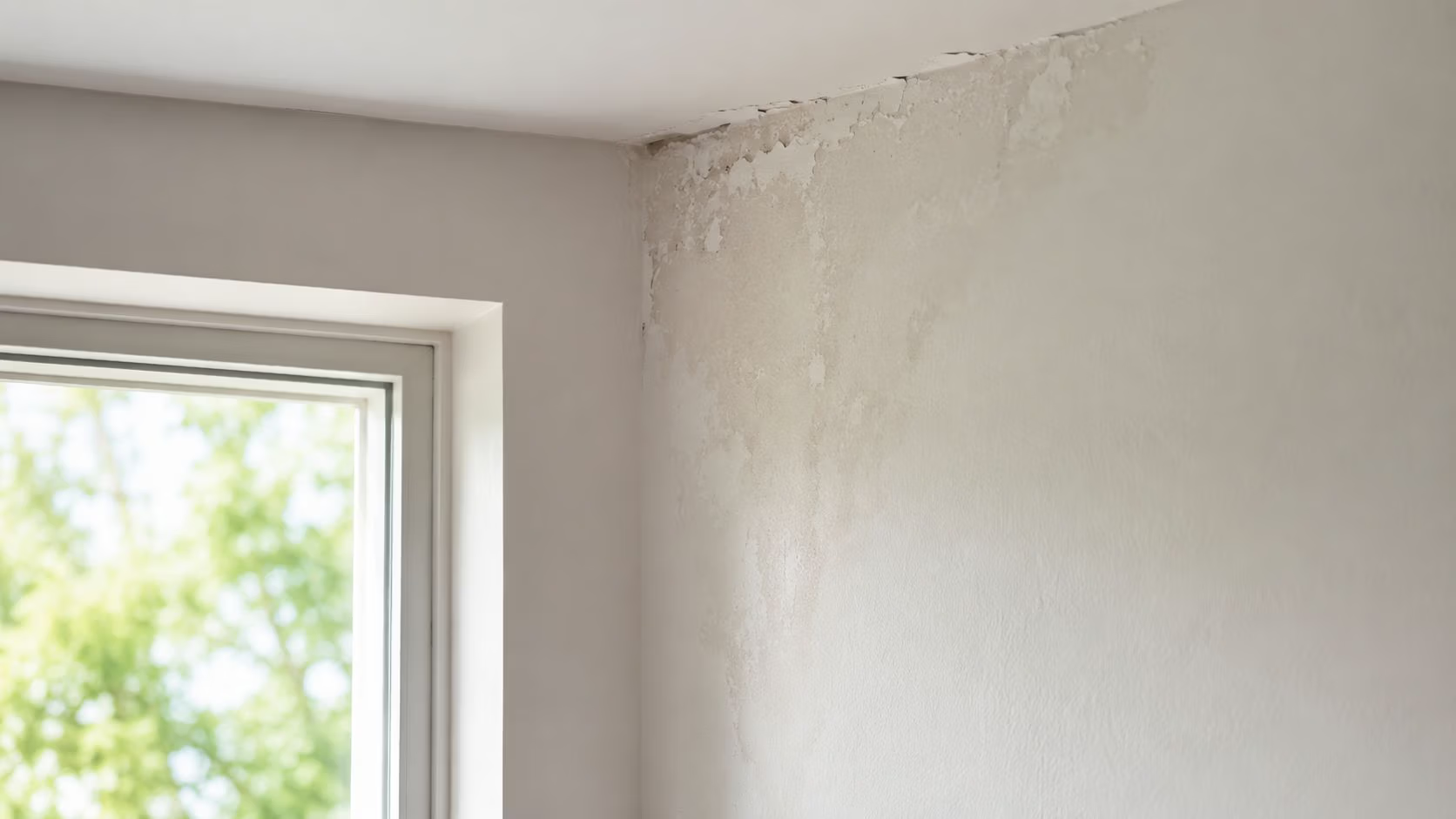
With waterproofing matters, delay usually makes the job harder. Damage spreads. Materials are replaced. Photos get lost. Builders carry out partial patching that hides the failure path but doesn’t fix the cause. If the dispute later reaches NCAT, everyone then argues over incomplete evidence.
What usually goes wrong early
A lot of people make one of two mistakes.
- They rely on a repair quote as proof. A quote can price work, but it usually doesn’t establish causation or compliance.
- They engage the wrong kind of inspector. A standard inspection may identify dampness, but that doesn’t mean the report is structured for a tribunal.
A leaking balcony or shower isn’t just a maintenance annoyance once a dispute starts. It becomes an evidence problem.
Awesim Building Consultants brings 35+ years in building and construction and 15+ years providing litigation support for homeowners, builders and lawyers. That background matters because waterproofing disputes sit right at the intersection of site practice and legal process. A report has to reflect both.
Sometimes the leak isn’t even the only issue in play. Boundary drainage, retaining structures, paving levels, and external ground conditions can all contribute to how water behaves around a building. If you’re dealing with external site conditions as well, Booms Up Civil Group’s NSW wall regulations give useful context on adjoining land and retaining wall responsibilities in NSW.
What a useful expert actually provides
A practical expert does more than confirm damage. The job is to sort the defect from the noise and build a clear path from observation to conclusion.
That usually means:
- identifying the wet areas and affected building elements
- documenting the visible symptoms properly
- testing likely causes against the construction details
- matching the work against the applicable standards and code requirements
- presenting the findings in a form that can survive challenge
If you’re already in dispute, clarity is the first priority. Not outrage. Not assumptions. Evidence.
Defining the Expert Witness Role in Waterproofing Cases
A builder, tradesperson, or ordinary inspector may have useful practical knowledge. But an expert witness serves a different function. The role is to provide an independent, evidence-based opinion that a tribunal or court can rely on.
In Australia, waterproofing is treated as a critical building compliance issue because water ingress is one of the most common triggers for expert evidence in residential disputes. In NSW matters, the expert isn’t merely describing leakage. The key question is whether the work complied with relevant standards, including AS 3740 for domestic wet areas and AS 4654.2 for external above-ground waterproofing, which is often the legal pivot in NCAT proceedings, as noted in this waterproofing expert witness reference.
What the role is not
An expert witness is not there to act as an advocate for the party paying the fee. That’s one of the first misunderstandings I see in disputes.
The report has to stand on its own. If the site evidence points away from the theory the owner or builder prefers, the report still has to say so. NCAT and the courts are interested in reasoning, not loyalty.
What the role includes
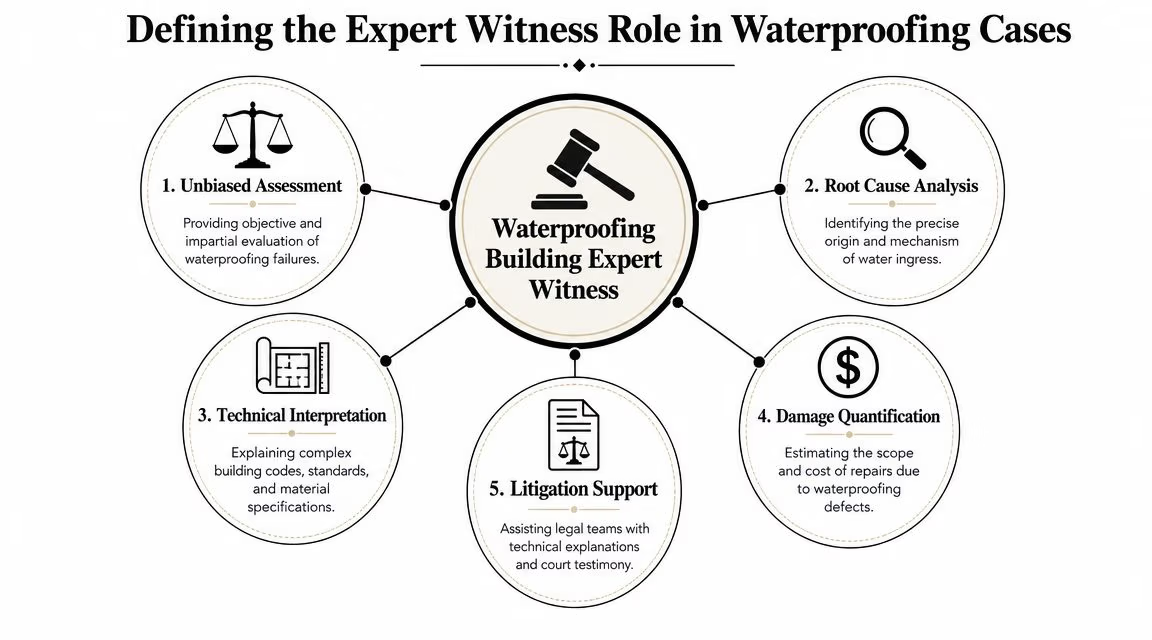
A proper waterproofing building expert witness usually deals with five practical tasks:
| Function | What it means in practice |
|---|---|
| Compliance review | Checks the work against the NCC and relevant Australian Standards |
| Defect identification | Records where the failure appears and what elements are affected |
| Causation analysis | Explains how water is entering and why that mechanism is credible |
| Rectification guidance | Sets out what needs to be opened, repaired, replaced, or retested |
| Hearing support | Assists solicitors and clients in presenting technical issues clearly |
Why this differs from a normal building inspection
A pre-purchase inspection or maintenance report often asks, “What can be seen today?”
An expert witness report asks harder questions:
- What standard applied when the work was installed
- Whether the substrate, junctions, penetrations, falls and terminations were compliant
- Whether the visible damage matches the alleged source
- Whether another cause is more likely
Practical rule: If the report can’t explain why the water got in, it won’t carry much weight in a dispute.
That’s why technical familiarity matters, but it isn’t enough on its own. Waterproofing often intersects with insulation, condensation risk, cladding interfaces, roof edges and wall systems. For readers looking at broader moisture control approaches in building envelopes, this guide on how to protect your home with spray foam is a useful example of where waterproofing, air sealing and moisture management can overlap, although it doesn’t replace a forensic defect analysis.
The expert’s value is in turning a wet building complaint into a structured opinion tied to objective benchmarks. That’s what separates legal evidence from trade commentary.
How to Select the Right Expert for Your NCAT Case
The biggest mistake people make is choosing someone who knows construction but doesn’t know dispute procedure. Those are not the same skill set.
A lot of consultants can tell you that a membrane looks suspect, a balcony threshold is low, or the shower recess falls are poor. Far fewer can produce a report that fits the way NCAT deals with evidence, competing reports, and defect itemisation.

A major gap in understanding is the difference between a waterproofing expert and a dispute-resolution expert. With around 40% of recent NSW building complaints involving waterproofing issues, NCAT disputes often turn on whether the report ties failure back to Australian Standards and a clear chain of causation, as noted in this discussion of tribunal-ready waterproofing evidence.
The practical difference that matters
A technically skilled consultant might give you a list of defects.
A dispute specialist gives you a report that can be used. That means the report is usually organised around instructions received, documents reviewed, observations, standards, methodology, defect mechanism, causation, and rectification implications. It also means the opinions are restrained, reasoned and traceable to evidence.
If a report jumps from “there is water damage” to “the builder is responsible” without showing the steps in between, it’s vulnerable.
Questions worth asking before you engage anyone
Use these as a filter, not a formality.
- Ask about NCAT experience. Have they prepared reports specifically for NSW tribunal matters, not just general building disputes?
- Ask how they handle causation. Do they identify the likely mechanism of failure, or do they mostly describe symptoms?
- Ask what standards they rely on. You want someone who works from the NCC and the applicable Australian Standards, not personal preference.
- Ask whether they prepare Scott Schedules. That tells you whether they understand how defect evidence is often organised in live disputes.
- Ask how they deal with invasive inspection. A waterproofing case often needs more than moisture readings and photos.
- Ask whether they can explain their opinion clearly. If they can’t explain it to you clearly, they won’t explain it well under questioning.
Warning signs
Some reports fail before the hearing starts. Common signs include:
| Warning sign | Why it matters |
|---|---|
| Heavy conclusions, light evidence | Easy to challenge |
| No reference to standards | Weakens the compliance analysis |
| No clear defect map | Makes scope and responsibility blurry |
| No causation sequence | Leaves the tribunal to guess |
| Vague repair wording | Difficult to price or allocate in a Scott Schedule |
The right expert doesn’t just inspect the building. They prepare for the argument that will be made about the building.
For owners and solicitors alike, that’s the selection test. Choose the person whose report can do the work after the site visit is over.
The Forensic Inspection and Evidence Gathering Process
A sound waterproofing investigation follows a staged method. In NSW, the most defensible process is to confirm the defect scope, compare site conditions against the National Construction Code and AS 3740, document substrate preparation, membrane type and junction detailing, and then cross-check causation. That approach matters because expert evidence has to be tied to objective standards rather than bare opinion, as discussed in this NSW-focused piece on waterproofing defect claim methodology.
What happens first on site
The first task is usually mapping. Where is the damage? What rooms or external areas are affected? Is the moisture pattern consistent with a shower leak, balcony ingress, planter box failure, roof edge issue, window interface problem, or something else?
That initial pass often includes visual inspection, moisture meter readings, photographic records and measurements. The point isn’t to gather random photos. The point is to create a record that ties each defect to a location, an element, and a probable water path.
What gets checked against the building work
A proper inspection doesn’t stop at finishes. It pushes into the construction logic behind the finishes.
That usually includes review of:
- Falls and drainage paths in showers, balconies and external surfaces
- Penetrations and junctions around wastes, tap bodies, door tracks and wall-floor intersections
- Membrane terminations at edges, upturns and threshold details
- Substrate condition where delamination, cracking or movement may have affected adhesion
- Adjacent building elements such as flashings, cladding, roofing, windows and slab edges
If the dispute involves roof interfaces or weatherproofing overlaps, it can also help to understand how layered water barriers are meant to work in roof assemblies. This explanation of a DFW roof storm barrier is a good plain-English example of why water management depends on sequencing and continuity, even though local standards and construction details differ.
When non-destructive work isn’t enough
Moisture meters and thermal cameras can indicate where water is present. They usually can’t prove membrane continuity, substrate preparation, bond failure, or whether the installation matches the required build-up.
That’s where targeted invasive inspection may be needed. A tile may need to be lifted. A skirting removed. A threshold opened. A section of wall sheeting cut. Done properly, that work is limited, documented and directed to answering a specific causation question.
Don’t confuse minimal disturbance with a proper investigation. A report that avoids opening up a critical area can leave the main issue unresolved.
How evidence is preserved
A credible chain of evidence is usually built through a combination of notes, dated photographs, measurements, marked-up plans, test locations, and cross-references to standards and observed construction details.
For clients who need a focused defect assessment before the broader litigation documents are prepared, a dedicated waterproofing defect report can help frame the scope, probable causes and rectification issues early.
The reports that hold up best are the ones where every conclusion can be traced back to something seen, measured, opened, tested or verified.
Decoding the Expert Witness Report and Scott Schedule
Once the inspection is done, the true value sits in the report. A report is not just a summary of what was seen on the day. It is the written path from observed condition to expert opinion.
The biggest technical pitfall in Australian waterproofing reporting is failing to prove both defect mechanism and defect causation. Reliable reports need to show whether the issue comes from installation non-compliance, design inadequacy, or another source, and they must preserve a clear chain from observed defect to probable source and remedy. Courts may reject opinions if the expert can’t explain how the conclusion was reached, as outlined in this article on construction expert witness methodology and reliability.
What a strong report usually contains
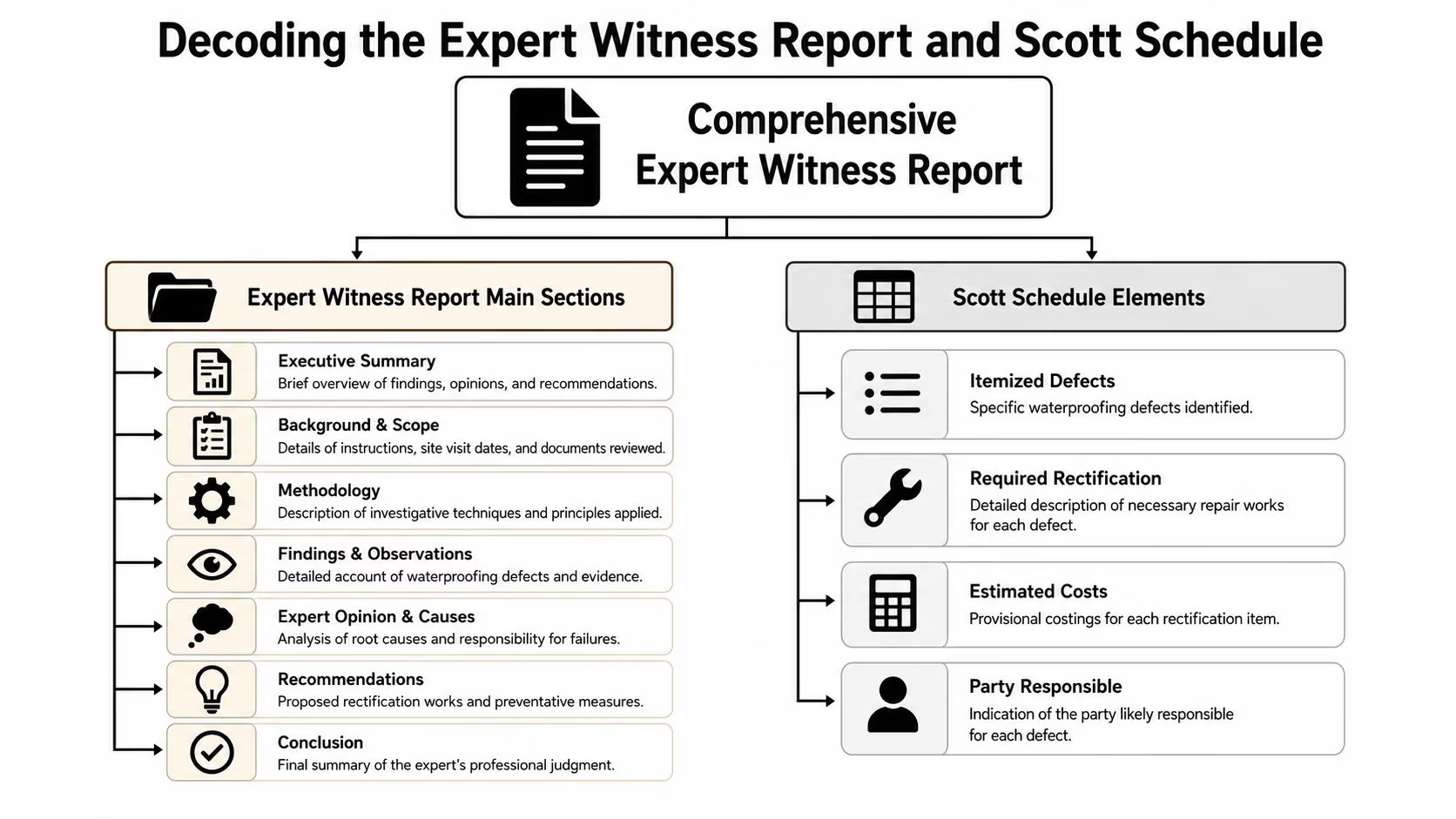
At minimum, a useful waterproofing expert report should identify the instructions received, the property and areas inspected, the documents reviewed, and the inspection limitations. It should then set out the methodology used and the standards relied on.
After that, the report should move defect by defect. Not as a vague narrative. As a disciplined analysis.
A workable structure often looks like this:
| Report component | Why it matters |
|---|---|
| Background and instructions | Shows what the expert was asked to do |
| Site observations | Records the physical evidence |
| Referenced standards | Anchors the opinion to objective benchmarks |
| Defect analysis | Identifies what is wrong |
| Causation reasoning | Explains why it is wrong and how failure occurred |
| Rectification comments | Helps define repair scope and later costing |
The part many reports get wrong
Many weak reports can identify damage but can’t close the loop on cause.
For example, saying “water damage was observed to the bedroom wall adjoining the balcony” is only a starting point. The report should then examine whether the likely source is balcony membrane failure, door threshold detail, flashing discontinuity, blocked drainage, inadequate falls, cracked grout that is merely symptomatic, or another adjacent element.
That analysis has to be tested, not guessed.
If the report doesn’t distinguish between symptom and source, the other side will exploit that gap.
How a Scott Schedule fits into the dispute
In NSW building matters, the expert report often feeds directly into a Scott Schedule. Within this schedule, broad complaints become itemised defects capable of response.
A Scott Schedule usually sets each disputed item out in a structured way so the parties and the tribunal can compare positions. Instead of arguing in general terms that “the bathroom leaks” or “the balcony is defective”, the schedule breaks the dispute into manageable issues.
Typical entries may cover:
- The defect item and where it is located
- The alleged non-compliance or building failure
- The proposed rectification scope
- The likely responsible party
- The competing response, if the other side disputes cause or scope
For solicitors, this makes the technical case usable. For owners, it turns a stressful general complaint into a list of issues that can be addressed one by one. For builders, it provides a clearer basis to admit, deny or qualify each item.
Where the matter requires formal defect scheduling for NCAT, a dedicated expert witness Scott Schedule is often the bridge between a technical report and a workable hearing document.
What makes a report persuasive
The most persuasive reports are usually the least theatrical. They don’t overstate. They don’t speculate outside the evidence. They don’t accuse where the evidence only supports a technical possibility.
They do three things well:
- They show the building elements involved
- They explain the failure mechanism clearly
- They connect that reasoning to a repair pathway
That’s what gives a waterproofing building expert witness report practical value in NCAT. Not length. Not jargon. Logic.
Your Next Steps Costs Timelines and Getting Help
If you think you have a waterproofing defect, act before more work is done to the affected area. Once tiles are replaced, walls are repainted, or a handyman applies sealant over a joint, the original evidence can be weakened.
Start by assembling the documents you already have. That usually means the contract, plans, specifications, waterproofing certificates if available, variation documents, photos, prior complaints, and any builder responses. If the property is in strata, gather correspondence and any earlier reports as well.
What to expect from the process
Most matters move through a practical sequence.
- Initial review of the complaint, documents and likely dispute issues.
- Site inspection to identify affected areas and decide whether invasive work is required.
- Report preparation with defect analysis, compliance review and causation reasoning.
- Scott Schedule or response work if the matter is already in NCAT or heading there.
- Further clarification if the tribunal, solicitor or opposing side raises technical questions.
The timeline depends on access, complexity, document quality, and whether opening-up works are needed. A small bathroom dispute usually moves faster than a whole-building ingress problem involving balconies, roofs, windows and common property interfaces.
What affects cost
I won’t invent a neat price table because waterproofing disputes vary too much for that to be honest.
Cost usually turns on:
- Property size and number of affected areas
- Whether the issue is isolated or involves multiple building elements
- Whether destructive testing is needed
- How much documentation must be reviewed
- Whether the matter also requires a Scott Schedule, reply report, or hearing attendance
For homeowners, the cheapest report is often the most expensive mistake if it can’t be used. For solicitors, a thin report usually means more letters, more conferences, more supplementary work and more argument about gaps that should have been resolved early.
What to do before you book anyone
A few simple steps will save time:
- Stop patch repairs unless they’re urgent for safety or damage control
- Photograph the issue consistently from the same locations over time
- Keep damaged materials if they’re removed
- Write down the history of when the problem appeared, after what weather or usage, and what repairs have already been attempted
If you need a tribunal-ready opinion, ask for a scope that matches the dispute. Some matters need only a focused defect report. Others need a full expert witness brief with scheduling support and possible appearance work.
If you’re dealing with a waterproofing dispute and need clear, standards-based evidence, get advice early while the site conditions can still be properly assessed.
If you need practical help with a waterproofing dispute, Awesim Building Consultants can assist with site investigations, Expert Witness Reports and Scott Schedules for NSW matters. For an obligation-free discussion, email admin@awesim.com.au or call 1800 293 746.

Related Posts
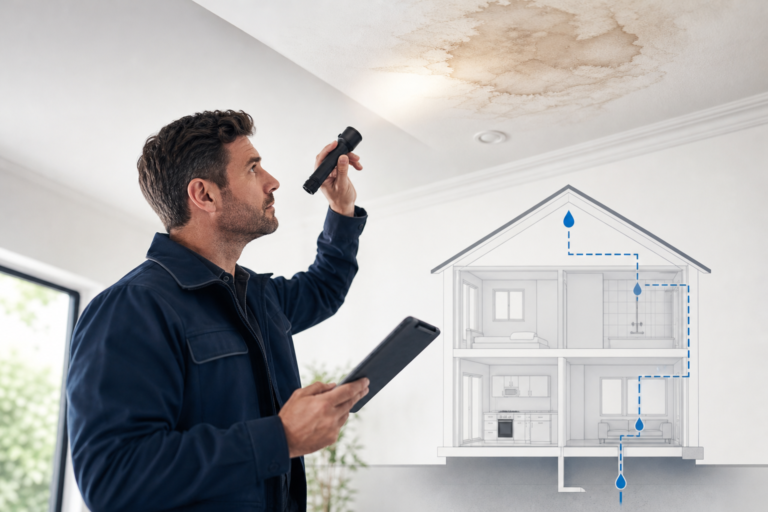
Water Damage in Homes: How to Track Down the Source
Water damage in a home rarely announces itself at the source. A stain on the ceiling, a musty smell in
Read More »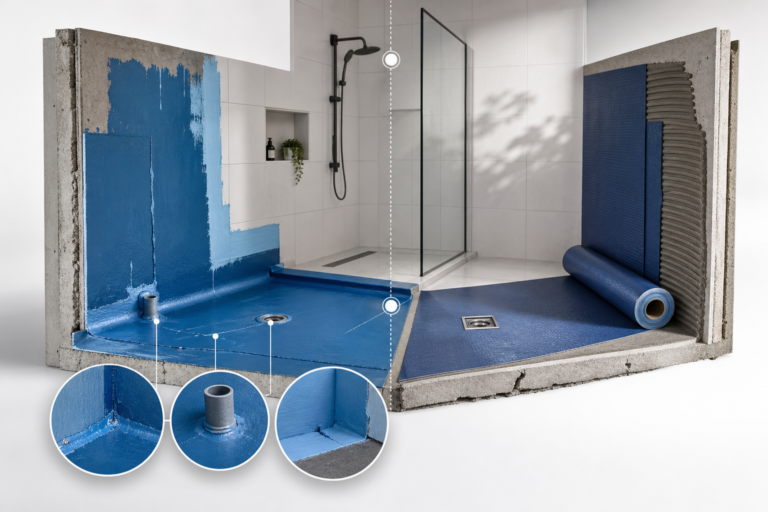
Waterproofing Membrane Types: Which Fails Most in NSW Bathrooms
Waterproofing failure is the single most common serious defect found in NSW apartments, and the type of membrane used, along
Read More »
Building Certifier NSW: Role, Limits, and When You Need More
A building certifier in NSW is a registered professional who issues construction certificates, conducts critical stage inspections, and grants occupation
Read More »