
What Building Defect Lawyers Need From Your Expert Report
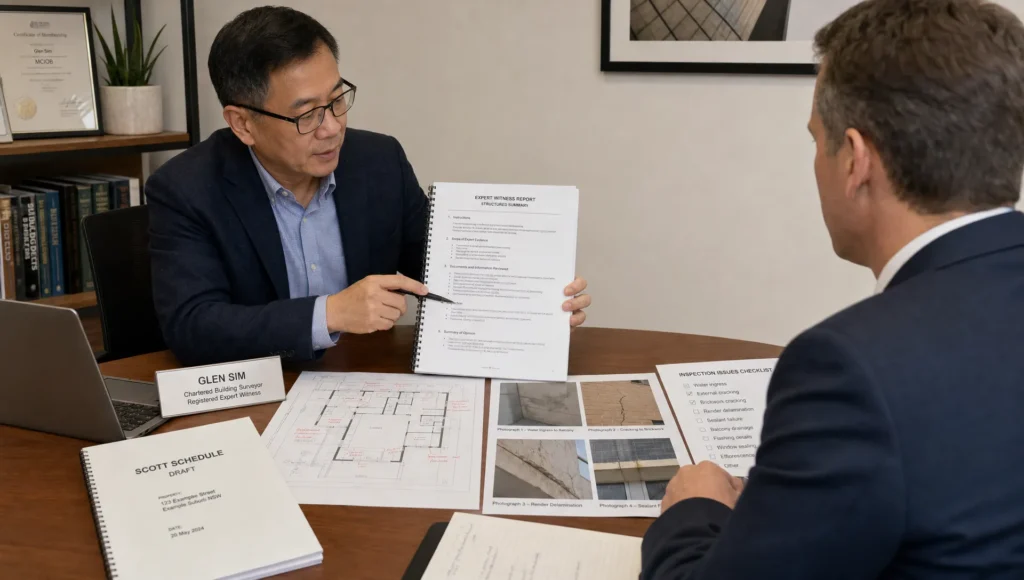
A building defect report can either make a solicitor’s job easier or force them to spend hours translating technical observations into usable evidence. For building defect lawyers, the most valuable expert report is clear, independent, properly reasoned and structured around the issues that must be proved or answered.
That means the report cannot stop at saying that waterproofing has failed, a slab has cracked, or cladding is non-compliant. It should explain what was observed, why it is a defect, what standard or contractual requirement is relevant, what likely caused it, what rectification is required and, where appropriate, what the cost implications are.
At Awesim Building Consultants, Glen Sim, owner and director, approaches expert reporting with that legal context in mind. His role is not to argue the case for either party. It is to provide independent technical evidence that lawyers, owners, builders, NCAT members and courts can understand and test.
Why lawyers need more than a defect list
A homeowner may want confirmation that something is wrong. A builder may want to know whether the complaint is fair. A lawyer needs something more precise: evidence that can support pleadings, settlement negotiations, expert conclaves, Scott Schedules, directions hearings and final submissions.
The legal team will usually be trying to answer questions such as:
- Is the alleged item actually defective or incomplete?
- What requirement has not been met?
- Is the issue caused by workmanship, design, materials, maintenance, movement, wear and tear, or another factor?
- Is rectification necessary, and if so, what is the reasonable scope?
- Is the claimed cost proportionate and supported?
- Are there assumptions or missing documents that could affect the opinion?
If the expert report does not answer those questions, the lawyer may have a technically interesting document that still falls short as litigation support.
Independence is the foundation of a useful expert report
Building defect lawyers rely on experts because they provide specialist knowledge that sits outside ordinary legal argument. That value depends on independence.
In NSW court proceedings, experts are commonly required to comply with the Expert Witness Code of Conduct in Schedule 7 of the Uniform Civil Procedure Rules 2005. NCAT matters also require careful attention to the Tribunal’s directions, orders and expectations around expert evidence. The details may vary depending on the forum, but the central principle is consistent: the expert’s paramount duty is to assist the decision-maker, not to act as an advocate for the party who engaged them.
This is why the value of an independent construction consultant becomes obvious early in a building dispute. A report that appears partisan, selective or overstated can undermine a lawyer’s case strategy. A balanced report that identifies both strong and weak points is usually far more useful.
A good expert report should make the expert’s independence visible. It should state the instructions received, identify the documents reviewed, set out the inspection process and separate observed facts from assumptions and opinions. When uncertainty exists, it should be acknowledged rather than hidden.
The core elements building defect lawyers look for
The best expert reports are written for use, not just for record keeping. They give the legal team a clear path from evidence to opinion.
| Report element | What the lawyer needs | Why it matters |
|---|---|---|
| Instructions and scope | A concise statement of what the expert was asked to assess | Prevents disputes about whether the opinion exceeds the brief |
| Documents reviewed | Contracts, plans, specifications, variations, photos, correspondence and prior reports | Shows the factual basis for the opinion |
| Inspection method | Date, access limitations, testing performed and areas inspected | Helps explain reliability and any limitations |
| Defect identification | Precise location, description and supporting photographs | Allows the item to be pleaded, scheduled and responded to |
| Applicable standard | Contract clause, specification, Australian Standard, NCC provision or accepted practice | Connects the defect to an objective benchmark |
| Causation | A reasoned opinion on likely cause | Helps lawyers address liability and competing explanations |
| Rectification scope | Practical steps needed to remedy the issue | Supports orders, settlement proposals and cost assessment |
| Quantum information | Cost opinion, basis of estimate or recommendation for further costing | Helps quantify the dispute and test claimed amounts |
| Assumptions and limitations | Missing documents, inaccessible areas or reliance on information from others | Protects the report from overreach and assists cross-examination preparation |
This structure also helps solicitors identify gaps before they become problems. If a report states that bathroom waterproofing is defective but does not identify the relevant requirement, explain the failure mechanism or state the necessary rectification, the lawyer may need supplementary evidence before the matter can progress confidently.
Clear causation is often the difference between opinion and evidence
In building defect disputes, causation is where many weak reports fail.
A report might correctly identify cracking, water ingress, uneven flooring or defective finishes. But the lawyer needs to know why the expert says the issue occurred. Was it poor workmanship? Was it a design issue? Was it inadequate substrate preparation? Was it movement outside the builder’s scope? Was it later damage or lack of maintenance?
An expert does not need to provide a legal conclusion about breach, negligence or entitlement. That is the lawyer’s role. But the expert should explain the technical chain of reasoning. For example, if a balcony is leaking, the report should not simply say that the balcony is defective. It should explain the observations, the likely pathway of water entry, the relevant waterproofing requirements, the evidence that supports the conclusion and whether further invasive investigation is required.
This is also where Glen Sim’s experience as an expert becomes important. A defensible opinion must be traceable. A reader should be able to follow the logic from inspection findings to conclusion without needing to guess what the expert meant.
Standards, codes and contract documents must be tied to the facts
Building defect lawyers need reports that connect physical observations to objective requirements. Depending on the matter, those requirements may come from the building contract, approved plans, engineering documentation, manufacturer installation requirements, the National Construction Code, Australian Standards or accepted trade practice.
The report should avoid vague statements such as poor workmanship or not to standard unless the standard is identified and explained. A stronger report states what was observed, what requirement applies and how the work deviates from that requirement.
For example, it is more useful to say that a tile fall is insufficient in a specific wet area, based on measured levels and the applicable requirement, than to simply say the bathroom floor does not drain properly. The first statement gives the lawyer evidence. The second gives them a complaint.
The same principle applies to incomplete works. If a claim concerns unfinished items, the expert should distinguish between work not done, work done but defective, work outside the contract scope and work that may be a variation. That distinction can significantly affect pleadings, evidence and quantum.
Scott Schedule compatibility is essential
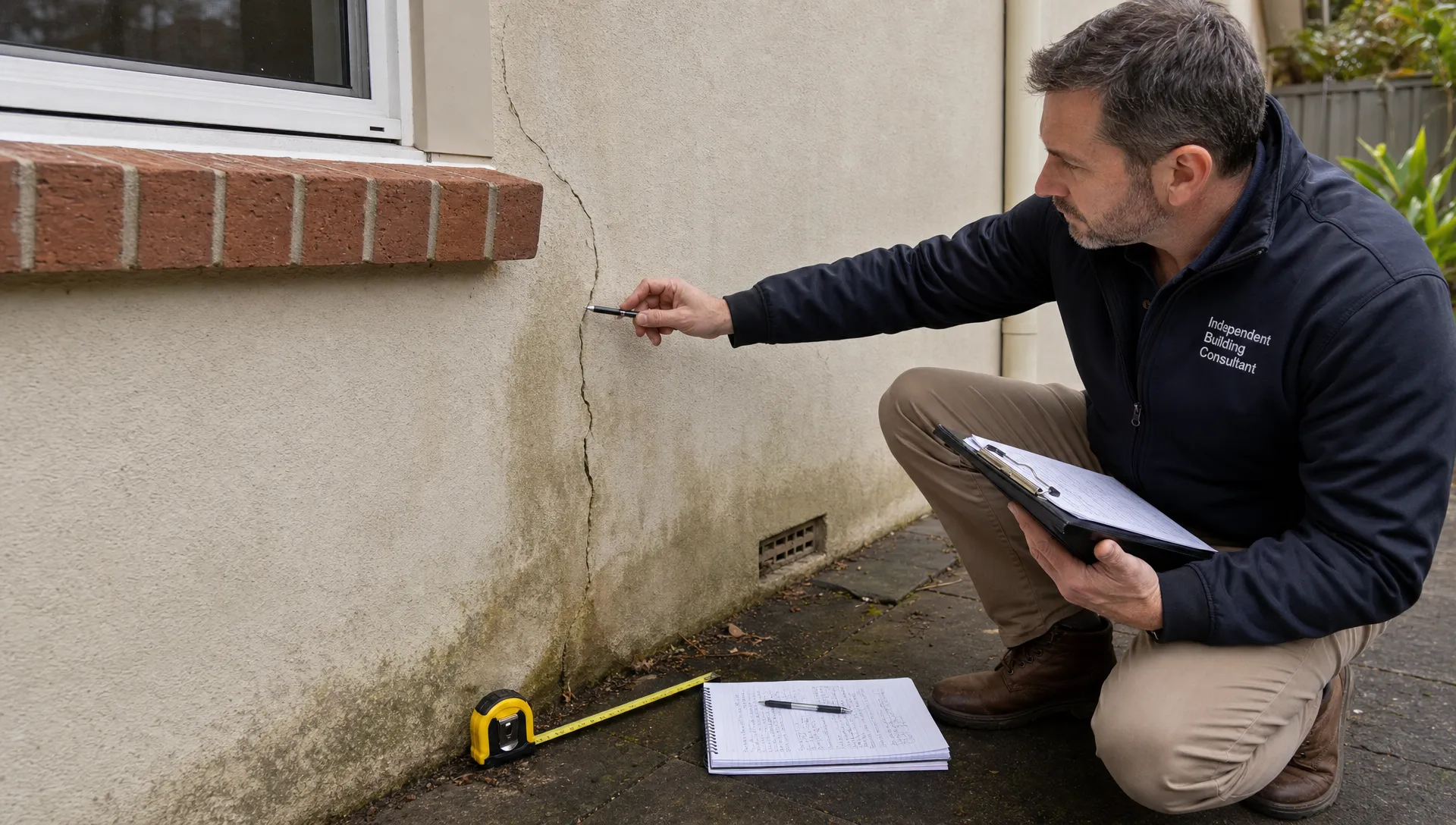
In many NSW building disputes, a Scott Schedule becomes the working document for allegations, responses, rectification positions and costs. If the expert report is not itemised clearly, the solicitor may need to manually break down the report into schedule entries, which increases the risk of inconsistency.
A lawyer-friendly expert report usually aligns each defect with a discrete item number, location, description, opinion, rectification method and cost position where relevant. This allows the same information to be transferred into a Scott Schedule with minimal interpretation.
For example, a broad statement such as external painting is defective may be too general. A more useful structure identifies each affected elevation or area, the nature of the defect, the probable cause, the recommended rectification and whether the problem is isolated or systemic.
Awesim regularly assists with expert witness reports and related dispute documents. For a broader explanation of the expert’s role in proceedings, see Awesim’s guide to how an expert witness helps in construction disputes.
Quantum must be transparent, not just a number
Cost evidence can become a major pressure point in building defect litigation. Lawyers need to understand not only the number claimed, but also how that number was reached.
Where the expert provides a rectification cost opinion, the report should clarify the basis of that opinion. Is it based on experience, quantity assessment, contractor quotations, industry rates, or a combination of sources? Are preliminaries, access costs, supervision, demolition, waste removal, GST or contingency included? Are there assumptions about hidden damage or staged works?
If the matter involves variations, incomplete work, disputed payment claims or quantum meruit, the expert report may need a different form of analysis. In those situations, it may be necessary to separate defect causation from valuation issues. Awesim’s article on when a quantum expert is needed in building matters explains why cost and entitlement questions often need careful technical treatment.
For lawyers, transparency is more important than false precision. A well-explained cost range may be more useful than a single unsupported figure. If further quotations or specialist input are required, the report should say so.
Photographs and annexures should prove, not decorate
Photographs are often the most immediately persuasive part of a building defect report, but only if they are properly used. Building defect lawyers need images that help prove the opinion, not a large collection of unlabelled site photos.
Useful photographs should be dated, referenced to the relevant defect item and accompanied by captions explaining what is shown. Where scale matters, the image should include a ruler, level, moisture meter reading or other reference where appropriate. If the report refers to a plan location, the photograph should be easy to match to that location.
Annexures should also be organised. Contracts, drawings, correspondence extracts, test results, photographs and quotations should be referenced in the body of the report so the lawyer can quickly find the evidence behind each opinion.
This matters in hearings and negotiations. A solicitor should be able to direct the decision-maker to a defect item, photograph, standard and rectification opinion without searching through unrelated material.
Common problems that weaken expert reports
Some reports appear detailed at first glance but become difficult to use once lawyers start preparing evidence. Common problems include vague defect descriptions, missing locations, no reference to standards, unsupported assumptions, unclear causation, bundled cost items and opinions that drift into legal argument.
Another recurring issue is failure to distinguish between observed facts and information supplied by the client. For example, an owner may report that water enters during heavy rain. That may be important background, but the expert should state whether water ingress was observed, whether staining or moisture readings support the history and what further investigation may be required.
Lawyers also need reports that are proportionate. A minor defect should not be exaggerated, and a serious defect should not be softened without reason. A credible report helps the legal team assess risk realistically, including whether settlement may be preferable to contested hearing preparation.
What solicitors should provide when briefing an expert
A strong expert report starts with a strong brief. The expert can only answer the right questions if the lawyer frames the issues clearly and provides the relevant documents.
A useful brief will usually include:
- The building contract and any variations or relevant payment documents.
- Approved plans, specifications, engineering documents and certificates.
- Pleadings, points of claim, points of defence or NCAT application material if available.
- Prior reports, photographs, notices and correspondence between the parties.
- A clear list of issues to be inspected or answered.
- Any deadlines, hearing dates, timetable orders or expert conclave requirements.
- Access limitations, safety issues or areas requiring specialist testing.
The brief should also ask questions in a way that invites expert opinion rather than advocacy. For example, instead of asking the expert to prove the builder is liable, ask whether the identified work is defective, what objective requirement applies, what likely caused the defect and what rectification is reasonably required.
That approach protects both the lawyer and the expert. It helps ensure the final report is independent, responsive and capable of being relied on.
How Glen Sim and Awesim approach expert reports
Glen Sim, owner and director of Awesim Building Consultants, leads expert reporting with a focus on independence, clarity and practical dispute use. The aim is to give lawyers a report that can be read by non-builders while still standing up to technical scrutiny.
Awesim provides building dispute support across New South Wales, including expert witness reports, Scott Schedules, quantum meruit reports, NCAT dispute reports and building defect assessments. The emphasis is on making the technical issues understandable, itemised and relevant to the legal pathway of the matter.
For building defect lawyers, that means receiving evidence that helps answer the real questions in dispute. What is defective? Why is it defective? What caused it? What should be done about it? What will it likely cost? What assumptions affect the opinion?
A report that answers those questions clearly can narrow the dispute, support settlement discussions and assist the tribunal or court if the matter proceeds.
Frequently Asked Questions
What should building defect lawyers expect from an expert report? They should expect an independent, reasoned report that identifies each defect, explains the applicable standard, addresses causation, sets out rectification requirements and clarifies any cost assumptions or limitations.
Does an expert report need to follow a specific legal format in NSW? The required format depends on the forum and orders made in the matter. Court reports often need to comply with expert witness code requirements, while NCAT matters may be governed by Tribunal directions and specific orders.
Should an expert give an opinion on who is legally liable? Generally, the expert should avoid legal conclusions. The expert should provide technical opinions on defects, causation, compliance and rectification so the lawyer can address liability and legal entitlement.
Why is a Scott Schedule useful in building defect disputes? A Scott Schedule organises each disputed item, the parties’ positions, expert opinions and cost claims in a structured way. It helps lawyers, experts and decision-makers compare allegations and responses efficiently.
When should a solicitor brief a building expert? Ideally, the expert should be briefed early enough to inspect the property, review documents and identify evidence gaps before pleadings, settlement negotiations or hearing preparation are too advanced.
Need an expert report for a NSW building dispute?
If you are a solicitor, homeowner or builder involved in a construction defect matter, the right expert report can make the dispute clearer and more manageable. Glen Sim and Awesim Building Consultants provide independent building dispute support across NSW, including expert witness reports, Scott Schedules, quantum meruit reports and NCAT dispute reports.
To discuss your matter, visit Awesim Building Consultants and brief an independent expert before technical uncertainty becomes a litigation risk.
Related Posts
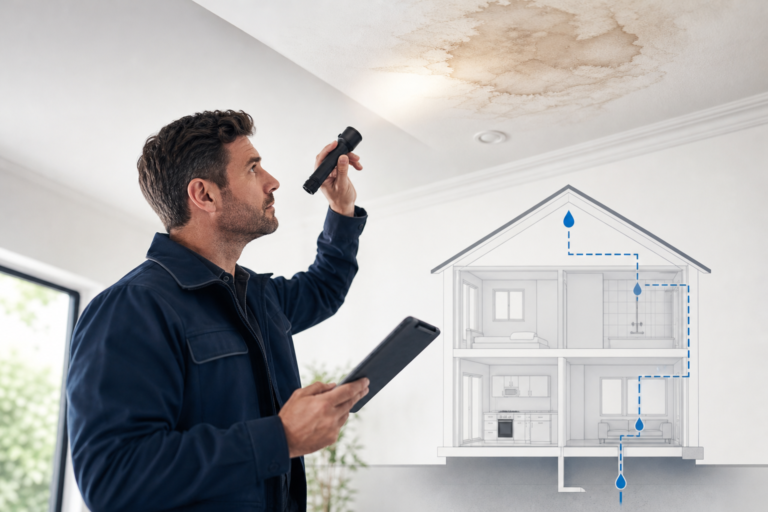
Water Damage in Homes: How to Track Down the Source
Water damage in a home rarely announces itself at the source. A stain on the ceiling, a musty smell in
Read More »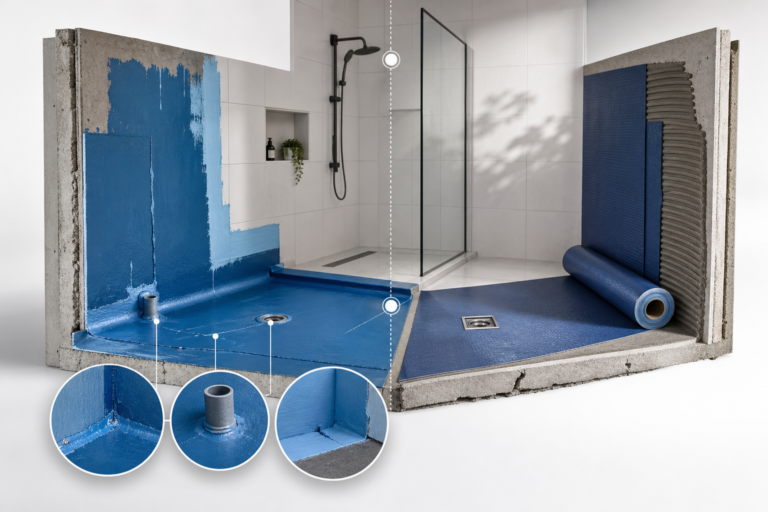
Waterproofing Membrane Types: Which Fails Most in NSW Bathrooms
Waterproofing failure is the single most common serious defect found in NSW apartments, and the type of membrane used, along
Read More »
Building Certifier NSW: Role, Limits, and When You Need More
A building certifier in NSW is a registered professional who issues construction certificates, conducts critical stage inspections, and grants occupation
Read More »