
When You Need a Scott Schedule for NCAT
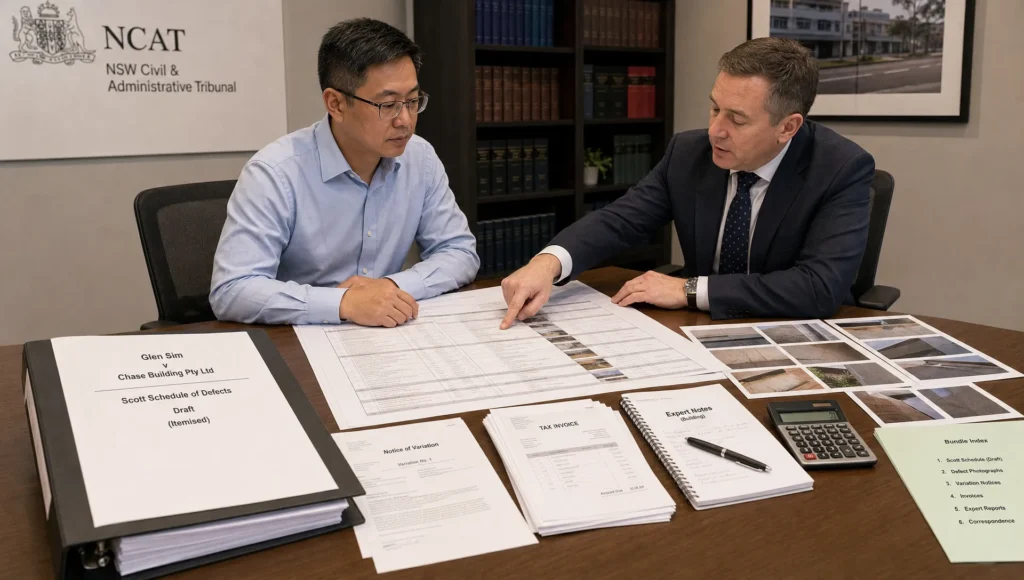
A Scott Schedule is not required for every NCAT building dispute, but when a matter involves multiple defects, disputed variations, competing quotes, incomplete works or expert evidence, it can become one of the most important documents in the case.
For homeowners, it helps turn frustration into a clear list of claimed defects and costs. For builders, it creates a structured way to respond to each allegation. For solicitors, it gives the Tribunal a practical roadmap through the evidence.
In NSW residential building matters, NCAT is often dealing with a large volume of documents, photographs, invoices, reports and competing versions of events. A well-prepared Scott Schedule helps organise that material so each item can be understood, answered and assessed.
Glen Sim, owner and director of Awesim Building Consultants, approaches Scott Schedules as a dispute management tool, not just a spreadsheet. The value is not in filling boxes. The value is in connecting each alleged defect, variation or payment issue to evidence, expert opinion and a defensible cost position.
What a Scott Schedule Does in an NCAT Matter
A Scott Schedule is a table used to break a building dispute into individual items. Each row usually deals with one alleged defect, incomplete work item, variation, payment claim or rectification cost. The columns set out the claimant’s position, the respondent’s answer, the evidence relied on, and often the amount claimed or disputed.
NCAT may use a Scott Schedule to understand the issues before a directions hearing, conciliation, final hearing or expert conclave. The schedule does not replace pleadings, witness statements, expert reports or legal submissions. Instead, it ties those materials together in a format that allows the Tribunal and the parties to compare positions quickly.
If you are new to the process, Awesim has a separate guide explaining what a Scott Schedule does in a building dispute. This article focuses on the practical question that usually comes first: when do you actually need one for NCAT?
When NCAT Is Likely to Expect a Scott Schedule
NCAT does not need a Scott Schedule for every minor disagreement. However, in building disputes, the need usually increases as the number of issues, documents and claimed amounts grows.
You are more likely to need a Scott Schedule when the dispute cannot be explained clearly in a few paragraphs. If the claim involves 10, 20 or 50 separate defects, a written statement alone can become difficult to follow. A schedule allows each item to be isolated, numbered and matched to evidence.
NCAT may also make directions requiring the parties to prepare, exchange or update a Scott Schedule. If that happens, it is important to comply with the directions and timetable. The NCAT website provides general information about Tribunal processes, but parties should obtain legal advice where procedural obligations are unclear.
A Scott Schedule is especially useful when the Tribunal must decide not only whether work is defective, but also what rectification is reasonable and what amount should be awarded.
Common Situations Where You Need a Scott Schedule
The clearest sign you need a Scott Schedule is that the dispute has become itemised. Instead of one broad complaint, there are multiple issues that each need a separate answer.
| Situation | Why a Scott Schedule helps |
|---|---|
| Multiple alleged defects | Separates each defect, location, evidence source and rectification cost |
| Incomplete works | Identifies what work is alleged to be unfinished and what completion cost is claimed |
| Disputed variations | Shows which variations are approved, denied, priced or unsupported |
| Payment disputes | Links claimed amounts to invoices, contract terms, progress claims and work performed |
| Competing expert reports | Allows each expert opinion to be compared item by item |
| Large document bundles | Gives the Tribunal a clear index of what evidence supports each claim |
| Settlement discussions | Helps parties negotiate by narrowing what is admitted, disputed or capable of compromise |
The schedule becomes particularly important where each party accepts some items but disputes others. For example, a builder may accept that one paint finish needs rectification but deny liability for water ingress. A homeowner may accept that a variation was requested but dispute the amount charged. A schedule keeps these issues separate instead of allowing the dispute to become a single general argument.
You May Need One Before the Hearing, Not Just at the Hearing
A common mistake is treating the Scott Schedule as something to prepare at the last minute. In reality, it can be useful much earlier.
Before filing or early in the matter, a draft schedule can help clarify the claim. It may reveal missing evidence, duplicated items or cost claims that need further support. For homeowners, this can prevent a claim from becoming a long narrative without clear dollar amounts. For builders, it can help identify what needs to be answered and what documents should be gathered.
During directions, NCAT may require parties to refine the issues. A schedule can help the parties focus on what is actually in dispute rather than repeating general complaints about workmanship, delay or payment.
Before conciliation or mediation, a Scott Schedule can support practical settlement discussions. If an item is admitted, it can be marked accordingly. If a cost is disputed, the parties can see whether the disagreement is about liability, scope of rectification, quantum or evidence.
Before the final hearing, the schedule can become a key working document for the Tribunal. It can point to report sections, photographs, invoices and witness evidence, reducing the risk that important material is overlooked.
When a Scott Schedule May Be Premature
Although Scott Schedules are useful, they are not magic. Preparing one too early, without enough evidence, can create confusion or lock a party into poorly framed items.
A schedule may be premature if the property has not been properly inspected, the alleged defects have not been identified with enough detail, or no reliable cost evidence is available. For example, writing “bathroom defective, $20,000” is not helpful unless the schedule explains what is defective, where it is located, why it fails to meet the required standard, what rectification is proposed and how the cost is supported.
In some smaller disputes, a simple statement with a few documents may be enough. If there is one unpaid invoice or one narrow contractual issue, a full Scott Schedule may add unnecessary complexity. However, if the issue involves workmanship, causation, rectification methodology or competing quotes, the schedule may still be worthwhile.
The key question is not whether a spreadsheet can be created. The key question is whether the schedule will make the dispute clearer.
Why Expert Input Matters
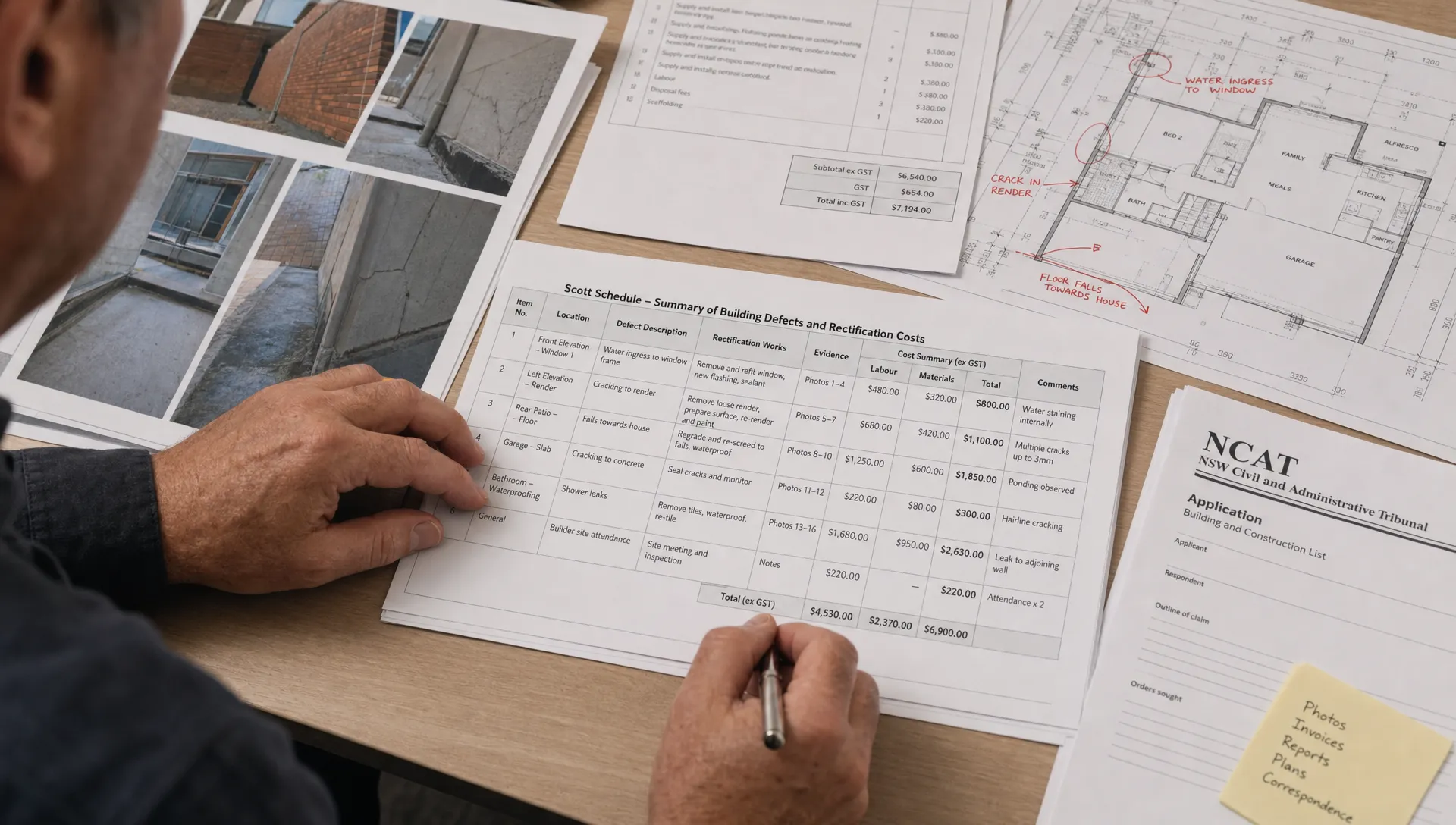
Many parties can create a basic table. The difficulty is creating a Scott Schedule that can withstand scrutiny.
In building disputes, the schedule often depends on technical judgement. Is the item truly defective, or merely unfinished? Is the alleged defect caused by poor workmanship, design, maintenance, movement, water entry or another issue? Is the proposed rectification reasonable, or is it excessive? Is the cost supported by the scope of work?
This is where independent building expertise becomes important. Glen Sim and the Awesim team prepare dispute-focused material for NSW building matters, including expert witness reports, Scott Schedules, quantum meruit reports and NCAT dispute reports. The purpose is to help organise the technical issues in a way that is clear, evidence-based and useful in a litigation context.
An expert can assist by identifying whether each item is properly described, whether the available evidence supports the allegation, and whether the claimed rectification aligns with the observed condition. For parties already preparing evidence, Awesim’s guide on NCAT independent building inspections explains how inspection findings can support reports and schedules.
Homeowners: When You Should Consider a Scott Schedule
Homeowners usually need a Scott Schedule when the dispute has moved beyond a simple complaint. If you have a list of defects, multiple quotes, photographs, emails and invoices, the schedule can help turn that material into a structured claim.
You should strongly consider one if you are claiming rectification costs for several areas of the property, such as roofing, bathrooms, waterproofing, flooring, brickwork or drainage. You may also need one if the builder denies responsibility for some items, argues that the work is within tolerance, or says the issue was caused by later use or maintenance.
A Scott Schedule can also help you avoid overclaiming. In NCAT, a claim is stronger when each item is specific and supported. Broad allegations such as “poor workmanship throughout” are less persuasive than itemised defects with locations, evidence references and cost support.
For homeowners, the goal is to make the Tribunal’s task easier. If the Member can see what is alleged, what evidence supports it and what amount is claimed, the case is usually easier to understand.
Builders: When You Should Prepare or Respond to One
Builders may need a Scott Schedule even when they are not the applicant. If a homeowner serves a schedule, the builder’s response should be careful, itemised and evidence-based. A general denial is rarely enough in a complex defect matter.
A builder may use the response columns to admit minor items, deny liability for others, explain that work was performed under instruction, refer to approved variations, identify access issues, or dispute the claimed rectification cost. If the homeowner claims a complete replacement but the builder says a targeted repair is sufficient, that distinction should be clear.
Builders can also benefit from preparing their own schedule in payment disputes. Where the issue involves unpaid progress claims, variations, set-offs or back charges, a schedule can help identify what amount is claimed and why.
The schedule should not be used as a place for emotional commentary. It should be concise, factual and supported by documents. Where technical matters are disputed, expert input may be needed to avoid weak or unsupported responses.
Solicitors: When a Scott Schedule Helps Manage the Case
For solicitors acting in NCAT building disputes, a Scott Schedule can be useful for both case preparation and advocacy. It helps identify what evidence is needed for each item, where expert opinion is required, and which issues may be capable of early resolution.
A strong schedule can also expose problems in the other side’s case. Some alleged defects may lack photographs, report references or cost evidence. Some variation claims may lack written approval or clear scope. Some rectification amounts may be unsupported or inconsistent with the expert opinion.
For lawyers, the schedule is often most useful when it is aligned with the expert report, witness evidence and hearing bundle. If the numbering changes repeatedly or the schedule does not match the report, the case can become harder to run. If the schedule is stable, properly cross-referenced and updated at the right times, it can become a practical hearing tool.
Awesim has a more detailed article on how to prepare an NCAT Scott Schedule that holds up for readers who need guidance on structure and evidence quality.
What Information Should Be Ready Before Preparing One?
Before preparing a Scott Schedule for NCAT, it helps to gather the core material. The schedule will only be as strong as the evidence behind it.
Useful material often includes the building contract, variations, invoices, payment records, photographs, videos, correspondence, inspection notes, expert reports, rectification quotes and relevant drawings or specifications. In defect claims, clear photographs and location details are especially important. In payment claims, the link between the amount claimed and the work performed must be clear.
The schedule should also distinguish between liability and quantum. Liability asks whether the party is responsible for the item. Quantum asks what amount should be paid or allowed. Confusing the two can weaken the presentation of the case.
For example, a homeowner may prove that tiling is defective but still need evidence to support the claimed rectification cost. A builder may prove that work was performed but still need to justify the amount charged. A good Scott Schedule helps keep those issues visible.
Signs Your Current Schedule Is Not NCAT-Ready
A Scott Schedule can hurt rather than help if it is unclear. Warning signs include vague defect descriptions, changing item numbers, unsupported costs, missing evidence references, duplicated claims, argumentative language and inconsistent terminology.
Another common problem is mixing several issues into one row. For example, “bathroom defects” may include waterproofing, falls to waste, tile lippage, cracked grout and incomplete fittings. Each may involve different evidence and different rectification options. Combining them can make the issue harder to decide.
The schedule should also avoid inflated or unexplained amounts. If a cost is claimed, it should be connected to a quote, report, invoice or other evidence. If the cost is an estimate, that should be made clear.
NCAT-ready does not mean perfect. It means the schedule is organised, transparent and capable of being tested.
Frequently Asked Questions
Do I always need a Scott Schedule for NCAT? No. A simple matter with one narrow issue may not need one. You are more likely to need a Scott Schedule where there are multiple defects, disputed costs, variations, incomplete works or competing expert opinions.
Can NCAT order parties to prepare a Scott Schedule? Yes, NCAT may give directions requiring parties to prepare or respond to a schedule. If directions are made, parties should comply with the timetable and seek legal advice if they are unsure about their obligations.
Should I prepare the schedule before getting an expert report? Sometimes a rough draft can help organise the issues, but a final or formal schedule is stronger when supported by inspection findings, expert opinion and cost evidence.
Can a builder use a Scott Schedule to respond to defect allegations? Yes. A builder can use the response columns to admit, deny or qualify each item, refer to evidence, dispute the rectification method, or challenge the amount claimed.
Is a Scott Schedule the same as an expert report? No. An expert report gives technical opinion. A Scott Schedule organises disputed items and competing positions. In many NCAT building disputes, the two documents work together.
Need a Scott Schedule for an NCAT Building Dispute?
If your NCAT matter involves building defects, incomplete works, variations, payment disputes or competing rectification costs, a clear Scott Schedule can make the dispute easier to understand and harder to dismiss as disorganised.
Awesim Building Consultants provides independent building dispute support across NSW, including expert witness reports, Scott Schedules, quantum meruit reports and NCAT dispute reports. Led by Glen Sim, owner and director, Awesim assists homeowners, builders and solicitors with evidence-based material prepared for building dispute contexts.
To discuss whether your matter needs a Scott Schedule or expert building input, contact Awesim Building Consultants for independent support in NSW building disputes.

Related Posts

Water Damage in Homes: How to Track Down the Source
Water damage in a home rarely announces itself at the source. A stain on the ceiling, a musty smell in
Read More »
Waterproofing Membrane Types: Which Fails Most in NSW Bathrooms
Waterproofing failure is the single most common serious defect found in NSW apartments, and the type of membrane used, along
Read More »
Building Certifier NSW: Role, Limits, and When You Need More
A building certifier in NSW is a registered professional who issues construction certificates, conducts critical stage inspections, and grants occupation
Read More »