When a residential building dispute reaches NCAT, the quality of the expert evidence often determines how clearly the Tribunal can understand the case. A strong expert witness building report does more than list defects. It explains what is wrong, why it is wrong, what standard applies, how the issue should be rectified and what the likely cost implications are.
For homeowners, builders and solicitors, that distinction matters. NCAT members are not looking for the loudest complaint or the thickest bundle of photos. They are looking for reliable, independent evidence that helps them decide the dispute fairly.
Glen Sim, owner and director of Awesim Building Consultants, approaches expert reporting with that purpose in mind: clear technical evidence, structured for the way NSW building disputes are actually argued in NCAT and court settings.
Why NCAT scrutinises expert witness building reports
NCAT deals with home building disputes involving issues such as defective work, incomplete work, variations, payment disputes and statutory warranty claims. The Tribunal has information about home building matters on its NCAT home building disputes page, but once a matter is underway, the evidence must still prove the technical issues in dispute.
That is where an expert witness building report becomes important. A homeowner may know a balcony leaks. A builder may know the work was performed in accordance with the plans. A solicitor may understand the legal claim. But NCAT needs the technical bridge between those positions.
A useful report helps answer questions such as:
- Is there a defect, incomplete item or disputed variation?
- What contract, drawing, Australian Standard, manufacturer requirement or statutory warranty is relevant?
- What is the likely cause of the condition observed?
- What rectification work is reasonably necessary?
- What cost is supported by evidence?
- Are there limitations, uncertainties or further investigations required?
If a report does not answer those questions in a disciplined way, NCAT may give it less weight, even if the expert has strong industry experience.
The core qualities NCAT looks for
An expert report is persuasive when it is independent, relevant and easy to test. The Tribunal must be able to follow the expert’s reasoning from observation to conclusion. It should not have to guess how the expert moved from a crack, leak or unfinished item to a finding about breach, causation or rectification.
| NCAT focus | What a strong report provides | Red flag in a weak report |
|---|---|---|
| Independence | Balanced findings that assist the Tribunal, not one party | Advocacy language or one-sided assumptions |
| Qualifications | The expert’s relevant experience and area of expertise | Opinions outside the expert’s competence |
| Scope | Clear instructions and issues inspected | A broad complaint list with no defined scope |
| Evidence | Photos, measurements, documents reviewed and site observations | Unsupported statements or missing references |
| Standards | Links to contract terms, plans, NCC requirements, Australian Standards or accepted practice where relevant | Vague phrases such as poor workmanship without explanation |
| Causation | A reasoned view on why the defect occurred | Jumping from damage to blame without analysis |
| Rectification | Practical repair scope and sequence | Overly broad replacement work not justified by the defect |
| Quantum | Cost basis, estimates or schedules that can be checked | Lump sum figures with no breakdown |
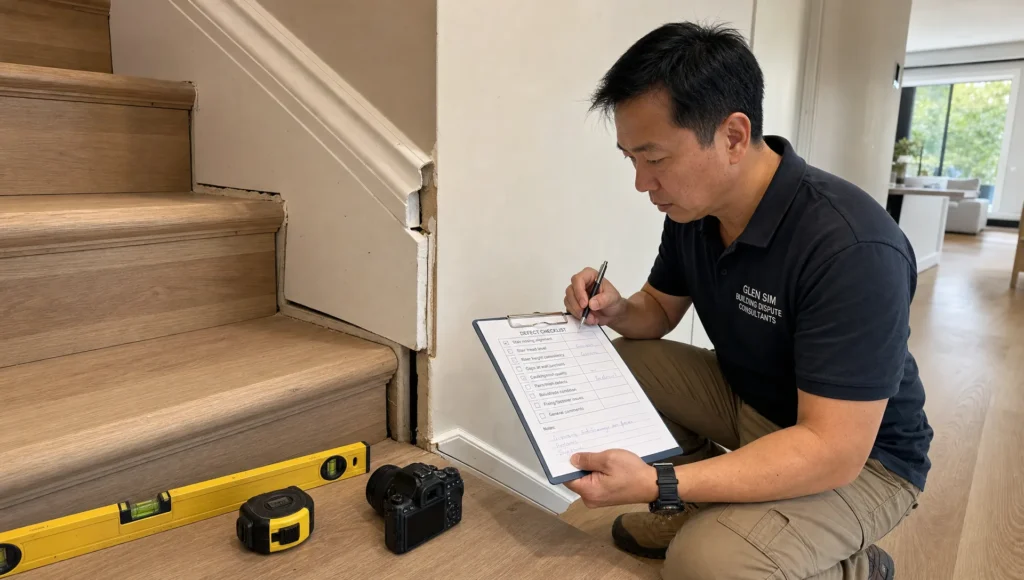
This is why an independent site inspection is usually more valuable than a desktop opinion alone. A well-run inspection allows the expert to observe, measure and photograph the disputed work, then connect those findings to the issues NCAT must decide. Awesim explains this evidence pathway in more detail in its guide to independent building inspections for NCAT disputes.
Independence is not optional
NCAT expects expert evidence to assist the Tribunal. That means the expert is not there to be a hired advocate. The expert may be engaged by a homeowner, builder or solicitor, but the report should remain independent in tone and reasoning.
This is one of the first things NCAT looks for, even if it is not always stated directly. A report that reads like a complaint letter can lose force quickly. So can a report that ignores obvious limitations, fails to acknowledge contrary evidence or uses emotive language.
Independence does not mean the report must be neutral on every item. An expert can firmly conclude that work is defective, incomplete or non-compliant. The key is that the conclusion must be reached through evidence, not preference.
A balanced report may say that some alleged defects are valid, some are maintenance issues, some need further opening-up works and some are not supported. That kind of discipline often increases credibility because it shows the expert is applying the same standard to every item.
The report must identify the applicable standard
NCAT cannot simply accept that a finish looks wrong or a detail feels unsatisfactory. The report should identify the benchmark used to assess the work.
Depending on the issue, that benchmark may include the building contract, approved plans, specifications, engineering details, the National Construction Code, relevant Australian Standards, manufacturer installation instructions, statutory warranties under the Home Building Act 1989 (NSW) or accepted industry practice.
For example, a report should not merely state that tiling is defective. It should explain the observed condition, such as drummy tiles, lippage, falls, cracking or failed waterproofing, then identify the relevant requirement or accepted method that has not been met.
This distinction is critical because many building disputes involve disagreement about quality, not just whether work exists. NCAT is more likely to rely on a report that turns subjective dissatisfaction into objective technical analysis.
Good reports separate defect, cause and consequence
A common weakness in expert evidence is merging three different issues into one statement. For NCAT, they should be separated.
A defect is the condition observed. Causation is the reason that condition likely occurred. Consequence is the impact of the defect and what must be done to fix it.
For instance, water staining to a ceiling is not the same thing as a waterproofing defect. The stain is evidence of moisture. The report must explain whether the likely cause is roof plumbing, membrane failure, condensation, window installation, pipe leakage or another source. Only then can the expert recommend rectification.
This separation matters because it prevents overreach. If the cause is not confirmed, the report should say so and identify what further investigation may be needed. NCAT generally responds better to a properly qualified opinion than to a confident but unsupported conclusion.
Rectification scope must be reasonable and specific
NCAT does not only need to know whether work is defective. It often needs to understand what should happen next. A strong expert witness building report sets out a rectification scope that is practical, proportionate and tied to the actual defect.
A weak rectification recommendation might say: replace bathroom. A stronger recommendation would identify the failed component, the area affected, the required removal works, the standard of reinstatement and any testing or certification required after completion.
The level of detail should match the dispute. If the matter involves multiple defects, the report may need item-by-item rectification recommendations. If the matter is primarily about incomplete work or disputed variations, the report may need to distinguish between original contract work, additional work and work that is not reasonably required.
This is also where the expert must avoid legal conclusions. It is usually for NCAT to decide liability. The expert’s role is to provide technical findings that help NCAT make that decision.
Costing must be transparent
Many NCAT building disputes turn on money. Even where the main dispute begins with defective work, the practical outcome may depend on the cost of rectification, the value of incomplete work or the reasonable value of work performed.
A persuasive report should make the cost basis clear. That may involve quantity assumptions, trade breakdowns, quotes, estimated rates, allowances and exclusions. In some disputes, a Scott Schedule or quantum meruit report may be needed to present the claim in a structured way.
NCAT is more likely to understand a cost claim when each item can be traced back to a specific defect, incomplete item or disputed scope. Lump sums can be difficult to test, especially where they combine unrelated works.
For payment and variation disputes, the expert may also need to explain the difference between defective work, omitted work, incomplete work and additional work. Those categories can affect how the claim is argued and what evidence is needed.
The Scott Schedule must match the report
In many NCAT building matters, the expert report and Scott Schedule work together. The report provides the technical reasoning. The Scott Schedule provides the itemised dispute framework.
Problems arise when the two documents do not align. Item numbers change. Defect descriptions differ. Costs appear in the schedule but not in the report. Rectification scopes are updated in one document but not the other. These inconsistencies make it harder for NCAT to follow the case.
A strong approach uses stable item numbers, consistent descriptions and cross-references between the report, photos, costings and schedule. If you are preparing schedule evidence, Awesim’s guide on how to prepare an NCAT Scott Schedule that holds up explains why structure and consistency matter.
For solicitors, this alignment can save hearing time. For homeowners and builders, it can reduce confusion and keep the focus on the issues that actually need determination.
What lawyers need from the report
Lawyers and solicitors often need expert evidence that can be used in pleadings, negotiations, directions, mediation and final hearing preparation. A report that is technically sound but poorly structured can still create problems.
Useful expert reports for legal teams usually provide a clear executive summary, numbered findings, defined assumptions, references to documents reviewed, photo schedules and concise opinions on causation and rectification. They also avoid straying into legal argument.
The expert should make it easy for the solicitor to identify which issues are strong, which require more evidence and which should not be pressed. Awesim covers this litigation-focused angle in its article on what building defect lawyers need from an expert report.
For NCAT, clarity is not just a presentation preference. It can affect how efficiently the matter progresses and how easily the Tribunal member can deal with competing expert opinions.
Common reasons reports lose weight in NCAT
Even a detailed report can fall short if it does not address the right issues. The following problems commonly reduce the usefulness of expert evidence:
- The expert repeats the client’s allegations without independent analysis.
- The report lists defects but does not identify the relevant standard or requirement.
- Photos are included without captions, locations or explanation.
- The report gives opinions on legal liability rather than technical matters.
- The rectification scope is excessive compared with the defect observed.
- Cost estimates are not broken down or linked to specific items.
- The report ignores documents that may affect the opinion, such as approved plans, variations or prior correspondence.
- The report is served late or does not comply with NCAT directions.
These issues do not always make a report unusable, but they can make it easier for the other side to challenge the evidence. More importantly, they can make it harder for NCAT to rely on the report when making findings.
How homeowners, builders and solicitors can prepare
A strong expert report starts before the inspection. The expert needs the right documents, a clear scope and enough context to understand the dispute. That does not mean coaching the expert. It means making sure the expert has the material needed to form an independent opinion.
| Party | How to help the expert | What to avoid |
|---|---|---|
| Homeowner | Provide the contract, plans, defect list, photos, correspondence and access to affected areas | Asking the expert to confirm every complaint regardless of evidence |
| Builder | Provide scope documents, variation records, certificates, product details and your response to alleged defects | Withholding documents that may explain the work performed |
| Solicitor | Provide pleadings, orders, key issues, required format and deadlines | Leaving the expert to infer the legal issues from a large bundle |
It is also sensible to check current NCAT directions, filing deadlines and any orders about expert evidence. NSW Fair Trading may also be involved before an application is made, depending on the dispute pathway. The NSW Government provides general information about building disputes and complaints that can help parties understand the broader process.
What a well-structured expert witness building report usually contains
While every dispute is different, a report prepared for NCAT will generally be easier to follow if it includes these components:
- The expert’s name, role, qualifications and relevant experience.
- The instructions received and the questions the expert was asked to address.
- A list of documents reviewed.
- The date, location and conditions of the inspection.
- The methodology used, including limitations.
- Itemised findings with photos, measurements and references.
- The relevant standards, contract documents or accepted practice relied on.
- Opinions on defect, causation and rectification where within the expert’s expertise.
- Costing information or references to a Scott Schedule where applicable.
- A concise conclusion that identifies the main issues for NCAT.
The best reports are not necessarily the longest. They are the reports that allow NCAT to understand the dispute quickly, test the reasoning and connect each conclusion to evidence.
Frequently Asked Questions
What is an expert witness building report for NCAT? An expert witness building report is an independent technical report prepared by a suitably experienced building consultant or expert to assist NCAT in understanding defects, incomplete work, causation, rectification and cost issues in a building dispute.
Does NCAT require an independent expert report? Not every matter will require the same level of expert evidence, but building defect disputes often benefit from an independent report. Parties should follow any NCAT directions about expert evidence, timing and service.
Can my builder or another tradesperson write the report? A tradesperson may provide useful factual or technical evidence, but an expert witness report should be independent and within the expert’s area of expertise. NCAT may give less weight to evidence that appears biased or unsupported.
What makes a report persuasive at NCAT? A persuasive report is clear, independent and evidence-based. It identifies the defect, the relevant standard, the likely cause, the reasonable rectification method and the cost basis where cost is in issue.
How does a Scott Schedule relate to an expert report? A Scott Schedule itemises each disputed defect, response and cost. The expert report should support and explain those items so NCAT can trace each claim back to technical evidence.
Need an expert witness building report for an NCAT matter?
Awesim Building Consultants provides independent building dispute support across NSW, including expert witness reports, Scott Schedules, quantum meruit reports, building defect assessments and litigation support for NCAT and court matters.
Led by Glen Sim, owner and director of Awesim Building Consultants, the focus is on clear, practical and independent evidence that helps homeowners, builders and solicitors present building disputes properly.
If you need an expert witness building report that is structured for NCAT, contact Awesim Building Consultants to discuss the dispute, the documents available and the evidence your matter may require.