A building dispute usually starts with something small. A wet area that never quite dries. A variation that was “agreed on” in a phone call but never written down. A crack that a builder says is cosmetic and an owner says is structural. Then the emails turn blunt, the site goes quiet, invoices stop getting paid, and everyone starts asking the same question. What now?
If you’re in that position, you’re not alone. In New South Wales, NCAT has become the practical forum where many of these matters land. Over a five-year period, the tribunal handled approximately 2,000 strata disputes, which shows how central it is to resolving building defect and maintenance disagreements in NSW, according to this strata disputes analysis.
Individuals often come to the process already frustrated. Homeowners feel they’ve paid for work they can’t rely on. Builders feel they’re being blamed for matters outside their scope or hit with inflated rectification claims. Lawyers often inherit a file after the relationship has already broken down and the evidence is scattered across texts, photos, emails, and half-finished reports.
That’s where practical discipline matters. Awesim Building Consultants have 35+ years in Building & Construction, with over 15+ years our providing litigation support to home owners, builders and lawyers. We provide site investigations, Building & Construction Expert Witness Reports and Scott Schedules. The legal process matters, but in building disputes, the technical facts usually decide whether a case holds together or falls apart.
Your Guide Through a Building Dispute
A typical dispute looks like this. The project starts with reasonable optimism. Then defects appear, or the job stalls, or the final account blows out beyond what either side expected. One party asks for rectification. The other says the works are compliant, or that access wasn’t provided, or that the complaint is outside the contract. By the time someone mentions NCAT NSW, trust is gone.
That’s the point where many people make their first costly mistake. They rush to “tell their side” before they’ve organised proof. They bring emotion, screenshots, and a few photos, but no coherent record showing what was built, what standard applies, what the defect is, and what it will take to rectify. NCAT will listen, but it won’t build the case for you.
A building dispute is a bit like a leaking roof. The visible stain on the ceiling isn’t the full problem. You need to trace the water path, identify the failed element, and show the repair method. Tribunal work is similar. The symptom is the argument. The cause is usually buried in scope, workmanship, sequencing, documentation, or compliance.
Practical rule: If the paperwork and expert evidence don’t line up with the complaint, the matter becomes harder than it needs to be.
For many owners and builders, NCAT is the first formal process they’ve ever faced. It’s still less rigid than a court, but it has rules, deadlines, and document standards that matter. If you miss those, the strength of your underlying complaint may not save you.
The sensible approach is to treat the dispute as both a technical problem and a procedural one. You need the facts on site, the right documents in the file, and a strategy that matches how the tribunal works.
What Is NCAT and What Can It Do For You
A homeowner usually reaches NCAT after the site meetings have gone nowhere, the emails are getting sharper, and both sides are talking past each other. At that point, the job is no longer just about the defect or the unpaid invoice. It is about proving the issue in a form the tribunal can use.
NCAT is the NSW Civil and Administrative Tribunal. For building matters, it is the forum that hears and determines many residential construction disputes in NSW without the full cost and procedure of a higher court. It is more accessible than court, but it still runs on orders, deadlines, evidence, and properly framed claims.

In practical terms, NCAT commonly deals with defective work, incomplete work, delay claims, payment disputes, variations, scope arguments, and disagreements about the value of work carried out. It also hears many strata-related building disputes, including arguments between lot owners, owners corporations, and contractors about responsibility for defects and repair work.
Why people end up there
Building disputes usually arrive at NCAT because the parties have run out of road. One side says the work is defective. The other says it matches the contract, the drawings, or the budget. Sometimes both are partly right. The tribunal gives them a formal process for testing those positions against the contract, the evidence, and the applicable standard.
That matters because NCAT does not decide cases on frustration or volume. It decides them on material that can be identified, organised, and tested.
For a more specific overview of tribunal building matters in NSW, this guide on building disputes tribunal NSW sets out the forum in more detail.
What NCAT can actually do
NCAT can make orders with real commercial and site consequences. Depending on the case, that may include orders for rectification, payment of money, completion of works, or other relief tied to the building contract and the defects in issue. If the parties resolve the matter during the proceedings, the agreed terms can be recorded as consent orders, which are enforceable.
That is the practical value of the tribunal. It can turn a deadlocked dispute into an outcome with legal force.
From a consultant’s point of view, the key benefit is structure. NCAT forces the parties to pin down what is wrong, what standard applies, what work is needed, and what it will cost. In building cases, that is half the battle.
What NCAT will not do for you
NCAT will not repair a vague case. It will not sort out a muddled scope, identify the defects for you, or calculate rectification costs because someone has guessed at them. If your expert report is loose, your photos are not tied to specific complaints, or your Scott Schedule does not comply with the current procedural direction, the case can lose traction quickly.
That point is missed in a lot of online guides. In practice, the tribunal process works best for parties who prepare the technical material properly before the hearing timetable tightens. A well-structured expert report and a compliant Scott Schedule do more than make the file look tidy. They tell the member exactly what the dispute is, where it is located, what standard is relied on, whether the item is agreed or disputed, and what remedy is sought.
That is what NCAT can do for you. It can give you a forum, a procedure, and enforceable orders. But it still depends on disciplined preparation and evidence that matches the case you are asking it to decide.
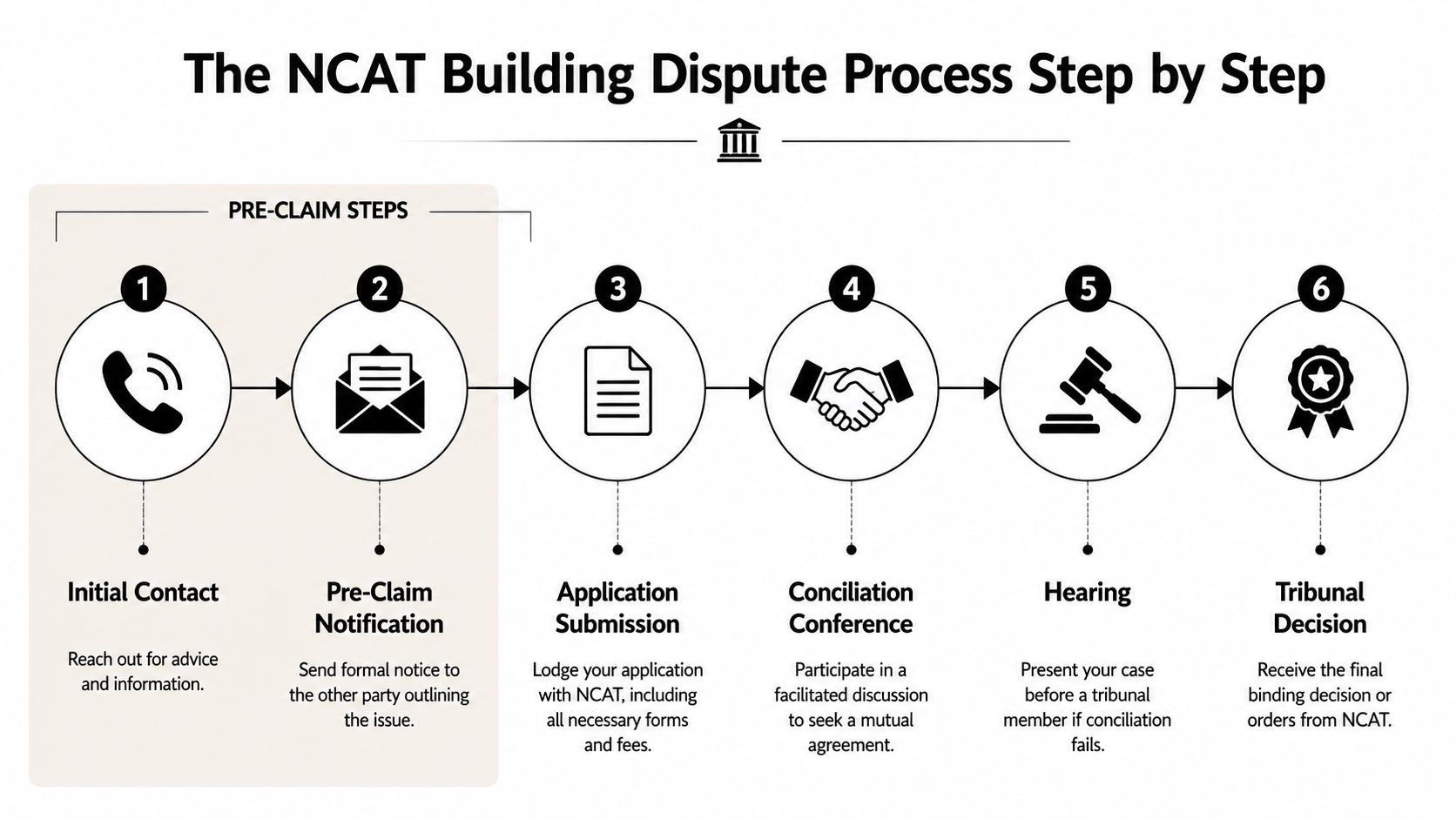
The NCAT Building Dispute Process Step by Step
A homeowner usually calls me at the same point. Fair Trading has not resolved it, the builder says the work is fine, water is still getting in, and the hearing date is getting closer. By then, the primary risk is no longer just the defect. It is presenting a case that is too vague, too late, or too poorly organised to get proper traction at NCAT.
Start before the application
The process starts well before the application is lodged. The first job is to define the dispute in a way the tribunal can decide. “Defective bathroom” is too broad. “Shower waterproofing failure at the hob and wall junction causing moisture ingress to the adjacent bedroom wall” is a proper issue. It identifies the location, the condition, and the complaint.
For residential building disputes, a Fair Trading step is usually required before filing. That is not just a box-ticking exercise. It often exposes the weak parts of a claim, shows which items are legitimately disputed, and gives both sides one last chance to resolve practical items without burning time and money on a hearing.
This early stage is also where many cases go off the rails. Owners tend to bring every frustration they have had on the project. Builders often respond with broad denials and a stack of emails. Neither approach helps much. NCAT works better when each item is reduced to a clear issue, linked to a location, and matched to the order being sought.
Lodge the application properly
Once the pre-filing step is dealt with, the application needs to be precise. The tribunal is not there to sort a mixed pile of complaints into a coherent case for you.
A workable filing set usually does three things:
- Defines each claim item clearly, whether it is a defect, incomplete work, delay issue, variation dispute, or payment claim.
- Links each item to the supporting documents, such as the contract, plans, specifications, variation records, emails, photos, and invoices.
- States the remedy sought, whether that is rectification, money, access, extension of time, dismissal of the claim, or another specific order.
The practical guide on how to prepare for an NCAT building dispute hearing is a useful checklist at this point, especially for parties trying to avoid the usual filing mistakes.
A short application with clear defect items will often do better than a long one full of emotion. Members read a lot of material. If the point is buried, it can be missed.
Directions and conciliation
After filing, NCAT will usually make directions. Treat them like a construction program. If a concrete pour is booked for Tuesday, no one turns up on Friday and says they were still thinking about formwork. Tribunal directions work the same way. They set dates for evidence, replies, expert material, Scott Schedules, and the next appearance.
Conciliation often sits alongside that timetable. It is less formal than a hearing, but it still rewards preparation. A party who arrives with a clean defect list, key photos, realistic costing, and a sensible settlement position is in a much stronger position than a party who turns up wanting to “tell the whole story”.
Here is the trade-off in plain terms:
| Stage | What helps | What causes trouble |
|---|---|---|
| Conciliation | A narrowed list of issues, organised documents, and a realistic outcome range | Treating every grievance as a hearing point |
| Directions | Serving the required material on time and in the required format | Assuming late evidence will be excused |
| Case management | Matching each claim item to evidence and relief sought | Running arguments that are not tied to documents or expert opinion |
Organisation matters. In practice, the better organised party often starts with a credibility advantage.
Hearing preparation
If the matter does not settle, preparation for hearing becomes a technical exercise. At this stage, the paper trail, the site evidence, and the expert material must line up. A hearing is the wrong place to realise the photos do not match the pleaded defects, the costings do not match the scope, or the expert has not addressed the correct standard.
I tell clients to sort their material into four working folders:
What was agreed
Contract, drawings, specifications, variations, emails, text messages, and site instructions.What happened on site
Progress photos, complaint notices, access records, diaries, invoices, certificates, and delivery documents.What standard or obligation applies
Contract requirements, statutory warranties, codes, Australian Standards, manufacturer instructions, and any expert analysis tying those requirements to the observed condition.What order is sought
Rectification scope, method, staged access, money claim, defence to a claim, or a combination of those outcomes.
This is also the point where expert evidence stops being optional in many building cases. If the dispute involves waterproofing failure, structural movement, slab levels, fire separation, stormwater falls, or rectification costing, the tribunal will usually need more than competing opinions from the parties. It will need properly presented technical evidence.
Just as important, the 2025 procedural directions have made compliant Scott Schedules harder to treat as an afterthought. In larger defect matters, each item needs to be set out in a disciplined way, with location, complaint, response, expert opinion, and status clearly recorded. If that schedule is poorly structured, inconsistent with the report, or missing the right columns, the case becomes harder to run and harder for the member to decide.
A practical primer can help before the hearing itself:
At the hearing and after it
At the hearing, the member is working through three basic questions. What happened. What requirement applies. What order should follow. Every document, photo, witness statement, expert report, and Scott Schedule entry should help answer one of those questions.
Some matters settle on the day or part-way through the process and are recorded by consent orders. Others run to a final decision. Either way, the practical lesson stays the same. Strong cases are usually built item by item, with disciplined evidence and a Scott Schedule that complies with the current directions, not broad allegations and last-minute scrambling.
The Critical Role of Expert Witness Reports
In building disputes, people often assume the strongest evidence is the most dramatic photo. It isn’t. A photo can show staining, movement, or poor finish, but a tribunal member still needs help answering the harder questions. What caused it? Is it defective? What requirement applies? What rectification method is appropriate?
That’s where an Expert Witness Report earns its place. It translates site conditions into usable evidence. It doesn’t just say work is “bad” or “non-compliant”. It identifies the observed condition, links it to the relevant technical benchmark, and explains the significance in neutral terms.
What gives a report weight
A high-quality Expert Witness Report must cross-reference claims to specific technical standards such as AS 3740 for waterproofing, and the language must remain neutral, applying specialised knowledge to observed facts rather than advocacy, as discussed in this article on presenting expert evidence through the Scott Schedule layout logic and language.
That point is more important than many parties realise. The quickest way to weaken a technical report is to turn it into an argument piece. The tribunal expects expertise, not campaigning.
A sound report usually includes:
- Clear defect identification with locations, observations, and supporting photographs.
- Reference to the right benchmark such as the contract documents, manufacturer requirements, or the applicable Australian Standard.
- Causation and consequence explaining why the issue matters in serviceability, compliance, durability, or safety terms.
- Rectification scope setting out what work is required to address the problem.
- Reasoned costing where the dispute involves the value of remedial works.
What doesn’t work
Reports fail when they are vague, emotional, or padded with opinion. They also fail when they jump from conclusion to conclusion without showing the path in between. If the report says “defective waterproofing” but doesn’t identify the evidence, the standard, and the failed element, it leaves a hole in the case.
A tribunal member doesn’t need a report that sounds forceful. They need one that can be followed and tested.
There is also a strategic point here for both applicants and respondents. Expert evidence is not only for attacking defective work. It is equally useful for defending a claim that is overstated, technically inaccurate, or based on the wrong repair method.
Getting the brief right
Lawyers and self-represented parties often improve their position by briefing the expert properly. That means supplying the contract, plans, approved variations, all key correspondence, photographs, and the exact questions to be answered. A vague brief usually produces a vague report.
For matters that need technical analysis for NCAT, the service page on NCAT building expert witness reports outlines the kind of reporting used in these disputes.
Mastering the NCAT Scott Schedule
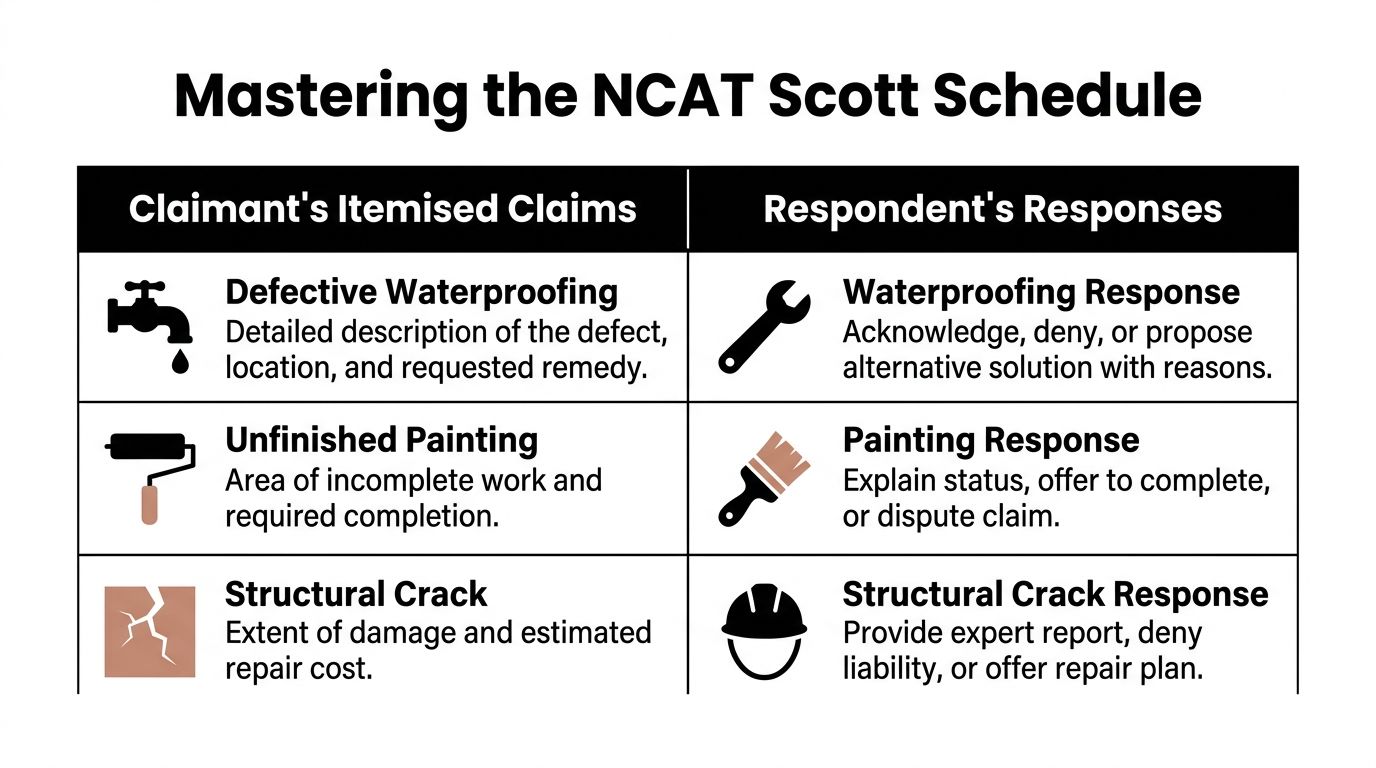
For larger building claims, the Scott Schedule becomes the battleground on paper. If an expert report explains the technical story, the Scott Schedule organises the dispute so the tribunal can compare one item against the other without digging through scattered submissions.
A Scott Schedule is a structured table. One side sets out each issue. The other side responds. The expert comments on the item. Done well, it turns a chaotic argument into a manageable sequence of disputed points.
Why the 2025 direction matters
Under NCAT Procedural Direction 3 (2025), a Scott Schedule is mandatory for home building disputes exceeding $30,000, and many first-time applicants are unaware of the updated formatting rules. That lack of awareness contributed to 34% of defect claims being dismissed in 2024 due to improper documentation, as outlined in this page on building consultant Scott Schedule requirements.
On this matter, many online guides are already out of date. They describe the older style of schedule or treat it as optional paperwork. It isn’t. If your matter crosses the threshold, compliance with the current direction matters.
What a compliant Scott Schedule should achieve
A useful Scott Schedule does more than list complaints. It should let a member see, item by item, four essential things:
| Function | What the schedule should show |
|---|---|
| Identification | The defect or disputed item with enough detail to locate and understand it |
| Response | The other party’s position, including admission, denial, partial agreement, or alternative explanation |
| Technical comment | The expert’s neutral assessment linked to evidence and standards |
| Outcome frame | The claimed remedy, rectification scope, or disputed value |
If those elements are muddled, the hearing becomes slower and more expensive because everyone is trying to reconstruct the dispute orally.
Common mistakes that damage a claim
The first mistake is bundling multiple defects into one line item. If waterproofing, tiling falls, and door clearance are all shoved into a single row, the response becomes messy and the issue loses precision.
The second mistake is writing advocacy into the expert column. That column is not the place for frustration or attack. It should read like measured technical analysis.
The third mistake is failing to cross-reference evidence. A schedule without links to photographs, plans, reports, or standards is just a spreadsheet of complaints.
Field note: The best Scott Schedules read plainly. They don’t try to sound clever. They make each disputed item easy to test.
How to approach it properly
If you’re preparing one, think in rows, not in emotions. Each row should be a self-contained issue. A stranger should be able to read that row and understand what is alleged, what is denied, what technical standard applies, and what result is sought.
In practice, that means:
- Split issues carefully so each row deals with one defect or one claim item.
- Use location detail such as room, elevation, element, or drawing reference.
- Tie every technical comment back to observed facts and the relevant standard.
- Keep wording neutral even when the dispute itself is heated.
- Check format against the current direction before filing, not after a problem is raised.
Awesim Building Consultants provide site investigations, Building & Construction Expert Witness Reports and Scott Schedules, which is the kind of support parties often need when the dispute has become document-heavy and technically contested.
Practical Tips for Homeowners Builders and Lawyers
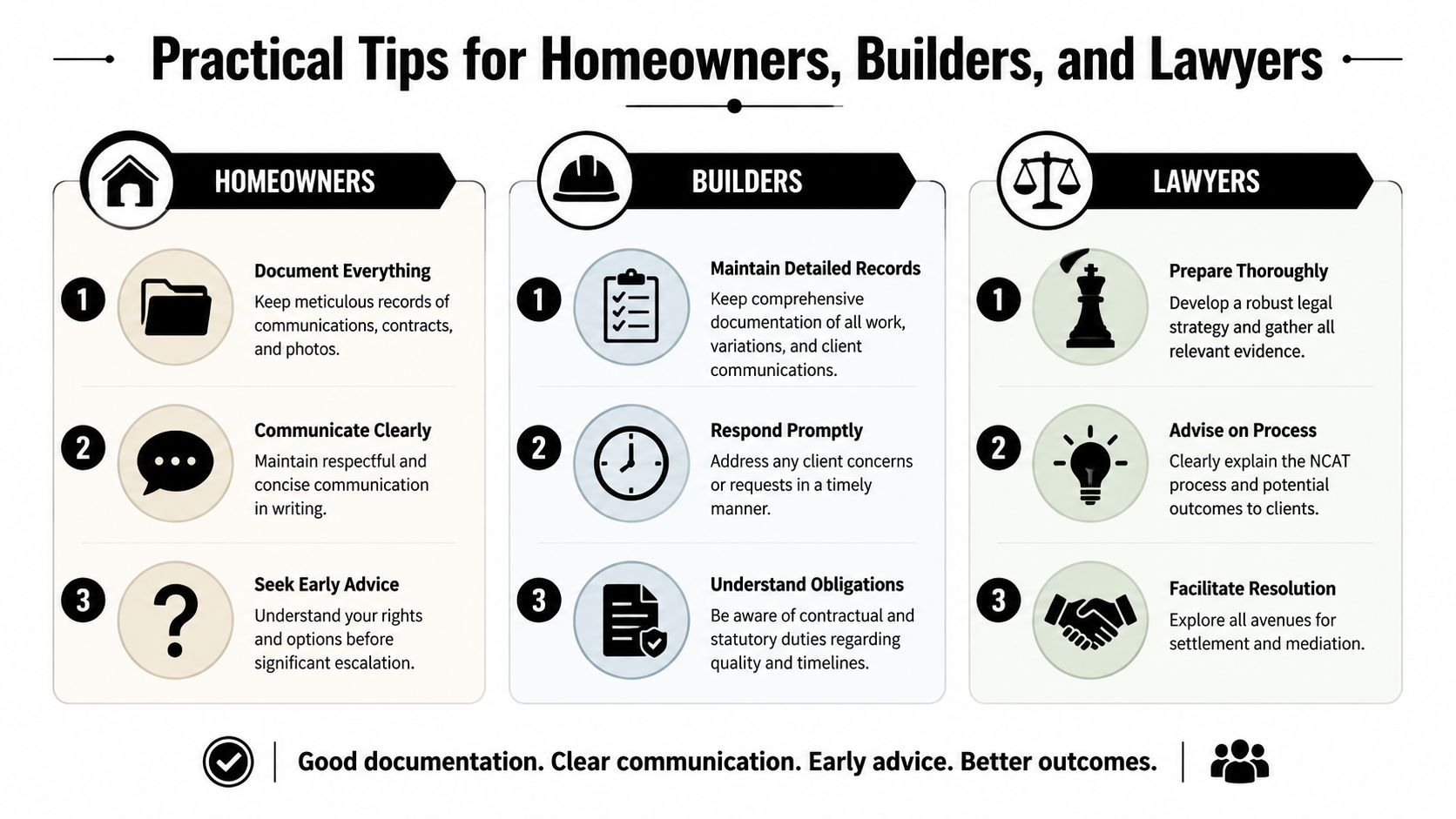
The strongest NCAT NSW matters usually come from ordinary discipline, not dramatic tactics. Different people need different habits, though. A homeowner’s weak point is often record keeping. A builder’s is often communication around scope and variations. A lawyer’s is often getting the technical brief too late or too loosely.
For homeowners
Owners often wait too long before organising the evidence. By then, access has changed, finishes have deteriorated further, and the chronology is muddy.
- Write while events are fresh. Keep a simple timeline of conversations, complaints, attendance dates, and promised actions.
- Photograph methodically. Wide shot, mid shot, close shot. Add location and date. Random photos without context are less useful than people think.
- Know the difference between appearance and defect. Some issues are cosmetic dissatisfaction. Others are compliance or performance failures. The distinction matters.
- Use reliable reference material when you’re trying to understand whether a finish issue is workmanship, maintenance, or product related. If your dispute involves tiled areas, a practical homeowner’s guide to tiling can help you ask better questions before the argument hardens.
For builders
Builders lose defendable cases when the file is poor. Good work with bad paperwork is still hard to defend.
A few habits matter more than most:
Confirm variations in writing
If price, scope, or material changes, pin it down. A text saying “all good” is not the same as a clear written variation.Respond to complaints specifically
Don’t send vague reassurances. Identify the item, your position, proposed inspection, and next step.Separate workmanship from design and maintenance issues
If you say a problem sits outside your scope, explain why and point to the relevant document.
The builder who keeps contemporaneous records usually has a calmer hearing than the builder who relies on memory.
For lawyers
In technical disputes, legal framing and building evidence have to work together. One without the other is inefficient.
A practical checklist helps:
- Brief the expert narrowly at first so the core issues are identified before the report grows unnecessarily wide.
- Ask for standards-based opinions rather than broad comments about quality.
- Test the rectification methodology. Not every alleged defect requires full replacement.
- Prepare the client for technical cross-examination on site events, access, instructions, and document history.
- Use the documentary sequence to support the expert, not to duplicate the expert.
The best files are the ones where the chronology, expert evidence, and sought orders all point in the same direction.
Achieve a Resolution with Expert Support
NCAT NSW is manageable when you approach it with the right mindset. Treat it like a structured dispute forum, not an informal complaint desk. The process has steps. The evidence has to do real work. And in larger claims, document compliance can decide whether the matter proceeds cleanly or stalls.
The practical lessons are straightforward. Start with the correct pre-filing pathway. Define the dispute precisely. Keep your records tight. Use expert evidence that is neutral, technical, and tied to the right standards. If a Scott Schedule is required, prepare it to the current direction rather than relying on outdated examples.
After decades in building and years supporting litigation, the pattern is consistent. Cases usually turn on clarity. Clear scope. Clear facts. Clear expert reasoning. Clear documents.
If you’re already in dispute, or you can see one coming, it’s worth getting the technical side organised before the tribunal timetable starts running. That gives you a better chance of resolving the matter early, and if it doesn’t resolve, it puts you in a stronger position when the hearing arrives.
If you need practical help with a building dispute, Awesim Building Consultants can assist with site investigations, Building & Construction Expert Witness Reports and Scott Schedules. Email admin@awesim.com.au or call 1800 293 746 to discuss your matter.