
Expert Witness Construction: A Practical NSW Guide
A waterproofing job starts with a promise and ends with a dispute faster than most owners expect. One day the shower is leaking into the hallway ceiling, the next day the builder is blaming maintenance, the tiler is blaming the membrane, and everyone is asking for another quote while the damage keeps spreading. That’s usually the point where talk stops helping and expert witness construction evidence becomes the only thing that can move the matter forward.
In NSW, the decision to call in an expert isn’t really about formality. It’s about shifting the argument from blame to proof, from opinions to a report that can be tested against plans, standards, photographs, and site facts. Once that happens, the question is no longer who sounds convincing. The question is who can explain the defect, the cause, and the remedy in a way NCAT or the Court can rely on.
When a Building Dispute Stops Being a Conversation
A common NSW dispute starts with a renovation that looked fine at handover. Then the bathroom floor starts lifting, the grout cracks, water stains appear below, and the builder says the problem came from something the owner did after completion. The owner gets a second quote, the rectification scope gets larger, and the conversation turns defensive.
At that point, the core issue isn’t who is angrier. It’s that the matter has crossed from a practical building disagreement into a technical dispute about causation, compliance, and quantum. That’s the moment where a private opinion won’t cut it, because each side already has a story and neither story has been tested properly.
What changes when the matter escalates
The procedural clock starts to matter once lawyers, NCAT, or the Court enter the picture. Documents need to be preserved, access needs to be arranged, and the evidence has to be organised before memories fade and site conditions change. If the dispute is left to drift, the report eventually becomes harder to write because the evidence chain is already broken.
That’s why a disciplined expert approach matters more than a loud one. I’ve seen plenty of reports that read like advocacy and very few that help the tribunal. The tribunal wants a technical pathway, not a speech.
A useful way to think about the shift is the same way product teams use product management best practices, define the problem, separate evidence from assumption, and document what drove the decision. Building disputes need that same discipline, only the stakes are a leaking wall, a failed membrane, or a rectification bill that keeps growing.
Practical rule: if the parties are still arguing about who’s “to blame” instead of what the evidence proves, it’s time to get an independent expert involved.
What a Construction Expert Witness Does
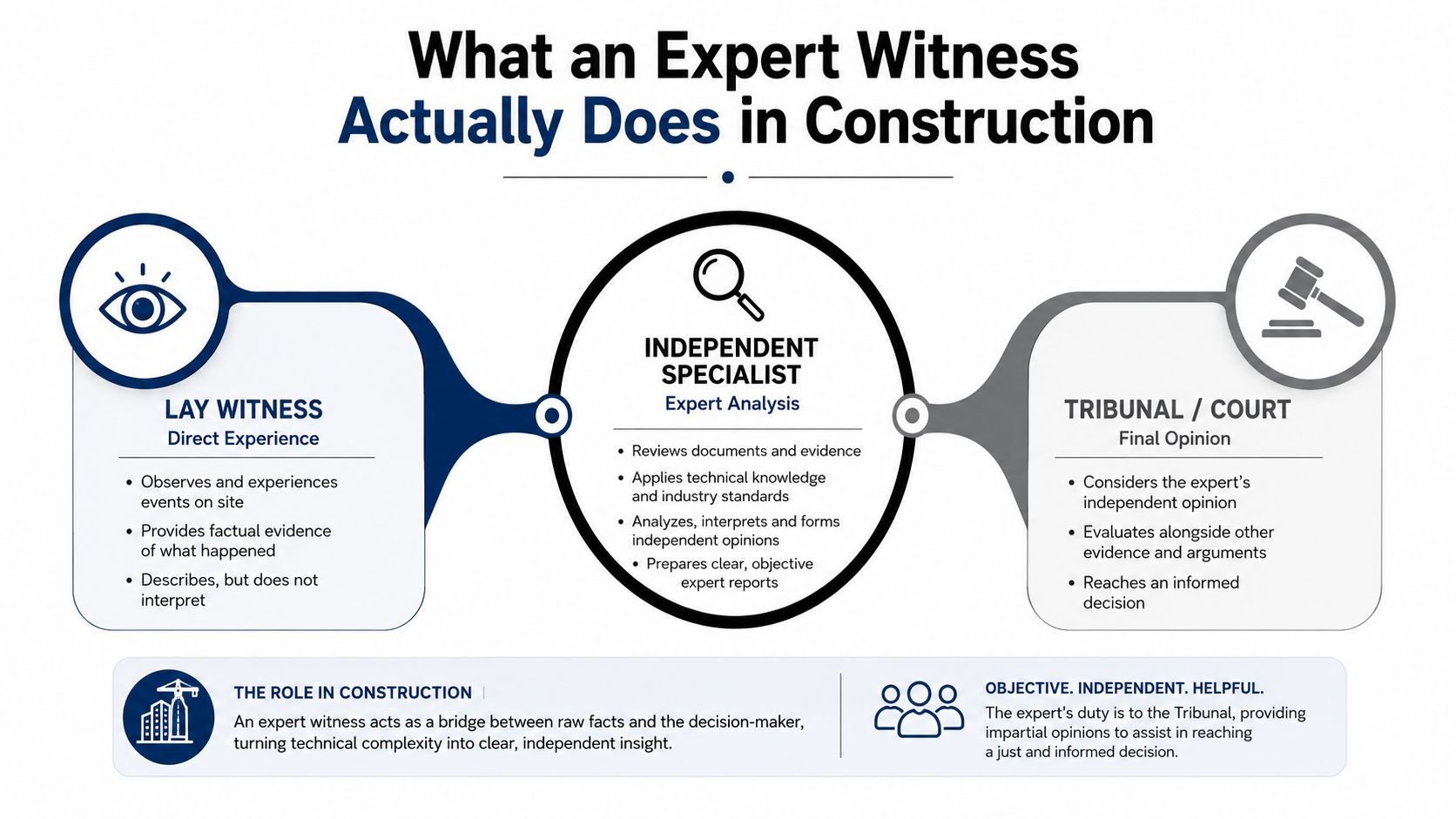
A construction expert witness is not there to repeat what the owner or builder already believes. The role is to give the tribunal or Court an independent opinion based on specialised knowledge, and to show the basis for that opinion clearly enough that it can be tested in cross-examination. In NSW, that means the expert has to disclose qualifications, the facts relied on, and the assumptions made, because the procedure expects transparency, not guesswork (Rimkus on expert evidence in construction disputes).
Independent specialist, not hired advocate
The expert’s duty is to the tribunal first. That sounds simple, but it is where a lot of reports go off the rails, because some consultants write as if they are building a case for the paying client rather than answering the technical questions in dispute. NSW expert evidence rules, including the Uniform Civil Procedure framework and tribunal directions, push the work back towards objectivity and issue-specific analysis (Pinsent Masons on expert witness duties in construction disputes).
A lay witness can say, “I saw the leak.” An expert can say, “I inspected the shower, reviewed the waterproofing details, compared the observed condition against the relevant standard, and formed an opinion about why the failure occurred.” That distinction matters because one is factual observation and the other is specialised reasoning.
The admissibility question
The clearest operational test is whether the opinion is based on sufficient facts or data, uses a reliable method, and explains how experience leads to the conclusion. The rule on expert testimony says exactly that, and it also requires an expert who relies on experience to explain how that experience leads to the opinion and how it was applied to the case facts (Federal Rule of Evidence 702). In practice, tribunals test the same idea, even if the language differs.
The report has to show the “why” and the “how”, not just the answer.
That is why a private repair scope and an expert witness report are not the same thing. A building consultant can help a homeowner understand what is wrong and what to fix. An expert witness has to build a report that can survive scrutiny, stay within scope, and answer the dispute issue by issue.
Qualifications and Evidence a Construction Expert Must Bring
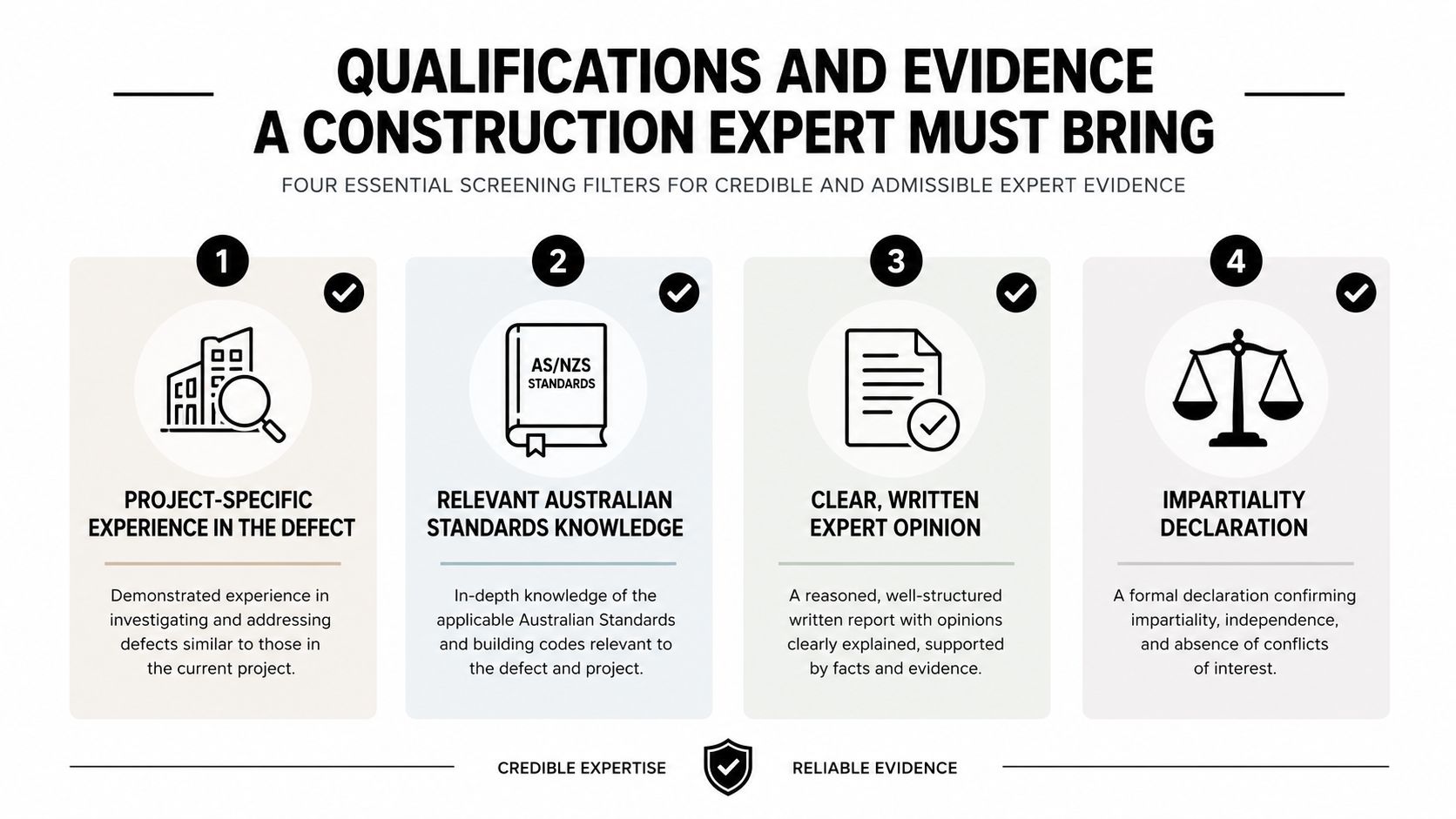
Tribunals and lawyers usually screen a prospective expert through four practical filters. First, does the person have project-specific experience in the defect type, whether that’s waterproofing, structural movement, roofing, or cladding? Second, do they know the National Construction Code and the relevant Australian Standards, not just the general building trade? Third, have they written reports or given testimony that can stand up under scrutiny? Fourth, can they explain complex material in plain language without drifting into jargon or advocacy (Symetrix on expert witness qualifications in construction litigation).
What the expert should ask for on day one
A proper evidence chain usually starts with plans, contracts, correspondence, photographs, site inspection records, and root-cause analysis, then ties the observed condition back to the standard that matters (Awesim practical guide to expert witness construction reports). Each item has a job to do. Plans show what was intended, contracts show scope, photographs capture condition, and correspondence often reveals when the dispute first became live.
The best reports don’t just list documents. They connect each document to an issue in dispute. That’s the difference between a consultant who knows the trade and an expert who knows how evidence works.
A useful screening checklist looks like this:
- Project-specific history: Has the expert dealt with this defect type before, on similar residential or commercial work?
- Standards literacy: Can they read the NCC and the relevant Australian Standards without hand-holding?
- Written discipline: Do their reports explain assumptions, limitations, and reasoning in a way a tribunal can follow?
- Impartiality: Do they understand that their opinion must remain independent, even when retained by one party?
Why methodology beats title
A long list of jobs on a CV doesn’t fix a weak reasoning chain. NSW construction disputes often turn on whether the expert can show how observations lead to causation and then to rectification, not whether they’ve been in the industry for decades. The methodology has to be visible, because the tribunal needs to test the path from defect to conclusion.
Practical rule: if the expert can’t explain what facts were relied on and why the opinion follows from those facts, the report isn’t ready.
Anatomy of an Expert Witness Report That Survives Cross-Examination
A tribunal-ready report is built in layers. It starts with instructions and scope, then lists the documents reviewed, the assumptions and limitations, the factual background, the inspection method, the defect findings, the causation analysis, the proposed rectification scope, and, where needed, the cost quantum. That structure matters because a report that jumps straight to conclusions usually gives the other side an easy target.
One useful way to see the standard is through a leaking shower allegation. If the owner says the membrane failed, the report should identify the observed condition, note whether water stops are missing, compare the details against the relevant standard, and explain whether the likely cause is non-compliant waterproofing, poor falls, defective installation, or another cause. Then the report should explain the rectification logic, not just say “replace the shower.”
What a solid report actually contains
The strongest reports keep facts, assumptions, and opinions separate. That discipline is similar to creating compliance documentation, because the reader needs to see what was checked, what was assumed, and what evidence supports each conclusion. If those lines blur, cross-examination gets easier.
A working structure usually looks like this:
- Instructions and scope. What dispute is being answered, and what isn’t.
- Documents reviewed. Plans, photos, correspondence, contract material, and inspection notes.
- Assumptions and limitations. What wasn’t available, what couldn’t be opened, and what remains uncertain.
- Site findings. Observed defects, measured conditions, and where they were found.
- Causation. Why the defect likely occurred, and what alternatives were considered.
- Rectification. What needs to be done to fix the problem properly.
- Quantum. The cost basis, if the brief requires it.
The fatal mistake is the net opinion problem, bare conclusion without reasoning. A tribunal can’t test a sentence that just says the work was defective, because there’s no pathway from observation to opinion.
A report that survives cross-examination doesn’t try to sound impressive. It sounds controlled. It gives the other side less room to say, “That’s just your say-so.”
How a Scott Schedule Fits Into the Evidence
A Scott Schedule is a comparison document, not a narrative. Each alleged defect is listed in its own row, then the claimant’s position, the respondent’s reply, the expert opinion, and the proposed rectification sit side by side. That format forces the dispute into a shape the tribunal can work with, instead of letting it spread across long affidavits and scattered attachments.
Why the schedule matters in NSW disputes
Under the NSW tribunal approach, and especially in the current procedural environment, the schedule-style format helps turn a building dispute into a series of testable issues rather than one large argument. The practical value is simple. Every contention gets itemised, every response gets recorded, and every opinion has to line up with evidence instead of rhetoric. For a plain-language explanation of that workflow, see Awesim’s Scott Schedule guide for NSW tribunal matters.
A strong schedule row normally includes:
- Item reference: A clear defect label tied to a location.
- Claimant position: What the owner or claimant says is wrong.
- Respondent position: The builder’s reply or denial.
- Expert opinion: The expert’s view, tied to observed facts and standards.
- Recommended rectification: The fix, or the cost basis if quantum is disputed.
| Scott Schedule Row Structure | ||||
|---|---|---|---|---|
| Item | Claimant Position | Respondent Position | Expert Opinion | Recommended Rectification |
| Defect 1 | Leak at shower base | Water entry denied | Membrane details need testing against the relevant standard | Rectify waterproofing and associated finishes |
| Defect 2 | Cracked tiles | Settlement blamed | Movement or substrate issue needs technical assessment | Remove and replace affected tiling |
| Defect 3 | Uneven finish | Minor variation alleged | Tolerance and workmanship need evidence-based review | Rework to compliant finish level |
The row format does something narrative reports often fail to do. It makes the disagreement visible. That helps at conciliation, and it helps even more if the matter goes to a hearing.
NCAT and Court Procedure Considerations in NSW
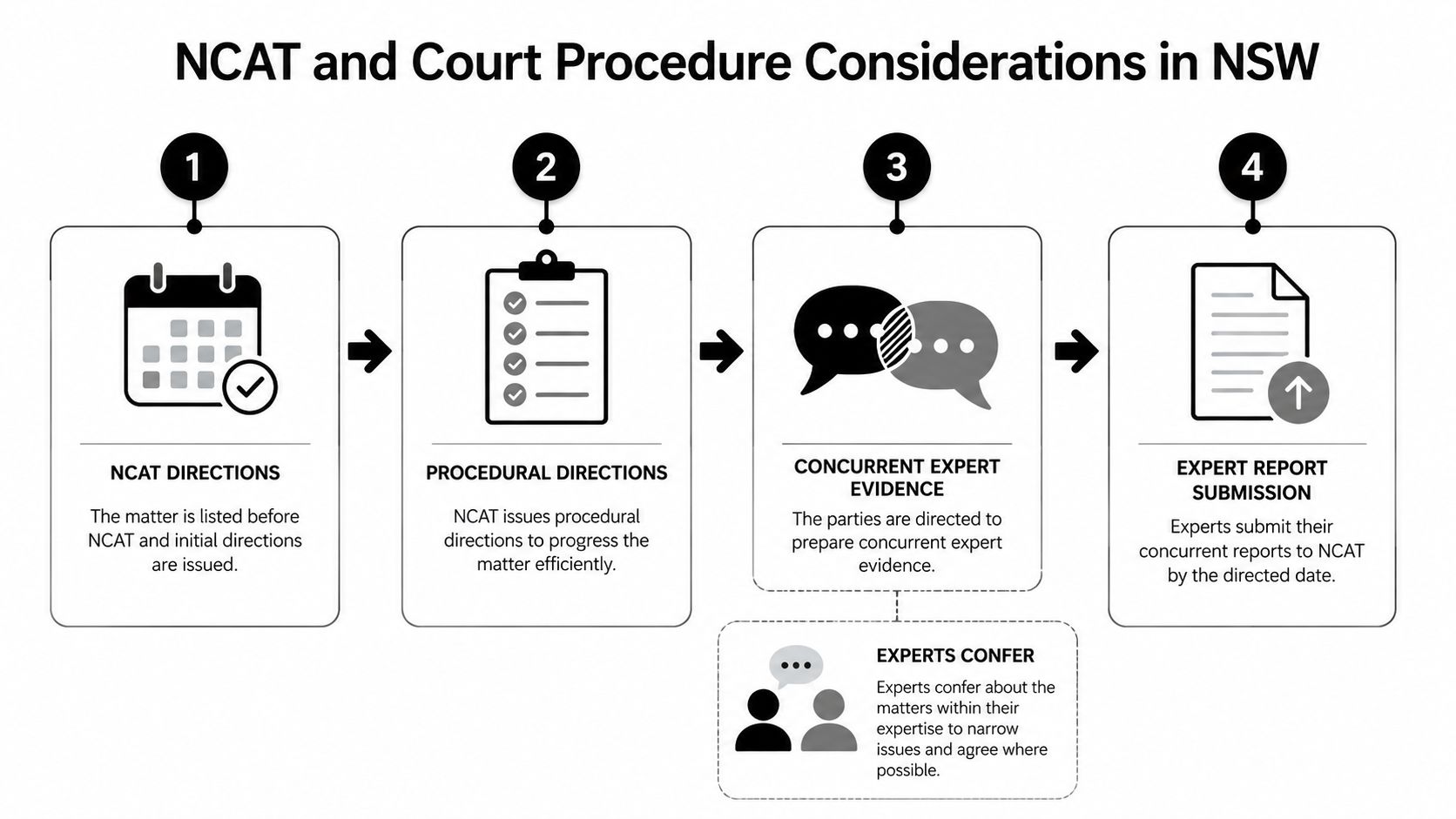
A dispute changes the minute it enters NCAT or a court list. The expert is no longer writing for a client alone, the report has to fit the directions, the timetable, and the way the tribunal expects evidence to be tested. In practice, that means reading the procedural orders line by line and shaping the report to the issues in contest, not to every complaint the owner has ever raised.
Concurrent evidence and narrow opinions
Where experts are required to confer, the report has to be tight enough to stand beside another expert’s report without drifting into argument. If an opinion is padded out with rhetoric or mixed with advocacy, it becomes harder to reconcile in concurrent evidence and easier to attack under questioning. Tribunal-ready work is usually shorter, clearer, and more disciplined than a report written to impress a client.
Local NSW experience matters here. A seasoned expert knows when the file supports a firm view and when it does not. If the records are thin, the right move is to flag the gap and limit the opinion, because a weakly supported conclusion will not survive scrutiny just because it sounds decisive.
Rural NSW disputes add their own pressure points. Records are often incomplete, site histories are informal, travel takes time, and the claim may involve variations, quantum meruit, or a no-contract argument. The expert has to separate workmanship defects from owner change, partial scope, and older site conditions before any cost allocation can be defended.
For a tribunal-focused overview of the process, see Awesim’s NCAT information page.
If the brief is vague, the expert should narrow it. A broad opinion on a thin record usually looks impressive and falls apart under questioning.
Cross-examination starts at the desk, not in the hearing room. The report should be written on the assumption that every assumption will be tested against the documents, site notes, and the actual evidence chain. In NSW building matters, that is what NCAT and the courts are looking for, a report that stays within the brief, shows its working, and answers only what the material can support.
Costs, Timelines, and What Slows Reports Down
The time and effort involved in an expert report depend on the size of the dispute, the number of defects, the number of sites, the depth of standards analysis, and whether quantum has to be calculated. Rural inspections can add travel and scheduling complexity, especially when access is limited and the documents are incomplete. Those are the practical drivers, not the brochure version of the job.
What slows a report down in real life
Reports usually stall for the same reasons. Instructions are unclear, critical documents are missing, site access is delayed, or the expert is asked to opine before the evidence is ready. Another common failure is advocacy creeping into the draft, because once the report starts arguing instead of analysing, the other side will attack its reliability.
A second set of issues comes from scope drift. If the brief keeps expanding, the report keeps expanding too. That’s not efficient, and it’s often a sign the dispute hasn’t been framed properly.
The cost discussion gets more complicated when the matter involves variations, incomplete scope, or no formal contract. In those cases, the expert’s real value is in converting messy现场 observations into a defensible causation and scope analysis, rather than merely saying what looks wrong. For a practical pricing overview, see Awesim’s guide to expert witness report costs in 2026.
One thing that helps is a clean brief from the start:
- Define the defects. Don’t ask for a general opinion if the dispute is itemised.
- Release the documents early. Late photographs and missing correspondence slow everything down.
- Book access in advance. Delays on site often ripple into the report date.
- Keep quantum separate. Technical causation and cost analysis are related, but they’re not the same task.
The cheapest report is rarely the cheapest outcome. A weak report often leads to rework, extra questions, and more delay than a properly scoped engagement would have caused in the first place.
Hiring Tips and Common Pitfalls Specific to NSW
A good hire starts with a blunt question. Has the consultant worked on site, can they show a real sample report, have they dealt with NCAT or Court work before, and will they sign an independence declaration without hedging? Then ask how they handle NCAT Procedural Direction 3 in practice, because a consultant who does not know that format usually produces a report the tribunal has to keep untangling.
The other mistakes are familiar. People hire on price alone, instruct too late, ask for advocacy instead of evidence, or commission a report that is so wordy the key issues disappear inside it. That choice usually costs more later, because a tribunal cannot test what it cannot quickly understand.
Awesim Building Consultants, founded by Glen Sim, brings 35+ years of building and construction experience and 15+ years of litigation support into site investigations, expert witness reports, and Scott Schedules for NSW dispute work. That background matters when the task is to separate defect, causation, and scope in a report that can be used. Their Expert Witness Reports are built around that discipline.
If you are choosing an expert, keep the decision practical.
- Check the site background. The expert should understand the work from experience, not just theory.
- Review a sample report. You want clear reasoning, not polished filler.
- Confirm prior dispute work. NCAT and court familiarity saves time later.
- Ask about independence. The report should read as objective, not client-led.
- Match the brief to the dispute. A narrow, well-scoped instruction usually works better than a sprawling one.
You can also look at Awesim’s related pages when you need documents built for NSW construction disputes. The right expert does not just describe defects, they build evidence that can be tested.
If you are dealing with a defect dispute in NSW and need evidence that will stand up in NCAT or Court, Awesim Building Consultants can help with site investigations, Expert Witness Reports, and Scott Schedules. Contact the team at Awesim to organise an independent review, or call 1800 293 746 or email admin@awesim.com.au for a practical first discussion.
Related Posts

Scott Schedule Template: What Columns a NSW Claim Needs
What Is a Scott Schedule? Why the Column Structure Matters The Core Columns in a NSW Scott Schedule Template Column
Read More »
Brick Veneer Construction Defects: A Site Inspector’s View
What Brick Veneer Construction Actually Is The Most Common Brick Veneer Construction Defects Cracking in the Brickwork Missing or Blocked
Read More »
Liquidated Damages in Construction: How NSW Contracts Work
What Are Liquidated Damages in Construction? Why Contracts Use Them How Liquidated Damages Work in NSW Building Contracts Standard Contracts
Read More »