
NSW Civil and Administrative Tribunal (NCAT) Guide
When a building job goes off the rails, individuals don’t typically start by thinking about tribunal procedure. They start with a leaking shower, cracked tiles, unfinished works, unpaid invoices, or a builder getting blamed for damage that wasn’t part of the contract. The dispute usually begins on site, in emails, in text messages, and in a growing folder of photos that no one has properly organised.
That’s where many NCAT matters are won or lost. Not in the argument itself, but in how the facts are prepared.
For homeowners, builders, and solicitors dealing with the NSW Civil and Administrative Tribunal NCAT, the biggest stumbling block is rarely filling in the form. It’s producing evidence that is clear, compliant, and technically useful. A weak defect list, an opinion dressed up as expert evidence, or a poorly structured claim can derail a matter long before the hearing starts.
Awesim Building Consultants have 35+ years in Building & Construction, with over 15+ years our providing litigation support to home owners, builders and lawyers. We provide site investigations, Building & Construction Expert Witness Reports and Scott Schedules. That practical side matters, because NCAT building disputes don’t reward vague complaints or general denials. They reward evidence that can be tested, item by item, against the contract, the scope, the standards, and the physical condition of the work.
Your Building Dispute Begins What Happens Next
Most readers arrive here at the same point. The job has soured, trust has broken down, and every call now feels loaded. A homeowner may be carrying a defect list handed over by a second contractor. A builder may be staring at a claim that rolls valid issues together with complaints that have nothing to do with workmanship. A solicitor may already know the legal frame but still need someone to turn construction facts into usable evidence.
NCAT is usually the forum where that dispute lands. It exists to deal with matters like defective workmanship, incomplete work, contract disputes, and rectification claims without the full formality of a court. That sounds straightforward, but in practice a building matter becomes technical very quickly.
What usually goes wrong early
The first mistake is emotional overloading. People submit every grievance they have, but they don’t separate defect, scope change, maintenance issue, access problem, delay, and cost. NCAT needs those issues untangled.
The second mistake is relying on raw material without structure:
- Photos without context don’t tell the Tribunal what the defect is, where it is, or why it matters.
- Quotes from other trades often give a price to redo work, but they don’t explain breach, cause, or the correct rectification method.
- Long email chains show frustration, but they don’t replace technical analysis.
Practical rule: If a third party can’t look at your evidence and follow the story item by item, your case isn’t ready.
What helps from day one
A better approach is to treat the matter like a file that may be tested in detail. Keep the contract, plans, specifications, approvals, progress claims, variation records, photos, inspection notes, and correspondence in order. Then get clear on the actual issues in dispute.
For building cases, a pathway does exist. It’s workable, but it rewards preparation. When the dispute is framed properly from the start, the next steps become much easier to manage.
Understanding the NSW Civil and Administrative Tribunal NCAT
A homeowner usually reaches NCAT after the project has already gone off track. Work is unfinished, defects are disputed, invoices are being withheld, and each side is convinced the documents speak for themselves. In practice, NCAT is the point where the story has to be organised into evidence the Tribunal can test.
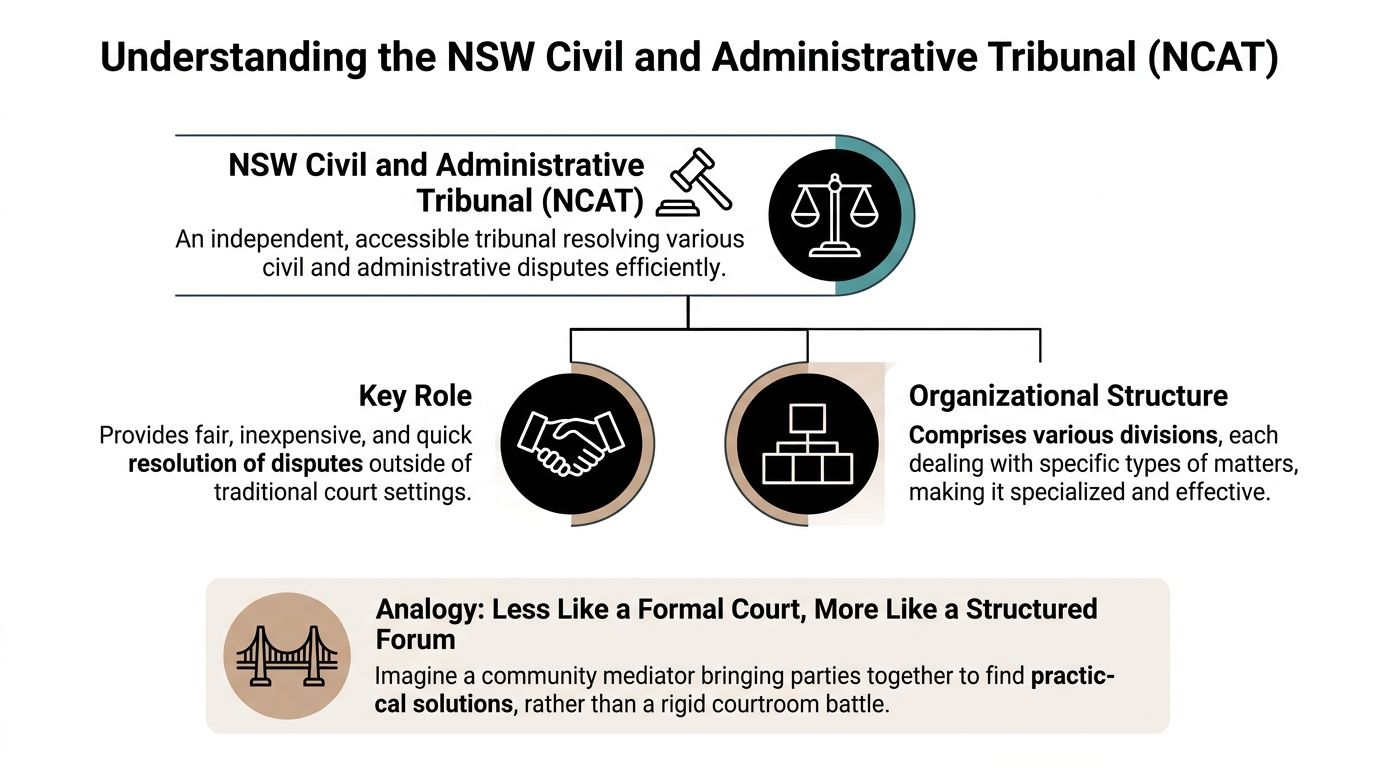
The NSW Civil and Administrative Tribunal NCAT decides a wide range of civil and administrative matters in New South Wales, including residential building disputes. It operates with less formality than a court, but that should not be mistaken for a lower standard of proof. In building cases, the real pressure point is usually not the application form. It is whether the party can present the defects, scope issues, causation, and rectification cost in a clear, admissible, itemised way.
Where building disputes are heard
For residential construction matters, proceedings usually sit in the Consumer and Commercial Division. That division deals with home building claims involving defective work, incomplete work, delays, payment disputes, statutory warranty issues, and rectification orders.
Other divisions deal with different subject matter:
| Area | What it deals with |
|---|---|
| Consumer and Commercial Division | Home building disputes, defect claims, contractual issues, rectification disputes |
| Administrative Division | Review of government and administrative decisions |
| Guardianship Division | Matters involving decision-making support and guardianship |
| Occupational Division | Professional and licensing matters |
That distinction matters for a practical reason. In a building case, the Member is usually dealing with technical allegations that must be tied back to the contract, plans, specifications, relevant standards, site conditions, and the proper method of rectification.
After you understand the structure, it also helps to hear how NCAT is explained in plain terms.
Why NCAT building matters often turn on evidence quality
Parties without representation often assume NCAT will piece the case together from photos, emails, and a few quotes. It rarely works that way. A Member still needs to see what the defect is, where it appears, what contractual or technical requirement has been breached, what caused it, and what rectification is required.
That is why two documents come up repeatedly in serious building claims. An Expert Witness Report explains the technical case in a form NCAT can use. A Scott Schedule breaks the dispute into individual items so each allegation can be answered and costed line by line.
From a building consultant’s perspective, that is the trade-off. NCAT is more accessible than court, but it expects discipline in how the case is presented. Parties who understand that early usually save time, reduce argument about side issues, and give themselves a better platform for settlement or hearing.
The Key Steps in an NCAT Building Dispute Process
A typical NCAT building matter starts the same way. The owner is frustrated, the builder says the work is within tolerance, and both sides arrive with a folder full of emails, photos, and competing versions of what happened on site. The process itself is usually straightforward. The difficulty is presenting the dispute in a form NCAT can deal with efficiently.
As noted earlier, many building matters resolve before a final hearing and many take months, not weeks, to run. That makes early preparation a practical decision, not just a procedural one. A party who starts with clear documents, a defined claim, and a realistic position usually has more control over cost, timing, and settlement.
Step one starts before the application
The work begins before anything is filed.
Pull together the contract, approved plans, specifications, variations, progress claims, invoices, defect notices, photos, site correspondence, and any diary notes that show what was said and when. Then sort the issues item by item. A claim that says “poor workmanship throughout” is difficult to prove and just as difficult to answer. A claim that identifies cracked tiling to the ensuite, inadequate fall to the shower, and incomplete waterproofing at a nominated location gives NCAT something concrete to deal with.
This is also the point to make a commercial assessment. Filing fees, expert costs, hearing preparation, and time away from work can outweigh the value of a smaller claim. This practical guide to NCAT application fees and hearing costs helps quantify that decision early.
What usually happens after filing
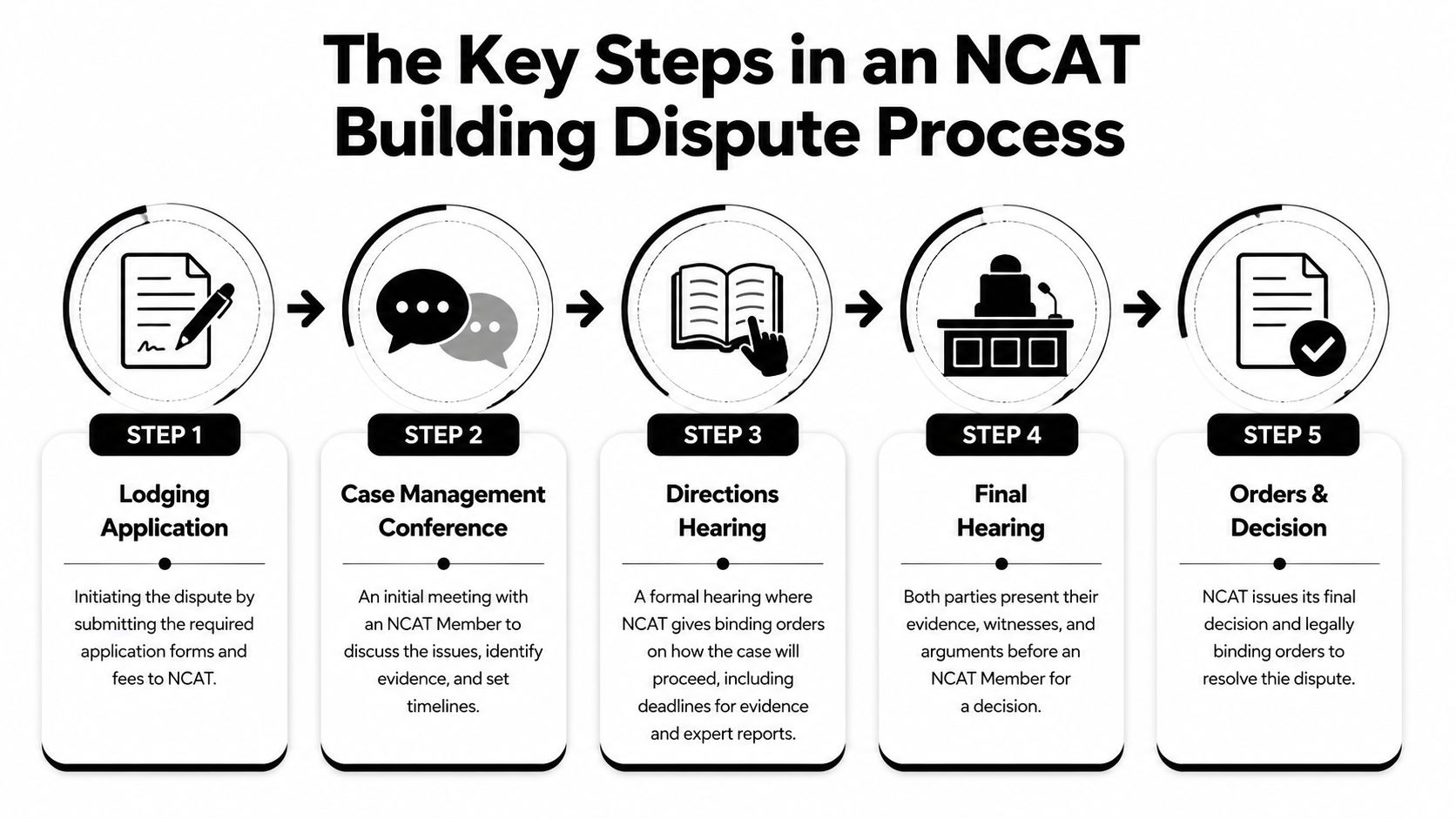
Once the application is lodged, the matter generally moves through a predictable sequence. The names of the events can vary, but the practical steps are much the same.
Application and response
One party files the claim and the other party responds. The response should deal with each allegation directly. Admit what is correct, dispute what is wrong, and identify any issue said to arise from design, maintenance, owner-supplied materials, access, or work outside the contract.Directions or case management
NCAT makes orders about what must be filed and by when. At this stage, many unrepresented parties often encounter difficulties. If the orders require an expert report, Scott Schedule, witness statements, or updated costings, each document needs to be prepared properly and served on time.Conciliation or mediation
Settlement discussions usually become productive when both sides can see the actual points of agreement and disagreement. Vague accusations rarely help. Itemised defects, properly referenced evidence, and realistic rectification figures do.Hearing
If the matter does not settle, the Member hears the evidence and makes findings on the disputed items. By that stage, late documents and poorly framed allegations usually cause avoidable damage.
The pressure point is usually the directions stage
In practice, the case often turns before the hearing date arrives.
The directions stage is where NCAT expects the dispute to be organised into a workable form. For a building claim, that usually means each alleged defect is identified separately, linked to the relevant contractual or technical requirement, and supported by evidence that deals with cause, extent, rectification, and cost. If that material is missing, a party can spend months arguing around the edges without ever proving the point that matters.
That is why experienced practitioners focus early on the documents NCAT can use. An expert report is often needed to explain the technical position. A Scott Schedule is often needed to break the dispute into line items that can be answered, admitted, disputed, costed, or resolved.
| Stage | What helps | What causes problems |
|---|---|---|
| Pre-filing | Defined issues, organised records, realistic cost assessment | General complaints, missing contract documents, mixed-up defect items |
| Directions | Complying with orders, preparing evidence in the required format | Late material, incomplete expert instructions, unexplained cost claims |
| Conciliation | Itemised allegations and supportable figures | Inflated positions and broad accusations |
| Final hearing | Clear chronology, referenced evidence, disciplined presentation | Last-minute bundles, unsupported opinions, new issues raised too late |
Well-prepared matters often settle earlier because each issue is clear enough to value. If they do not settle, the same preparation puts the case in a far better position at hearing.
Why Strong Evidence is Your Most Important Asset
In a building dispute, people often think the contract will carry the day. It won’t, at least not by itself. The contract sets rights and obligations, but NCAT still has to determine what happened on site, whether the work complies, what caused the problem, and what rectification is reasonable.
That is why evidence matters so much.
NCAT operates under a strict merits review jurisdiction. For building disputes under $500,000, the Tribunal can substitute its own decision on the factual merits of the case, and that puts real weight on the initial evidence, particularly the expert material, as noted in Justice Wright’s discussion of the tribunal framework.
Merits review changes the way you prepare
In plain language, merits review means the Member isn’t only checking whether someone made a legal mistake. The Member is deciding the factual dispute itself. That changes the whole strategy.
If you’re the claimant, you must prove more than dissatisfaction. You need to show:
- What the defect is
- Why it is non-compliant or defective
- What standard or obligation has been breached
- What rectification is required
- What the reasonable cost is
If you’re the respondent, it isn’t enough to say the work was fine. You need evidence showing why the allegation fails. That may involve scope limits, maintenance issues, client-supplied products, design responsibility, later damage, or an incorrect rectification method proposed by the other side.
Raw documents are not the same as technical proof
Photos, emails, text messages, invoices, and site notes all matter. But they don’t carry the same weight as an independent technical analysis that links physical conditions to contractual and statutory obligations.
Here’s the practical difference:
| Material | Useful | Limited if used alone |
|---|---|---|
| Photos | Show condition and progression | Often don’t explain breach or cause |
| Emails | Show notice, chronology, and conduct | Rarely prove technical non-compliance |
| Quotes | Suggest cost of works | Often don’t justify scope of rectification |
| Expert report | Connects facts, standards, cause, and remedy | Only if prepared properly and independently |
If the evidence doesn’t explain the defect in building terms, NCAT may treat it as complaint material rather than proof.
That’s the turning point for many self-represented parties. They may have genuine grievances, but they present them as a narrative instead of a technical case. In a simple matter, that might be enough to get traction. In a defect-heavy matter, it usually isn’t.
Preparing a Compliant Expert Witness Report
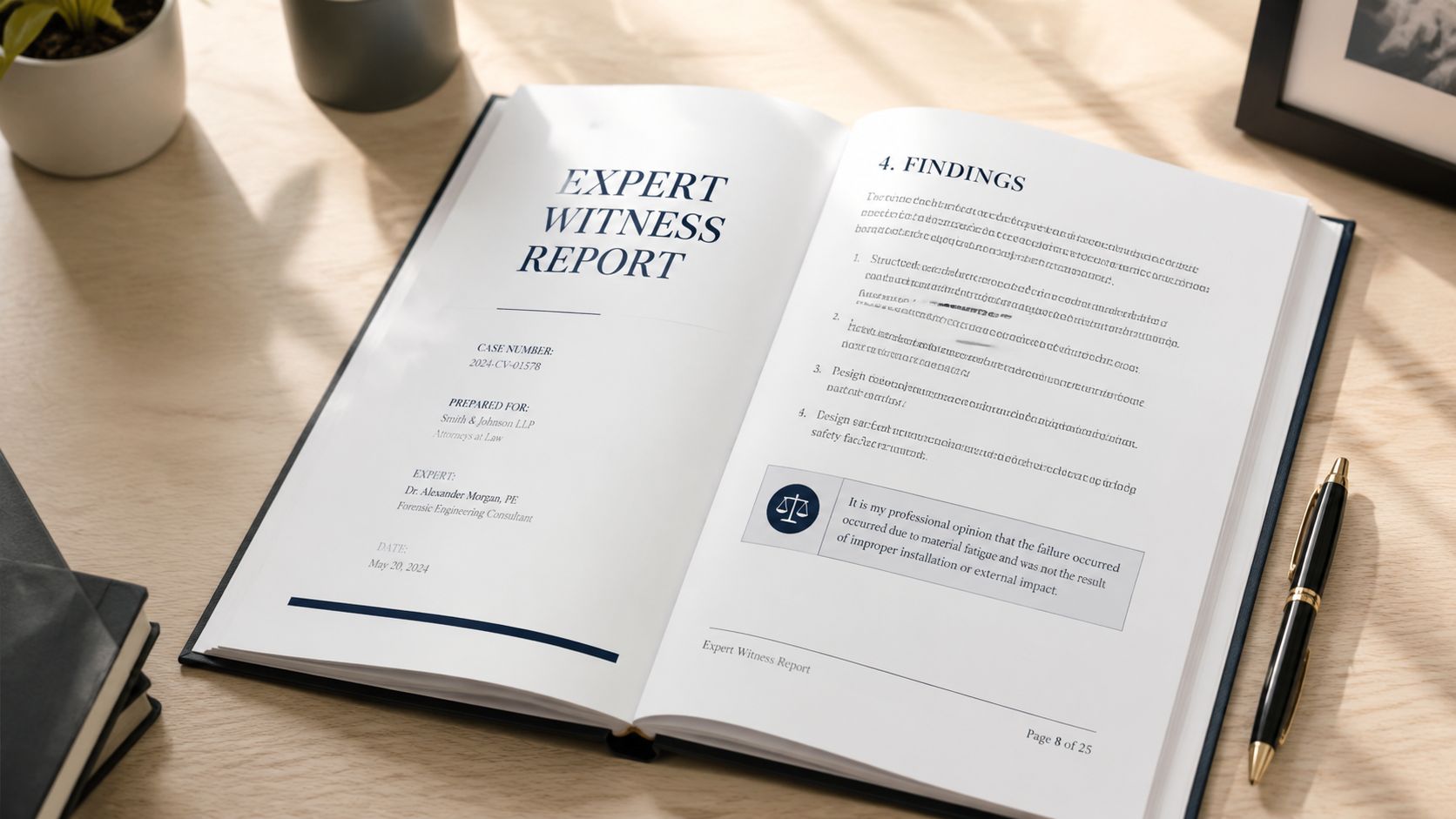
An expert witness report has to do more than sound professional. It must be usable. If it blurs fact and opinion, skips standards, or reads like advocacy for one party, it can lose force very quickly.
NCAT Procedural Direction 3 requires expert evidence in NSW building defect proceedings to clearly distinguish between opinion and factual observation, state the expert’s independence, and confirm the expert’s understanding of the Code of Conduct for Expert Witnesses, as outlined in this summary of preparing a Scott Schedule and expert material for NCAT.
What a compliant report needs to cover
A useful report usually includes a clear site inspection record, identification of each alleged defect, relevant contractual context, reference to applicable standards, and a reasoned rectification pathway. It should also explain what the expert observed directly and what conclusions are being drawn from those observations.
A practical report often deals with these core elements:
Observed condition
What was physically seen on site, where it was located, and how it was documented.Technical assessment
Whether the work departs from contract requirements, Australian Standards, the NCC, or accepted workmanship expectations.Causation and responsibility
Whether the issue appears to arise from workmanship, design, materials, movement, maintenance, access, or later interference.Rectification method and costing basis
What work is needed to rectify, and why that method is proportionate and technically sound.
What weak reports tend to do
Poor reports usually fall into one of three traps.
First, they overstate. They call everything defective without separating serious non-compliance from cosmetic dissatisfaction or minor tolerance issues.
Second, they under-explain. They attach photos and conclusions but don’t show the reasoning in between.
Third, they act like submissions. An expert report is not a closing argument. NCAT expects independence, not loyalty.
A report gains credibility when it acknowledges limits, identifies assumptions, and avoids taking sides on matters outside the expert’s discipline.
For parties who need technical support, one available option is an NCAT building expert witness report service that prepares site-based defect and compliance reporting for tribunal use. The important point is not the provider’s branding. It’s whether the report is independent, specific, and able to withstand challenge.
What works better in practice
The strongest reports read like a disciplined inspection record with technical reasoning attached. They avoid sweeping language. They reference the relevant documents. They separate what was observed from what was inferred. They identify what can and can’t be concluded from the available material.
That approach helps whether the matter settles early or proceeds all the way to hearing.
Using a Scott Schedule to Structure Your Claim
When a case involves multiple alleged defects, a Scott Schedule becomes one of the most useful documents in the whole matter. It turns a scattered dispute into a structured one.
In the Consumer and Commercial Division of NCAT, the use of a Scott Schedule is a mandatory procedural specification for complex defect claims under NCAT Procedural Direction No. 3, and it helps ensure expert evidence maps non-compliance with statutory warranties under the Home Building Act 1989 (NSW), as described on NCAT’s application and process guidance.
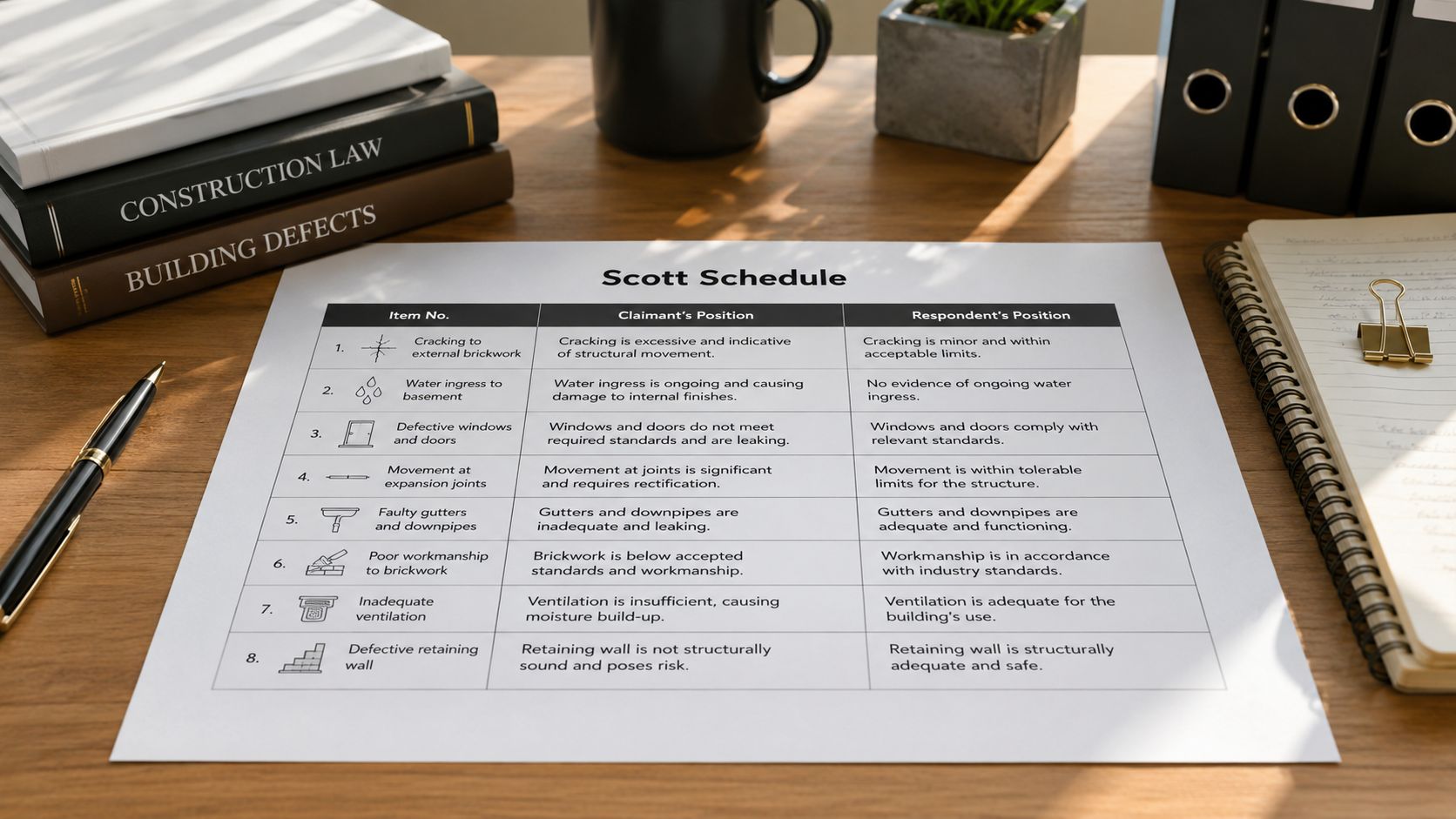
What goes into the schedule
A compliant Scott Schedule assigns each defect a unique item number and deals with one discrete issue per row. It should include columns for the item number, description of defect, claimant’s position, proposed rectification, claimant’s cost, respondent’s response, and respondent’s cost. Best practice also means cross-referencing the contract, photos, standards, and contemporaneous records, while keeping scope, quality, and quantum issues separate.
That structure matters because it stops parties from arguing in broad strokes.
| Scott Schedule field | Why it matters |
|---|---|
| Item number | Keeps each issue discrete and traceable |
| Defect description | Defines what is actually being alleged |
| Claimant’s position | Ties the issue to codes, standards, or contractual obligations |
| Rectification proposal | Shows the claimed solution, not just the complaint |
| Costs | Forces each side to state its valuation |
| Respondent’s response | Narrows what is admitted, denied, or partly accepted |
Why it changes the hearing
A proper schedule makes everyone more precise. The claimant has to identify each issue clearly. The respondent has to answer each issue clearly. NCAT can then work through the dispute in an ordered way instead of trying to decode a long narrative.
A Scott Schedule doesn’t just organise the paperwork. It exposes weak items, duplicated claims, and inflated rectification positions before they consume hearing time.
For parties dealing with that document for the first time, this guide on Scott Schedules in NSW tribunal matters is a useful starting point.
Your Next Steps for a Stronger NCAT Case
NCAT is accessible, but building disputes still turn on disciplined preparation. The parties who do best usually have one thing in common. They stop treating the matter as a running argument and start treating it as an evidence exercise.
That means identifying the core issues, separating defect from scope, getting the chronology right, and making sure technical opinions are supported by site observations, standards, and records. In more complex matters, a compliant expert witness report and a properly structured Scott Schedule aren’t optional extras. They are the framework that allows the Tribunal to understand the case.
For homeowners, builders, and solicitors, the practical question is usually the same. What evidence do we need, and how do we present it so NCAT can use it? Once that question is answered properly, the dispute becomes far easier to assess, negotiate, and, if necessary, run to hearing.
If you need help preparing an NCAT-ready building case, Awesim Building Consultants can assist with site investigations, Building & Construction Expert Witness Reports, and Scott Schedules for homeowners, builders, and solicitors across NSW. To discuss your matter, email admin@awesim.com.au or call 1800 293 746.

Related Posts

Water Damage in Homes: How to Track Down the Source
Water damage in a home rarely announces itself at the source. A stain on the ceiling, a musty smell in
Read More »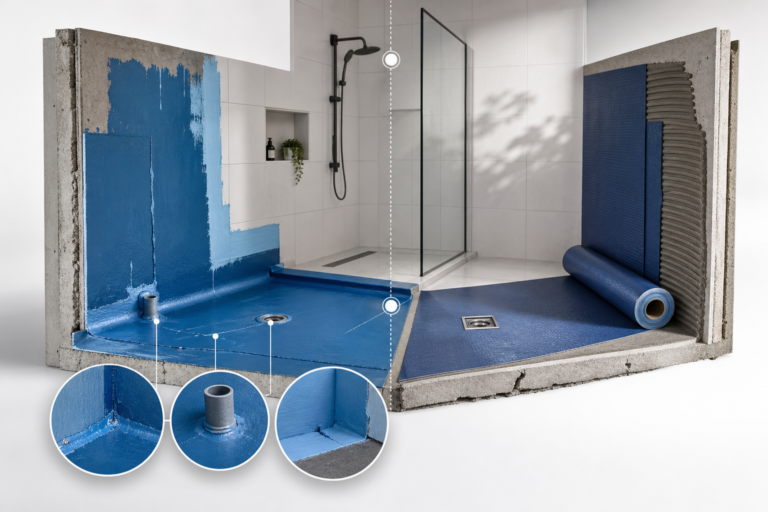
Waterproofing Membrane Types: Which Fails Most in NSW Bathrooms
Waterproofing failure is the single most common serious defect found in NSW apartments, and the type of membrane used, along
Read More »
Building Certifier NSW: Role, Limits, and When You Need More
A building certifier in NSW is a registered professional who issues construction certificates, conducts critical stage inspections, and grants occupation
Read More »