
If you’re dealing with a building dispute in NSW, the problem often isn’t whether work was done. It’s how to put a fair, defensible value on that work when the contract doesn’t give you a clean answer. The job may have stopped halfway through. Variations may have been discussed on site but never signed. Progress claims may have gone in, but certification never followed. By the time the matter reaches NCAT or a solicitor’s office, everyone has a different number and no one agrees on the method.
That’s where a Quantum Meruit Report becomes useful. It isn’t a dressed-up invoice. It’s a structured valuation of work performed, built from evidence, trade pricing, scope analysis, and deductions where required. For homeowners, builders, and lawyers, the report helps convert a messy factual dispute into something a tribunal or court can assess.
With over 35 years in building and construction, and more than 15 years providing litigation support, Awesim’s field experience sits squarely in the practical side of this process. Estimating, site inspection, expert reporting, and Scott Schedules all come back to the same discipline. Work out what was done, what it was worth, what supports it, and what won’t stand up under scrutiny.
Navigating Construction Disputes Without a Clear Contract
A common dispute starts like this. The builder says substantial work has been completed and payment is overdue. The owner says the work changed from the original arrangement, some items weren’t approved, and the contract path has broken down. There may be a termination notice, an argument over defective work, or a job that drifted beyond the paperwork.
Once that happens, the contract price often stops being the whole answer. You might still have drawings, emails, delivery dockets, photographs, and progress claims. What you don’t have is a clean mechanism that everyone accepts for valuing the work already carried out.
Where disputes usually break down
In practice, I see the same pressure points repeatedly:
- Variations drifted off paper: The work changed on site, but the written approval process didn’t keep pace.
- Payment claims outpaced evidence: A claim was made, but the supporting records weren’t organised well enough to prove value.
- Termination froze the job: One side ended the contract before completion, leaving partly finished work that still needs valuation.
- Verbal directions took over: The parties relied on conversations, texts, and conduct instead of formal contract administration.
When that happens, both sides usually make the same mistake. They argue their number first and the evidence second. NCAT and the courts don’t work that way. The value has to be built from the underlying work, not from the loudest invoice or the broadest assertion.
Practical rule: If the paperwork is incomplete, the report has to do more work. It must identify the scope, prove the work was done, and explain why the valuation method is reasonable.
A proper report brings discipline to the dispute. It separates completed work from omitted work. It deals with labour, materials, plant, deliveries, supervision, and relevant onsite and offsite costs. It also addresses defects, incomplete items, and duplicated claims. That is what turns an argument into an assessment.
Understanding the Principle of Quantum Meruit
Quantum meruit means recovery for the reasonable value of work or services provided. In Australian construction disputes, that matters because the remedy is not only whatever the contractor hoped to be paid. The focus is the value of the work performed.
A simple analogy helps. If you ask a mechanic to investigate and repair a fault without fixing the price first, you still expect to pay for the labour and parts reasonably supplied. You don’t pay an invented figure because the mechanic wanted a larger margin. The assessment turns on what was done and what that work was reasonably worth.
What the principle does in practice
Australian legal commentary describes quantum meruit as a fallback where no enforceable contract exists, or where contract terms can’t be relied on, and the court assesses recovery by the reasonable value of the services or materials provided rather than internal costs or hoped-for profit, as outlined in this Australian overview of quantum meruit.
That point is critical in building disputes. A contractor’s ledger might show one thing. A claimed margin might suggest another. But a tribunal usually wants a grounded valuation tied to market reality, supported by evidence of work performed.
What a report must not confuse
A recurring problem in disputed matters is that parties blur different ideas together. They mix up contract entitlements, damages, unpaid invoices, and quantum meruit as if they’re interchangeable. They’re not.
A Quantum Meruit Report is not designed to:
- Re-price the entire project from scratch when a valid contractual pathway still governs the issue
- Recover lost expectations unrelated to work performed
- Adopt internal budgets uncritically just because they appear in accounting records
- Ignore defects or omissions that affect the value of the work on site
The question isn’t “What did the contractor want to earn?” The question is “What is the reasonable value of the work, materials, and supervision actually supplied?”
Why lawyers and clients need a practical lens
The legal principle is straightforward. The valuation exercise is not. In construction, reasonable value has to be translated into trade components. That means measuring scope, allocating labour, pricing materials, identifying plant and delivery costs, and deciding what can properly be included for supervision and overhead-related components.
That is why the report matters so much. The doctrine may be legal, but the proof is physical, documentary, and cost-based.
When a Quantum Meruit Report is Essential in NSW
Not every payment dispute needs this kind of report. If the contract is clear, the work matches the contract, and the claim fits the agreed payment mechanism, the contractual path should usually be dealt with first. But some disputes move outside that neat framework very quickly.
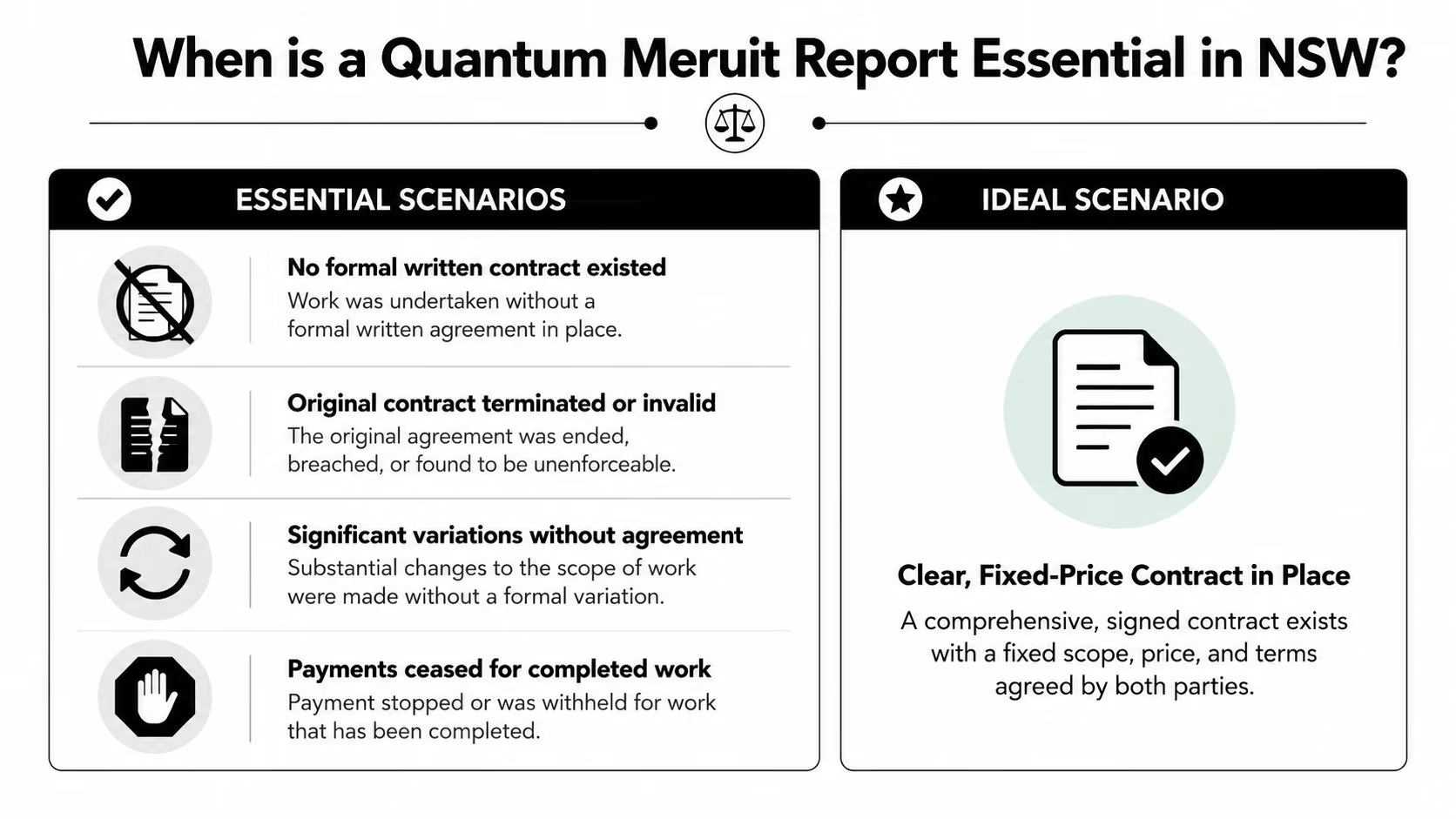
Typical dispute scenarios
One common scenario is a terminated residential building job. The frame is up, roof coverings may be partly installed, rough-in may be underway, and payments have stopped. The builder says the owner has received the benefit of substantial work. The owner says the contract ended for good reason and the claim is overstated. A report is then needed to assess the actual value of completed work, item by item.
Another scenario involves variations without proper written approval. This happens often enough on live projects. A staircase detail changes, drainage is altered, excavation deepens, or finishes are upgraded. The work proceeds because the site can’t wait, but the documentation remains incomplete. Once the relationship deteriorates, the parties no longer agree on what was directed, what was included, or what the variation was worth.
A third scenario arises where there was no adequate formal contract at all. The parties may have had a quote, a verbal understanding, a string of emails, or a partial scope. Work starts, money is paid in stages, and then the arrangement collapses. At that point, a tribunal still needs a method to assess value.
Where payment legislation and valuation can diverge
NSW building disputes can also sit awkwardly beside payment claim processes. Some matters fit neatly within statutory payment pathways. Others don’t, especially once the dispute has escalated and the core issue becomes evidentiary valuation rather than certification alone. For readers comparing contract claims with statutory pathways, it’s worth reviewing the NSW Security of Payment Act overview.
A report becomes particularly important when the contractual payment machinery hasn’t been followed cleanly, or can’t resolve the core dispute. That includes:
- Partial completion disputes: Work has value, but completion milestones were never properly reached or certified.
- Disputed verbal instructions: One side says extra work was requested. The other says it wasn’t authorised.
- Mixed claims involving defects: Some work is complete and valuable, while other items may justify deductions.
- Poor document trails: The claim exists, but the evidence needs to be reconstructed in a usable format.
The practical threshold
If the matter requires someone independent to identify scope, test the records, and build a valuation from trade evidence rather than assertion, a Quantum Meruit Report is usually no longer optional. It’s the bridge between site history and admissible opinion.
The Anatomy of an NCAT-Compliant Report
A tribunal-ready report has to do more than present a figure. It has to show the reasoning, the factual foundation, and the valuation path. If the report skips steps, it invites attack. If it overreaches, it loses credibility.
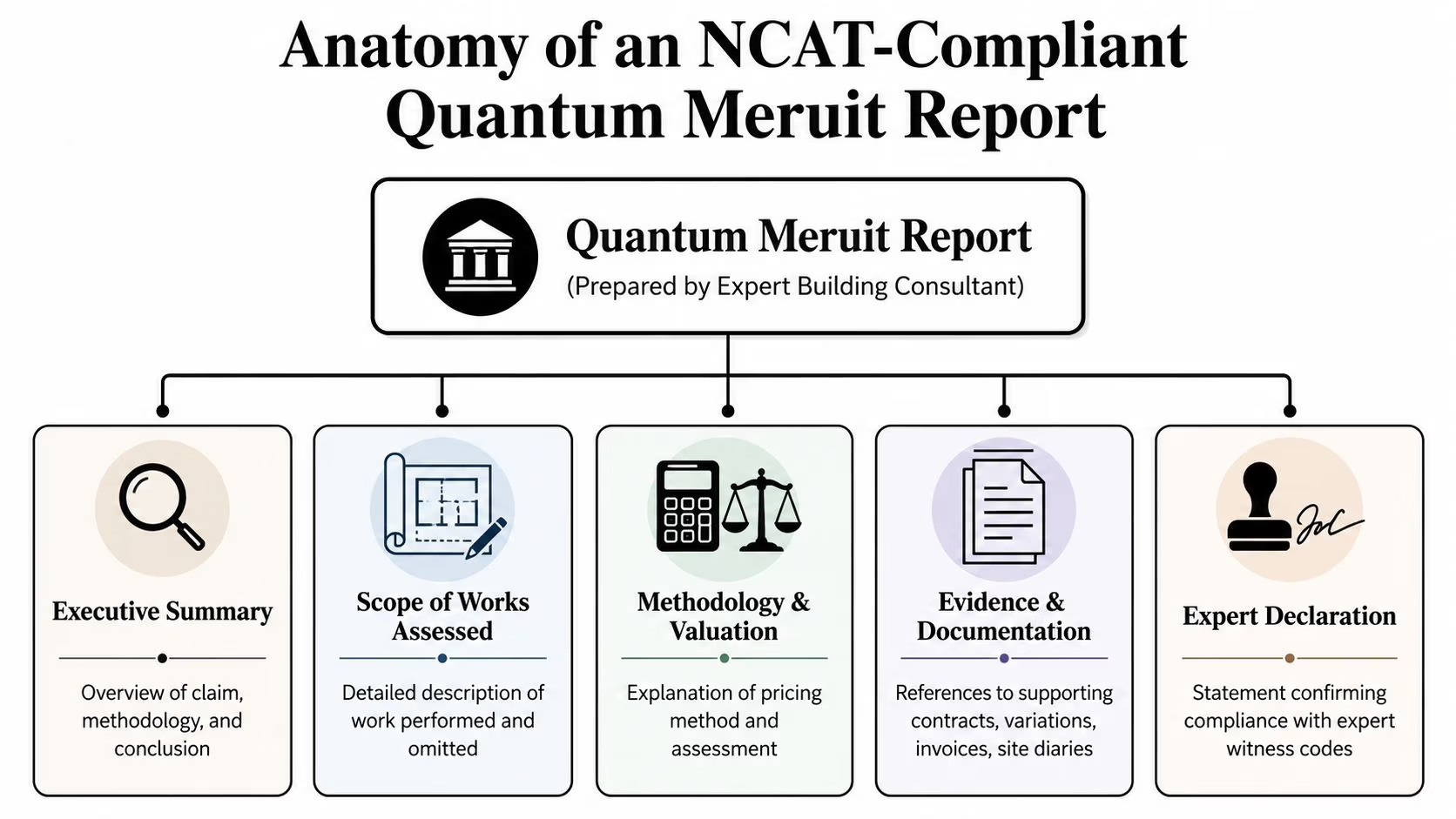
Scope comes first
The first task is identifying what work is being valued. That sounds obvious, but it’s where many claims become unreliable. A report should separate:
- completed work
- partly completed work
- omitted work
- defective work
- work said to be varied or additional
Without that separation, the final figure can become inflated or confused. Scope has to be tied back to observable site conditions and project records. Where the site condition no longer reflects the original state, the report may need to rely more heavily on contemporaneous photographs, diaries, delivery records, and correspondence.
Methodology must be transparent
A sound report explains how the valuer moved from evidence to amount. That includes the pricing basis, assumptions used, and any limitations caused by missing records. The tribunal doesn’t need mystery. It needs a method it can follow.
A useful methodology section will usually address:
| Report element | Why it matters |
|---|---|
| Document review | Shows what records were relied upon and what gaps remain |
| Site inspection findings | Connects the valuation to physical evidence |
| Trade measurement | Prevents broad-brush estimates from replacing actual scope |
| Pricing rationale | Explains how labour, materials, plant, and related costs were assessed |
| Adjustments | Identifies deductions for defects, omissions, or unsupported items |
A good expert report doesn’t hide weak points. It identifies them, limits them, and explains their effect on the valuation.
The valuation must be trade-based
This is where practical estimating experience matters. A proper Quantum Meruit Report should break the work into recognisable building components and trade packages. That often includes a breakdown for labour, materials, hire equipment, deliveries, onsite costs, offsite costs, and supervision.
With over 35 years of estimating building and construction costs, the difference is usually found here. Broad allowances tend to unravel under scrutiny. Detailed trade analysis tends to hold. If the dispute reaches formal proceedings, that level of structure also makes it easier for lawyers and decision-makers to test the claim.
For related litigation support work, including tribunal-focused reporting, readers can also review this building expert witness report service.
Deductions are part of a fair report
A credible report doesn’t only support the claimant’s favourable items. It also deals with what should be excluded. If part of the work is defective, incomplete, duplicated, or unsupported, the report should say so. That doesn’t weaken the report. It strengthens it.
A balanced report commonly includes:
- Allowance reductions where the evidence doesn’t fully support the claimed extent
- Defect-related deductions where workmanship affects value
- Exclusions for items outside the assessed scope
- Clarifications where records show a cost was incurred but don’t prove the work was incorporated into the project
Expert compliance matters
In tribunal and court contexts, form matters alongside substance. The report needs to be organised, clear, and prepared with the discipline expected of an expert opinion. That usually includes an executive summary, factual assumptions, documents relied on, inspection basis, valuation method, and an expert declaration consistent with the applicable code or procedural requirements.
Gathering the Right Evidence for Your Claim
The phrase quantum meruit is generally understood once explained. The harder issue is proof. In NSW disputes, the crucial gap is often the evidence needed to establish the reasonable value of labour, materials, and supervision when the contract is incomplete or payment milestones were never properly certified, as discussed in this commentary on the practical limits of quantum meruit claims.

What usually proves value
A tribunal doesn’t automatically accept that work occurred because someone says it did. The evidence has to show scope, timing, and connection to the claimed amount. The strongest files usually contain a mix of technical, commercial, and site-based records.
Key categories include:
- Contract records: Signed contracts, quotations, specifications, drawings, and schedules, even if one side says they were later displaced.
- Variation trail: Emails, texts, marked-up plans, site meeting notes, and any instruction that helps prove changes to scope.
- Progress material: Payment claims, claims summaries, worksheets, and draft valuations that show what was being claimed at the time.
- Site proof: Dated photographs, videos, diaries, delivery dockets, inspection records, and subcontractor attendance notes.
- Cost support: Invoices, receipts, purchase orders, labour records, and plant or equipment hire documents.
What works and what doesn’t
Not all evidence carries the same weight. A clean photo sequence linked to dates and work areas can be very persuasive. A spreadsheet prepared after the dispute started, with no supporting records behind it, usually isn’t.
Here is the practical difference:
| Stronger evidence | Weaker evidence |
|---|---|
| Contemporaneous site diary tied to daily activities | Retrospective summary created from memory |
| Invoices linked to installed work | Bulk supplier statements with no project allocation |
| Photos showing progress by area | Undated images with no context |
| Emails confirming directions | Broad verbal assertions with no supporting trail |
| Measured trade breakdowns | Round-number global claims |
The more a record was created during the project for ordinary site reasons, the easier it is to rely on later.
Organising the file before expert review
A well-organised brief saves time and usually leads to a stronger report. Documents should be grouped by type and then ordered chronologically. If there are multiple disputed variations, separate them. If there are photographs, name them by area and approximate date if exact metadata isn’t available.
For parties who need help tracing legal issues, contract pathways, and authority before the expert brief is finalised, a useful supporting resource is this step-by-step legal research guide. It won’t replace technical valuation, but it can help lawyers and self-represented parties frame the dispute more efficiently.
A short evidence checklist
Before commissioning a report, gather these first:
- Daily records: Site diaries, attendance notes, and supervisor logs.
- Visual proof: Photos of each stage, each room, or each work zone.
- Commercial documents: Invoices, receipts, subcontractor claims, and delivery dockets.
- Communications: Emails, texts, meeting notes, and instructions.
- Payment history: What was claimed, what was paid, and what was disputed.
If those records are missing, the report can still proceed in some matters. But the methodology has to be more conservative, and the scope for challenge becomes much wider.
A Practical Checklist for Commissioning a Report
Engaging an expert isn’t just an administrative step. The quality of your instructions can shape the quality of the report. A rushed brief with loose documents usually creates delay, extra questions, and a weaker end product.
Start with the right expert fit
You need someone who understands both building work and litigation support. Those aren’t the same skill set. A capable estimator may not know what a tribunal expects. A capable writer may not understand how the work was built.
When comparing experts, ask practical questions:
- What construction background supports the opinion
- Whether they inspect sites personally
- Whether they prepare reports for NCAT or court use
- How they deal with missing records, defects, and incomplete work
- Whether they can provide related material such as Scott Schedules
Prepare a usable written brief
A strong brief should identify the dispute history, the parties, the address, the works in question, and the specific purpose of the report. Don’t send boxes of unsorted material and expect clarity to emerge on its own.
A practical brief usually includes:
- A short chronology of the project and dispute.
- The key issues to be assessed, such as incomplete work, variations, termination, or unpaid labour and materials.
- The documents relied on, organised in folders or indexed PDFs.
- The intended forum, whether solicitor advice, negotiation, NCAT, or court.
Be upfront about adverse material
Clients sometimes hold back bad photos, complaint emails, or defect allegations because they think it protects their case. It usually does the opposite. An expert who sees the whole file can deal with the weak points properly. An expert surprised later in the process may need to revise opinions, which is expensive and avoidable.
If there are defects, delays, contradictory instructions, or missing approvals, disclose them early. A defensible report deals with them directly.
Clarify scope and costing at the outset
Before work starts, confirm what the expert will and won’t do. That includes whether the engagement covers a site inspection, document review only, valuation only, expert witness formatting, conference with lawyers, or later response work.
One available option for parties needing this specific service is the Quantum Meruit Report page from Awesim Building Consultants, which sets out the report’s role in disputed building work where approval or payment issues have arisen.
A straightforward commissioning checklist looks like this:
- Choose the right discipline: Building valuation for dispute purposes, not just a general estimate.
- Organise the evidence: Chronology, records, photos, claims, and communications.
- Define the question: What exactly must be valued, and for what purpose.
- Confirm deliverables: Report format, timing, inspection needs, and any follow-up requirements.
Your Expert Partner for Quantum Meruit Reports
Construction disputes rarely fail because people have no opinion. They fail because the opinion isn’t structured, supported, or measured in a way that a tribunal can use. A proper Quantum Meruit Report gives the dispute a framework. It identifies the work, values it by trade and evidence, and accounts for omissions and defects.
For homeowners, builders, and solicitors, that practical discipline matters. It can help in negotiation before proceedings. It can sharpen the issues once proceedings begin. It can also reduce the tendency for both sides to argue from broad numbers that have no clear foundation.
Awesim Building Consultants brings over 35 years of building and construction experience and more than 15 years of litigation support across disputes involving homeowners, builders, and lawyers. The work includes site investigations, Expert Witness Reports, Scott Schedules, and the kind of trade-based cost analysis needed when payment claims move beyond ordinary contract administration.
If your matter involves disputed variations, incomplete documentation, a terminated project, or work performed outside a clean contractual payment pathway, get the records reviewed properly before positions harden any further.
If you need a clear, evidence-based assessment of disputed building work, contact Awesim Building Consultants. Email admin@awesim.com.au or call 1800 293 746 to discuss a Quantum Meruit Report, Expert Witness Report, site investigation, or Scott Schedule for your NSW matter.