
Building Expert Witness Report Sydney: Your 2026 Guide

You’ve usually got this problem when the project has already gone off the rails.
A homeowner has water ingress, movement cracks, incomplete finishes, or work that doesn’t match the contract. A builder is facing a defect list that’s exaggerated, poorly described, or mixed up with maintenance items. A solicitor has a hearing date, a pile of photos, and no technically sound report that answers the Tribunal’s questions.
That’s where a proper building expert witness report Sydney matters. Not a routine inspection. Not a defect list scribbled into an email. A report built for scrutiny, cross-examination, and NCAT procedure.
In New South Wales, NCAT deals with a very large building dispute workload. The Consumer and Commercial Division registers over 25,000 applications annually, with approximately 15-20% involving home building disputes requiring expert witness reports under Procedural Direction 3 according to practical guidance on expert witness reporting in NSW. If your matter ends up there, the quality of the expert evidence often shapes what happens next.
What Makes a Building Report ‘Expert’ for NCAT?

An expert report is not just a more detailed inspection report. It serves a different purpose and is written under a different duty.
A standard building inspection is usually prepared for risk awareness. It tells a buyer or owner what was seen on the day and what may need further attention. An expert witness report is prepared for a dispute forum. It must identify the defect, explain the likely cause, link the issue to the relevant standard, and set out a rational rectification pathway.
The expert’s duty is to the Tribunal. That catches people out.
The expert is not your advocate
If you’re paying for the report, it’s easy to assume the consultant is there to “support your side”. That’s the wrong mindset. Once a consultant is acting as an expert witness, the report has to be independent, balanced, and based on observable facts and recognised standards.
Practical rule: If the report reads like an argument instead of an analysis, it’s already vulnerable.
That’s why compliance with the Expert Witness Code matters. NCAT expects experts to stay within their field, disclose assumptions, identify the material they relied on, and avoid advocacy. If you need to understand that duty properly, read the Expert Witness Code of Conduct Schedule 7 guide.
What NCAT expects to see
A compliant report generally needs more than photographs and opinions. It should show a method.
Key ingredients usually include:
- A defined scope so the reader knows what questions the expert was asked to answer.
- Document review covering plans, specifications, contracts, variations, approvals, prior reports, and relevant correspondence.
- A site-based methodology that explains what was inspected, what was not accessed, and what testing or observations were used.
- Standards linkage tying each conclusion back to the National Construction Code, Australian Standards, or other applicable benchmarks.
- Causation and remedy so the report deals not only with what is wrong, but why it is wrong and what rectification would reasonably address it.
Why routine reports usually fail in litigation
Routine inspections often use broad language such as “appears defective” or “recommend further review”. That wording may be fine in a pre-purchase context. It’s not enough in NCAT when parties are arguing over workmanship, responsibility, scope, and cost.
An expert report has to answer harder questions:
| Issue | Routine inspection | Expert witness report |
|---|---|---|
| Purpose | General condition snapshot | Evidence for dispute resolution |
| Standards references | Often limited | Must be specific and relevant |
| Causation analysis | Usually brief | Central to the opinion |
| Rectification scope | Often general | Should be technically reasoned |
| Tribunal use | Limited | Written for admissibility and challenge |
Some disputes also involve financial loss, delay, or accounting questions that sit outside building expertise. In those matters, parallel input such as specialist forensic accounting support can help the legal team separate technical defect evidence from loss quantification.
The standards aren’t optional
A building expert witness report Sydney should be anchored to the rules that govern the work. In practice, that often means the NCC, relevant Australian Standards, contract documents, approved plans, and NSW tolerances guidance where applicable.
NCAT doesn’t need drama. It needs clear evidence, proper standards references, and a report that stays in its lane.
If the report can’t show the path from observation to conclusion, it’s not expert evidence in any useful sense.
Selecting Your Sydney Building Expert A Crucial First Step
The most expensive mistake is often made before the first inspection happens. It’s choosing the wrong expert.
You don’t need someone who only knows how to write reports. You need someone who can inspect a live issue on site, recognise defective workmanship, distinguish cause from consequence, and then explain it in a way that survives challenge.
That matters more now because dispute pressure has increased. The NSW Government reported a 28% increase in Home Warranty Insurance claims from 2022 to 2025, and the same verified data notes that 85% of failed reports stem from inadequate standards referencing or cost quantification errors, as discussed in Effective Consultancy’s review of expert witness reports.
What to ask before you engage anyone
Don’t start with price. Start with suitability.
Ask direct questions such as:
- Have you personally prepared reports for NCAT building matters? You want someone who understands how these disputes operate.
- Do you inspect first and conclude later? A proper expert doesn’t arrive with the answer already formed.
- How do you deal with standards references? If the answer is vague, that’s a warning sign.
- Can you explain causation, not just list symptoms? Water ingress, cracking, and movement all need cause analysis.
- Are you comfortable with Scott Schedules and concurrent evidence? Many are not.
- Will you stay within your discipline? A credible expert knows when a structural engineer, hydraulic consultant, or quantity surveyor is needed.
Field experience beats polished theory
There’s no substitute for time on site. A consultant with long construction experience will often spot the sequence problem behind the visible defect.
For example, tiles may be drummy, cracked, or lifting. The visible issue is surface failure. The underlying issue may be substrate preparation, movement control, moisture, membrane detailing, or sequencing of trades. That distinction changes the report, the rectification method, and sometimes liability.
Here’s a practical comparison:
| What you need | Why it matters |
|---|---|
| Active construction knowledge | Helps identify workmanship failures in context |
| NCAT familiarity | Keeps the report aligned with procedure |
| Standards literacy | Prevents loose or unsupported conclusions |
| Clear writing | Helps the Tribunal follow the reasoning |
| Courtroom discipline | Reduces damage under cross-examination |
Red flags that should stop you
Some warning signs are immediate.
- Outcome promises. If an expert tells you they’ll “win the case”, they’re talking like an advocate, not an expert.
- One-sided language. Reports loaded with blame, emotion, or speculation are easy to attack.
- No clear scope. That leads to mission creep, loose opinions, and later admissibility arguments.
- No understanding of costing. A defect opinion without a reliable rectification basis often falls short.
- Overreach. Consultants damage their own credibility when they stray into engineering, legal interpretation, or specialist trade opinions they aren’t qualified to give.
The strongest experts are often the least theatrical. They inspect carefully, speak plainly, and document what they can prove.
A good expert won’t always tell you what you want to hear. Sometimes the defect list is overstated. Sometimes part of the problem is maintenance, owner changes, or incomplete instructions. That independence is exactly what makes the evidence useful.
The Expert Report Journey From Briefing to Site Investigation

A solid report starts long before anyone picks up a moisture meter or camera. The first job is to define the assignment properly.
That usually begins with a Letter of Instruction. Verified guidance on expert witness methodology notes that the process typically starts with a formal instruction letter to define scope, followed by a thorough site inspection that captures photographic evidence and links defects to specific NCC clauses or Australian Standards. The same source warns that inadequate disclosure of data collection methods can lead to 30-40% rejection rates in cross-examination, as outlined in Awesim’s expert witness building report process.
The instruction letter sets the rails
A proper brief stops the report drifting into opinion on everything under the sun.
The instruction should identify:
- The parties and property involved.
- The issues in dispute. Defects, incomplete works, causation, rectification, cost, or compliance.
- The documents available. Contract, plans, specifications, photos, correspondence, prior reports.
- The precise questions the expert is being asked to answer.
- Any limits on scope such as inaccessible areas, destructive testing restrictions, or time constraints.
Without that discipline, reports often become bloated, repetitive, and vulnerable.
What happens on site
A proper site investigation is systematic. It isn’t a casual walkthrough.
The consultant usually moves through the property with the dispute issues in mind while also checking the broader construction context. That means looking at the defect itself, the surrounding work, interfaces between trades, moisture paths, set-out, levels, alignment, finishes, tolerances, and signs of prior repair or concealment.
The inspection commonly involves:
- Photographic recording of each material issue from context view to close-up detail
- Document cross-checking against plans, specifications, and approved details
- Targeted observations tied to likely breaches of the NCC or relevant standards
- Non-destructive checks where appropriate, such as moisture readings or surface assessment
- Notes on access limits so no one later pretends the report dealt with areas that were never available for inspection
This short video gives useful context on how the evidence process is approached in practice:
What the expert is really looking for
Clients often think the expert is there to “find defects”. That’s only half the job.
The harder task is to separate categories of issue:
| Site observation | The real question behind it |
|---|---|
| Cracking | Cosmetic movement, structural concern, shrinkage, or poor articulation |
| Water staining | Active ingress, historic event, condensation, or plumbing source |
| Uneven finishes | Tolerance issue, substrate problem, or poor workmanship |
| Missing items | Variation dispute, incomplete works, or scope ambiguity |
That’s why raw evidence matters. Site photos, marked plans, inspection notes, and records of what was said on site can all become important later.
Bring your documents together before the inspection. Missing plans and incomplete contract records often create more confusion than the defect itself.
A well-run investigation doesn’t rush to blame. It builds a chain from observation, to cause, to standard, to remedy.
Structuring the Report for Maximum Impact and Admissibility
A persuasive report is usually calm, organised, and easy to follow. Tribunal members and solicitors shouldn’t have to hunt for the reasoning.
The strongest reports follow a structure that lets the reader move from instruction, to method, to findings, to conclusion without gaps. If the logic jumps around, the other side will exploit it.
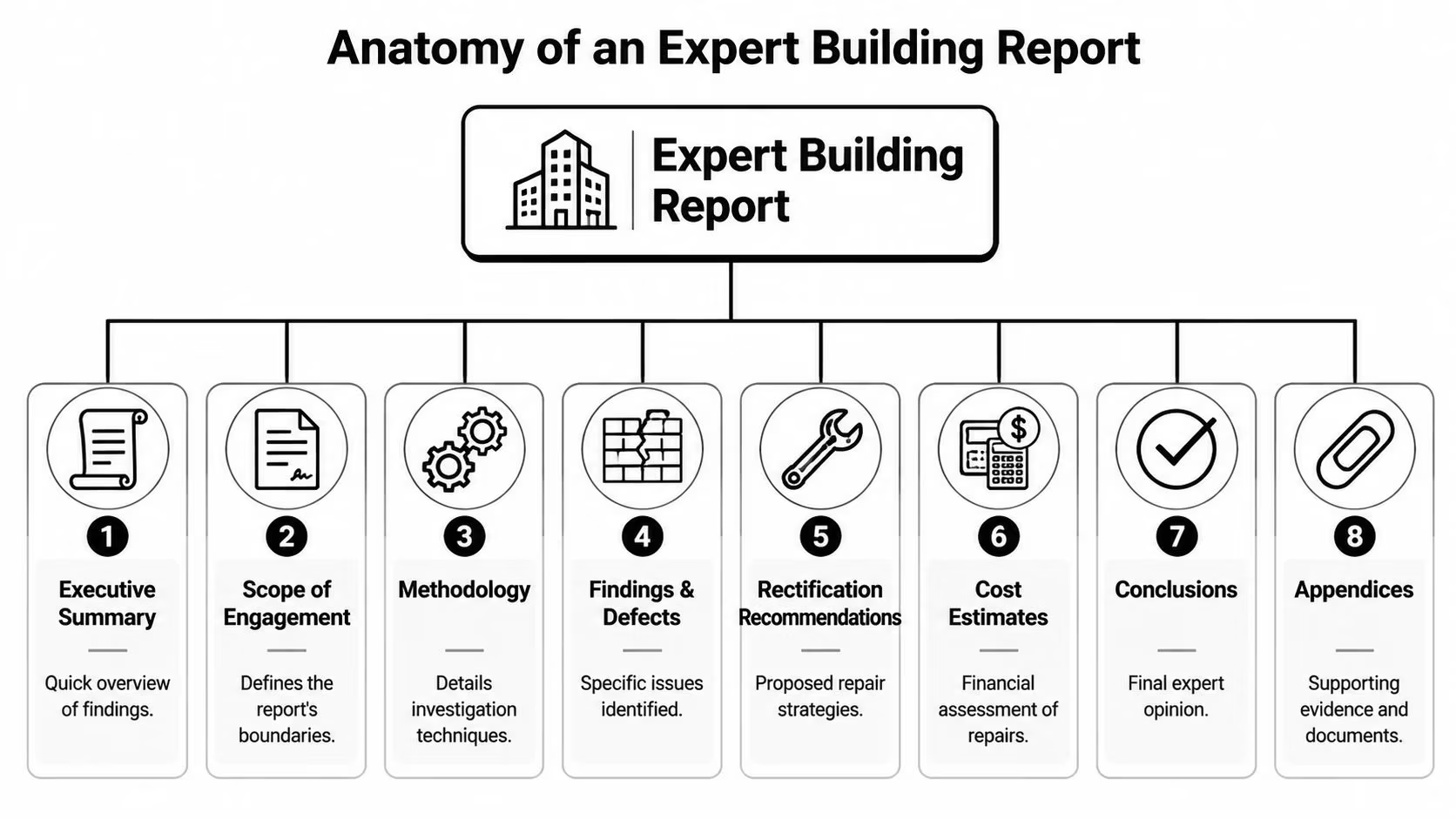
The core report anatomy
A practical report for NCAT usually includes the following parts.
Scope and instructions
This section states who engaged the expert, what documents were provided, what questions are to be answered, and what the report does not attempt to cover.
If the scope is blurred, the entire report weakens. The Tribunal needs to know exactly what task the expert undertook.
Qualifications and experience
This isn’t a marketing biography. It’s a credentials section.
It should identify the expert’s construction background, relevant licences or qualifications, and dispute-reporting experience. It also needs to make clear where the expert’s expertise ends.
What works: qualifications tied directly to the opinions given.
What doesn’t: long resumes that still don’t explain why the person is competent to opine on the issues in dispute.
Documents and material relied on
Every important opinion should be traceable to the material reviewed.
That usually includes contracts, plans, specifications, approval drawings, variation records, photographs, correspondence, prior reports, and inspection notes. If something important was not available, the report should say so.
Methodology is where many reports stand or fall
A report needs to explain how the conclusions were reached. That means setting out the inspection date, who attended, what access was available, what was visually observed, what measurements or readings were taken, and what limitations applied.
This part is often underdone. That’s a mistake.
A weak methodology section leaves openings such as:
- Unclear inspection basis making findings appear subjective
- No testing explanation when moisture, levels, or material condition are relevant
- Missing assumptions that only emerge under questioning
- No limitations note for concealed or inaccessible areas
The findings section should be defect-by-defect
This is the engine room. Each issue should usually be broken into a repeatable sequence:
| Report element | What it should do |
|---|---|
| Defect description | Identify the issue clearly and precisely |
| Location | Pinpoint where it occurs |
| Evidence | Refer to photos, observations, or documents |
| Standard reference | Link the issue to the relevant benchmark |
| Opinion on cause | Explain the likely reason for the defect |
| Rectification view | State what is required to address it |
That structure matters because NCAT doesn’t just need conclusions. It needs reasons.
Language must stay objective
The report should use plain, technical language. Not loaded language.
For example, “tile installation does not appear to comply with the specified substrate preparation requirements” is useful. “The builder did a terrible and unacceptable job” is not.
It also helps to include annotated photographs, marked-up plans where necessary, and appendices that support the main body without cluttering it.
A report becomes more persuasive when the reader can verify each step. Opinion first and evidence later is the wrong order.
The code acknowledgment and required declarations should also be properly signed and attached. If that formal side is neglected, a technically sound report can still end up with procedural problems.
Mastering the Scott Schedule and Quantifying Costs

A hearing date is set. The parties arrive with bundles of photos, emails, quotations, and competing defect lists. By mid-morning, the argument is not only about workmanship. It is about what item 7 means, whether item 12 is one defect or four, and which costs relate to rectification rather than improvement. That is the point where a properly prepared Scott Schedule starts doing real work.
In NCAT matters, especially under the tighter case management now being seen in 2026, the Scott Schedule is often the document that controls the dispute. Procedural Direction 3 (2025) has pushed parties and experts toward clearer issue definition and tighter document discipline. If the schedule is vague, repetitive, or padded with claim language, the report becomes harder to use in directions, conclaves, mediation, and hearing preparation.
A useful Scott Schedule reduces each disputed item to a form that can be decided. It should let the Tribunal, the parties, and any joint experts see the same issue in the same words, then test three things. What is alleged. What standard applies. What work and cost are said to fix it.
The format does not need to be elaborate. It does need to be disciplined.
A practical schedule usually includes:
- Item number
- Exact location
- Alleged defect or incomplete work
- Builder or respondent position
- Expert opinion
- Reference to drawings, photographs, or standards
- Recommended rectification scope
- Estimated reasonable cost
The drafting of each row matters more than the template. One item should deal with one defect condition. If a row mixes set-out error, drainage failure, and cracking into a single allegation, the responses become evasive and the costing becomes unreliable. I have seen matters lose a day because the schedule was drafted at too high a level.
The 2026 approach is more strategic than many parties expect. A good schedule is not prepared after the report as an administrative add-on. It is built alongside the inspection findings so the defects, standards, scope, and costing stay aligned. That is particularly important where the Tribunal orders experts to confer, because a disciplined schedule makes areas of agreement and disagreement visible much earlier.
Costing is where weak schedules usually break down.
An amount in the final column only has value if it reflects an actual rectification pathway. If balcony waterproofing has failed, the cost may need to cover strip-out, disposal, substrate preparation, falls correction, membrane installation, flood testing where appropriate, tile reinstatement, and making good to adjoining work. If the item is limited to local sealant failure at a junction, the allowance should reflect that narrower scope. The schedule has to show which of those positions the expert is taking.
That is why I prefer cost notes that state the basis of allowance in plain terms. Labour, materials, access, demolition, waste removal, protection, and reinstatement should be considered item by item or in logical trade groups. Rawlinsons, current subcontractor rates, and recent tendered rates can all assist, but the expert still has to explain why the figure is reasonable for the actual defect condition observed.
For parties trying to understand the likely scope, preparation effort, and pricing involved, this outline on the cost of a Scott Schedule is a useful starting point.
The difference between a weak and effective schedule is usually obvious:
| Weak Scott Schedule | Effective Scott Schedule |
|---|---|
| Broad complaint wording | Single, identifiable defect per row |
| Scope of work unclear | Rectification steps stated clearly |
| Cost entered as a lump sum | Cost tied to the proposed repair method |
| No distinction between defect and upgrade | Rectification limited to making the work compliant |
| Difficult to use in conclave or hearing | Easy to compare positions item by item |
That last point matters. A schedule should separate rectification from betterment. NCAT will want to know the reasonable cost of addressing defective or incomplete work, not the price of replacing serviceable work with a higher specification. If the costing drifts into upgrade territory, the other side will attack it quickly and often successfully.
Lawyers also use the schedule as a case management tool. It helps identify which items need another specialist, which items are really about contractual scope, and which are suitable for early compromise. For firms coordinating inspections, conferences, and hearing preparation, tools such as TimeTackle legal time software can assist with the administrative side, but the Scott Schedule remains the central technical record.
The best schedules narrow the dispute with precision. They do not try to win the case through volume. They give the Tribunal a defect map, a standards path, and a cost basis that can survive scrutiny. That is what makes them useful.
Critical Mistakes That Can Weaken Your Expert Report
A common 2026 NCAT scenario goes like this. The party has photos, invoices, messages, and a report that looks substantial at first glance. Then the hearing starts, the expert is pressed on independence, methodology, or the basis of a cost figure, and the report loses weight fast.
That usually happens because the report was prepared to support a position, not to meet the Tribunal’s requirements. Under NCAT’s current approach, including Procedural Direction 3 (2025), an expert report has to do more than sound technical. It has to show a disciplined method, stay within the expert’s field, and give the Tribunal a clear path from observation to opinion.
The weakest reports tend to fail in predictable ways.
- Partisanship in tone or method. If the expert appears to be arguing the client’s case, the report becomes easier to challenge. NCAT expects independence, and experienced lawyers test that early.
- Opinions outside the expert’s actual discipline. A building consultant can identify many defects and compliance issues, but some questions belong to a structural engineer, certifier, hydraulic consultant, waterproofing specialist, or quantity surveyor.
- Conclusions without a standards pathway. Saying work is defective is not enough. The report should identify the relevant contract requirement, Code provision, Australian Standard, manufacturer instruction, or accepted trade practice, then explain the non-compliance.
- Poor scope control. Reports often become bloated because the author comments on every complaint raised in emails, text messages, and site conversations. That creates avoidable attack points.
- Weak evidence handling. Unclear photographs, missing dates, no marked-up plans, inconsistent room names, and annexures that do not match the body of the report all reduce reliability.
- Causation and rectification mixed together. It is common to see a report jump from a defect observation straight to a repair recommendation without explaining the likely cause. That gap matters when liability is disputed.
- Repair opinions that amount to upgrades. If the proposed work goes beyond what is reasonably required to rectify the defect, the other side will say the report is inflating the claim.
- No regard to the Tribunal file. I still see experts prepare reports as if nobody will compare them against pleadings, quotations, prior reports, and directions. They will. Inconsistency causes trouble.
One point deserves special attention. A report can be technically right and still perform poorly in the proceedings if the expert has not read the orders, the pleaded issues, and the core questions in dispute. That is where experience in litigation support matters. The task is not just to inspect a building. The task is to produce an opinion that can survive conference, joint report discussions, cross-examination, and close reading by a Tribunal Member.
A practical check before service helps. Ask these questions.
- Does the report read as independent, or as an argument for one party?
- Does each material opinion identify the evidence relied on?
- Is every serious conclusion tied to a recognised standard, contract term, or other clear benchmark?
- Has the expert stayed within their discipline and identified where another specialist is needed?
- Are the photographs, annexures, and room references consistent from start to finish?
- Do the proposed rectification works address the defect, rather than improve the property beyond compliance?
- Would a Member who has never visited the site understand the defect, the basis of the opinion, and the reasonable remedy?
If any answer is no, fix it before the hearing date. That work is cheaper before service than after the other side has exposed the weakness.
If you need an independent assessment for a dispute, rectification claim, or NCAT matter, Awesim Building Consultants can assist with site investigations, expert witness reports, and Scott Schedules across Sydney and NSW. For a confidential discussion, email admin@awesim.com.au or call 1800 293 746.
Related Posts

NCAT Consumer Division: Steps From Lodgement to Hearing
Most people who end up at the NCAT Consumer and Commercial Division do not arrive there by choice. They arrive
Read More »
Statutory Warranty NSW: What Builders Must Fix and for How Long
Statutory warranty NSW obligations exist precisely for the moment a builder stops returning calls. A crack appears in the render.
Read More »
Home Building Act NSW: Key Clauses Every Owner Should Know
The Home Building Act 1989 (NSW) sets the rules for residential building work in New South Wales. It requires licensed
Read More »