
Construction Cost Consultant: Your Guide for NSW Disputes
A building dispute usually starts with one sentence: “That’s not what we agreed.”
Then the paperwork starts piling up. A builder says the extra work was necessary. A homeowner says the variation was never approved. Someone produces an invoice with round figures and little detail. Someone else waves around photos of defects. By the time NCAT is mentioned, both sides are often tired, angry, and guessing at the cost position.
That’s where a Construction Cost Consultant matters. Not the kind hired to help price a clean project before the first sod is turned. The one brought in when the relationship has broken down, the numbers are contested, and every dollar may need to be justified against documents, site evidence, and current market rates.
When Building Dreams Become Financial Nightmares
A common NSW dispute looks like this. The renovation starts well enough. Then excavation uncovers a problem. Joinery changes. Waterproofing is questioned. Progress claims get larger. Emails get sharper. Before long, the job isn’t just about building anymore. It’s about proving what work was done, what it should have cost, and who should carry the loss.
For homeowners, that’s frightening because the figures often stop making sense. For builders, it’s just as dangerous because legitimate work can go unpaid if it isn’t properly valued and documented. Verbal instructions, rough allowances, and vague invoices might feel manageable during the job. In a dispute, they become liabilities.

The scale of the problem shouldn’t surprise anyone. The Australian construction industry is projected to reach a market size of $641.1 billion in 2026, with over 431,000 businesses, according to IBISWorld’s Australia construction industry data. With that amount of work moving through the system, defects, variations, payment fights, and scope disagreements are inevitable.
What a dispute specialist actually does
A dispute-focused construction cost consultant is part estimator, part investigator, and part translator. They take a mess of claims, invoices, plans, photos, contracts, and site conditions, then turn it into something a tribunal can follow.
That means asking hard questions:
- Was the work in scope under the original contract, or was it a variation?
- Was the claimed amount reasonable for that type of work in that location?
- Did defective work inflate the claim because rectification is now needed?
- Can the cost position be tied to evidence, not assumptions?
Practical rule: If a cost can’t be traced to documents, site evidence, or a recognised method of valuation, it usually won’t survive serious scrutiny.
If you’re trying to make sense of why prices have shifted so sharply in recent years, understanding construction cost inflation is useful background reading. It won’t replace case-specific analysis, but it helps explain why old assumptions about “reasonable cost” often fall apart in a live dispute.
Why independent cost evidence matters
In these matters, opinion isn’t enough. A tribunal needs a clear path from defect or variation to financial consequence. That’s why an independent consultant matters. They don’t just total invoices. They test them.
A good report brings order where the project has lost it. It separates emotional argument from measurable cost. That’s often the first point where a dispute becomes manageable.
The Two Faces of Construction Cost Consulting
A homeowner can have two people look at the same project and get two very different answers. One will say what the build should cost if everything runs properly. The other will say what the disputed work is worth now, after delays, defects, scope arguments, and payment claims have turned the file into evidence.
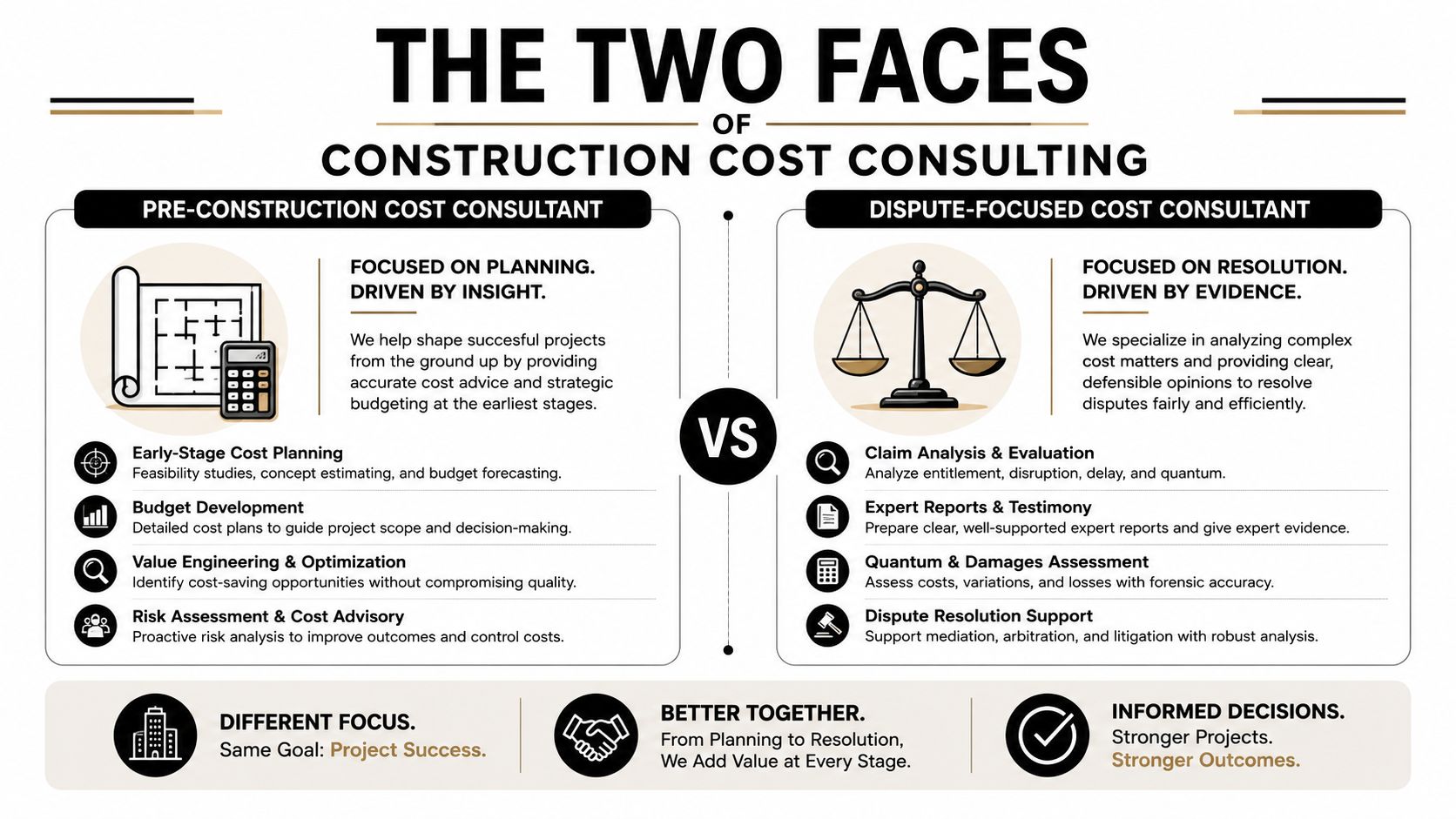
Pre-contract planning versus forensic cost work
Pre-construction cost consulting is about prediction. Dispute cost consulting is about proof.
Before a contract is signed, or while a job is still on track, a quantity surveyor or estimator usually helps with pricing, budget allocation, tender review, and contingency allowances. That work is commercial and forward-looking. It helps an owner avoid under-budgeting and helps a builder price the risk sensibly.
Once the matter is heading toward NCAT, the brief changes. The consultant is no longer asking, “What should this project cost?” The actual questions are harder.
- What is the reasonable value of work if the contract wording, scope, or instructions are disputed?
- Which variations can be supported by documents, measurements, or site evidence?
- What part of the claim relates to incomplete work, defective work, or rectification?
- Will the costing method stand up if the other side, their solicitor, or the Tribunal pulls it apart line by line?
That is forensic work. It is closer to investigation than budgeting.
The wrong consultant can weaken the case
I see this regularly in NSW disputes. Parties engage a capable estimator who knows rates and quantities, but has little experience with NCAT procedure, Scott Schedules, or reasonable value claims. The numbers may look tidy and still be unusable.
A dispute report has to do more than show arithmetic. It must connect each amount to the contract, the actual work on site, the evidence available, and the legal issue being argued. If that chain breaks, the figure is exposed. A Scott Schedule works like a spreadsheet version of the dispute itself. Each item has to match the allegation, the response, and the cost consequence. Quantum Meruit is similar. It is not a fancy way of saying “send a bigger invoice.” It is a method for valuing work where the contract path has failed or become contested, and the reasoning behind the valuation matters as much as the total.
A budget forecast helps with planning. A dispute cost report has to survive challenge.
For disputes involving reasonable value assessments, defective work, or contested payment claims, a guide on when a quantum expert is needed in building matters explains why ordinary estimating experience often falls short.
A simple way to choose
Ask one direct question. What does this consultant spend most of their week producing?
| Consultant type | Main focus | Typical output | Best time to engage |
|---|---|---|---|
| Pre-construction cost consultant | Budgeting, cost planning, tender pricing | Estimate, elemental cost plan, tender review | Before or during the build |
| Dispute-focused cost consultant | Evidence-based valuation for contested matters | Scott Schedule, quantum assessment, expert report support | After defects, delays, variations, or payment disputes arise |
If the matter is in NCAT, or plainly heading there, choose the consultant who knows how costs are tested in a live dispute, not just how they are forecast at the start of a job.
Core Services for Building Disputes in NSW
Once a building matter reaches NCAT, mediation, or solicitor-led negotiation, the cost consultant’s job changes. The task is no longer estimating what a project should cost. It is proving, item by item, what was built, what was omitted, what is defective, what was varied, and what each issue is worth in dollars.
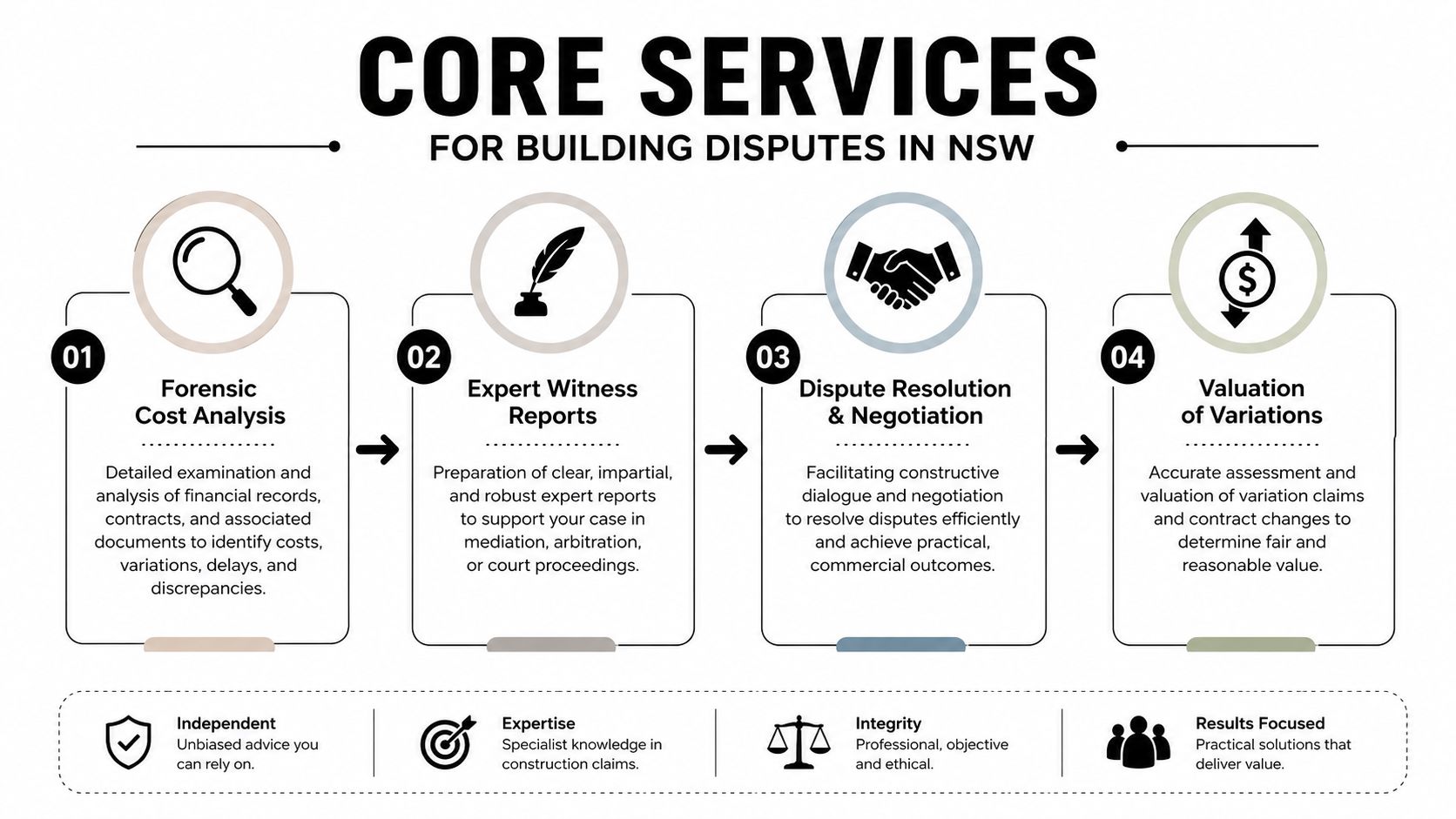
Forensic cost analysis
Forensic cost analysis starts with distrust of neat totals.
A disputed claim might look tidy on the page and still be badly wrong once it is checked against the contract, drawings, specifications, progress claims, invoices, emails, site photos, and what can be seen on site. In NSW residential disputes, the common problem is category confusion. Owners, builders, and sometimes even project managers roll incomplete work, defective work, excluded work, and variations into one figure. That is how weak claims get dressed up as strong ones.
A proper review separates those categories because each one is valued differently. A variation may depend on notice, scope change, and rate. Defective work turns on reasonable rectification cost, not the original contract price. Incomplete work is usually measured by the cost to finish, less any allowance already paid.
One practical reference point is Bidkon’s discussion of variation disputes in its construction cost planning and benchmarking guidance. The exact percentage matters less than the pattern. Unagreed variations turn up again and again in residential claims, and they are often poorly documented.
On site reality: the figure that survives scrutiny is usually the one tied to documents, measurements, and a repair method. Noise does not hold up in a tribunal.
If you want a basic estimating refresher before getting into dispute valuation, this guide for construction estimators explains the foundation. Dispute work goes further. It tests entitlement, evidence, and reasonableness, not just price.
Expert witness reports
An expert witness report for NCAT has to do one job well. It must give the decision-maker a clear path from evidence to opinion.
That means the report needs a disciplined structure. Instructions received. Documents reviewed. Site observations. Method used. Assumptions made. Limits on the opinion. Final conclusions. If a consultant cannot show how a rectification allowance was built up, line by line, the number is exposed the moment the other side asks questions.
Under NCAT practice requirements, expert evidence also has to stay independent. The consultant is not there to repeat the client’s grievance in polished language. The consultant is there to assess cost, scope, and value in a way that can withstand challenge from the other party, their expert, and the Tribunal.
Homeowners often underestimate how much this discipline affects cost. A short letter with broad comments is cheap and usually of limited use. A tribunal-ready report takes much longer because every conclusion has to be anchored to records, inspection findings, and a method that can be defended. For a practical breakdown of likely report pricing, see this article on expert witness report costs in NSW in 2026.
The following video gives useful context on the broader dispute environment and how building matters are often prepared for formal review.
Scott Schedules
In NSW building disputes, a Scott Schedule often becomes the control document for the quantum side of the case.
It works like a case ledger. Each defect, incomplete item, or disputed variation is listed separately so everyone can see the allegation, the response, the proposed rectification scope, and the competing cost positions. That structure matters because NCAT members do not decide building disputes by reacting to a pile of photos and invoices. They need issues broken down into manageable parts.
A useful Scott Schedule usually records:
- Item number for tracking and cross-reference.
- Clear description of the issue in factual language.
- Exact location within the property.
- Nature of the complaint, such as defect, omission, incomplete work, or variation.
- Rectification or completion scope with enough detail to price properly.
- Each party’s cost position and the basis for that figure.
The quality of the schedule often shapes the quality of the negotiation. If the schedule is vague, the parties argue in generalities. If it is precise, weak items are exposed early and cost issues become easier to resolve.
Quantum Meruit valuations
Quantum Meruit claims usually appear when the contract path has broken down or does not give a clean answer on payment. In plain terms, the question becomes: what was the reasonable value of the work carried out?
That sounds straightforward until you test it. Reasonable value is not whatever the contractor says is fair, and it is not whatever the owner wishes they had paid. It has to be assessed against the work performed, the quality achieved, the market rate, the degree of completion, and whether parts of the work are defective or non-compliant.
In practice, these valuations require careful separation of claim components. Labour, materials, preliminaries, subcontract costs, overhead recovery, and margin may all need review. If part of the work has to be demolished and redone, the gross claim tells only half the story. The consultant has to assess value with the defects and contractual context in view.
Handled properly, this service gives the parties something they rarely have at the start of a dispute. A reasoned number.
Understanding the Costs How Fees Are Structured
The first question asked is fair enough. “What will a construction cost consultant cost me?”
The honest answer is that fees depend on the work required, not just the name of the report. A simple desktop review of documents is one thing. A full site inspection, defect analysis, Scott Schedule, and tribunal-ready expert report is another.
What usually drives the fee
Most dispute consultants structure fees in one of two ways. They may charge hourly for investigation, review, conferencing, and ongoing analysis. Or they may offer a fixed fee for a defined deliverable such as a Scott Schedule or a specific report, provided the scope is clear.
The final cost is usually shaped by a handful of factors:
- Document quality. If the file includes organised contracts, plans, emails, invoices, and dated photos, the work moves faster.
- Number of issues in dispute. A handful of variations is easier to assess than a long list of defects across multiple rooms or stages.
- Site complexity. Occupied homes, concealed defects, or incomplete access often increase the time needed.
- Urgency. Tight tribunal deadlines compress the work and leave less room for staged review.
- Need for attendance. Meetings, joint expert discussions, or tribunal appearances add to the scope.
Why benchmark rates matter
In Quantum Meruit matters, the consultant often has to test whether a claimed amount aligns with current building rates. In NSW, residential construction costs can fluctuate between AUD $2,200 and $3,500 per square metre, and those benchmarks are used to help substantiate the reasonable value of work for NCAT purposes, as outlined by WT Partnership’s cost management and quantity surveying guidance.
That doesn’t mean every dispute gets priced by square metre. It means benchmark rates provide a reference point. They help test whether a claim is plausible before the consultant drills down into the specific trade, scope, specification, and workmanship issues involved.
Cheap reports often become expensive mistakes. If the analysis is thin, the other side will find the holes quickly.
For readers who want a plain-language primer on how estimating logic works before it’s adapted to dispute work, this guide for construction estimators is a useful starting point.
If you want a more direct look at likely reporting costs in this context, how much an expert witness report costs in NSW in 2026 gives a practical breakdown of the issues that tend to affect price.
What doesn’t work
Clients sometimes try to save money by giving half the documents, asking for a fast “ballpark” opinion, or expecting a serious report without a site inspection where one is clearly needed. That approach rarely saves anything. It usually means the consultant has to revisit the file later, or the report ends up too weak to be useful.
The better approach is to define the purpose at the start. Are you negotiating? Preparing for NCAT? Testing a claim before filing? The clearer the objective, the cleaner the fee structure.
Your Engagement Process A Step by Step Guide
People are often more anxious about the process than the report itself. That’s understandable. Most clients reach out when the project is already under strain and they’re worried about time, cost, and what they may have missed.
A structured engagement helps. It turns a stressful dispute into a sequence of manageable steps.
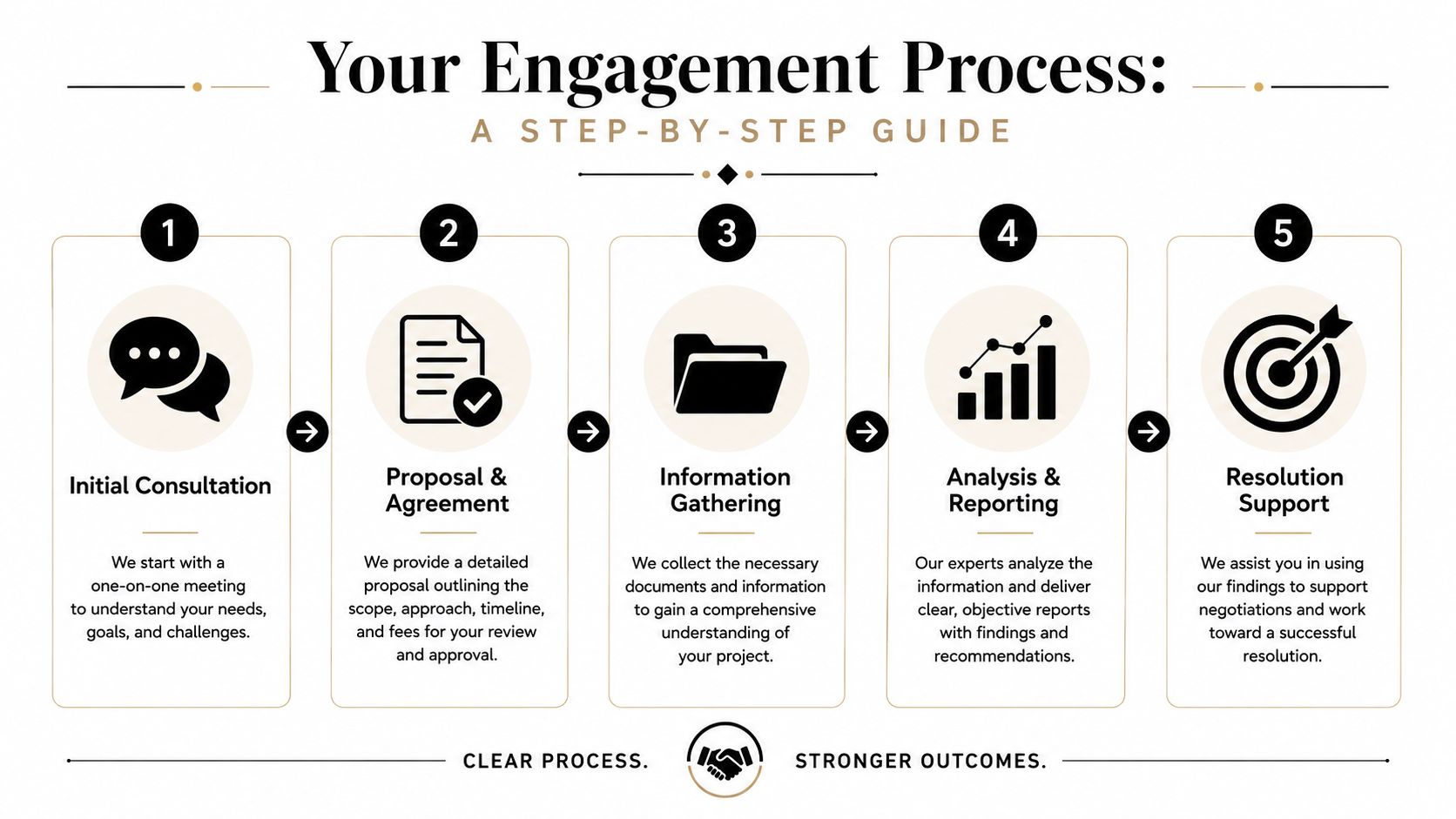
Step one and step two
The first stage is the initial consultation, during which the consultant works out what sort of dispute it is. Is it mainly about defects, unpaid work, disputed variations, incomplete scope, or a mix of all four? That distinction matters because the methodology follows the issue.
The second stage is scoping and agreement. A proper consultant should define what they are being asked to do and what they are not being asked to do. If the engagement is for a Scott Schedule, that should be clear. If it includes an expert report, site inspection, or review of the other side’s material, that should also be written down.
Step three
Next comes document collection. This stage is often where matters improve or deteriorate.
For an NCAT report, the instructing party needs to provide the relevant materials, including contracts, plans, emails, and photos, so the conclusions are evidence-based. The expert then documents all material facts, assumptions, and the methodology used, as explained in this guide to NCAT expert witness reports.
A practical file usually includes:
- Contract documents such as the signed agreement, specifications, and approved variations
- Project records, including progress claims, invoices, payment receipts, and programme information
- Communications like emails, letters, text messages, and site instructions
- Visual evidence consisting of dated photographs and videos
- Plans and consultant documents where they help define the scope or compliance position
Step four
Then comes the site investigation and analysis. At this stage, the consultant checks whether the documents match the built outcome.
They inspect the relevant items, photograph the issues, compare alleged defects with standards or contractual scope, and begin costing. In a dispute about variations, they may compare the claimed work against what was originally included. In a defect matter, they may separate cosmetic complaints from genuine non-compliance requiring rectification.
Step five
The last stage is reporting and resolution support. Depending on the engagement, that may mean a Scott Schedule, a Quantum Meruit valuation, a full expert report, or targeted advice for negotiation.
A sound process at this stage usually looks like this:
- Drafting the report in a clear, tribunal-friendly structure.
- Checking evidence links so every conclusion can be traced back to a document, observation, or costing method.
- Finalising the document for service, negotiation, or filing.
- Supporting the matter if questions arise from lawyers, the other party, or the tribunal.
The strongest brief is usually the most boring one. Clean dates, complete documents, labelled photos, and a clear timeline beat dramatic emails every time.
The process isn’t glamorous. It’s disciplined. That’s why it works.
Key Questions to Ask Your Potential Consultant
Before you engage anyone, ask direct questions. A polished website and a confident phone manner don’t tell you whether the person can produce a report that holds up under scrutiny.
The right questions force the consultant to show whether they understand dispute work at a professional level.
Ask about compliance, not just experience
A consultant should be able to explain what an NCAT-compliant expert report requires. Under Procedural Direction 3, the report must include a statement of qualifications, disclosure of relationships, an explanation of methodology, and a signed declaration confirming the expert understands their overriding duty to the tribunal, as outlined in this explanation of NCAT Procedural Direction 3 and expert evidence.
If the consultant hesitates when asked about those components, that’s a warning sign.
Questions worth putting on the table
Use questions that reveal how the consultant thinks, not just what they claim to have done.
- How do you distinguish estimating from dispute valuation in an NCAT matter?
- What documents do you need before you’ll express an opinion on defects, variations, or reasonable value?
- How do you deal with missing records when the paperwork is incomplete?
- How do you structure a Scott Schedule so the cost items are tied to evidence?
- What assumptions do you usually need to state in your reports?
A capable consultant should answer plainly. They shouldn’t hide behind jargon.
The answer you’re listening for
You want to hear discipline. You want to hear caution where caution is needed. You want to hear that they test facts rather than adopt the client’s version and dress it up.
A good consultant won’t promise to “win” the case. They’ll tell you whether the evidence supports the claim, what documents are missing, and where the weaknesses sit.
For a practical benchmark on how to compare one professional against another, how to compare construction consultants in Sydney is a sensible checklist.
The best expert in a dispute is rarely the one who sounds most certain at the start. It’s the one who knows exactly what must be proved and what can’t be assumed.
Achieve Clarity and Control Your Next Steps
A building dispute becomes more manageable the moment the numbers stop being emotional and start being evidentiary. That’s the core value of a specialist construction cost consultant in NSW disputes. They don’t just prepare figures. They turn a confused cost argument into a structured position that can be tested, negotiated, or presented properly.
For homeowners, that means understanding whether a demand is inflated, whether a defect claim is costed correctly, and what documents still need to be gathered. For builders, it means giving legitimate work a fair and defensible valuation, particularly where variations or incomplete contracts have muddied the waters. For lawyers, it means working from a report that is organised, methodical, and capable of standing up to challenge.
General budgeting skills aren’t enough once NCAT procedure, Scott Schedules, expert evidence, and Quantum Meruit issues come into play. This is a specialised part of the industry. It calls for someone who understands how construction happens on site and how evidence must be presented when the project has ended in dispute.
Awesim Building Consultants have 35+ years in Building & Construction, with over 15+ years providing litigation support to home owners, builders and lawyers. They provide site investigations, Building & Construction Expert Witness Reports and Scott Schedules. If you need help, it’s worth reviewing related service pages on the Awesim website so you can match the service to the actual dispute, rather than guessing at what kind of consultant you need.
If you’re at the point where progress claims, defects, variations, or payment disputes are no longer being resolved by ordinary discussion, don’t wait for the paperwork to get worse. A clear brief, a proper site review, and an evidence-based cost analysis can save a great deal of wasted time and pressure.
If you need practical help from Awesim Building Consultants, contact the team at admin@awesim.com.au or call 1800 293 746. They assist home owners, builders, and lawyers with site investigations, Building & Construction Expert Witness Reports, Scott Schedules, and dispute-focused construction cost consulting across NSW.
Related Posts

Water Damage in Homes: How to Track Down the Source
Water damage in a home rarely announces itself at the source. A stain on the ceiling, a musty smell in
Read More »
Waterproofing Membrane Types: Which Fails Most in NSW Bathrooms
Waterproofing failure is the single most common serious defect found in NSW apartments, and the type of membrane used, along
Read More »
Building Certifier NSW: Role, Limits, and When You Need More
A building certifier in NSW is a registered professional who issues construction certificates, conducts critical stage inspections, and grants occupation
Read More »