
Construction Management Expert Witness: A NSW Guide
You’ve got the photos, the emails, the builder’s denial, and the sinking feeling that nobody independent has really looked at the job. That’s the point where a lot of NSW homeowners, builders, and junior solicitors start asking the same practical question, who turns all of this into evidence a tribunal or court can use?
A construction management expert witness does that translation work. They don’t just stand on site and point at defects. They examine the records, inspect the work, test the explanations, and give an independent opinion about what likely happened, why it happened, and what it means for cost, delay, compliance, or rectification. In plain English, they’re the person who turns a messy building dispute into something a decision-maker can follow without having to guess.
What a Construction Management Expert Witness Actually Does
A Sydney homeowner usually doesn’t call an expert witness on a happy project. They call after the builder’s response lands, the rectification claim is denied, and the folder of photos starts feeling heavier than the facts. At that point, the core problem isn’t just the defect, it’s proving whether the defect came from workmanship, design, access, a late variation, or something the client themselves caused.
More translator than inspector
A construction management expert witness is not the same thing as a building inspector, a quantity surveyor, or a solicitor. An inspector may identify defects. A quantity surveyor may value work or loss. A solicitor may frame the legal case. The expert witness sits in the middle of the technical side and gives independent opinion evidence that can be tested in NCAT or court.
That role matters because the larger Australian construction sector is, the more disputes are going to turn on detailed technical disagreement rather than minor cosmetic complaints. The ABS figures cited in the brief show construction contributed about 7.5% of Australia’s gross value added in 2022–23 and employed roughly 1.29 million people in August 2024. That scale helps explain why disputes over delay, variation pricing, quality, and compliance show up so often in the files that land on an expert’s desk. For a good plain-English overview of how builders think about positioning and credibility in the market, this guide to winning profitable jobs is a useful read.
Practical rule: if the question is “what is wrong?”, you may need an inspector. If the question is “what caused it, who bears it, and what does it cost to fix?”, you’re in expert witness territory.
What they’re really expected to deliver
The deliverable is usually not a casual opinion. It’s a structured report, sometimes a Scott Schedule, sometimes both, that pulls site observations, contract documents, photos, correspondence, and standards into one defensible view. That report should help the tribunal member or judge see the issue item by item, not just as a story with one side’s version attached.
If you’re unsure whether your dispute fits the pattern, a useful test is this. Are you trying to prove defects, delay, incomplete works, or a pricing dispute, and do you need someone independent to explain the technical reasoning? If yes, you’re probably looking at the right kind of expert.
Why NSW Construction Disputes Need Independent Expert Evidence
NSW doesn’t treat every building dispute as a simple yes-or-no argument. The system expects the parties to put forward evidence that can be tested, compared, and challenged. That’s why expert reports aren’t a luxury in many matters, they’re often the thing that lets the case move at all.
How the tribunal setting shapes the evidence
NCAT is the principal tribunal for many home building and consumer disputes in NSW, and its procedures expect evidence to be organised, objective, and capable of being tested by the other side. The current procedural framework includes directions for expert evidence and structured comparison documents such as Scott Schedules, which are used to compare alleged defects, rectification items, and responses in a disciplined way. In other words, the forum itself pushes the dispute towards itemised, technical evidence rather than broad complaint language. You can see the practical role of independent reports in NSW building matters in this overview of how an expert witness helps in construction disputes.
NSW Fair Trading also sits inside the wider home building dispute environment, which is why workmanship, warranties, and compliance get such careful attention. That regulatory and tribunal model means expert reports have become central whenever the issues are defects, delay, variations, or incomplete works. The expert isn’t there to argue the case like a solicitor. They’re there so the decision-maker can see whether the alleged failure matches the records, the standards, and the site conditions.
The pathway most disputes follow
A simple way to picture it is complaint, expert report, Scott Schedule, hearing or settlement. Sometimes the matter settles once both sides see the technical position clearly. Sometimes the report sharpens the disagreement because one side can no longer rely on vague claims.
An independent expert is most useful when both sides need a version of the facts they can actually test.
The key point is simple. In NSW, the expert witness isn’t a hired gun. They’re the person both sides may have to trust if the case is going to settle fairly or be decided properly.
Qualifications That Actually Matter in NSW
Many people assume “qualified” means having a degree and a few years in the industry. That is too vague for tribunal work. In NSW, the better question is whether the expert has case-specific qualifications, meaning they have done the kind of work the dispute is about and can explain it clearly under pressure.
Experience that matches the dispute
A licensed structural engineer versus someone who’s read a few plans. The paper trail matters, but only if it matches the job in front of the tribunal. A good expert should have a verifiable CV, relevant project history, and enough hands-on building or construction management experience to speak from real work, not just theory.
The guidance in the brief points to checking the expert’s CV, project portfolio, prior testimony, and ability to communicate technical issues to non-technical people. That’s practical, not decorative. If the matter is about waterproofing, scheduling, incomplete works, or defective supervision, the expert should have lived in that part of the industry, not just passed through it.
What to ask before you engage them
Use a short checklist and keep it blunt.
- Relevant project history: Have they dealt with the same type of residential or commercial problem before?
- Hands-on experience: Did they build, manage, or inspect comparable work, not just advise on it?
- Prior report work: Can they show they’ve prepared tribunal-ready reports before?
- Testimony experience: Have they given evidence and handled questions without drifting into advocacy?
- Communication skill: Can they explain the issue to a NCAT Member who isn’t a builder?
- Scope discipline: Will they stay inside their qualifications and not wander into opinions they can’t defend?
A prospective expert who sounds impressive but can’t explain a simple causation chain is a red flag. So is someone who keeps promising certainty where the records are thin. In dispute work, clarity beats bravado every time.
The Methodology That Makes a Report Hold Up
In construction disputes, the strongest report usually isn’t the one written by the most decorated person. It’s the one that shows its working. Tribunals and courts care whether the expert personally carried out and documented the relevant analysis, because unsupported conclusions are much easier to attack.
The four parts that need to connect
A defensible report should show issue identification, contemporaneous inspection notes, defect causation reasoning, and a clear chain from observation to final opinion. If one link is missing, the whole opinion gets shaky. It’s a bit like a load-bearing wall. Remove one section and the rest starts carrying more weight than it should.
First, the expert needs to define the issue tightly. That means naming the defect, delay event, or cost dispute in a way that can be tested. Second, they need notes from the inspection or review that are close to the actual site conditions and records. Third, they need to explain causation, not just say a problem exists. That’s where they deal with alternatives, like workmanship versus design change versus access issues. Finally, the opinion has to be stated clearly enough that someone else can follow the logic.
Practical rule: a report that jumps from “I inspected the site” to “therefore the builder is responsible” is exposed. The missing reasoning is exactly what cross-examination will target.
Independence matters as much as technical skill
The brief also makes clear that the expert must stay within scope, disclose relevant relationships, and avoid drifting into advocacy. That matters because the moment an expert starts sounding like a paid supporter, the weight of the opinion drops. Even a technically strong background won’t rescue a report that reads like a brief written for one side.
Tools can help organise the data, especially where the file is large and the cost history matters. In some matters, teams also use Exayard construction estimating software to organise estimate-driven analysis, but the expert still has to do the thinking, the inspection, and the reasoning. Software doesn’t replace judgment. It only helps if the methodology is already sound.
The test is simple. Can the expert explain why they reached their conclusion, and can they show the records that led them there? If the answer is yes, the report has a chance of surviving scrutiny.
Scott Schedules and How They Differ From a Narrative Report
In NSW building disputes, a Scott Schedule often does more heavy lifting than a long narrative report. It’s a columnar comparison document that lets the tribunal see each alleged defect, the other side’s response, and the estimated rectification cost or remedy, item by item. That structure is why NCAT matters often move better when the issues are lined up in a disciplined table.
Why the format matters
A narrative report tells the story. A Scott Schedule puts the arguments side by side. Think of it as a comparison spreadsheet instead of an essay. Both contain information, but the spreadsheet makes disagreement visible at a glance.
NCAT Procedural Direction 3 in practice aligns with this itemised approach, because the tribunal needs the parties to deal with specific defects, specific responses, and specific costs. That’s also why the schedule is often prepared by the claimant and responded to by the other side, with an independent expert sometimes asked to review both versions and help produce a consolidated technical view. For a fuller practical breakdown, see this Scott Schedule explained NSW tribunal guide.
| Column | Purpose | Prepared by | Typical content |
|---|---|---|---|
| Item number | Identifies each alleged issue separately | Usually claimant or applicant side | Defect reference, room, location |
| Alleged defect | Describes the problem in plain terms | Usually claimant or applicant side | Cracks, leaks, incomplete works |
| Response | Records the other party’s answer | Respondent or defendant side | Admitted, denied, partly accepted |
| Remedy or cost | Sets out rectification or other remedy | Often expert assisted | Cost to fix, replace, complete |
| Comment | Adds technical context | Expert or instructing party | Standards, cause, inspection notes |
How it differs from a free-form report
A narrative report is still useful when the expert needs to explain causation, standards, or program issues in detail. But it can hide the disagreement if it stays too broad. A Scott Schedule forces precision. That’s the point.
If you’re a homeowner, it can feel uncomfortable seeing your dispute reduced to rows and columns. In practice, that’s often what the tribunal needs, because it makes the alleged defects, the answers, and the money line up in a way that can be tested.
Common Scenarios Where an Expert Witness Adds Value
The cleanest way to understand the job is to look at the kinds of disputes that keep showing up in NSW practice. These aren’t real cases, just representative examples that show how the engagement usually works.
Multiple defects in a recently completed home
A homeowner has handover photos, later inspection photos, and a long list of visible problems. The builder says some items are cosmetic, others were already accepted, and a few are client damage. The expert’s job is to inspect the work, separate genuine defects from normal wear or disputed items, and prepare an independent defect list with a rectification view.
That often becomes a report plus a Scott Schedule. The deliverable needs item-by-item clarity, because the tribunal won’t want a broad complaint that lumps paint, waterproofing, and external paving into one paragraph. The expert needs to say what the issue is, whether it appears to be a workmanship problem, and what rectification path is likely.
A quantum meruit claim with no clean contract trail
A builder says work was done, variations were ordered verbally, and no proper written contract captured the later scope. The dispute isn’t just whether the work happened, it’s what the work was worth. In that setting, the expert may be asked to value the work performed, compare it with site records, and help quantify the claim in a way that can be tested.
This kind of file needs careful record matching. The expert has to look at invoices, site photos, progress evidence, and correspondence, then strip out what can’t be supported. That’s where disciplined methodology matters, because estimates without evidence can collapse quickly.
Delay and disruption
A project runs late, and each side blames the other. One side says weather, access, and late decisions caused the delay. The other says the contractor underperformed. The expert then has to work through the program records, contemporaneous site notes, and any available chronology against the contract programme.
Delay work is rarely about one dramatic event. It’s usually about whether the records line up with the story each party is telling.
For readers wanting a separate legal context on claims and disputes in the construction setting, this article on Differences in construction accident claims is useful background, even though it sits in a different part of the law.
In every scenario, the expert’s value comes from narrowing the noise. They help show what is proven, what is merely alleged, and what still needs evidence.
How to Engage an Expert and What to Expect
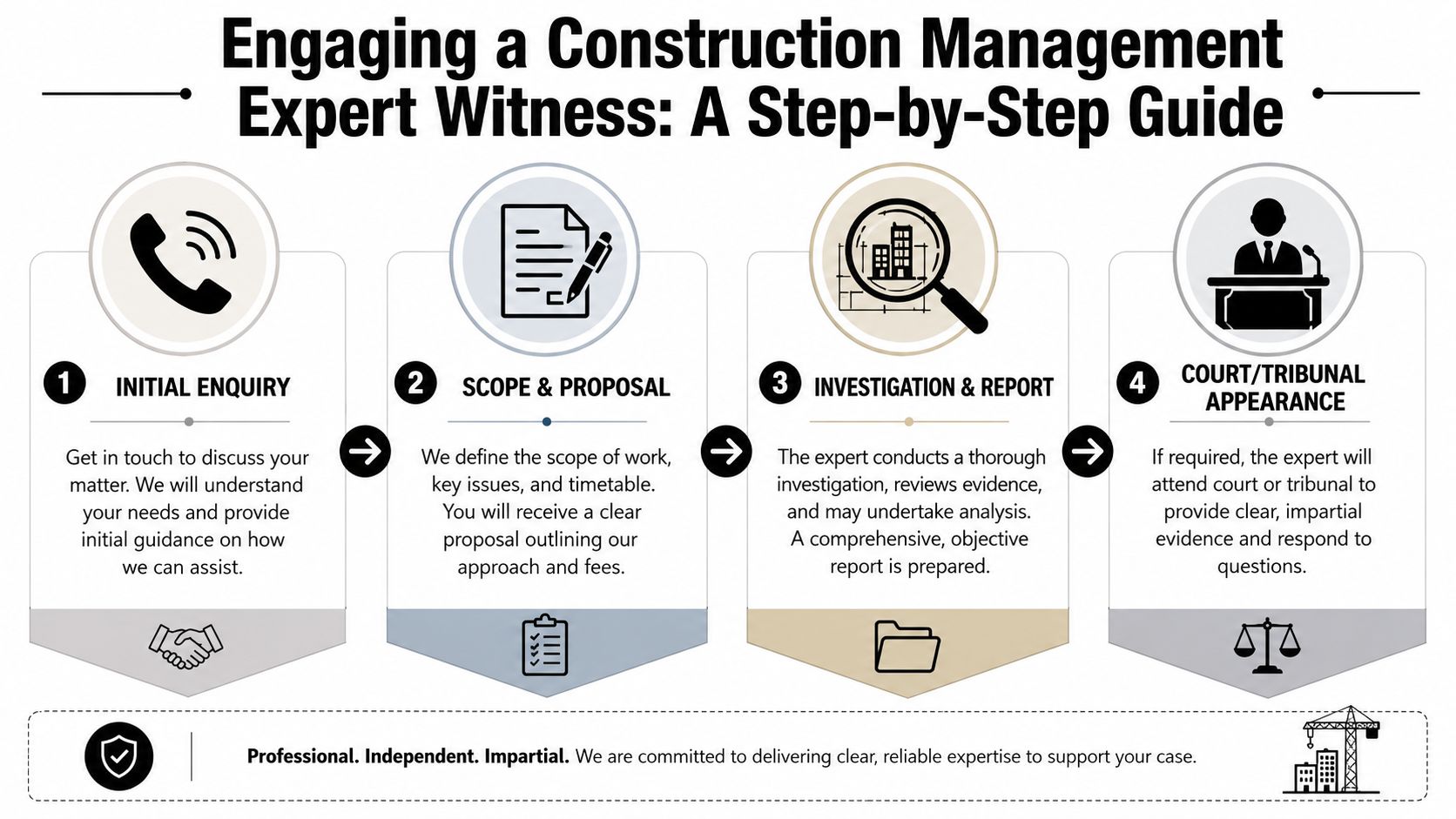
Start with an enquiry, not a report. That first contact should be short and practical. Explain the dispute, the location, the documents you already have, and what forum the matter is likely to go into, then ask whether the expert can take the brief.
The usual workflow
The first stage is the initial discussion. The second is the site inspection and document request list. The third is drafting the report or Scott Schedule. The fourth is final delivery, and sometimes testimony if the matter goes to hearing. If the dispute is still raw, this is often the stage where the expert can tell you whether the file is ready for a tribunal or whether the records are too thin.
A few things make the engagement more efficient. Give the contract, variations, photos, correspondence, prior reports, and any timeline you’ve already built. If the matter is technical, the expert needs the paper trail, not just a summary of what one side thinks happened.
What to ask before you sign
- Scope clarity: What exactly will the expert answer, and what won’t they cover?
- Inspection basis: Will they need one visit, or more than one?
- Document list: What do they want before they start?
- Turnaround: Is this a fast triage opinion or a full tribunal-ready report?
- Evidence use: Can the report be used in negotiation, NCAT, or court if needed?
Costs vary by complexity, document volume, and the number of items in dispute. A narrow crack assessment is one thing. A full defects, delay, and variation file is another. The same is true of timing. A short triage opinion can be quicker, but a proper tribunal-ready report takes more review and more care.
If you want a practical inspection checklist before the expert turns up, this how to prepare for an expert witness inspection in NSW guide is worth reading first.
The safest approach is to brief the expert like you’re preparing for scrutiny, because that’s exactly what will happen later.
Why Awesim Building Consultants and How to Get Started
Awesim Building Consultants brings over 35 years in building and construction, with over 15 years providing litigation support to homeowners, builders, and lawyers. That combination matters in expert work, because the report has to be technically grounded and procedurally usable, not just well written. The firm provides site investigations, Building & Construction Expert Witness Reports, and Scott Schedules, which is the kind of practical output NSW disputes usually need.
For matters involving itemised defects, the Scott Schedule approach is especially relevant, and related Awesim resources on water stops and expert witness reporting sit alongside the broader dispute support work. The point is simple. If the report can’t be followed by a NCAT Member, it hasn’t done its job.
If you’re stuck in a building dispute, the next step is to get the records reviewed before the file gets any messier. Email admin@awesim.com.au or call 1800 293 746 to discuss the scope, the evidence you already have, and whether a site investigation, expert report, or Scott Schedule is the right next move.
If you need a construction management expert witness for an NCAT matter, a defect dispute, or a detailed Scott Schedule, Awesim Building Consultants can help you turn site evidence into a clear, independent report. Reach out with your contract, photos, and correspondence, and ask for a practical first look at what the tribunal is likely to need next.

Related Posts

Water Damage in Homes: How to Track Down the Source
Water damage in a home rarely announces itself at the source. A stain on the ceiling, a musty smell in
Read More »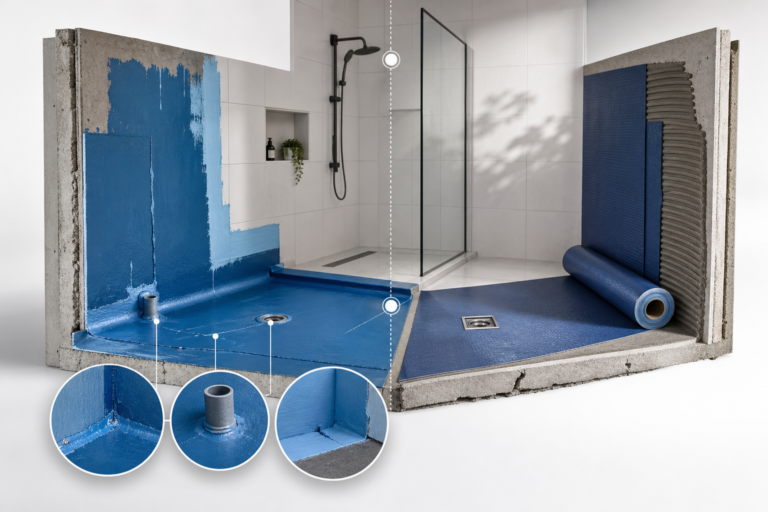
Waterproofing Membrane Types: Which Fails Most in NSW Bathrooms
Waterproofing failure is the single most common serious defect found in NSW apartments, and the type of membrane used, along
Read More »
Building Certifier NSW: Role, Limits, and When You Need More
A building certifier in NSW is a registered professional who issues construction certificates, conducts critical stage inspections, and grants occupation
Read More »