
Expert Witness Building Construction: Your NSW Guide
A roof starts leaking after handover. A slab shows cracking that nobody can quite explain. A builder says the issue is maintenance. An owner says it is defective work. A strata manager has photos, emails, invoices, and growing pressure from lot owners, but still no clear answer about what failed, why it failed, and what it will take to put it right.
That’s usually the point where people realise a normal inspection report won’t carry the dispute very far.
In NSW, building disputes don’t turn on who is angriest or who has the longest email trail. They turn on evidence that is organised, relevant, and capable of standing up in NCAT or court. That’s where expert witness building construction work becomes valuable. The job isn’t to write a dramatic report. It’s to convert site conditions, documents, and standards into an opinion the decision-maker can practically use.
Awesim Building Consultants bring 35+ years in building and construction and 15+ years providing litigation support for homeowners, builders, and lawyers. That background matters because dispute work is different from ordinary consulting. You need site experience, but you also need to understand how evidence is tested.
When Building Dreams Turn into Disputes
Parties involved often arrive at this point reluctantly. They started with a renovation, a new home, remedial works, or a contract variation dispute. Then the usual pattern follows. One side says the work is acceptable. The other says the defects are obvious. The paperwork becomes messy, site access becomes difficult, and everyone starts talking past each other.
The underlying problem is usually not just the defect itself. It’s the lack of a structured explanation that links condition, cause, responsibility, and rectification.
A leaking balcony is a good example. The owner sees staining to the ceiling below. The builder says the leak may be coming from elsewhere. Another contractor suggests grout failure. Someone else mentions waterproofing. Without disciplined issue-framing, the dispute turns into competing opinions with no evidentiary weight.
Most online material on expert witness building construction tells you what an expert is. It rarely tells you what makes a report persuasive in a NSW tribunal. As noted in guidance on the role of expert witnesses in construction defect litigation, the practical gap is report strategy, especially disciplined issue-framing and evidentiary relevance.
That gap matters in NSW because the process is formal. Technical detail on its own doesn’t win disputes. A long report that wanders through every possible issue often performs worse than a shorter report that isolates the actual questions in dispute and answers them methodically.
What clients are usually dealing with
- Homeowners often need to prove that a visible problem is a building defect, not wear and tear or poor maintenance.
- Builders often need an independent review where the owner’s allegations overreach the actual scope of defective work.
- Solicitors and strata managers usually need evidence that is usable, not just descriptive.
In practice, that means identifying the live issues early. Is this a defect? Is it non-compliance? Is it incomplete work? Is there consequential damage? Is the claimed rectification scope proportionate to the actual failure?
Those questions sound simple. On site, they rarely are.
The Role and Value of a Construction Expert Witness
A construction expert witness isn’t the same as a standard inspector. Both may inspect the same building, photograph the same defects, and review the same plans. The difference is purpose.
A standard inspection report usually helps a client understand condition. An expert witness report is prepared for use in a dispute environment, where independence, assumptions, methodology, and reasoning all matter.
The duty is to the tribunal or court
In NSW, expert witness reports are governed by the Uniform Civil Procedure Rules, and experts must act independently and acknowledge that their overriding duty is to the court, not the party who retained them, as outlined in this discussion of NSW expert witness requirements and report obligations.
That principle changes how the work should be done. A proper expert doesn’t become an advocate for your side. The expert’s role is to give an opinion that is technically grounded, fair, and defensible. Sometimes that helps your position. Sometimes it narrows it.
Practical rule: If you want someone to “back your story” regardless of the evidence, you don’t want an expert witness. You want an advocate. NSW tribunals treat those roles differently.
Why this work is valuable
The best expert witness building construction work acts like a translator. It converts technical building issues into findings a non-builder can follow.
That usually involves:
- Identifying the actual defect rather than repeating the complaint.
- Separating breach from consequence so the reader can distinguish poor workmanship from resulting damage.
- Assessing compliance issues against the relevant documents, site conditions, and applicable standards.
- Addressing rectification scope in a way that is proportionate to the defect identified.
Clients often assume more technical language means a stronger report. Usually it doesn’t. What helps is clarity. The opinion has to show how the expert got from observation to conclusion.
Building inspector report versus expert witness report
| Aspect | Standard Building Inspection Report | Expert Witness Report for NCAT/Court |
|---|---|---|
| Primary purpose | General condition assessment | Dispute-ready technical opinion |
| Audience | Owner, purchaser, or manager | NCAT, court, solicitors, parties |
| Independence requirements | Useful, but less formalised for litigation | Central to the report’s credibility |
| Assumptions and reasoning | Often brief | Must be clearly stated and supported |
| Defect analysis | Usually descriptive | Must address issue, cause, consequence, and relevance |
| Use in cross-examination | Limited | Prepared on the basis it may be tested |
| Suitability for Scott Schedule work | Usually not enough on its own | Designed to support itemised dispute analysis |
If you need a broader explanation of inspection functions before stepping into dispute work, this guide to understanding building inspector roles is a useful starting point.
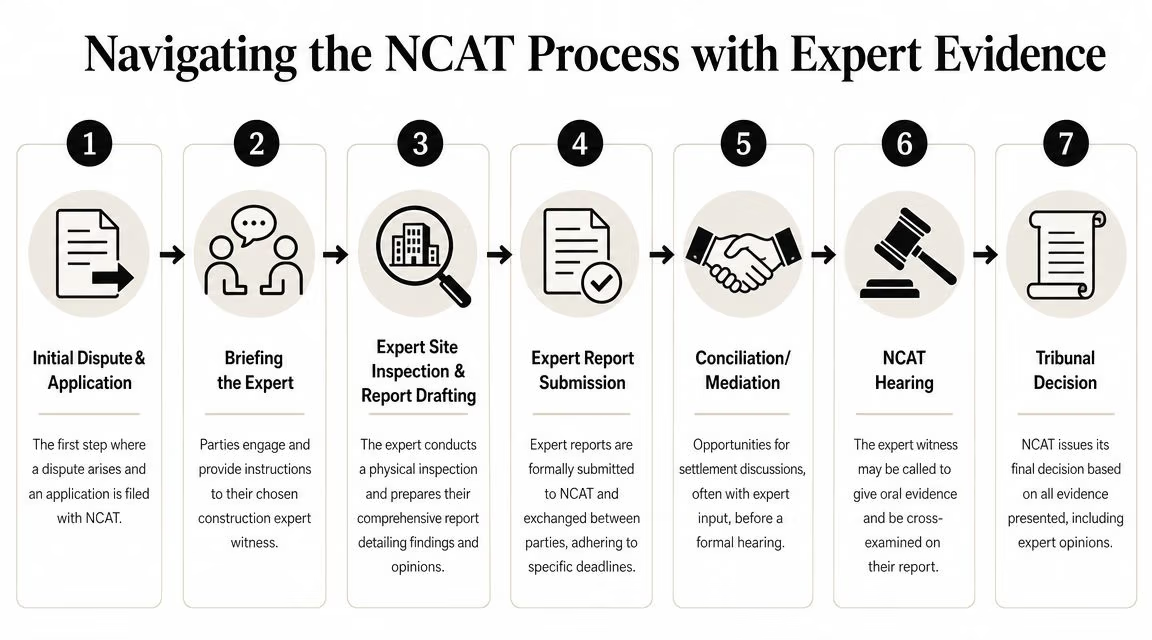
Navigating the NCAT Process with Expert Evidence
Most building disputes don’t fail because there was no problem. They fail because the evidence was gathered too late, framed too broadly, or presented in a way NCAT couldn’t use efficiently.
NSW residential building volume remains high. The Australian Bureau of Statistics recorded 225,000 dwelling completions in 2023-24, which keeps dispute exposure broad and increases the need for early-stage forensic inspection to preserve evidence before matters harden into full proceedings, as noted in this summary of construction dispute expert engagement trends.
Where the expert fits in
An expert can be engaged before an application is filed, after the other party has responded, or once NCAT has made directions about evidence. Early engagement often helps because the expert can inspect conditions before repairs, weather, cleaning, or further occupation change the evidence.
That early stage is often where practical mistakes happen.
- Repairs are started too soon and destroy the defect pathway.
- Photos are taken without context so there is no date sequence, location, or scale.
- The brief is too vague and the expert is asked to “inspect everything”, which creates cost without focus.
A better approach is to identify the disputed items, gather the core documents, and ask the expert to address specific questions.
The two documents that matter most
In NSW building disputes, the report usually does the heavy lifting. It should identify the issue, set out observations, describe the methodology, state any assumptions, and give a reasoned opinion.
The second key document is the Scott Schedule. In simple terms, it is a structured table that breaks the dispute into items. Each item can set out the alleged defect, the claimant’s position, the respondent’s reply, and the expert’s opinion. That format helps NCAT deal with multiple defects without losing the thread of the case.
For parties dealing with tribunal requirements, it helps to review NCAT Procedural Directions 3 on expert evidence before finalising the format and scope of the report.
A report that can’t be mapped cleanly into the issues in dispute often causes more trouble than it solves. NCAT needs evidence that is organised by issue, not a site diary rewritten as a narrative.
What usually works better in NCAT
A persuasive NCAT report is rarely the longest report in the room. It is usually the one that stays within the pleaded issues and answers them directly.
What tends to work:
Tight issue definition
Each defect item should be separately identified. “Poor workmanship throughout” is not an item. “Insufficient falls to shower base causing ponding” is an item.A site-based methodology
The report should explain what was inspected, what documents were reviewed, and what limits applied.Clear separation of categories
Defect, non-compliance, incomplete work, consequential damage, and cost to rectify shouldn’t be blurred together.A schedule-friendly structure
If the report can’t be translated into a Scott Schedule cleanly, the hearing becomes harder for everyone.
What usually goes wrong
Some reports collapse under cross-examination because they overstate conclusions. Others fail because they avoid conclusions altogether.
Common problems include:
- Speculation presented as fact
- Missing assumptions
- No link between photographs and conclusions
- No distinction between observed damage and alleged cause
- Rectification scopes that read like a full renovation instead of targeted remediation
Awesim Building Consultants provide site investigations, expert witness reports, and Scott Schedules for this type of dispute work in NSW.
Key Evidence Standards for Expert Reports
A defect report becomes persuasive when it does more than list complaints. The report has to show a reliable path from observed condition to technical conclusion.
That path is often called the causation chain.
For an expert opinion to be useful in court, it must establish that chain. The expert must do more than describe a defect. The opinion needs to document the condition, compare it to the required standard of care, and explain how that specific failure caused a quantifiable loss, which is the core point made in this explanation of causation in expert witness testimony.
What a strong report contains
A sound report usually starts with the physical evidence. What is visible on site? Where is it located? How extensive is it? Is it consistent across multiple areas or isolated to one part of the building?
From there, the expert should tie the observation to the likely mechanism of failure.
For example, water staining by itself is only a symptom. It doesn’t tell the tribunal whether the cause is failed waterproofing, defective flashing, poor falls, plumbing failure, or another pathway. The report has to move beyond symptom description.
The causation chain in practice
A useful sequence often looks like this:
Observed condition
Cracking, moisture damage, ponding, movement, gaps, distortion, or other measurable condition.Relevant benchmark
Contract documents, plans, approved details, site conditions, and the applicable construction standard.Failure mechanism
The technical explanation for how the problem occurred.Direct consequence
Water ingress, loss of performance, structural movement, finish failure, or related damage.Rectification relevance
What work is necessary to address the cause rather than just conceal the symptom.
A report that says “the workmanship is poor” is weak. A report that says “the observed water ingress is consistent with a failure at this junction, for these reasons, with these consequences” gives the tribunal something it can assess.
What to look for before relying on a report
Not every detailed report is a defensible report. Clients should check for a few basics before assuming the document is ready for dispute use.
| Report element | Why it matters |
|---|---|
| Site observations tied to photos | The reader must be able to match conclusion to evidence |
| Document review identified | Shows what plans, contracts, and records informed the opinion |
| Assumptions stated clearly | Prevents hidden reasoning |
| Standards referenced appropriately | Grounds the opinion in recognised requirements |
| Causation explained | Connects defect to loss |
| Rectification scope framed properly | Helps with damages and practical resolution |
A report that skips these steps may still sound technical. It just won’t be very useful when the other side starts testing it.
How to Choose the Right Construction Expert
Choosing a construction expert for a dispute is not the same as choosing a contractor to do remedial work. The skill set is different.
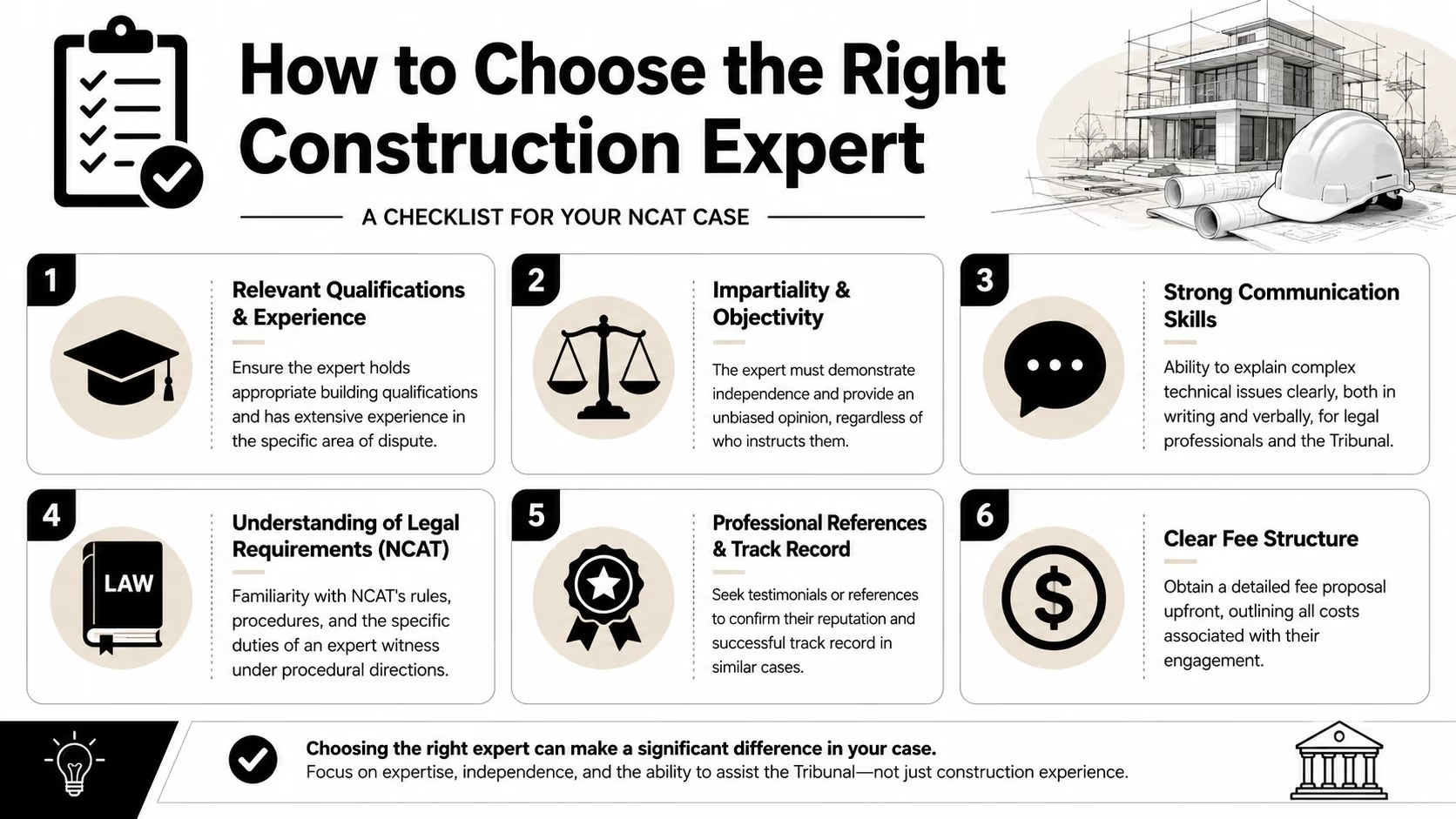
You need someone who understands buildings from the ground up, but also understands how opinions are read by lawyers, insurers, opposing experts, and tribunal members. Plenty of capable tradespeople and consultants know construction well. Fewer can produce a report that stays independent, methodical, and usable in a contested setting.
What matters more than polished marketing
Start with hands-on experience. If the dispute concerns waterproofing transitions, framing movement, external cladding, slab performance, or incomplete residential works, the expert should understand how those issues arise on real sites. Theory alone doesn’t help much when the evidence is messy and the documents are incomplete.
Then test litigation experience. A technically sound consultant may still struggle if they don’t know how to structure assumptions, answer specific questions, or keep the opinion within the scope of instruction.
A good shortlist usually turns on these points:
Relevant site background
Ask what kind of projects they’ve actually worked on and what categories of defects they commonly inspect.Dispute-specific experience
Ask whether they regularly prepare reports for NCAT or court use, not just general condition reports.Communication under pressure
Ask how they explain a complex issue to a non-technical audience. If they can’t explain it clearly in a phone call, the report may have the same problem.
Questions worth asking before you engage
Some questions reveal more than a CV does.
- What is your methodology for this kind of defect?
- What documents do you need before inspection?
- How do you distinguish defect, non-compliance, and consequential damage?
- Have you prepared Scott Schedules in disputes like this?
- What assumptions will you need to make if access is limited or documents are missing?
- Do you carry the appropriate professional cover for this work?
Here’s a practical overview that may help when comparing providers:
Warning signs clients often miss
Some red flags are subtle.
They promise a favourable outcome
An expert should never sell certainty about the result of the case.They agree with your position before seeing the documents
That usually means they’re adopting a side, not forming an opinion.They can’t explain report limits
Every inspection has boundaries. A credible expert will state them.They produce very cheap reports very quickly
Fast can be fine. Superficial is not.
The right choice is usually the consultant who asks careful questions early, narrows the scope properly, and resists the temptation to overstate conclusions.
Engaging and Instructing Your Expert Effectively
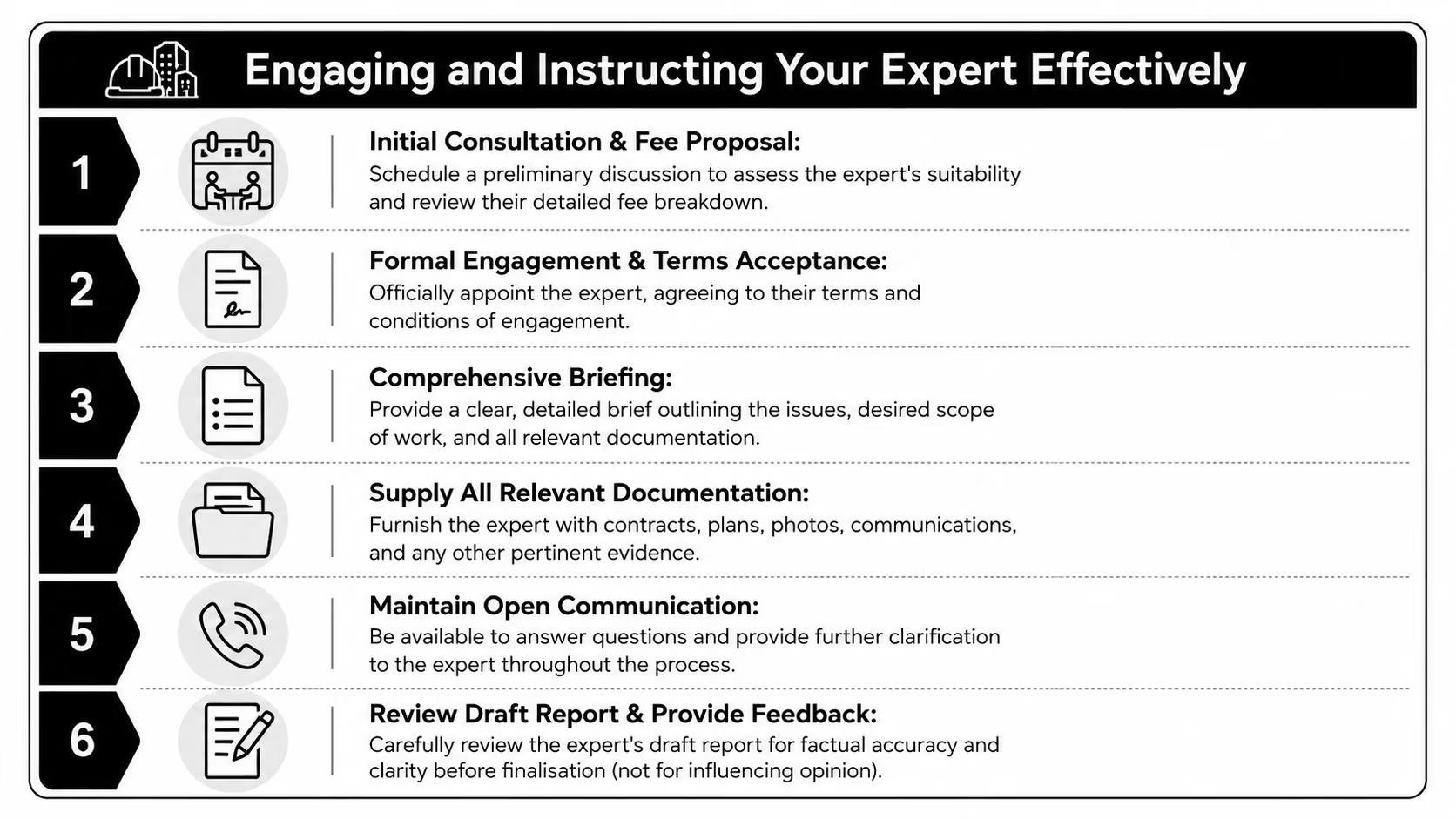
Once you’ve selected the expert, the quality of your instructions matters almost as much as the inspection itself. A poor brief produces a poor report. Not because the expert lacks skill, but because dispute work depends on having the right documents, the right questions, and the right boundaries from the start.
A clear engagement also helps control cost. When clients provide scattered emails, incomplete plans, and a general request to “look at everything”, the expert spends time sorting the file before they even get to the technical issues.
What to provide at the beginning
A useful brief should allow the expert to understand the project, the alleged defects, and the procedural context without guessing.
That usually includes:
Contract and scope documents
Include the signed contract, specifications, variations, and any relevant quotations.Plans and approvals
Provide drawings, engineering details, approved plans, and any revised issue sets.Defect list
A simple itemised list is better than a long narrative. Group defects by area if possible.Correspondence
Include the key communications only. The expert usually doesn’t need every email ever sent.Photos and chronology
Dates matter. Sequence matters. Label the images if you can.Prior reports or quotations
These can help identify disputed scope, but they shouldn’t be treated as determinative.
If your matter is likely to require item-by-item dispute analysis, it helps to understand how an expert witness Scott Schedule is structured before briefing the expert.
How to instruct without trying to shape the opinion
Clients sometimes make the mistake of briefing the expert like a lawyer briefs a witness. That can backfire badly.
The better approach is to ask focused questions such as:
- What defects are observable on inspection?
- Are the observed conditions consistent with non-compliant or defective work?
- What is the likely cause of each issue identified?
- What consequential damage is evident?
- What rectification scope is reasonably required?
Give the expert the facts, the documents, and the questions. Don’t give them the answer you want them to reach.
How to keep the process efficient
A few practical habits make the engagement smoother.
| Step | What helps |
|---|---|
| Before inspection | Confirm access, provide the latest documents, identify disputed areas clearly |
| During inspection | Avoid talking over the inspection. Let the expert observe systematically |
| After inspection | Respond promptly to document requests and factual queries |
| Draft review | Check names, dates, addresses, and factual accuracy. Don’t pressure the expert to change opinions |
Draft review is often misunderstood. You can and should correct factual errors. You should not try to negotiate the expert’s conclusions. If the opinion doesn’t support your case as strongly as you hoped, it’s better to know that early than to force a report into a position it can’t defend.
Get Clarity and Confidence for Your Building Dispute
Building disputes become harder when the evidence is vague, emotional, or poorly organised. They become more manageable when the issues are isolated properly and the technical opinion is clear, independent, and relevant to the NSW process.
That’s the fundamental value of expert witness building construction work. It gives the tribunal a usable explanation of what is wrong, why it is wrong, what caused it, and what work is reasonably required in response. It also helps parties test their own position early, which is often just as important as proving the other side wrong.
In NSW, the strongest reports usually aren’t the most dramatic. They are the ones built on site observation, disciplined reasoning, proper issue-framing, and procedural usefulness in NCAT.
If you’re dealing with defects, workmanship allegations, incomplete works, scope disputes, or a Scott Schedule requirement, getting the evidence right early can save time, cost, and unnecessary escalation.
If you need practical guidance on a building dispute in NSW, Awesim Building Consultants can discuss your situation and whether a site investigation, Expert Witness Report, or Scott Schedule is the right next step. Email admin@awesim.com.au or call 1800 293 746.
Related Posts

Water Damage in Homes: How to Track Down the Source
Water damage in a home rarely announces itself at the source. A stain on the ceiling, a musty smell in
Read More »
Waterproofing Membrane Types: Which Fails Most in NSW Bathrooms
Waterproofing failure is the single most common serious defect found in NSW apartments, and the type of membrane used, along
Read More »
Building Certifier NSW: Role, Limits, and When You Need More
A building certifier in NSW is a registered professional who issues construction certificates, conducts critical stage inspections, and grants occupation
Read More »