
Expert Witness Building Construction: A 2026 NSW Guide
You're already in the middle of the problem if the grout is cracking, the waterproofing is disputed, and the builder says the work is “within tolerance” while your solicitor is asking for proper evidence. In NSW building disputes, that gap between what you can see on site and what a tribunal can rely on is exactly where an expert witness building construction report earns its keep.
A strong expert doesn't act like another voice in the argument. They test the defect against the dated standards that applied when the work was designed or built, separate fact from opinion, and give NCAT or the court a report that can be used. That distinction matters because the wrong report looks busy, but the right one helps narrow the issues, settle the dispute, and, sometimes, avoid a final hearing altogether.
What an Expert Witness in Building Construction Actually Does
A cracked tile joint can feel like a small thing until it keeps widening, water starts tracking where it shouldn't, and the builder's response turns into a dispute over blame. At that point, most homeowners don't need more noise, they need a technical opinion that can stand up in NCAT or court.
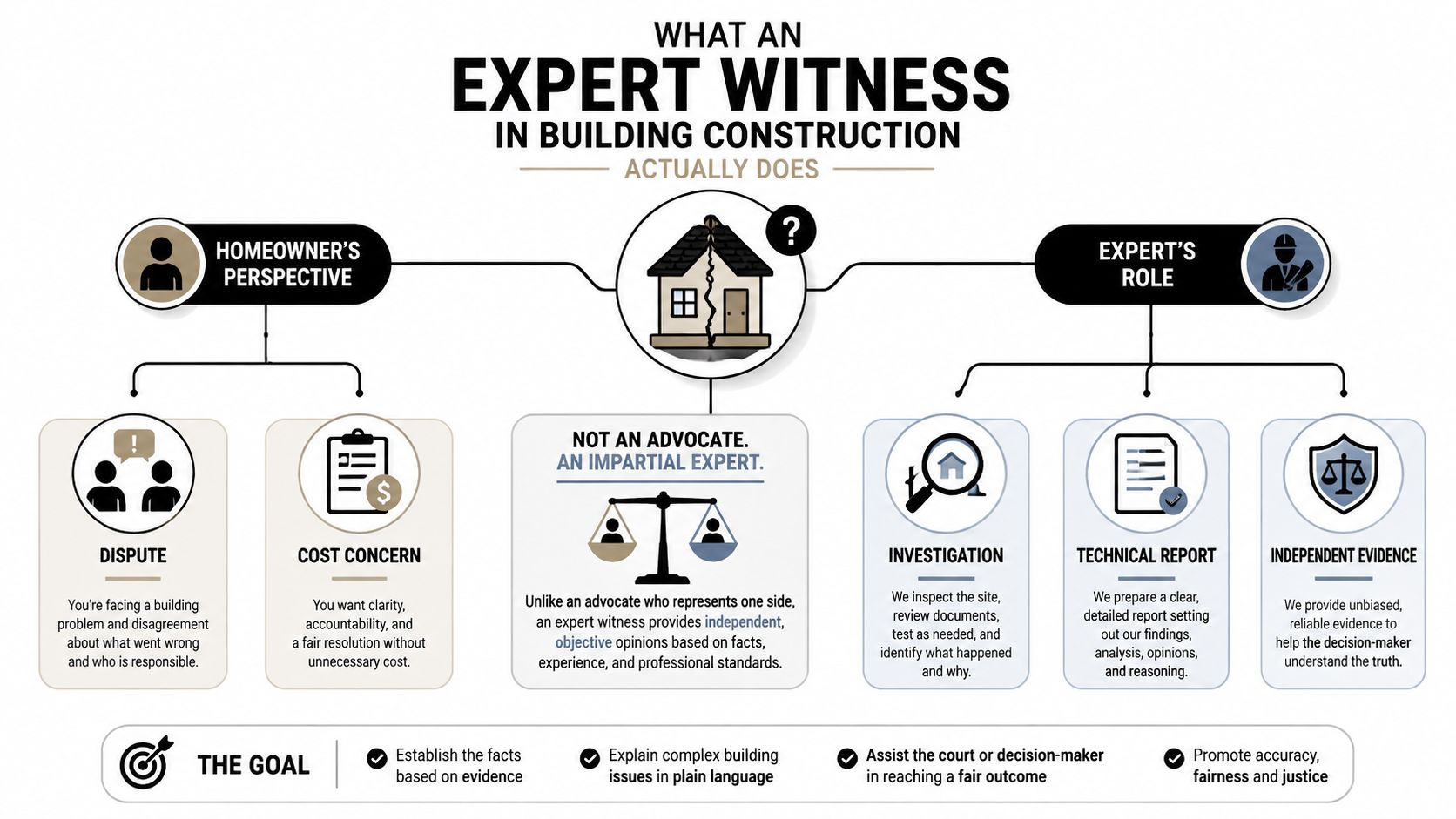
The role is independent, not argumentative
An expert witness is not there to repeat the client's story. In NSW proceedings, the expert's duty runs to the tribunal or court, and that independence is the whole reason the opinion carries weight. Under the NSW expert evidence framework, the report has to set out the facts and assumptions relied on, then explain how those facts lead to the opinion, not just assert a conclusion NSW expert witness Code of Conduct.
That's why a builder's casual view, or a homeowner's complaint letter, isn't enough. A lay complaint can describe what happened, but it can't usually answer whether the observed condition is a workmanship issue, a compliance breach, or something else entirely. A proper expert witness building construction opinion does that translation work.
The practical questions usually cluster around four issues. Was there a defect. Did the work comply with the applicable code or standard. What caused the condition. What should be done to fix it.
Practical rule: if the report can't be read by a non-technical NCAT member without a phone call to decode it, it's probably written for the wrong audience.
That's also where insurance and risk questions start to matter. If you're dealing with a defect claim, a useful outside reference is finding CG liability protection, especially where parties need to think about whether the dispute sits inside or outside a policy response.
When the report is done properly, it often does quiet work. It narrows the arguments, exposes weak allegations early, and gives both sides enough structure to settle before the matter becomes a hearing fight.
Qualifications and Experience That NSW Tribunals Expect
NSW tribunals don't want a theory-only witness who's brilliant on paper but hasn't spent time on real sites. They want someone whose qualifications make sense for the problem, and whose experience shows they can tell the difference between an actual defect and an ordinary construction compromise.
Credibility starts with fit for the issue
Formal trade, building, engineering, or architectural qualifications help, but they're not the whole story. In a building dispute, the tribunal will care just as much about whether the expert understands the relevant NCC edition, Australian Standards, and NSW regulatory context as it does about the letters after the name. The essential question is whether the person can explain the defect in the language of the job, not just the language of a textbook.
Current registration matters where it's required, but site experience matters too. A witness who has recently inspected houses, managed remedial work, or solved live construction problems usually reads differently from a witness whose experience stopped at academic writing years ago. That difference shows up immediately in the report because a seasoned consultant tends to write in concrete terms, not broad generalisations.
Awesim Building Consultants states it has 35+ years in Building & Construction and 15+ years providing litigation support to home owners, builders and lawyers, which is the sort of background that signals long exposure to both site realities and dispute work. That kind of experience is rare enough to be visible on the first page of a report, because it tells the reader the consultant understands how evidence behaves under challenge.
A tribunal doesn't need the fanciest CV. It needs an expert whose background matches the defect, the forum, and the standards in force.
For practical background on workplace competency, many readers also check a first aid and white card guide when they're trying to understand how construction-facing qualifications sit alongside site readiness and compliance culture.
How to vet an expert before you engage them
Look at three things. First, whether they've handled dispute work, not just inspection work. Second, whether they can write for NCAT without hiding behind jargon. Third, whether their experience aligns with the sort of defect you've got, because a witness who knows waterproofing won't necessarily be the right person for every structural issue.
A good front page should make that match obvious. If it doesn't, ask harder questions before signing the engagement letter.
What Belongs Inside an NCAT-Compliant Expert Witness Report
The report is where the core work happens. In NSW disputes, a polished biography means very little if the report doesn't identify the instructions, the documents reviewed, the site evidence, the standard applied, and the reasoning that connects them.
The report needs a clear structure
NCAT and the courts want a report that is organised around the issue, not around the expert's stream of consciousness. A compliant report should state who instructed the expert, what they were asked to consider, what documents were reviewed, how the site inspection was carried out, what was observed, what standard applied, and what opinion follows from those facts NCAT construction expert report structure.
That structure matters because it lets the reader test the opinion. A sentence like “the bathroom failed due to poor workmanship” is too vague to help anyone. A better sentence identifies the observed condition, the applicable standard, and the reason that condition is considered non-compliant or defective.
The NSW framework also expects the report to identify material outside the brief and any assumptions that were made. That protects the opinion from looking selective, which is one of the fastest ways to lose credibility.
| Report element | What it should do | Why it matters |
|---|---|---|
| Instructions received | Define the dispute scope | Stops the expert drifting beyond the brief |
| Documents reviewed | List plans, specifications, records | Shows the opinion is evidence-based |
| Factual observations | Record what was seen on site | Separates observation from assumption |
| Applicable standard | Identify the code or standard | Anchors the opinion to the right test |
| Reasoning | Explain the path from facts to opinion | Makes the conclusion usable in hearing |
| Reservations | Note limits or missing information | Prevents overstatement |
The language has to work for a non-technical reader
The best reports are plain enough for a tribunal member to follow without guesswork. That doesn't mean dumbing them down, it means removing padding, defining technical terms when they matter, and making each conclusion trace back to evidence.
This is also where settlement value shows up. A well-drafted report often becomes a persuasive tool in mediation because the parties can finally see the dispute in a structured, defensible form rather than as competing complaint narratives.
For NSW reporting standards, the applicable conduct requirements are also set out in Awesim's NSW expert witness code of conduct guide, which is worth reading before any report is commissioned.
How a Scott Schedule Fits Beside the Report
A report explains the expert's reasoning. A Scott Schedule turns that reasoning into a dispute matrix the other side can respond to. People often treat them as the same thing, but in practice they do different jobs.
The schedule is the comparison document
A Scott Schedule lists each item in dispute, then sets out the claimant's position, the respondent's position, the expert's opinion, the applicable standard, the rectification approach, and the indicative cost. That's why it's so effective in building disputes, it compresses a messy fight into a side-by-side format that NCAT members and lawyers can work through quickly.
In NSW, this format aligns with the way dispute material is commonly organised under NCAT's procedural approach, and Awesim prepares these schedules for both claimant and respondent matters Scott Schedule and NCAT report support.
Sample Row From a Scott Schedule
| Item | Claimant Position | Respondent Position | Expert Opinion | Applicable Standard | Rectification | Indicative Cost |
|---|---|---|---|---|---|---|
| Shower waterproofing | Water ingress is due to failed waterproofing | No defect, minor maintenance issue | The observed cracking and leakage evidence support defective waterproofing | Applicable waterproofing and wet area standard | Remove affected finish, reinstate membrane, retile | Included in schedule |
That single row shows why the schedule can be the most powerful page in the bundle. Competing claims stop being abstract once they're forced into one line item, one standard, and one recommended fix.
The schedule also helps with quantum meruit and variation arguments, because costed rectification or incomplete work can be discussed in a disciplined way instead of being traded as loose numbers. In real disputes, that's often the point where settlement becomes realistic.
If the report is the analysis, the Scott Schedule is the battleground map.
A strong schedule doesn't replace the report. It relies on the report's observations, reasoning, and standards. Without that foundation, the schedule becomes just another spreadsheet with opinions in it.
The Engagement Process From First Call to Hearing-Ready Bundle
Most disputes don't fail because nobody cared. They fail because the instructions were vague, the documents were incomplete, or the report was needed yesterday. The process goes much better when homeowners and lawyers know what happens at each stage.
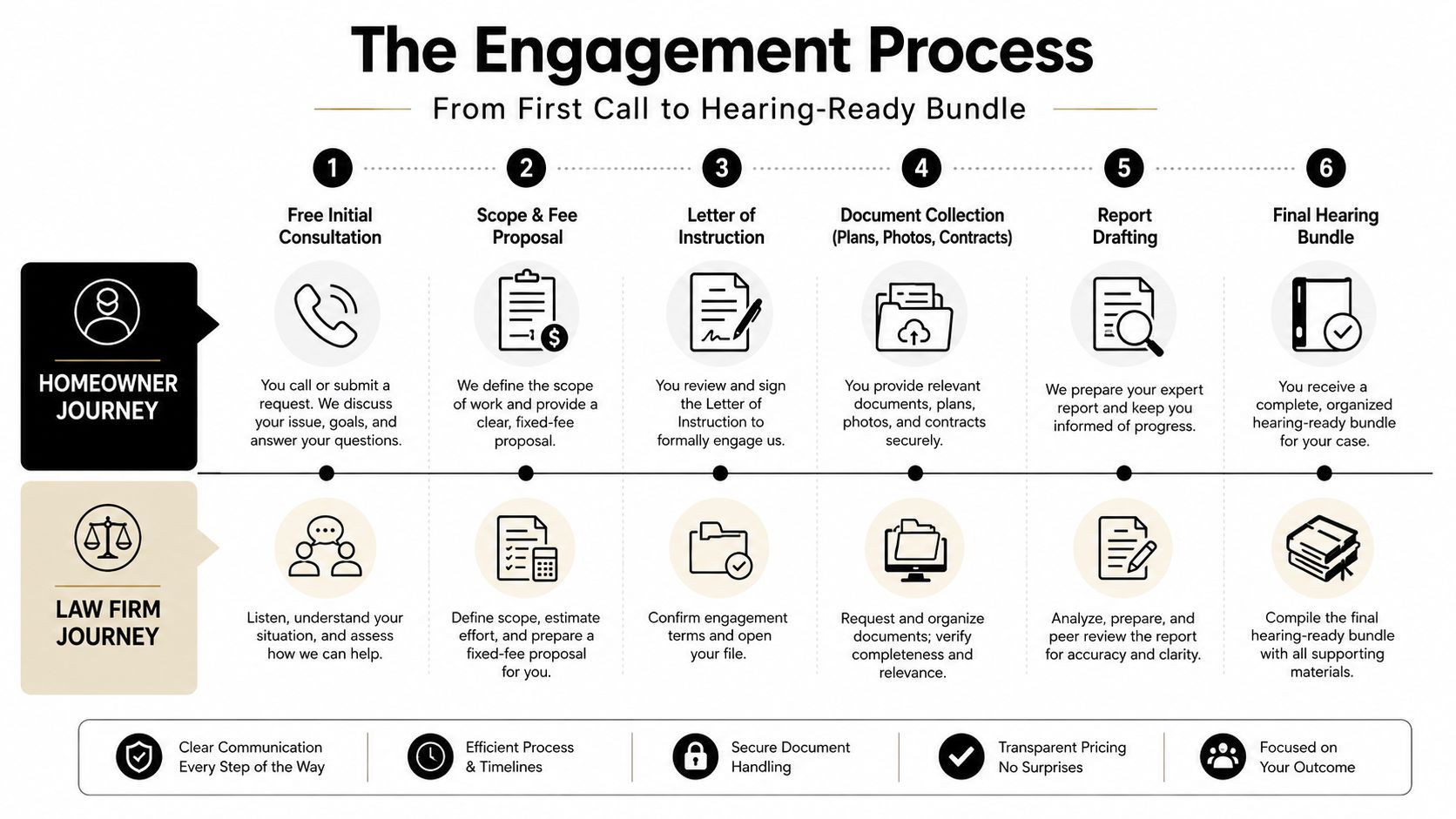
Homeowner and lawyer workflows overlap, but they're not identical
A homeowner usually starts with the problem itself, leaking shower, cracking tiles, uneven floors, settlement, or a dispute over variation work. A lawyer usually starts with the pleaded issues, the evidence needed, and the hearing timetable. Both need the same core material, plans, specifications, contract, variations, correspondence, photographs, and inspection access, but the way that information is used differs.
A typical engagement begins with a free initial consultation, then a scope and fee proposal, then a letter of instruction. After that comes the document collection stage, site inspection, report drafting, and, where needed, peer review or joint report work before the matter is bundled for hearing. The timeline depends on the size and complexity of the job, but short defects reports can take a few weeks, while a multi-defect home prepared for a full NCAT hearing often runs two to four months from instruction to final report expert witness engagement process.
The pinch point is usually not the inspection itself. It's the gap between a good inspection and a complete evidentiary file. If the contract, variation records, or correspondence are missing, the expert can still inspect, but the final opinion may have to carry more reservations.
The video below is useful if you want a visual overview of how the engagement normally unfolds in a dispute file.
What to prepare before the first call
Bring the documents that show what was agreed and what happened. If the matter is urgent, say so early, because hearing dates can compress the drafting window very quickly.
The best engagements are the ones where the expert gets enough material to make the report useful the first time. That saves everyone from rework, which is where both cost and delay start to climb.
Costs, Fees and Who Pays for the Expert
Money is usually the second question after “Can you help?” and it's the one people hesitate to ask directly. In building disputes, that hesitation is expensive, because the fee structure should match the scope before the work starts.
What usually drives the invoice
Expert fees in NSW are commonly structured by hourly rate, fixed fee for a defined deliverable, or staged billing against milestones. The final cost usually turns on the number of defects, the size of the dwelling, travel for regional or rural inspections, joint report meetings, supplementary questions after the first report, and any hearing attendance.
That's why a simple single-issue defect matter and a whole-home dispute don't sit in the same cost bucket. One may need one inspection and one report. The other may need multiple site visits, further questions, and careful schedule work to keep every issue aligned.
Funding can also come from different places. In some matters, NCAT costs orders become relevant. In other matters, policyholders may have insurance cover to consider, or a litigation funding arrangement may exist for eligible claims. The important thing is to understand the likely funding path early, before the report scope gets broader than the budget can carry.
Awesim's free initial consultation is useful precisely because it lets the scope be tested before a formal engagement starts, which often prevents misunderstandings that would otherwise show up after work has already begun. If you want to see how fee expectations are framed in practice, review what you can expect to pay for an expert witness report in 2026.
Who should ask about fees first
Homeowners should ask whether the report is being prepared for information, negotiation, or hearing. Lawyers should ask what the expert needs to do to make the file hearing-ready. Builders and insurers should ask whether the opinion will need to address causation, scope of rectification, or apportionment.
If those questions aren't answered early, the bill tends to reflect the confusion later.
Common Pitfalls That Weaken Expert Evidence
The easiest way to damage expert evidence is to let the report drift into advocacy. A witness who sounds like they're representing a side, instead of assessing the evidence, usually gives NCAT more reason to discount the opinion.
Bias shows up in the writing first
The common mistake is not always obvious. It might be wording a client's allegation as if it were an established fact, leaving out inconvenient observations, or jumping straight to a conclusion without spelling out the reasoning. It can also show up when the expert forgets to anchor the opinion to the correct NCC edition or other applicable standard for the build date.
That point matters because in Australia the National Construction Code is updated on a 3-year cycle, and NCC 2022 was a major milestone as the first edition to integrate significant energy-efficiency and livability reforms across residential building work NCC timing and relevance. For disputes, the edition in force at the time of design or construction is often the one that matters, not a later version.
A better report is honest about uncertainty. If the cause can't be pinned down because access was limited, or because records are incomplete, the report should say so. That candour usually makes the opinion stronger, not weaker.
What to push back on during draft review
- Unsupported certainty: If the draft says a defect was caused by one thing only, ask what alternative causes were considered.
- Missing documents: If plans, photos, or variations are absent from the reviewed material, ask whether the opinion needs to be qualified.
- Overwritten instructions: If the report sounds like a complaint letter, ask where the expert's own observations begin.
- Wrong standard: If the defect is tested against the wrong NCC edition or code, the opinion may be unusable.
- No room for contrary evidence: If the draft ignores the other side's records, it may read as selective.
A report that identifies its own weak points usually persuades better than one that pretends every defect claim is airtight.
For readers who want examples of how practitioners think about report quality and dispute communication more broadly, the blogs from our team are a useful place to look without treating them as a substitute for proper expert evidence.
Putting It Together and Getting Started
If you're a homeowner, builder, insurer, or lawyer dealing with a dispute, the decision framework is straightforward. Choose an expert whose background matches the defect, make sure the report is tied to the right standard and build date, insist on a Scott Schedule where items need side-by-side comparison, and check that the opinion is written for NCAT or court rather than for marketing.
The files that move fastest are the ones with the right records from the start. Plans, specifications, variations, photographs, correspondence, and inspection access all matter, because they let the expert separate workmanship, compliance, causation, and quantum instead of guessing at them.
Awesim Building Consultants provides site investigations, Building & Construction Expert Witness Reports, and Scott Schedules for NSW dispute work. If you're dealing with shower waterproofing, defect causation, or a broader NCAT matter, the next practical step is to ask for a free initial consultation, then send the documents that show what was built and when.
Awesim Building Consultants prepares site investigations, Expert Witness Reports, and Scott Schedules for NSW building disputes, with reports structured for NCAT and court use. If you need help turning a defect into a defensible report bundle, visit Awesim Building Consultants or contact the team directly to discuss your matter.

Related Posts
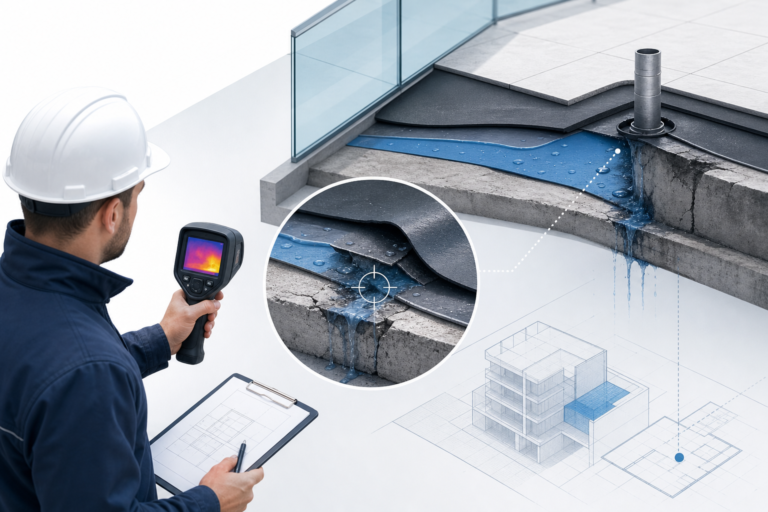
Waterproof Membrane Failure: How Inspectors Find the Cause
Waterproof membrane failure is diagnosed by tracing the water entry point, reviewing design documents, exposing the membrane for visual inspection,
Read More »
Cornice Cracking: How to Tell If the Damage Is Serious
Cornice cracking is one of the most common concerns Australian homeowners raise, and the hard part is not spotting the
Read More »
Digital Construction Consultant Australia: What They Do
A digital construction consultant in Australia manages the technology-driven side of building projects: BIM coordination, clash detection, asset data handover,
Read More »