You’ve noticed the crack, the leak, the balcony movement, or the tiled shower that never quite dried properly. The builder says it’s minor. The trades blame one another. Your solicitor wants clear evidence. You need someone who can look at the site, separate noise from fact, and explain what went wrong.
That’s where Building Consultants Sydney property owners and solicitors rely on become essential. In dispute work, the issue usually isn’t whether something looks wrong. The issue is whether the defect can be documented properly, tied to the right standards, and presented in a form that stands up in NCAT proceedings or court.
Awesim Building Consultants have 35+ years in Building & Construction, with over 15+ years our providing litigation support to home owners, builders and lawyers. We provide site investigations, Building & Construction Expert Witness Reports and Scott Schedules. That combination matters because construction disputes don’t turn on theory alone. They turn on what happened on site, what should have happened under the National Construction Code (NCC) and Australian Standards, and what evidence can be proved.
Why Sydney Property Owners Need Experienced Building Consultants
A typical dispute starts small. Water appears below a bathroom. A roof leak shows up after rain. A new extension develops cracking around openings. At first, most owners try the informal route. They call the builder, exchange emails, get a quote, and hope common sense will fix it.
Sometimes that works. Often, it doesn’t.
In Sydney, defect disputes have become more frequent and more technical. Data from the New South Wales Civil and Administrative Tribunal (NCAT) and NSW Fair Trading reveals that building rectification claims have surged by 22%, driving the average repair bill to staggering new highs according to Awesim’s NSW dispute overview. Once a matter reaches that point, guesswork becomes expensive.
What owners usually get wrong early
Too often, independent experts are brought in too late. This leads to reliance on:
- Builder explanations: A verbal assurance isn’t evidence.
- Repair quotes: A quote may price work, but it usually doesn’t diagnose causation.
- Photos alone: Photos help, but they don’t establish compliance failures by themselves.
- General inspections: A routine inspection is not the same as litigation-focused reporting.
Practical rule: If the defect is disputed, repeated, or affecting multiple parts of the building, get an independent assessment before the paper trail gets messy.
The other mistake is treating all consultants as interchangeable. They aren’t. A dispute consultant has to understand defective work, contractual context, sequencing, tolerance, moisture pathways, standards, and tribunal expectations. That’s a different skill set from a basic property inspection.
Why Sydney disputes escalate quickly
Sydney projects are rarely simple. Renovations tie into older structures. New work interfaces with waterproofing, structural framing, drainage, membranes, balustrades, and finishes. One defect can trigger another. A balcony leak can become internal water damage. Framing movement can crack finishes and distort windows. Poor supervision can produce a chain of non-compliant work rather than one isolated issue.
That’s why experienced consultants matter. They don’t just identify the visible symptom. They trace the sequence.
For owners trying to judge timing, this guide on when to hire an independent building consultant in Sydney is useful because timing often decides whether a dispute settles early or hardens into formal proceedings.
What experienced advice changes
An experienced consultant helps you answer the questions that move a dispute forward:
| Issue | Weak approach | Strong approach |
|---|---|---|
| Cause of defect | Opinion without testing against standards | Site evidence linked to standards and code |
| Builder response | Verbal denial or partial repair | Written findings with rectification scope |
| NCAT readiness | Disorganised complaints | Structured evidence and documented issues |
| Negotiation position | Emotion-driven argument | Evidence-based position |
Owners usually come looking for answers. What they really need is a defensible position.
The Role of an Independent Building Consultant in Construction Disputes
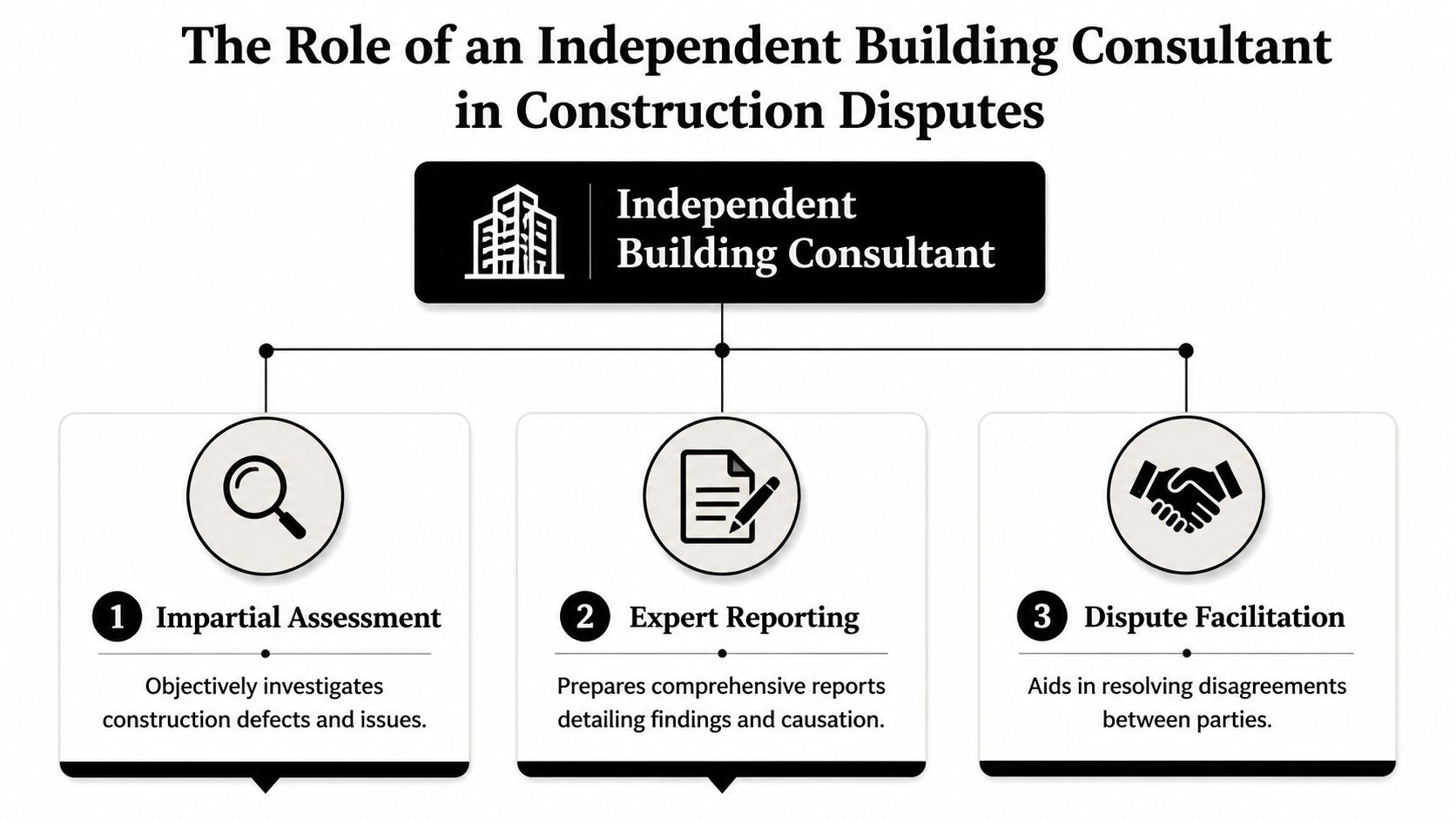
An independent building consultant in dispute work is not just an inspector. They are an impartial technical assessor, a reporting expert, and often the person who turns a confused complaint into a coherent evidence brief.
They are not just looking for defects
A pre-purchase inspector usually answers a broad risk question. Is this property showing signs of concern?
A litigation-focused consultant answers a narrower and harder set of questions:
- What is the defect
- What caused it
- Is it non-compliant
- Which standard or NCC provision is relevant
- What rectification is reasonable
- How should the issue be documented for a dispute forum
That difference is critical. In building disputes, surface observations don’t carry much weight unless they’re connected to objective criteria.
The three jobs that matter most
Impartial assessment
The first job is site investigation. That means inspecting the works, taking measurements, reviewing documents, checking workmanship, and identifying whether the complaint is cosmetic, structural, waterproofing-related, contractual, or a combination of these.
An independent consultant should test the allegation, not repeat it.
Expert reporting
The second job is formal reporting. A good report sets out the observations, the likely cause, the relevant code or standard, and the recommended rectification path. It should be clear enough for a solicitor to use and technical enough for scrutiny by the other side.
Dispute facilitation
The third job is helping parties move from accusation to specifics. Many disputes drag on because no one has defined the issues properly. Once defects are itemised and evidence is organised, negotiation usually becomes more realistic.
The most useful consultant in a dispute is the one who can explain site reality in a form that survives legal scrutiny.
What independent reporting should include
A sound dispute investigation usually covers:
- Document review: Contracts, plans, specifications, variations, emails, and prior reports.
- Site observations: Physical inspection of the complained-of works and adjoining affected areas.
- Compliance analysis: Assessment against the NCC, relevant Australian Standards, and accepted building practice.
- Causation opinion: A reasoned view on why the issue occurred.
- Rectification view: What needs to be done, in what order, and why.
This work applies across a wide range of disputes, including waterproofing failures, poor workmanship, balcony leaks, structural movement, construction delays, contract disputes, and progress payment disputes. In some matters, the technical issue is obvious but the contractual issue is not. In others, the paperwork looks strong but the workmanship says otherwise.
What doesn’t work
These approaches usually fail in contested matters:
- Advocacy dressed up as expertise: A consultant isn’t there to act as a cheerleader.
- Generic reports: If the report doesn’t tie findings to standards, it won’t carry enough weight.
- Late evidence gathering: Delay can obscure causation and complicate responsibility.
- One-sided inspection assumptions: Real dispute work requires independent analysis, not client-driven conclusions.
That’s why Sydney building consultants who work in disputes need site knowledge and procedural discipline in equal measure.
Expert Witness Reporting and Scott Schedules for NCAT Matters
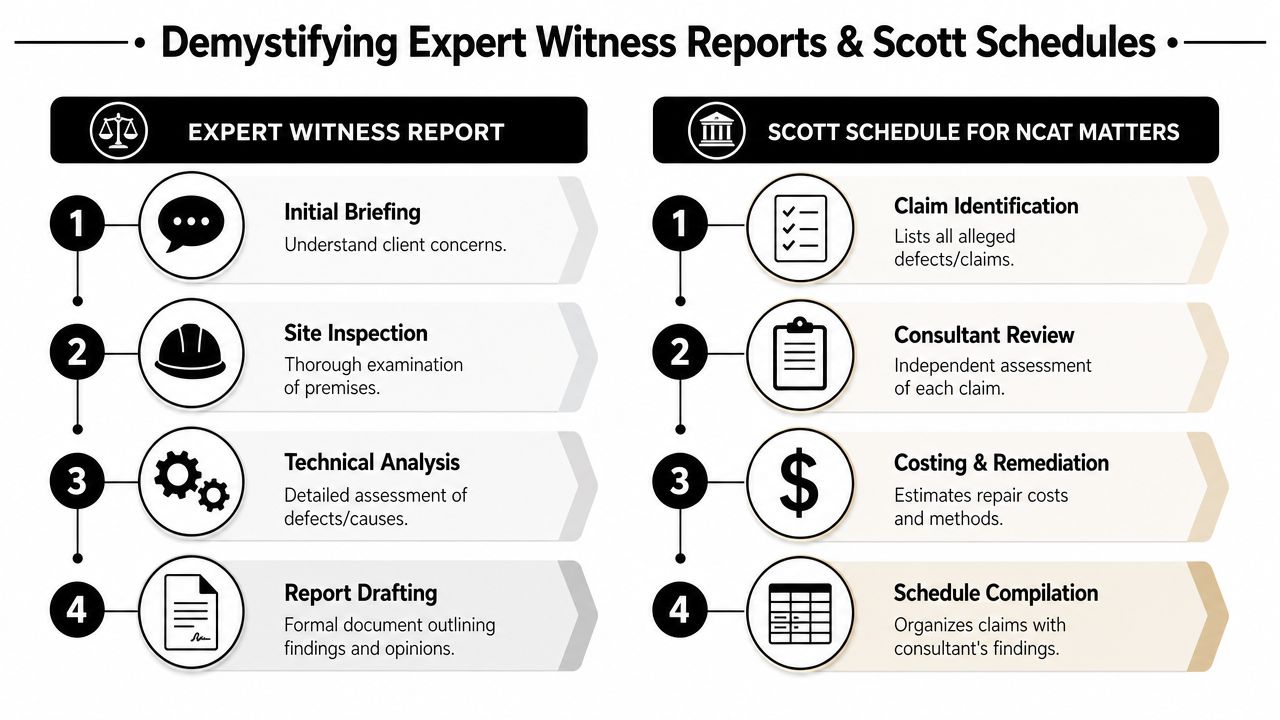
When a dispute enters NCAT, two documents often become central. The first is the Expert Witness Report. The second is the Scott Schedule. If either is poorly prepared, the case becomes harder than it needs to be.
What an Expert Witness Report actually does
An Expert Witness Report is not a complaint letter with technical language added to it. It is formal evidence. It should identify the issues, record the inspection findings, explain causation, refer to the applicable standards or NCC requirements, and express an independent opinion.
In NSW, that independence is not optional. An expert witness report for NCAT must be prepared by a consultant holding a current builder’s licence and relevant qualifications like a Certificate IV in Building and Construction. Failure to meet these standards can render the evidence inadmissible under NCAT Procedural Direction 3 (2025), as explained in this NCAT report guide for NSW building consultants.
What a good expert report looks like in practice
A useful report usually has these traits:
- Clear scope: It answers the actual dispute questions.
- Proper observations: Defects are described precisely, not vaguely.
- Referenced standards: Findings are tied to specific technical benchmarks.
- Reasoned opinions: The report explains how the expert reached the conclusion.
- Practical rectification thinking: It addresses what should be done, not just what went wrong.
A poor report, by contrast, often reads like advocacy. It overstates, skips technical references, and leaves too much unexplained.
What a Scott Schedule is
A Scott Schedule is a structured table used to organise disputed items. In building matters, it usually lists each alleged defect or claim item line by line, together with the competing positions and the expert’s view. In practical terms, it stops the matter becoming a pile of emails, photographs, and competing narratives.
For larger disputes, this structure is valuable because it forces precision. Each issue must be described, answered, and evaluated on its own merits.
Why tribunals and solicitors value Scott Schedules
A Scott Schedule helps by:
- Separating issues: Waterproofing, cracking, finishes, structural concerns, and contractual claims are itemised.
- Reducing confusion: Parties can see where they agree and where they don’t.
- Supporting directions compliance: The document format suits contested defect lists.
- Improving hearing efficiency: NCAT can move through issues in a disciplined way.
What makes these documents credible
The credibility of both documents depends on the same things:
| Requirement | Why it matters |
|---|---|
| Independence | The expert owes a duty to the tribunal, not the client’s preferred outcome |
| Technical competence | Defects must be assessed against recognised standards |
| Site experience | Real-world building knowledge helps identify probable cause |
| Clear drafting | Legal decision-makers need findings they can follow |
A consultant who has only paper knowledge often misses how defects develop on site. A consultant with site experience but no reporting discipline may observe the right problem and still present it badly.
A report only helps if it can survive challenge from the other side.
If you’re preparing for formal proceedings, this article on what NCAT looks for in expert witness building reports is worth reviewing because procedural compliance and report quality often decide whether the evidence assists or falls short.
Common Building Defects in Sydney and How We Investigate Them
Sydney defects are rarely random. They usually come from one of four sources: poor workmanship, bad sequencing, non-compliant design execution, or failure to follow the relevant standard. The investigation has to be methodical because the visible damage is often the end of the story, not the beginning.
Independent building consultants use Australian Standards like AS 3740 and AS 1684 to quantify defects, and failures in compliance with these standards are directly linked to 68% of residential building claims filed with NCAT in NSW, according to MB Consultancy’s review of independent defect assessment in NSW.
Waterproofing defects and balcony failures
Waterproofing disputes are some of the most common and some of the most misunderstood. A leaking shower, podium, or balcony is often treated as a tile problem. In many cases, the tile finish is only where the failure becomes visible.
When investigating these matters, the first check is whether the assembly and detailing align with AS 3740 where relevant. Then the focus turns to falls, membrane continuity, terminations, penetrations, junctions, drainage, thresholds, and movement points.
A typical balcony failure might involve water entry at door thresholds, membrane termination defects, poor falls, or cracked junctions. The internal staining is the symptom. The investigation has to identify the path of water movement and the likely construction failure that allowed it.
Structural cracking and framing movement
Cracking raises immediate concern because owners often don’t know whether they’re looking at normal settlement, finishing failure, or structural movement. The pattern matters. So does the location.
Where timber framing is involved, compliance with AS 1684 becomes important. The crack alone doesn’t tell the full story. The assessment looks at framing alignment, support conditions, spans, openings, lintels, movement joints, moisture influence, and whether the cracking corresponds with deflection or differential movement.
Cracks don’t prove cause by themselves. The pattern, substrate, location, and surrounding construction details usually tell the real story.
Roof leaks and non-compliant building works
Roof leaks often produce long arguments because the water shows up far from where it entered. What looks like a flashing issue can involve roof pitch, sheet laps, penetrations, drainage, junction detailing, or adjacent wall interface problems.
Non-compliant works are broader again. They can involve:
- Poor installation: Work that departs from plans, specifications, or manufacturer instructions.
- Code issues: Elements that don’t meet NCC requirements.
- Trade interface failures: One trade leaves a condition that causes another trade’s work to fail later.
- Rectification-on-top-of-defect: Previous patch repairs that concealed rather than solved the issue.
For strata owners trying to understand how major repairs can unfold across shared property, these strata title repair process insights help explain why documentation, sequencing, and responsibility allocation matter so much.
Poor workmanship, delays, and payment disputes
Not every dispute is about a leak or crack. Some involve plainly poor workmanship, unfinished items, defective finishes, repeated incomplete rectification attempts, or work that falls short of the contract requirements.
Others revolve around time and money:
| Dispute type | What gets investigated |
|---|---|
| Construction delays | Sequence of work, access, variations, site events, and whether delay claims match records |
| Contract disputes | Scope, inclusions, exclusions, variations, and whether the work delivered matches the agreed documents |
| Progress payment disputes | Stage completion, defect impact, withheld amounts, and whether claimed work was properly achieved |
For owners dealing with a broad range of defects, this guide to comprehensive building defect inspections for NSW homeowners gives a practical overview of how an investigation should be approached.
The difference between a weak case and a strong one usually comes down to this. One side says something is wrong. The other side proves why.
Why Early Expert Advice Reduces Litigation Costs
Often, a building consultant is perceived as someone you engage after the dispute is already in full swing. In practice, early expert advice is often cheaper than waiting for the matter to harden into formal litigation.
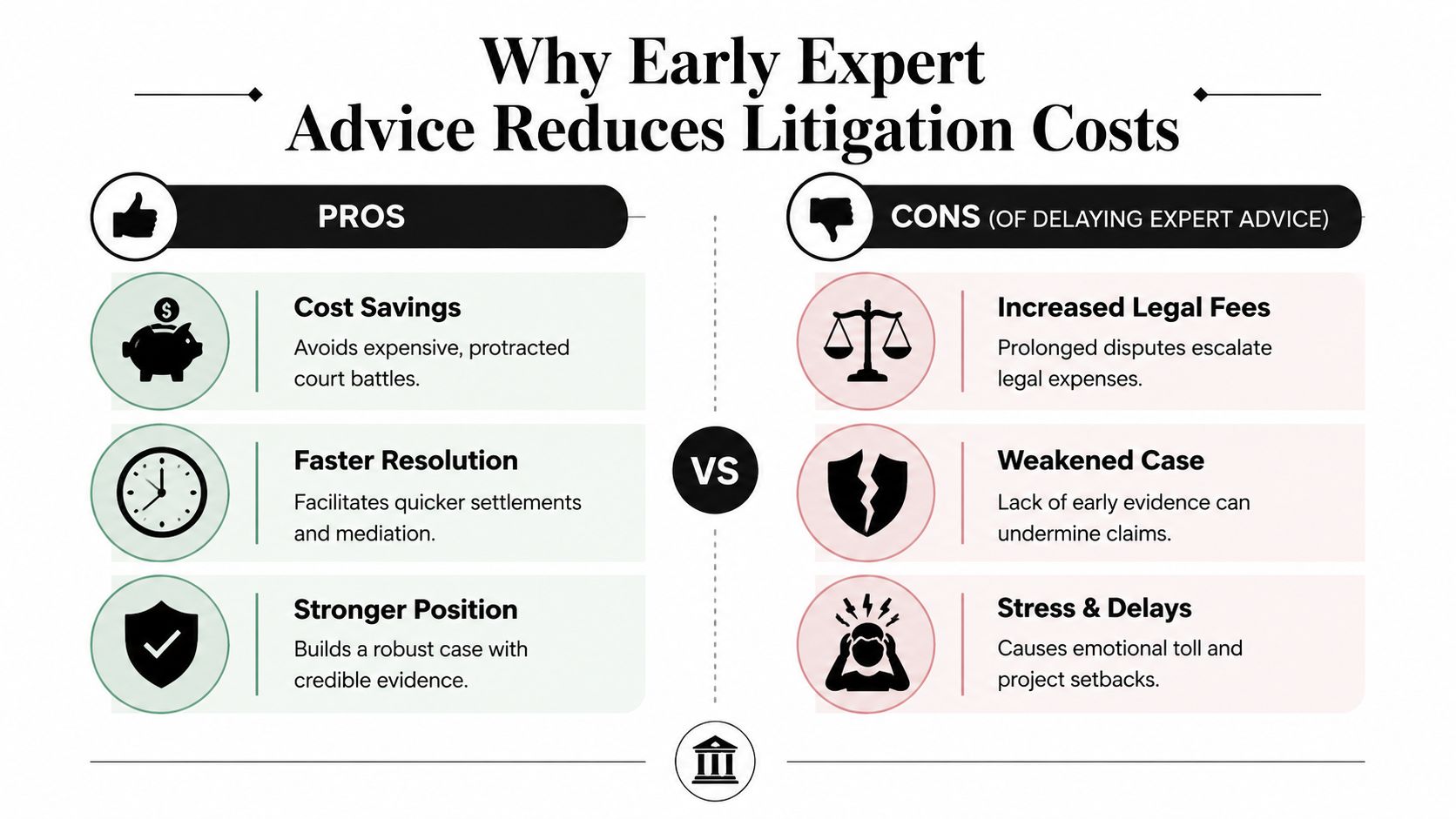
The main reason is simple. Early evidence narrows arguments. Late evidence tends to multiply them.
What early advice changes
A prompt independent inspection can do several useful things at once:
- Clarify the defect: It distinguishes actual non-compliance from assumption.
- Preserve evidence: Conditions can change after weather exposure or repair attempts.
- Focus negotiations: Parties argue less when the issues are itemised properly.
- Reduce lawyer time: Better technical clarity means less effort untangling basic facts.
This isn’t just theory. A 2024 NSW Fair Trading report found that in 42% of building disputes that escalated to NCAT, the issue could likely have been resolved pre-litigation if a third-party expert inspection had been engaged earlier, as cited by SJNBC’s NSW building dispute commentary.
The cost of waiting
Delaying expert advice usually creates avoidable problems:
- Positions become entrenched: Each side commits to a version of events before the facts are tested.
- Rectification attempts muddy the evidence: Later repairs can obscure original workmanship failures.
- Documents become fragmented: Emails, quotes, and photos pile up without a technical framework.
- Stress rises: Owners and builders both spend more time reacting than resolving.
A lot of construction conflict comes from poor planning at the front end as well. For readers interested in the broader idea of avoiding defects before they become claims, this article on preventing construction rework gives useful context on how early review and buildability thinking can reduce downstream dispute risk.
Early consultant versus late tribunal scramble
| Timing | Typical outcome |
|---|---|
| Early independent advice | Better issue definition, more realistic negotiation, stronger evidence base |
| Late expert engagement | Reactive reporting, tighter deadlines, more disputed assumptions |
If you’re deciding whether to engage help now or later, the primary consideration isn’t whether the defect feels serious enough. Instead, consider whether the cost of inaction will leave you with a weaker case, a slower resolution, and a more expensive dispute path.
Why Awesim Building Consultants Is Trusted Across Sydney
Experience matters in building disputes because dispute reporting is not abstract work. It depends on recognising how buildings are put together, how trades interact, how defects develop over time, and how to explain those issues in a way that solicitors, owners, builders, and decision-makers can all understand.
That’s why long site experience carries weight. Industry bodies like IBC NSW require members to have a minimum of 10 years of post-training experience, while Awesim’s 35+ years in the building industry provides a depth of seasoned expertise that is critical for complex litigation and compliance cases, based on IBC NSW membership criteria.
Why solicitors and property owners look for depth
In dispute matters, people usually want the same four things:
- Independent evidence-based opinions
- Detailed defect investigations
- Reporting aligned with tribunal expectations
- Practical understanding of how rectification should happen on site
That combination is harder to find than many assume. Plenty of people can inspect a property. Fewer can produce litigation-focused reporting that holds together under challenge.
Awesim Building Consultants have 35+ years in Building & Construction, with over 15+ years our providing litigation support to home owners, builders and lawyers. The firm provides site investigations, Building & Construction Expert Witness Reports and Scott Schedules across Sydney and NSW. In practical terms, that means the work sits at the point where construction knowledge and dispute procedure meet.
What clients usually value most
Property owners and solicitors tend to place the most value on these qualities:
| Quality | Why it matters in a dispute |
|---|---|
| Real-world construction knowledge | Helps identify likely cause, sequencing failures, and poor workmanship |
| Independence | Makes the opinion more credible in NCAT and court contexts |
| Standards knowledge | Links site findings to the NCC and Australian Standards |
| Litigation familiarity | Keeps reports focused on the questions that matter |
There’s also value in broad service coverage. Defect disputes don’t only arise in one suburb or one asset type. Sydney-wide service matters because defects occur in detached homes, duplexes, renovations, strata property, extensions, and mixed project environments.
A short overview is helpful here:
Why independent reporting stays critical
A consultant’s role is not to tell a client what they want to hear. It’s to provide a supportable technical opinion. That’s exactly why independent building consultants remain valuable in NSW building disputes. Their work can identify defects, reject weak allegations, narrow live issues, and bring discipline to matters that would otherwise drift into expensive argument.
The best reports don’t inflame disputes. They clarify them.
Frequently Asked Questions About Sydney Building Consultants
What does a building consultant do in a dispute matter
A dispute-focused building consultant investigates alleged defects, checks compliance against the NCC and relevant Australian Standards, identifies likely cause, and prepares evidence-based reporting. In formal matters, that can include Expert Witness Reports and Scott Schedules for NCAT proceedings or court.
Is a building consultant the same as a pre-purchase inspector
No. A pre-purchase inspector gives broad condition advice for a buyer. A dispute consultant deals with contested issues, causation, compliance, rectification, and reporting that may be scrutinised by lawyers or a tribunal. The standards of detail are much higher.
When should I engage a consultant
Earlier is usually better. If the issue is being denied, repeated, poorly repaired, or affecting multiple building elements, early advice often gives you a clearer negotiating position and helps preserve evidence before conditions change.
Can I still get help if my NCAT matter is already filed
Yes. Many people only seek help once the dispute has reached a formal stage. At that point, the focus is usually on targeted site investigation, report preparation, defect itemisation, and making sure the evidence is presented clearly and independently.
What kinds of issues do Sydney building consultants investigate
Common matters include:
- Waterproofing defects
- Structural cracking
- Roof leaks
- Balcony failures
- Poor workmanship
- Non-compliant building works
- Construction delays
- Contract disputes
- Progress payment disputes
Why does independence matter so much
Because a report that reads like advocacy is easier to challenge. In dispute work, credibility comes from objective findings, site-based analysis, and clear reference to technical standards. Independent reporting helps owners, builders, and solicitors work from facts rather than assumptions.
What should I have ready before speaking with a consultant
Bring together the documents that define the dispute. That usually includes the contract, plans, specifications, variations, photographs, correspondence, invoices, prior quotes, and any previous reports. A consultant can work more efficiently when the project history is organised.
Who uses these services
Homeowners, builders, solicitors, strata stakeholders, and other parties involved in construction disputes all use building consultants. The common factor is the need for technically sound, evidence-based reporting.
If you need Awesim Building Consultants for Expert Witness Reports, Scott Schedules, building defect investigations, construction litigation support, or building dispute consultancy services across Sydney and NSW, contact the team directly at admin@awesim.com.au or call 1800 293 746.