
You’re usually not reading about NCAT because everything on site went smoothly. You’re here because the job has gone off track. The waterproofing doesn’t look right, the slab is cracking, the builder says the work is fine, the owner says it plainly isn’t, and every email now feels like it’s written for a future hearing.
That’s where the first costly mistake is often made. They assume NCAT is just a place to “tell their side” and bring a folder of photos. It isn’t. NCAT is a tribunal process with deadlines, evidence rules, procedural steps, and a very particular way of dealing with building defect disputes.
Awesim Building Consultants have 35+ years in Building & Construction, with over 15+ years providing litigation support to home owners, builders and lawyers. We provide site investigations, Building & Construction Expert Witness Reports and Scott Schedules. That practical combination matters because building disputes are rarely lost on passion. They’re lost on procedure, evidence structure, and poor defect analysis.
One figure tells the story clearly. In NSW, builders who represent themselves in building contract disputes succeed only 40% of the time, whereas those with legal representation achieve a 73% success rate, demonstrating the critical impact of professional evidence preparation, according to this NSW building dispute success rate analysis.
Practical rule: NCAT doesn’t reward the angriest party. It usually rewards the party whose evidence is organised, technical, and easy to test item by item.
This complete guide to NCAT building disputes in 2026 is written for three people who often end up in the same room for very different reasons. The stressed homeowner who wants defects fixed properly. The defensive builder who knows some items are arguable and some aren’t. The solicitor who needs an expert report and Scott Schedule that can be used.
Your Guide Through the NCAT Maze
A typical dispute starts long before the application. A homeowner notices movement in a tiled floor, water staining near a shower recess, or incomplete external works. The builder says the issue is maintenance, shrinkage, or outside scope. The owner gets a generic inspection report. The report lists complaints, but it doesn’t tie each item to a standard, explain causation properly, or cost rectification in a way the Tribunal can work with.
That’s the gap that catches people. They think they have evidence because they have photos and a report. Often, they only have materials. Materials become evidence when they’re structured properly.
What stressed parties usually get wrong
Homeowners often wait too long while hoping the builder will “do the right thing”. Builders often respond defensively to every point instead of separating genuine defect items from overreach. Solicitors sometimes inherit a file where the chronology is incomplete and the defect list is too vague to plead cleanly.
NCAT building disputes reward clarity. The Tribunal wants to know:
- What is the defect: not a broad complaint, but the exact item
- Where is it located: room, elevation, area, or drawing reference
- Why is it a defect: with a technical basis, not opinion alone
- What fixes it: in a defined scope of rectification
- What does that cost: in a supportable amount
What experienced support changes
With more than three decades in construction and more than fifteen years assisting in litigation support, the practical lesson is consistent. The strongest matters usually start with a proper site inspection, a disciplined document review, and a Scott Schedule that lets the Tribunal move through the dispute without guesswork.
The parties who do best are usually the ones who stop arguing in generalities and start presenting defect items in a form NCAT can decide.
For homeowners, that means resisting the urge to file quickly with weak documents. For builders, it means avoiding blanket denials. For lawyers, it means getting technical evidence early enough to shape the case rather than patch it later.
NCAT Jurisdiction and Critical Timelines
Before anyone spends money on reports, responses, or legal drafting, two questions need answering. Is NCAT the right forum, and are you still in time?
For residential building disputes in NSW, those are threshold issues. If you get either wrong, the strength of the defect case may not matter.
Start with the time limit
Under the Home Building Act 1989 (NSW), claimants must lodge NCAT applications within 6 years for major defects and 2 years for non-major defects, and failure to meet these deadlines results in automatic dismissal of a claim, as outlined in this explanation of NCAT procedures and statutory deadlines.
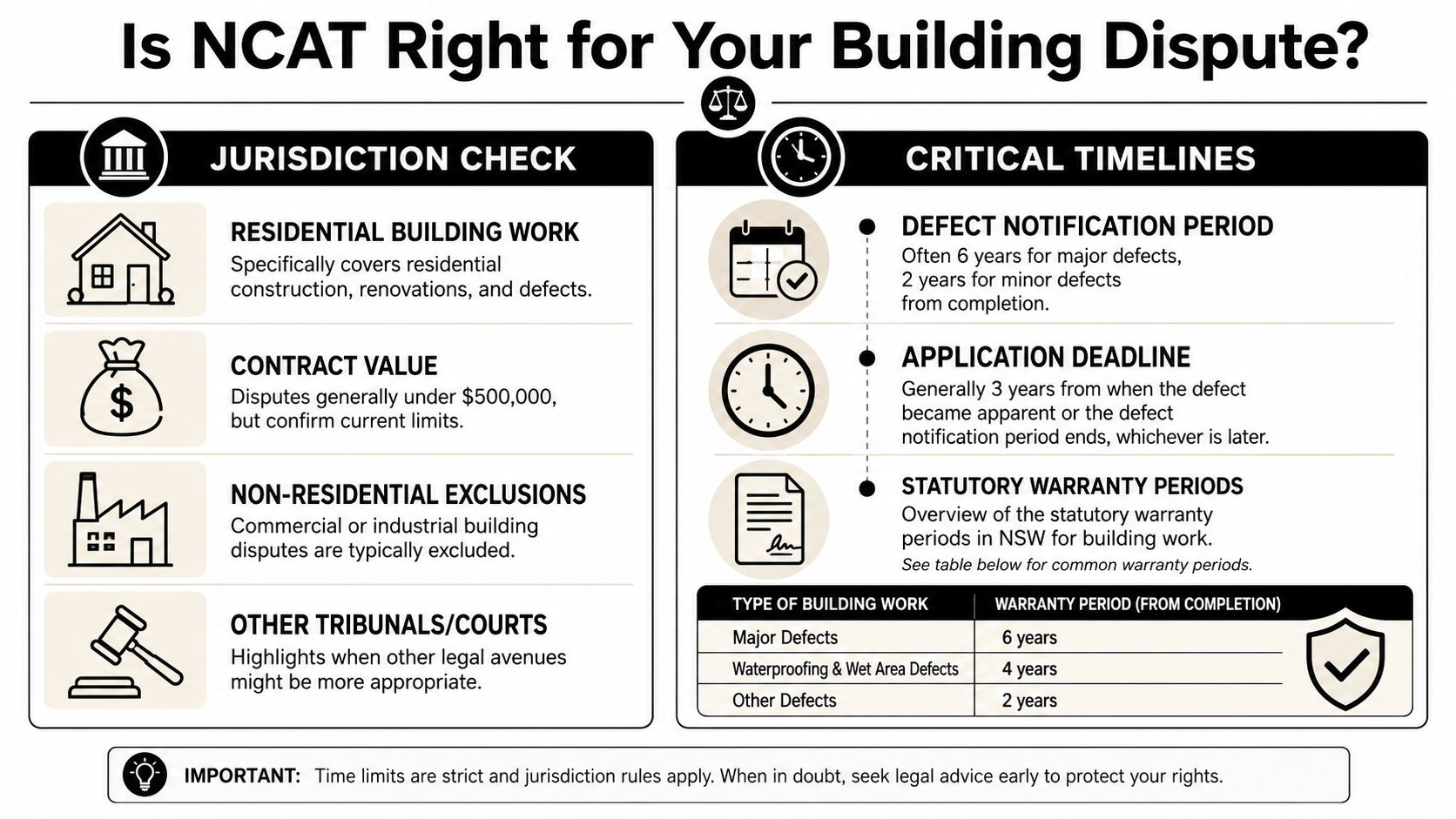
That distinction matters because parties often misclassify defects. A major defect may involve structural failure or fire safety system defects. A non-major defect might involve cosmetic workmanship issues or minor water ingress. The legal character of the defect drives the filing window, and the evidence strategy often follows from that classification.
Jurisdiction is practical, not theoretical
As a working rule, NCAT is commonly used for residential building disputes. That includes many defect, incomplete work, and contract-related issues arising from home building work. The usual practical check is whether the dispute concerns residential building work and whether NCAT is the proper venue rather than a court or another pathway.
A quick filter helps:
| Question | Why it matters |
|---|---|
| Is the work residential building work? | NCAT commonly deals with residential matters, not every construction dispute |
| Is the problem framed as identifiable defect, incomplete work, variation, or payment issue? | Vague complaints are difficult to run |
| Are you within the statutory period? | Out-of-time claims can fail regardless of merit |
| Is the relief you want something NCAT can order? | You need to match the claim to the forum |
Don’t confuse delay with strategy
A lot of owners lose useful time while waiting for informal promises, fresh quotes, or another inspection. Builders do something similar when they assume the owner won’t file. By the time someone finally takes the process seriously, the limitation issue can dominate the matter.
If you need a broader legal overview of consumer protections and dispute rights, this guide to homeowner rights in NSW building disputes is a useful companion.
If there’s any doubt about whether a defect is major or non-major, treat timing as urgent and get the technical assessment done early.
The NCAT Building Dispute Pathway Step by Step
A homeowner usually reaches NCAT after months of texts, patch jobs, missed return visits, and a Fair Trading complaint that did not fix the underlying problem. A builder often arrives convinced the owner is exaggerating, only to discover the Tribunal wants each disputed item pinned down with dates, scope, standard, and remedy. That gap between what people feel happened and what they can prove is where cases start to go wrong.
The process is not difficult to follow. The trap is procedural sloppiness. In my experience, self-represented parties rarely lose because they care less. They lose because they file too early, file the wrong material, or turn up to directions without a document set the Tribunal can use.
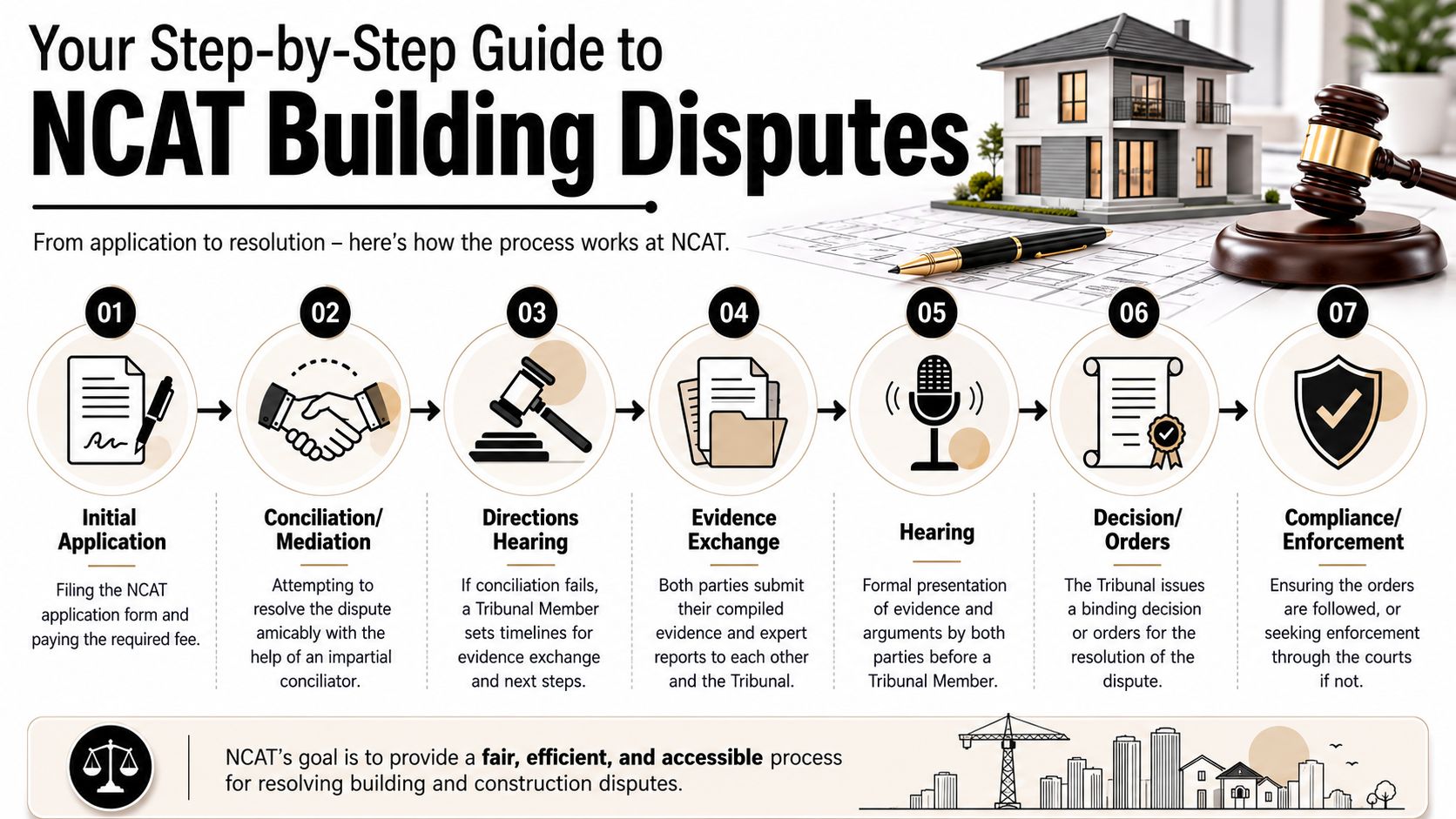
How the pathway usually runs in practice
Start with NSW Fair Trading
For residential building disputes, parties are generally expected to attempt Fair Trading first. Treat that step seriously. The complaint should identify the actual items in dispute, not just say the work is “defective” or “unfinished.”File the NCAT application properly
The application needs a clear claim, the right parties, and the right remedy. Owners often ask for “everything to be fixed” without identifying the work item by item. Builders often respond too broadly and fail to separate admitted defects from disputed allegations.Directions begin, and the actual work starts
Once NCAT takes control of the matter, deadlines matter. This is usually the point where the Tribunal orders evidence, expert material, a Scott Schedule, or a response in a set format. Missing the format can be as damaging as missing the deadline.Conciliation tests the case early
Conciliation is where weak claims and weak defences get exposed. A party with a disciplined schedule of defects, scope references, photos, and costing has options. A party with a folder full of screenshots and no structure usually ends up reacting.Hearing preparation narrows the fight
By the time a matter is listed for hearing, the sensible course is to reduce noise. Drop the items you cannot prove. Press the items that are documented, tied to the contract or statutory warranty, and supported by a rectification pathway.Orders follow the evidence, not the emotion
NCAT can make work orders, money orders, or other directions within its power. The Member is looking for a practical basis to decide each issue. That means clear defect identification, causation where relevant, and a workable measure of loss or rectification.
What usually causes delay
The pressure points are predictable.
The first is poor issue definition. If the claim is drafted as a general grievance, the Tribunal often has to force clarity through directions. That costs time and weakens settlement prospects.
The second is evidence format. Procedural Direction 3 is where many self-represented parties come unstuck, particularly if they do not understand what a compliant Scott Schedule needs to do. A useful primer is this guide to a Scott Schedule for NSW Tribunal proceedings. It explains the structure NCAT expects, which is very different from a standard defect report.
The third is overreaching. Owners sometimes run every annoyance as a major defect. Builders sometimes deny obvious workmanship issues that should be conceded and priced. Both approaches make conciliation harder and hearings longer.
For readers managing filing logistics, service requirements, and document preparation, these detailed instructions for court document submission are useful because procedural mistakes often create delay before the merits are even reached.
A short visual summary often helps when you’re trying to explain the process to a co-owner, client, or witness.
Conciliation works best when each item is already reduced to a schedule, supported by documents, and given a realistic settlement position. Turning up to “tell your side” is rarely enough.
Building Your Case with Compliant Evidence
A building dispute usually turns on evidence quality, not evidence volume. Parties often arrive with hundreds of photos, long email chains, and a broad defect list. Yet the case still struggles because none of it is translated into a format NCAT can efficiently decide.
That’s where people confuse a building inspection report with a litigation-ready expert brief. They are not the same thing.
A generic report won’t carry a hard-fought case
A generic report may describe concerns and attach images. That can be useful at an early stage. But a contested NCAT matter needs more. The expert material has to identify the actual defect item, explain the technical basis, reference the applicable standard, and connect the issue to a rectification method and cost.
Current guidance often misses that distinction, which is one reason some homeowner applications are dismissed or delayed for poor evidence formatting. In fact, existing guidance rarely explains the difference between a generic building inspection report and an NCAT-compliant Scott Schedule, contributing to 30% of homeowner applications being dismissed or delayed for inadequate evidence formatting, according to this guide on NCAT expert witness reports and evidence requirements.
What a compliant Scott Schedule must do
NCAT Procedural Direction 3 (2025) mandates that a compliant Scott Schedule must itemise each defect, identify the specific Australian Standard breached, such as AS 3740 for waterproofing, and include a quantified rectification cost, as explained in this Scott Schedule guidance for NSW disputes.
That sounds simple until you see what’s missing from many filed schedules. Vague labels like “poor tiling” or “bathroom leaks” aren’t enough. Each item must stand on its own.
The structure should do at least four things:
- Separate each issue clearly so one weak item doesn’t contaminate a stronger one
- Identify the technical breach by tying the complaint to a standard, code, or contractual requirement
- Define the repair scope so the Tribunal can understand what rectification involves
- Attach a supportable amount so the claim isn’t just an argument without a measurable remedy
The anatomy of a schedule that works
NCAT expects a disciplined document. The Scott Schedule structure requires every defect to have a unique item number, a factual description of the defect, a claimant position column citing the standard or code basis, and a proposed rectification column explaining the repair method, as outlined in this explanation of Scott Schedule structure in NSW.
Before filing, each item should also point back to the underlying evidence. A proper schedule cross-checks the report section and page, the photo or annexure number, the expert’s technical basis, and the quote or costing sheet for the claimed amount, as described in this guidance on preparing Scott Schedule Form 2.
Here’s the practical difference:
| Weak presentation | Strong presentation |
|---|---|
| “Shower leaks” | “Item 7. Ensuite shower recess waterproofing failure at hob junction” |
| “Doesn’t comply” | “References the applicable waterproofing standard and defect location” |
| “Needs fixing” | “Sets out removal, preparation, re-waterproofing, retile, test, and make-good scope” |
| “Approximate cost attached” | “Links the amount to a costing source for that item” |
Expert evidence has to be usable, not just impressive
In practice, the most useful expert reports are measured, technical, and restrained. They don’t advocate like a party submission. They help the Tribunal determine the issues. For lawyers, that makes pleadings and hearing preparation cleaner. For owners and builders, it narrows the dispute to what can be proven.
For parties needing that kind of technical material, Awesim’s guide to Scott Schedules in NSW Tribunal matters explains how the schedule is used in live disputes and what a compliant format looks like.
Site reality: A strong report doesn’t try to win every point. It identifies the points that can be defended under close scrutiny.
Preparing a Strong Defence as a Builder
A builder usually gets into trouble at NCAT long before the hearing. It starts with a rushed response, a blanket denial, and no disciplined answer to the owner’s schedule. By the time the matter reaches directions or conciliation, the builder looks evasive, even where several items were properly contestable from the start.
A strong defence is organised, specific, and commercially sensible. It shows the Tribunal that the builder has read each allegation, understood the technical issue, and taken a position that can be supported with records, scope, and cost.
What NCAT expects from a respondent
Where a Scott Schedule has been ordered, the respondent needs to answer each item in the format required by the Tribunal. In practice, that means identifying whether the item is admitted, denied, or only partly admitted, then stating the builder’s position on scope and cost where rectification is said to be required.
That sounds straightforward. Self-represented builders often get it wrong.
The common failures are predictable. They argue globally instead of item by item. They say the work is compliant without identifying the contractual or technical basis. They dispute the owner’s amount but provide no competing scope or costing. Under Procedural Direction 3, that sort of response usually weakens the defence rather than strengthening it.
The defence that carries weight
A useful defence does not try to win every skirmish. It narrows the core issues.
Admit the items that are plainly defective
A measured admission can protect credibility. If a fitting was omitted, silicone is failing, or a finish is visibly below standard, conceding the point often strengthens the response on the harder items.Deny with a proper basis
A denial needs a reason the Tribunal can use. The item may fall within tolerance, sit outside the contract scope, arise from owner-supplied materials, result from lack of maintenance, or reflect damage that occurred after handover.Partly admit inflated claims
This is common in building cases. There may be a defect, but the owner’s claim for full replacement, broad demolition, or premium reinstatement may go well beyond what is necessary to rectify the actual problem.Put forward your own rectification scope and figure
If the builder says the owner’s costing is excessive, the Tribunal will expect a practical alternative. Without one, the builder is often left criticising the owner’s number without giving the decision-maker anything better to work with.
What usually hurts builders most
The biggest problem is not always the defect itself. It is the lack of records behind the response.
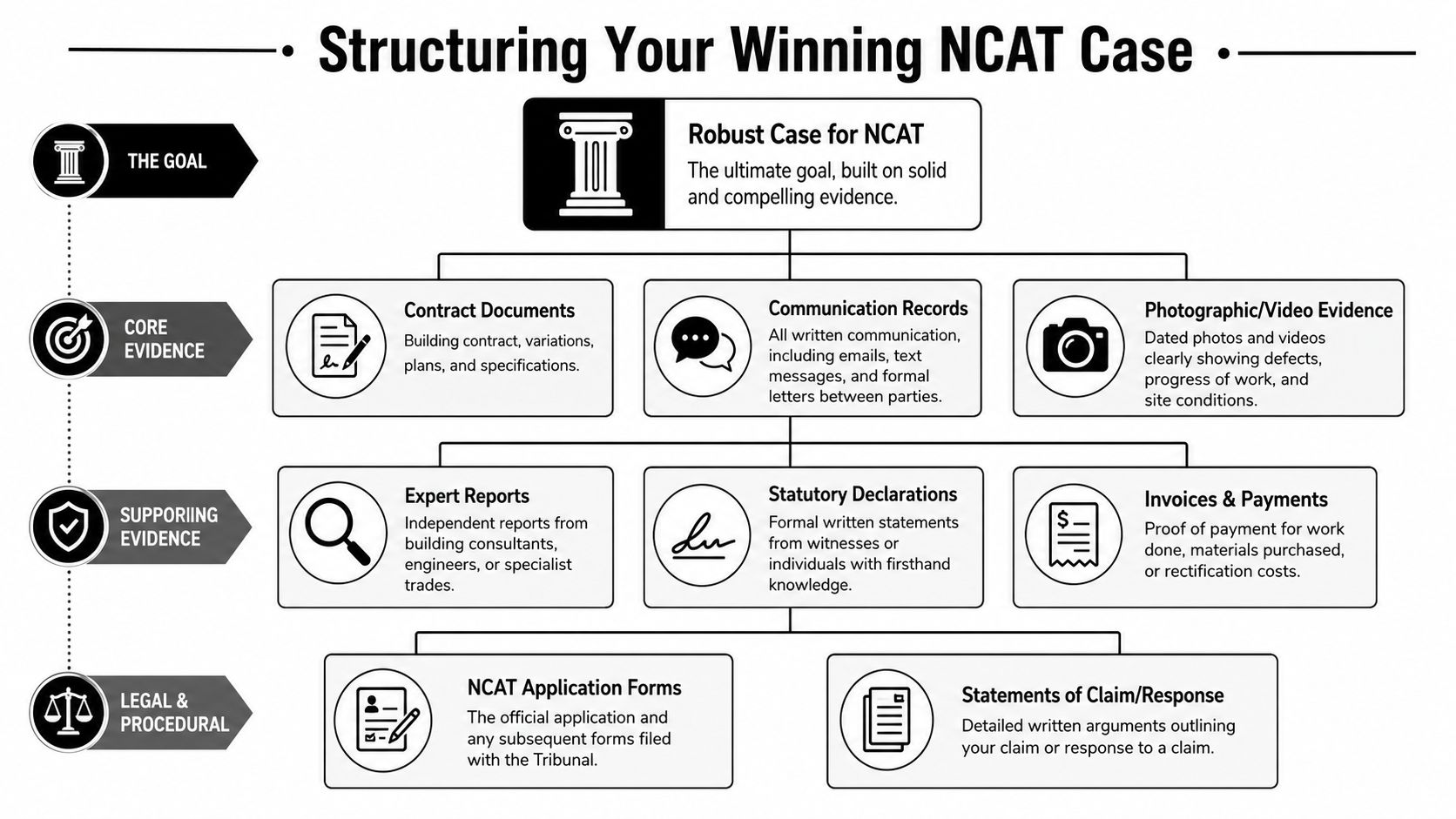
A builder defending a claim should have the contract, plans, specifications, variations, site instructions, progress claims, completion documents, photographs, emails, text messages, supplier information, and any maintenance or handover material in a usable bundle. If the issue turns on sequence, access, client selections, or excluded scope, those documents often matter more than argument.
I have seen builders with a reasonable technical defence lose ground because they could not show the paper trail. I have also seen modest defects claims shrink quickly once the builder produced dated site photos, variation approvals, and a clear rectification costing.
Why blanket denials fail
Blanket denials create two problems. First, they make settlement harder because the owner assumes every point will have to be fought. Second, they damage credibility when obvious defects are eventually conceded under pressure.
Tribunal members see this pattern often. A builder who contests everything can look less reliable than a builder who admits minor defects, disputes the overstated items, and explains the proper cost of fixing what is wrong.
That is usually the better position.
The strongest builder defence is usually a disciplined one. These items are not defects. These items are minor and repairable. This is the reasonable scope and cost.
Understanding Costs and Likely Outcomes
People often ask the wrong costs question. They ask what it costs to file. The more useful question is what the dispute will cost to run properly compared with what a realistic settlement might achieve.
NCAT matters involve several layers of cost. There are Tribunal filing expenses. There may be solicitor and counsel costs. There are often expert inspection, reporting, conferencing, and hearing attendance costs. Those aren’t wasted if they sharpen the dispute early, but they do need to be weighed against the size and nature of the claim.
NCAT outcomes aren’t only about money
A lot of parties assume the end result must be a cash order. In building disputes, that’s only one possibility. Depending on the case, the Tribunal may make orders directed at rectification, completion, compensation, or contract-related obligations.
That changes how parties should think about settlement. A homeowner who wants the work fixed may not be best served by pushing only for a damages figure. A builder who can rectify efficiently may be better off proposing a controlled scope of work than fighting every point to final hearing.
The conciliation trade-off is real
Settlement at conciliation can feel unsatisfying because neither side gets complete vindication. Yet many sensible outcomes happen there because the parties avoid further report costs, hearing preparation, witness coordination, and delay.
The trade-off usually comes down to this:
| Option | Typical upside | Typical risk |
|---|---|---|
| Conciliated outcome | Faster closure, lower running cost, practical control | You may compromise on some items |
| Final hearing | Binding determination on disputed items | More time, more preparation, more exposure if evidence is weak |
Expect enforcement issues in some matters
Winning on paper and obtaining compliance aren’t always the same thing. If orders are made and not followed, enforcement may become its own exercise. That’s why the framing of the orders matters. Clear, itemised orders are generally easier to act on than vague directions.
For that reason, parties should keep the end result in view from the beginning. What outcome is useful? A scoped rectification order. A completion order. Compensation that reflects a technical defect case. A negotiated settlement with dates and access conditions. The practical answer depends on the project and the relationship between the parties.
Your Expert Support Checklist and Next Steps
By the time a matter reaches NCAT, the easiest mistakes have already become expensive. Deadlines have tightened. Communications have hardened. Each side has usually spent months repeating the same arguments. What helps at that point isn’t more opinion. It’s a clean process.
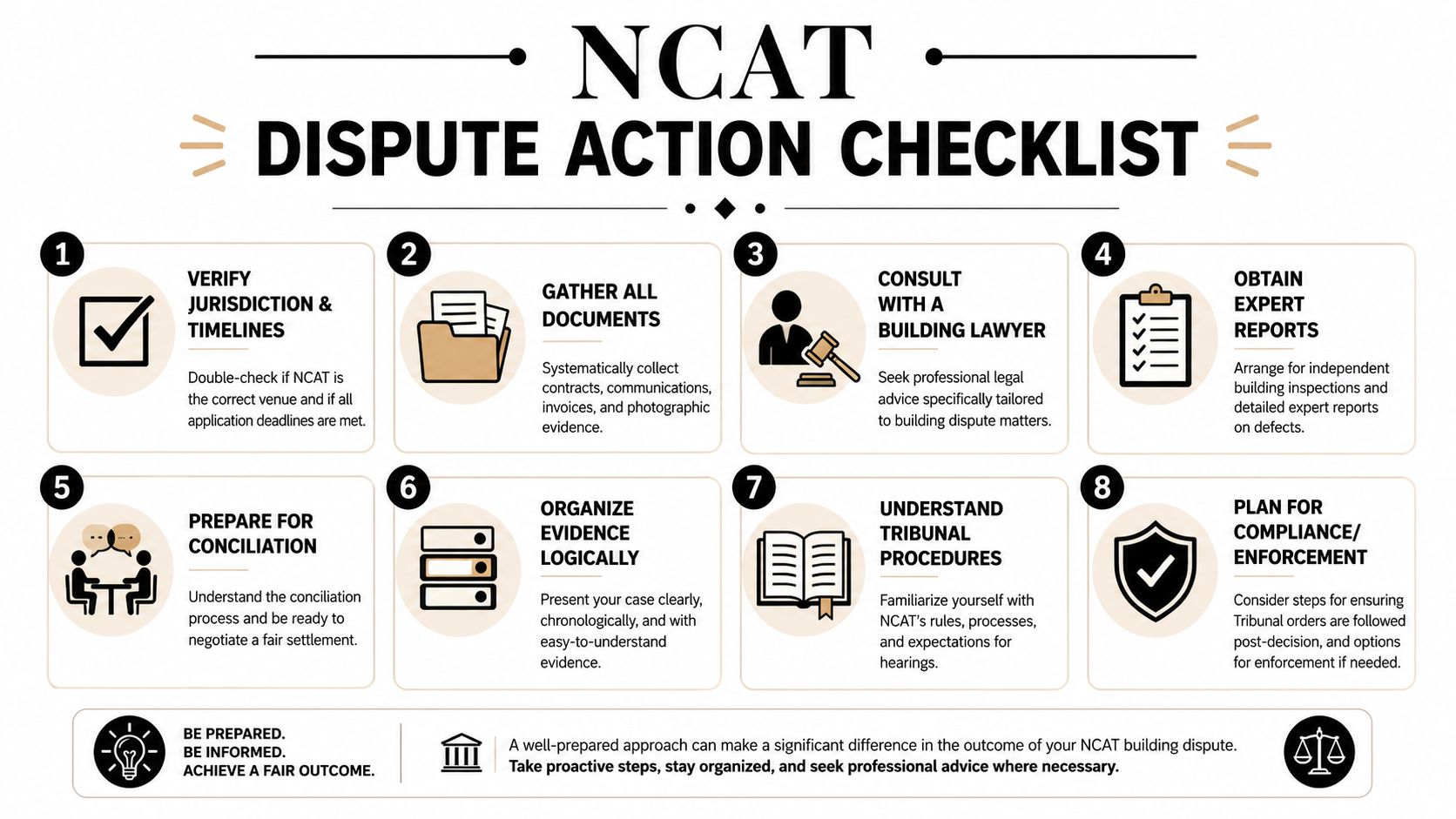
The most useful preparation is often simple and disciplined.
The checklist that keeps matters on track
Check the filing window first
If time is short, don’t wait for informal promises or another round of blame.Confirm the correct pathway
Many parties need to deal with NSW Fair Trading before the Tribunal will accept the matter.Collect the core documents
Contract, plans, specifications, variations, invoices, payment records, photos, videos, and correspondence.Sort the chronology
A good timeline often exposes the underlying issues quickly.Get the defects inspected properly
The aim is to identify each item technically, not just narrate dissatisfaction.Prepare evidence in Tribunal-ready form
A document bundle is not the same thing as a case.
When expert support becomes decisive
If the builder is unlicensed, the other side can’t be located, or service becomes a problem, practical investigation may also matter. In cross-border or hard-to-locate matters, resources such as UK tracing agents can be relevant when a party, witness, or former contractor has become difficult to find.
For technical preparation, the key is getting site investigation, expert analysis, and schedule preparation aligned from the start. That’s where NCAT building expert witness report guidance becomes useful for parties who need defect analysis, causation assessment, and rectification costing prepared in a format suited to dispute use.
The practical lesson from years of litigation support is straightforward. Most weak cases don’t fail because there was no problem on site. They fail because the problem wasn’t documented, classified, and presented in the language NCAT requires.
Get the technical issues out of conversation form and into evidence form as early as possible.
If you need help preparing for an NCAT matter, Awesim Building Consultants can assist with site investigations, Building & Construction Expert Witness Reports, and Scott Schedules for homeowners, builders, and solicitors. For practical next steps, email admin@awesim.com.au or call 1800 293 746.