
Building Consultants Sydney: Expert Inspection Guide
You're already in the wrong part of the process if you're waiting for the builder to “finish everything off” before getting a proper report. By the time cracks, leaks, or compliance arguments surface, the key question isn't whether there's a defect, it's whether the evidence can stand up in NCAT, in a solicitor's brief, or in front of a cross-examiner.
That's where Building Consultants Sydney work is different from a routine inspection. A general pre-purchase report might tell you something is wrong, but a dispute-grade report has to pin down what failed, where it failed, how it failed, and how the evidence is organised so a tribunal can use it. In NSW, that distinction matters more than most owners realise, because construction work is running at scale, with $83.4 billion in work done in the March quarter of 2026, including $44.7 billion in building work and $38.7 billion in engineering work, while New South Wales recorded $23.34 billion in construction work done for the quarter, the largest state figure in the ABS table shown. ABS construction work done release
When Building Disputes Need More Than a Standard Inspection
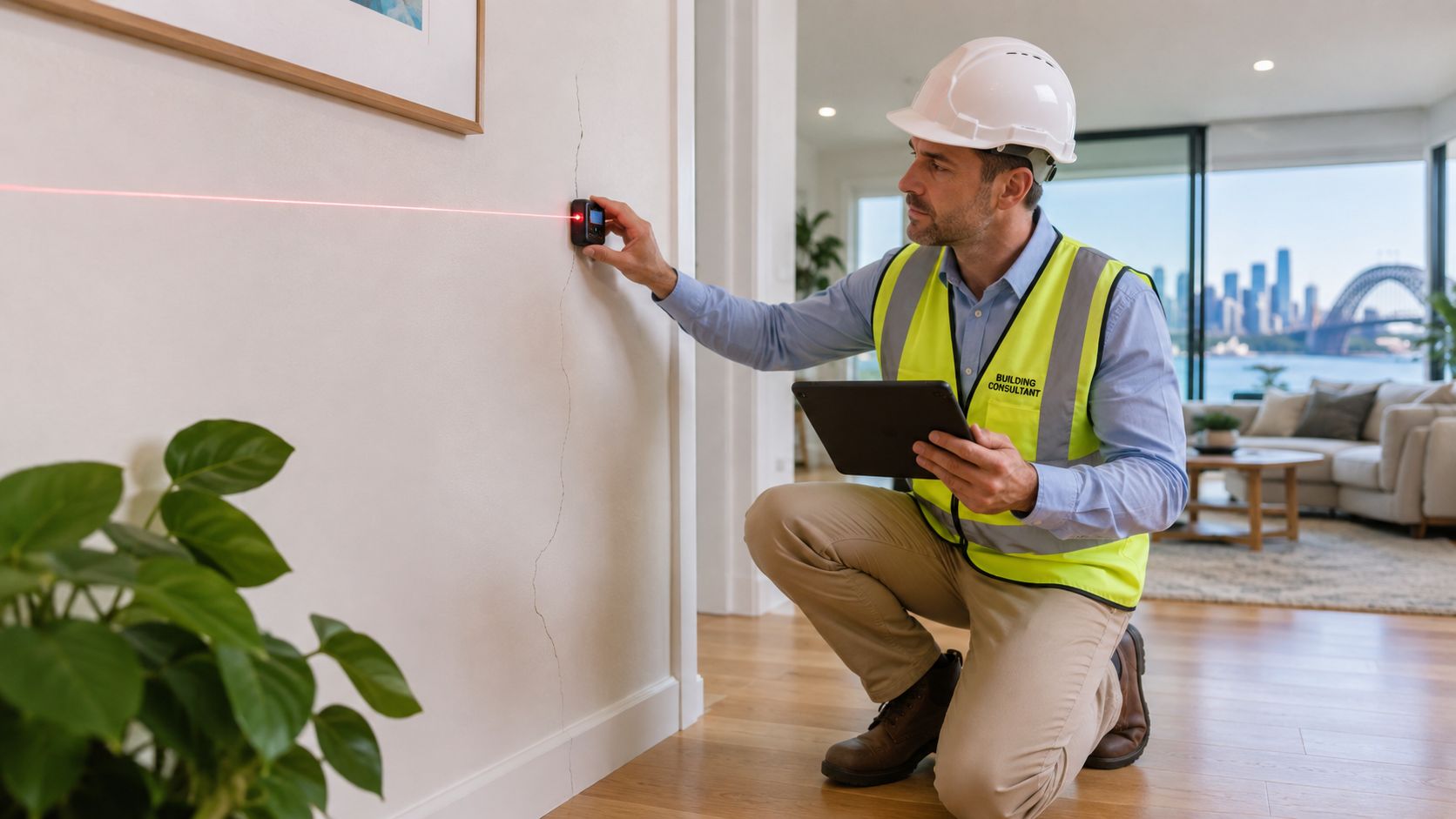
A homeowner calls after the builder insists the waterproofing is “within tolerance”, yet water is still entering a balcony junction every time it rains. The pre-purchase-style report sitting on the kitchen bench lists visible defects, but it doesn't answer the only question that matters in a dispute, who is responsible, what standard was missed, and what evidence can prove it.
That is where a building consultant earns their place. In Sydney, the work can range from site investigations and defect causation analysis to Expert Witness Reports, Scott Schedules, and compliance documentation, depending on whether the matter is heading to negotiation, NCAT, or court. Awesim's practical distinction between site investigation and tribunal-ready reporting is set out in its guidance on when to hire an independent building consultant in Sydney.
What fails in disputes
The weakest reports usually do three things badly. They describe visible damage without tying it to evidence, they avoid identifying the relevant standard or non-compliance issue, and they leave the reader guessing about rectification scope.
Practical rule: if a report can't be used by a solicitor to draft pleadings or by a tribunal member to follow the defect story, it isn't doing dispute work.
In Sydney disputes, that gap is expensive. Homeowners waste time relitigating basic facts, builders get forced into defence mode without a clear technical reply, and lawyers end up paying for a second report. The right consultant doesn't just inspect, they organise facts into a form that can survive scrutiny.
When you need litigation support rather than general advice
Some matters only need a quick opinion on whether a problem looks urgent. Others need a properly structured evidence package. If the dispute involves waterproofing failure, structural cracking, or disputed workmanship, the consultant should be thinking about chronology, causation, and how the evidence will read under pressure, not just whether the defect looks obvious.
Core Services Building Consultants Provide in Sydney
The services that matter in dispute work are not the same as the services marketed for a standard inspection. A consultant may be asked to identify defects, estimate rectification scope, assess compliance, or give evidence in a legal forum, and each of those tasks needs a different level of technical discipline.
Site investigations that go past the obvious
A proper site investigation does more than photograph a crack or a leak. It tests whether the visible symptom matches the likely source, whether adjacent work has contributed to the failure, and whether access limitations have hidden the underlying cause. That is the difference between saying a wall is damaged and proving why it is damaged.
Expert Witness Reports for tribunal use
An Expert Witness Report needs more than neat formatting. It has to be factual, defensible, and written so the tribunal can follow the evidence without having to translate marketing language into technical meaning. Awesim's service page for building consultant services that help resolve disputes sits in that lane, where the brief is not general advice but reportable evidence.
Scott Schedules and defect-by-defect structure
When a matter has multiple defects, a Scott Schedule helps organise the dispute in a way that lets each item be answered, tested, and compared. That matters in NCAT because a long, loose report often creates confusion, while a structured schedule forces the consultant to separate what was observed from what was alleged and what rectification is needed.
Compliance advice and causation analysis
Compliance review is a different exercise again. A consultant may be checking whether work aligns with the Building Code of Australia, site conditions, and the practical standard expected on a regulated project. For readers who need the technical basis behind that role, Awesim's explanation of the BCA is useful context.
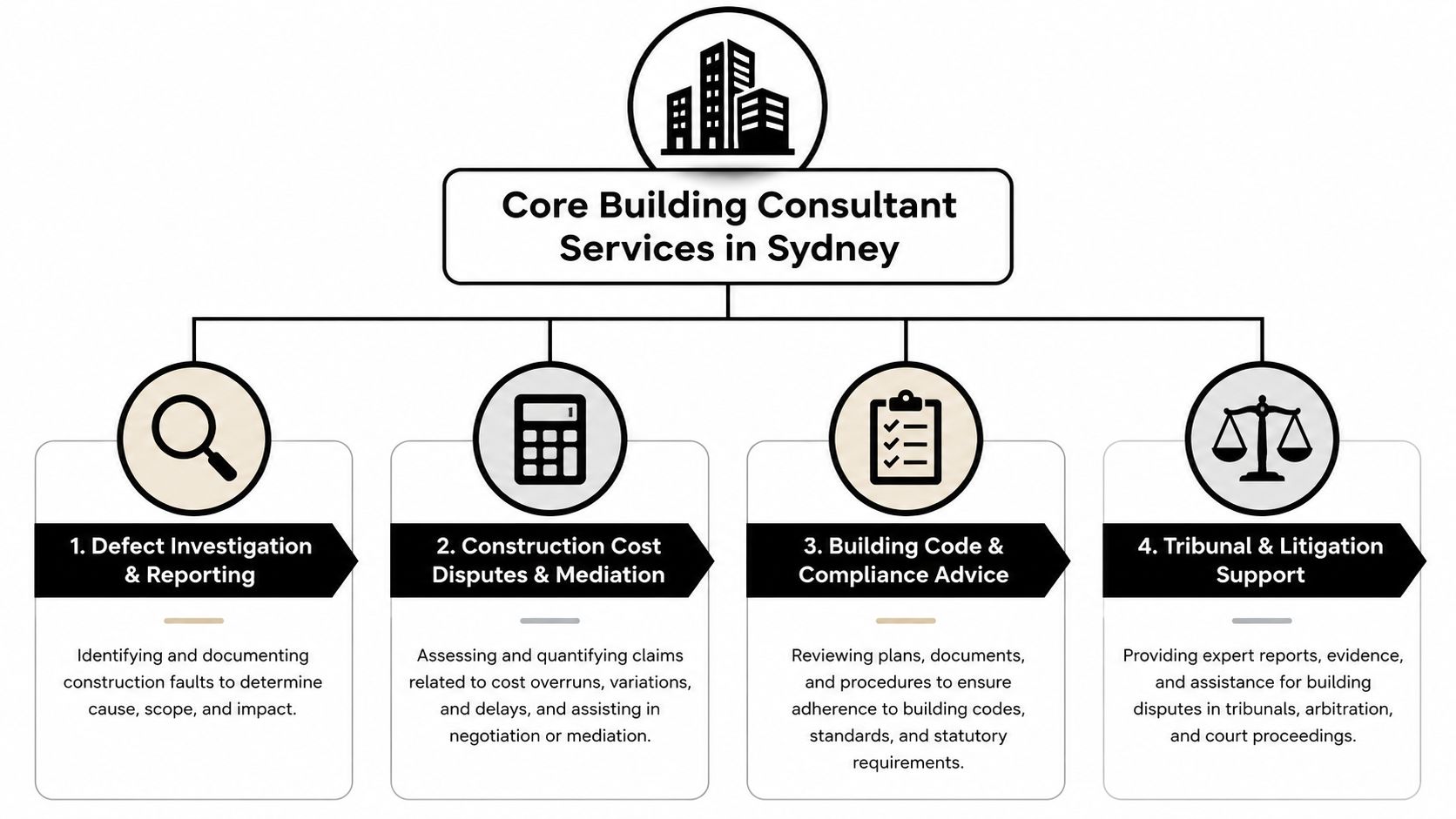
The main service categories usually look like this:
- Defect investigation and reporting: useful when the issue is hidden, repeated, or disputed.
- Construction cost disputes and mediation support: relevant when variations, incomplete work, or rectification cost are argued over.
- Building code and compliance advice: needed when the question is whether work meets the required standard.
- Tribunal and litigation support: essential when the report has to be used as evidence, not just information.
NSW Regulatory Framework and Compliance Requirements
NSW does not treat building consultancy as a casual label. It treats licensing, registration, certification, and dispute handling as formal compliance functions, which is why the consultant's paperwork matters just as much as their field experience. The state's building practitioner registration framework sets specific eligibility requirements, including being 18 or over, holding an endorsed contractor licence or meeting the qualification pathway for certain classes, having at least 5 years' practical experience in the last 10 years with at least 2 years in Australia for class 2, 3, 9a or 9c work, completing 2 mandatory Construct NSW learning modules, holding a current National Police Certificate no older than 4 months, and meeting insurance requirements. NSW building practitioners registration requirements
That sits alongside the government's public licensing contact channel, 13 27 00, available Monday to Friday from 8:30 am to 5 pm excluding public holidays, which is a reminder that licence checks should be done through official channels, not assumed from a polished website. NSW Building Commission contact details
Why the “BCA consultant” label needs context
A NSW-focused legal article notes that “BCA consultant” is not a legally required appointment under NSW legislation, even though certifiers must be engaged for developments requiring building approval under the relevant legislation. The same source explains that Fair Trading sees the certifier's role as not solving design issues, which is why some jobs need a separate specialist who can assess compliance or prepare evidence without pretending to be the certifier. Legal discussion of BCA consultant and certifier roles in NSW
That distinction matters in practice. A tribunal-ready consultant is not there to replace the certifier, and a certifier is not there to act as an expert witness on every defect question. The roles overlap in the building process, but they do not merge.
Why dispute evidence has to fit the process
NCAT matters and expert evidence work best when the report is written for procedure, not promotion. Awesim's statement that it prepares Expert Witness Reports, Scott Schedules, and NCAT-compliant documentation for Sydney and regional NSW reflects the genuine need: evidence must be written in a form the dispute pathway can use. Awesim about us
For homeowners and lawyers, a useful check is simple. Ask whether the consultant can explain how the findings will be used, whether the report is structured to answer the tribunal issues, and whether the consultant understands the difference between describing a defect and proving a defect.
For readers comparing regulatory burdens across NSW industries, a practical planning note is that compliance costs and certification requirements can shift sharply by sector. A useful example of that kind of regulatory cost context is 2026 battery savings in NSW, which shows how state-level rules can change project economics in entirely different trades.
How to Select a Qualified Building Consultant for Your Dispute
Choosing a consultant for a dispute is not the same as choosing someone to walk through a home before purchase. The ultimate test is whether they can produce evidence that still works when the other side pushes back, because that is where general inspectors often fall short.
The Australian Society of Building Consultants lists Sydney-area members with categories such as Accredited Consultant, Litigation Support, and Strata Inspector, and that mix tells you something important. The market expects more than observation, it expects specialist capability where defects, compliance, and rectification cost all have to be defended. ASBC member categories and expertise areas
What to check before you sign
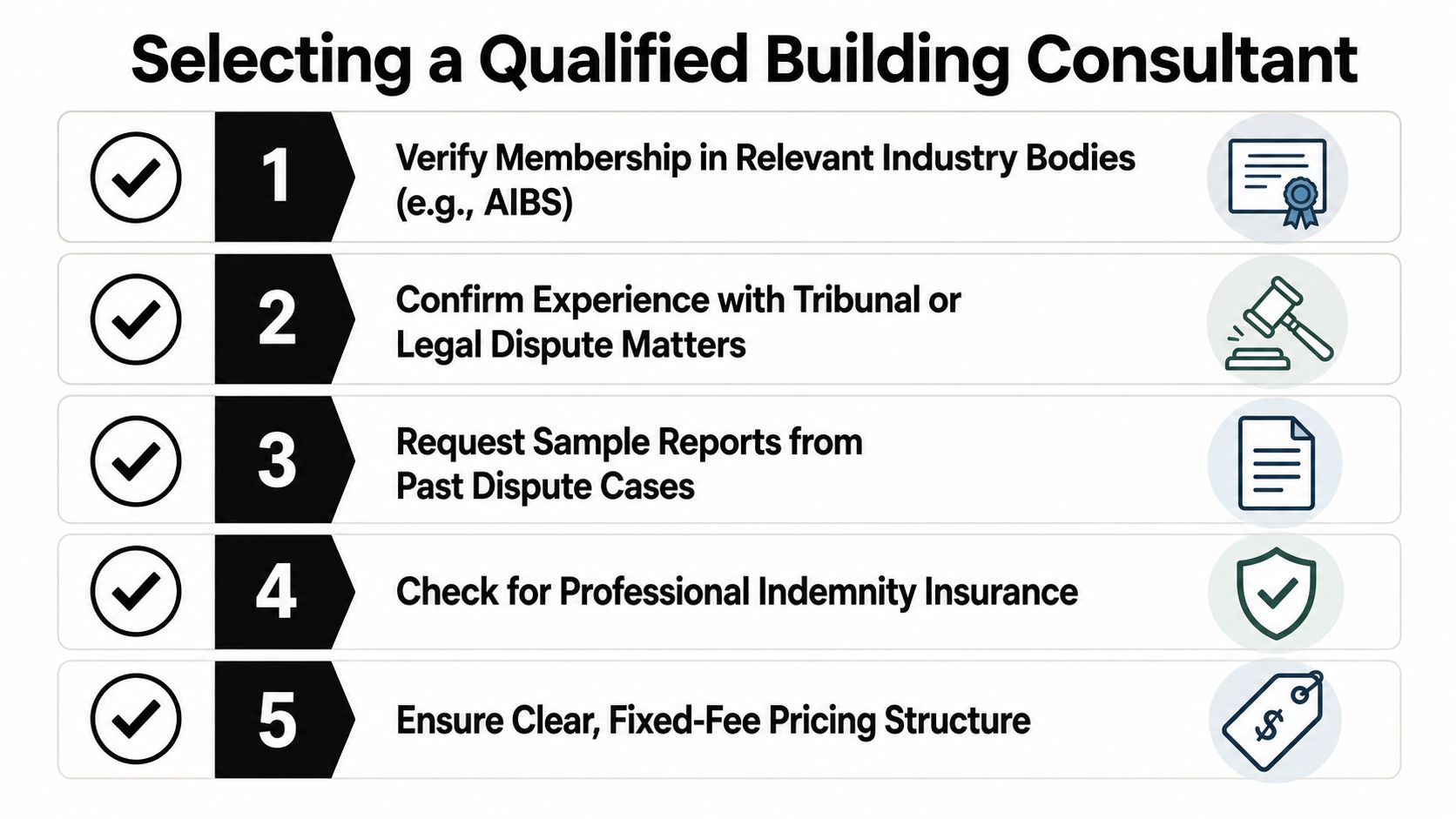
A simple checklist cuts through the sales talk:
- Relevant accreditation: look for specialist categories that match the dispute, not just broad membership claims.
- Dispute experience: ask whether the consultant has prepared reports for NCAT, court, or expert conclaves.
- Sample report quality: read a redacted report and check whether the findings are structured, referenced, and easy to follow.
- Insurance coverage: professional indemnity matters when a report is going to be relied on.
- Service area: some consultants travel widely across NSW, which matters if your property is outside inner Sydney.
Some consultants can inspect well but still produce a poor tribunal report. The report format, not the sales pitch, tells you whether they're litigation-ready.
Don't confuse visibility with capability
Sydney search results are crowded with providers advertising defect reports, compliance advice, or expert witness work. That doesn't mean each one can withstand cross-examination. Many listings make broad claims, but only a narrower group clearly shows that they understand NCAT, Scott Schedules, and evidence discipline.
That is where regional coverage also matters. A consultant who works across Sydney, the New England region, and other parts of NSW has to adjust to access issues, local construction conditions, and the practical realities of getting evidence on site. If the job is outside metro Sydney, ask how travel, access, and inspection timing affect the final report.
For safety-related dispute training, a practical comparison is the clarity you'd expect from Celtic Fire & Security's extinguisher guide, where the issue is not just information, but whether the guidance is usable under pressure. That same standard should apply to building dispute reports.
The Building Consultant Engagement Process and Timelines
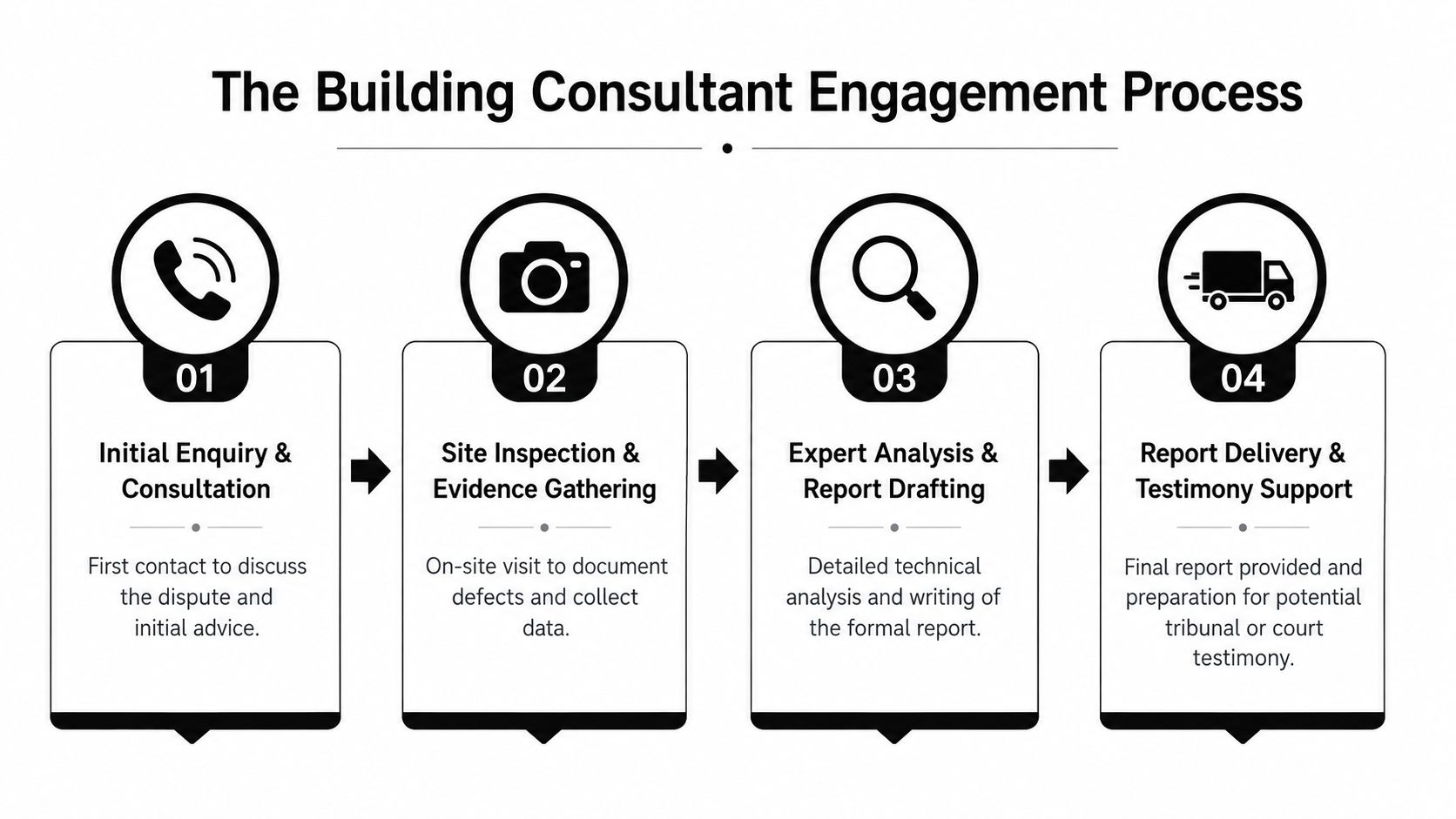
The first conversation should be direct. A decent consultant will ask what the dispute is, what documents exist, who the parties are, and whether the issue is urgent, because those details affect both inspection planning and the style of report required.
From there, the process usually moves through inspection, evidence capture, analysis, and report drafting. A straightforward defect review can move faster than a complex multi-defect matter, but once the report has to support litigation or NCAT evidence, the consultant needs time to check observations against the dispute issues and avoid sloppy drafting.
What clients should prepare
The best brief is the one that saves the consultant from guesswork.
- Contracts and variations: these show what was agreed and what changed.
- Photos and correspondence: they help establish timing and escalation.
- Access details: strata, tenant, or builder access can affect when the inspection happens.
- Question list: a good brief names the specific issues that need answering.
Where Scott Schedules fit
Scott Schedules are usually prepared when there are multiple disputed items and both sides need a clean comparison of claims, responses, and rectification positions. They sit inside the wider evidence set, they don't replace the expert report, and they work best when the underlying observations are already precise.
Realistic expectations
Some matters need urgent attendance because damage is active or access is about to disappear. Others need a more careful review, especially where the consultant has to compare drawings, photos, and site conditions before issuing final opinions. That is normal, and it is better than rushing a report that has to be revised later.
Understanding Building Consultant Pricing and Value
Pricing should reflect the work required, not just the time on site. A standard inspection is usually cheaper than an Expert Witness Report because the latter includes deeper analysis, tribunal-ready formatting, and tighter attention to evidence structure, all of which take longer to get right.
The main cost drivers are usually straightforward. Bigger and more complex properties take longer to inspect, multiple defects increase drafting time, regional travel adds practical overhead, and urgent delivery can compress the schedule. None of that is surprising, but it's why the lowest quote often becomes the most expensive choice when the first report has to be redone.
A useful way to judge value is to ask what you're buying. If the report can be used by a solicitor, understood by a tribunal, and defended if challenged, then the fee is tied to outcome, not just attendance. If it can't, the cheaper number on the invoice usually disappears once revisions start.
Price is not the same as value
There's a difference between paying for a site visit and paying for dispute-ready evidence. The first gives you observations. The second gives you a document that can be relied on when the other side disagrees, which is where the cost of a poor choice shows up.
Practical Tips for Homeowners Builders and Legal Professionals
Homeowners should document defects early, keep emails and photos in order, and stop relying on casual assurances once the dispute starts. If the matter looks like it could end up in NCAT, engage a consultant before positions harden, because timing affects what evidence can still be captured.
Builders need the same discipline, just from the other side. An independent report can help identify whether an allegation is real, overstated, or caused by another trade, and that matters when the dispute turns to quantum, scope, or responsibility.
Solicitors and barristers should brief the consultant tightly. Give the issues, the documents, and the procedural target, then ask whether the report can be structured for tribunal use and whether the expert is comfortable being tested on methodology.
Awesim Building Consultants provides site investigations, Building & Construction Expert Witness Reports, and Scott Schedules for disputes across Sydney and NSW, and its work is built around the evidence standards that matter in tribunal and litigation settings. If you need a report that is written for the dispute process rather than a sales brochure, speak to the consultant before the matter drifts any further.
If you're dealing with defects, NCAT, or a construction dispute in Sydney, talk to Awesim Building Consultants about the right evidence package for your matter. Visit Awesim Building Consultants to organise site investigations, Expert Witness Reports, or Scott Schedules with a consultant who understands NSW dispute work.

Related Posts
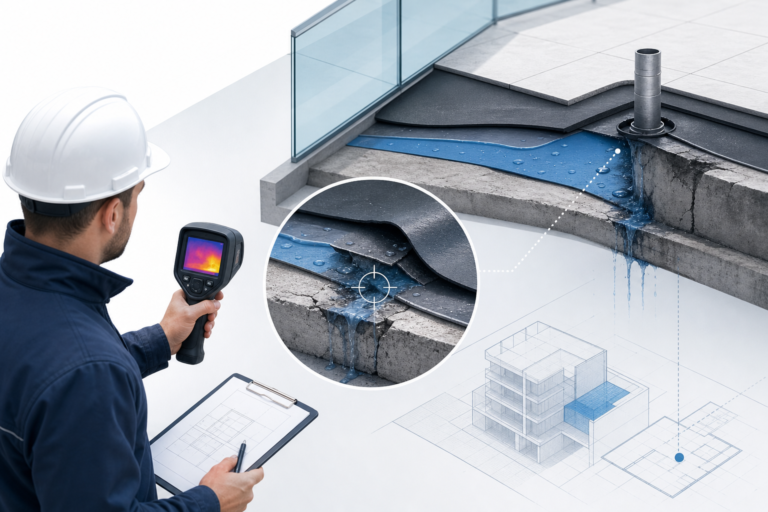
Waterproof Membrane Failure: How Inspectors Find the Cause
Waterproof membrane failure is diagnosed by tracing the water entry point, reviewing design documents, exposing the membrane for visual inspection,
Read More »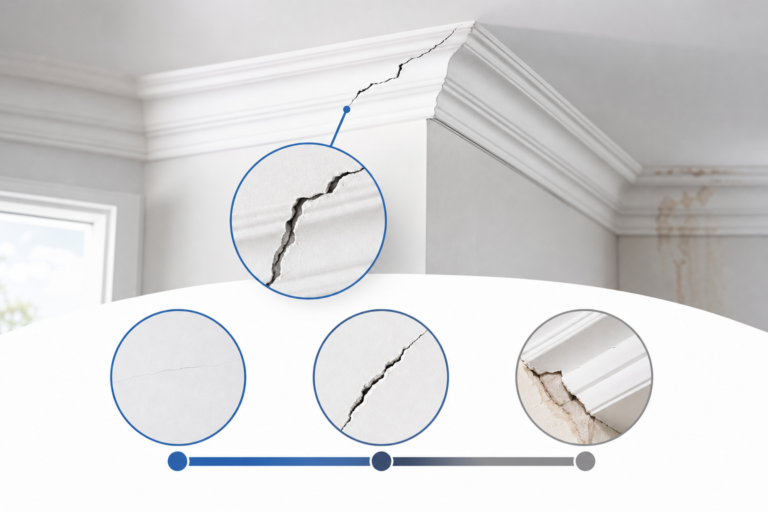
Cornice Cracking: How to Tell If the Damage Is Serious
Cornice cracking is one of the most common concerns Australian homeowners raise, and the hard part is not spotting the
Read More »
Digital Construction Consultant Australia: What They Do
A digital construction consultant in Australia manages the technology-driven side of building projects: BIM coordination, clash detection, asset data handover,
Read More »