
What Is Quantum Meruit Claim: Guide for NSW Builders

Quantum meruit is a restitutionary claim for the reasonable value of work, services, or materials supplied where there's no enforceable contract or where the contract price doesn't capture the benefit retained. In building disputes, that usually means the work is done, the owner has kept the benefit, and the fight is over what's fair to pay.
A builder finishes extras that were agreed over the phone, the paperwork never gets signed, and then payment stalls once the job looks close to finished. Or a homeowner gets a bill for “variations” that were never properly priced, never approved in writing, and don't match the site records. That's the territory where quantum meruit gets tested in NSW, and it's rarely about slogans. It's about proof, valuation, and whether the recipient should be allowed to keep the benefit without paying for it.
When Builders Work Without a Signed Contract
A common NSW dispute starts like this. The slab is down, framing is moving, the owner asks for extra work, the builder does it, and both sides keep talking as if the variation will be sorted out later. Then later never comes, the job finishes, and the owner says there is no signed variation, so payment stops.
That is the setting where quantum meruit matters. The phrase comes from Latin and means “as much as is deserved”, and in Australian law it developed as a restitutionary remedy to stop one party from keeping a benefit without paying for it Australian legal commentary on quantum meruit. In plain terms, the fight is not over what the builder hoped to earn. It is over the reasonable value of the work, services, or materials the other side accepted and kept.

Where it usually shows up in construction
This claim often appears when a builder has done extra work, pre-contract work, or work under an agreement that later turns out to be unenforceable or incomplete. Australian commentary describes it as recovery for the reasonable value of work performed or goods supplied where payment was not properly captured by the contract Kerrs legal commentary. The practical question is whether the homeowner accepted the benefit, knew payment was expected, and would be unjustly enriched if allowed to keep it for nothing.
Unsigned contracts create the same problem when the site keeps changing and no one locks down the price for added scope. A cost-plus arrangement can also drift into that territory if the numbers are not recorded clearly, and the way those figures unravel is shown in this cost-plus building contract breakdown.
For homeowners trying to understand the broader project context, a useful parallel is the way renovation planning drifts when scope is not pinned down early. The same discipline that helps with house upgrade advice from Posch Silva Moving also helps avoid dispute-prone variations.
Practical rule: if the paper trail is thin, the site records become the real contract.
That is why NSW building disputes often turn on conduct, not just signatures. If the owner requested the work, watched it being done, and kept the benefit, quantum meruit can become the only realistic path to payment.
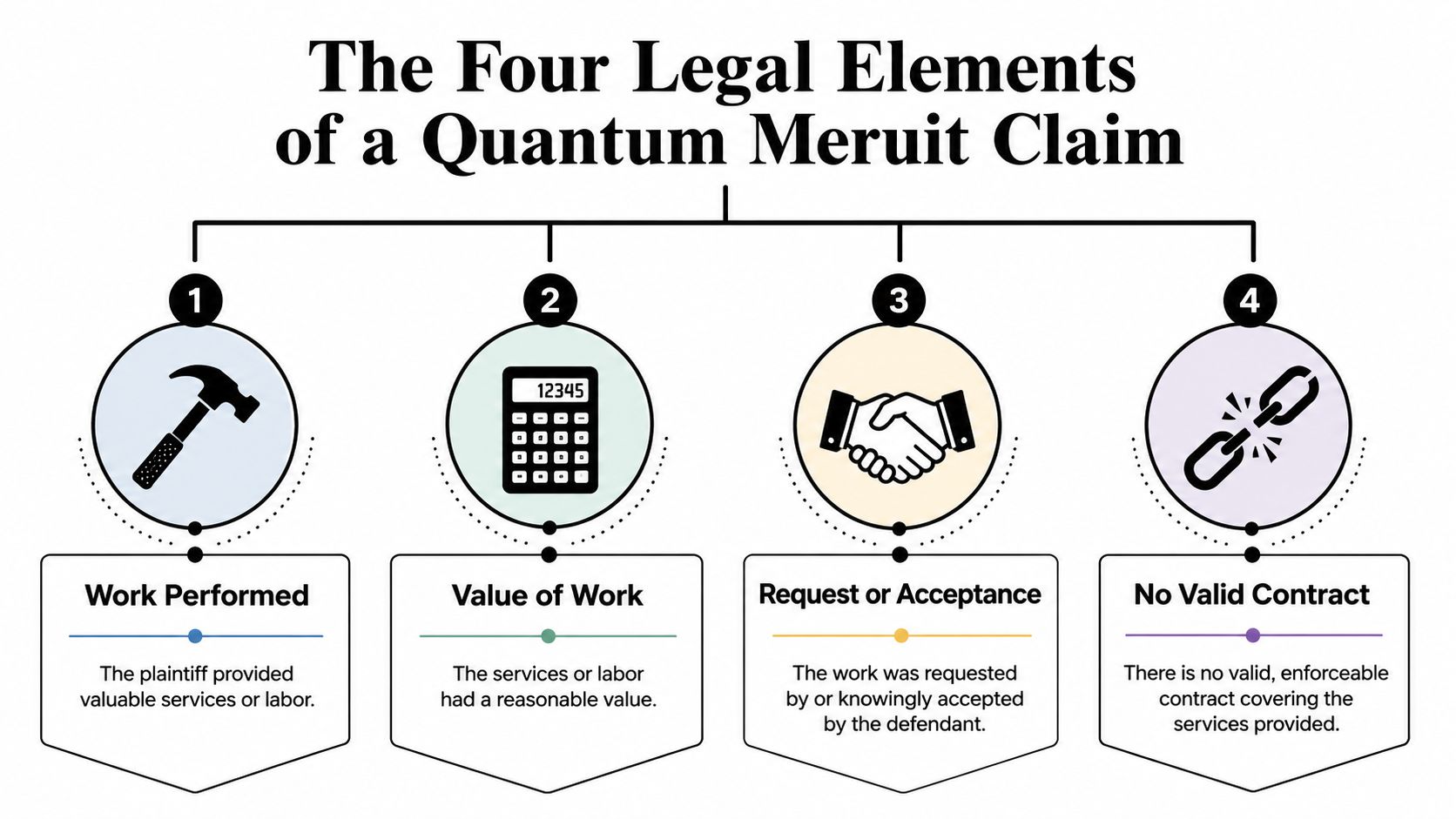
The Four Legal Elements You Must Prove
A strong claim starts with proof, not frustration. In practice, you need four things, benefit conferred, acceptance, reasonable expectation of payment, and reasonable value. Miss one of those, and the claim starts to wobble.
The question a tribunal asks is simple enough. What was done, who got the benefit, was payment expected, and what was that benefit worth in the market. That lines up with Australian legal commentary describing quantum meruit as recovery for the reasonable value of work performed or goods supplied where payment was not properly captured by the arrangement Australian legal references on quantum meruit. It also matches the practical recovery focus in building matters, where the claim turns on the value of the work accepted and retained, not on a contract price or a builder's hoped-for margin Cornell Wex on quantum meruit.
A builder who cannot show these four elements is left arguing in the abstract. A homeowner defending the claim will usually attack each one, line by line, starting with whether the work was requested and ending with whether the amount claimed reflects real trade costs.
What each element looks like on a building job
- Work Performed: You need to show the actual labour, materials, plant, supervision, or extras that were supplied. Site photos, diary notes, invoices, and variation emails matter because they tie the claim to specific work, not a vague complaint.
- Benefit Accepted: The other side must have received and kept the benefit. If the work was torn out immediately or never used, the value case gets harder.
- Expectation of Payment: The conduct has to show payment was expected. That can be a written quote, a message thread, progress claim history, or repeated discussions about paying for extras.
- Reasonable Value: This is the market question. Courts look to the benefit conferred and the reasonable cost of labour and materials, not the builder's internal mark-up or wishful billing.
On the tools, the claim gets tested against the way the job was run. A framing variation needs framing records, a plumbing change needs plumbing labour and material records, and an electrical upgrade needs evidence that separates that trade from the rest of the job. If the file cannot break the work down trade by trade, the valuation becomes guesswork, and guesswork is a poor place to stand in a NSW dispute.
The High Court's 2022 decision in Mann v Paterson Constructions Pty Ltd remains an important Australian marker because it narrowed how builders can recover in some residential building disputes and pushed attention back toward the contract where one exists. In that case, for building contracts governed by the Domestic Building Contracts Act 1995 (Vic), the Court held that a builder could not recover on a quantum meruit basis for work done under a variation if the contract already regulated payment for variations, and recovery had to be measured by the contract price framework Australian commentary on Mann v Paterson.
A valid contract price often acts like a ceiling. If the contract already allocates payment for the work, courts will usually start there before they entertain a restitutionary claim.
That matters in NSW because unsigned contracts, defective variation records, and incomplete scope definitions can decide whether quantum meruit is available at all, or whether the claim gets pushed back into the contract framework.
Building Your Evidence and Documentation
A quantum meruit claim lives or dies on records. If the job was done but the paperwork is sloppy, the tribunal is left to guess what was supplied, who asked for it, and what it reasonably cost.
Start with contemporaneous records
The strongest files usually have site diaries, variation notices, invoices, emails, texts, and progress photos that match the disputed scope. Those records should line up with dates, labour on site, materials delivered, and the exact work claimed, because the valuation exercise is evidence-led and can be tested against market comparables and expert opinion construction claim evidence guidance. If the photos show framing changes, the invoices should show the materials and labour tied to that change. If the texts show verbal approval, the diary notes should reflect who said what and when.
That's the discipline NCAT expects in practice, and it's why Awesim Building Consultants' approach to a quantum meruit report focuses on the actual trade split, not a headline figure. Their NCAT document requirements for building disputes in NSW page is a useful reminder that missing documents don't just slow a claim down, they can narrow it to the tiny slice you can prove.
Break the cost down trade by trade
A proper valuation doesn't stop at “labour and materials”. It should separate:
- Labour
- Materials
- Hire equipment
- Deliveries
- Onsite costs
- Offsite costs
That breakdown matters because it gives the tribunal a sensible open-market view of the work accepted. In NSW building disputes, the practical test is whether the records can support a reasonable cost analysis, not whether the builder's internal spreadsheet says the job should have returned more.
Organise the file the way a decision-maker reads it
The cleanest bundles are arranged by scope item. Start with the contract or quote, then variations, then site records, then invoices, then photos, then the expert valuation. That makes it easier to show the chain from work performed to benefit accepted to reasonable value.
If the documents don't tell a clear story, the tribunal will fill the gaps with doubt.
A contractor who can prove the work but not the value may still recover something. A contractor who can prove the value but not the work usually recovers nothing. Incomplete contract administration can leave you recoverable only to the extent of proven enrichment, and that's a hard limit.
Real Scenarios from NSW Building Disputes
A builder in western Sydney gets halfway through a renovation when the owner asks for a larger opening, extra steel, and changes to internal finishes. The builder does the work, sends progress invoices, but never issues a clean written variation price before proceeding. At the end, the owner says the extra work wasn't approved and refuses to pay the full amount claimed.
In that scenario, the builder's case turns on whether the records show request, acceptance, and reasonable value. If the site diary records the owner's instructions, the invoices match the extra steel and labour, and the photos show the altered opening, the builder has a real path to recovery. If the claim is just a lump sum built from the builder's own margin, the number will get challenged hard because quantum meruit is about market value, not wishful profit.
Now flip it. A homeowner in Newcastle receives a claim for “extras” after the builder allegedly ran additional work during a poorly documented project. The builder says the work was urgent and necessary, but there are no signed variations, no clear cost breakdown, and the scope was never properly defined. In that kind of file, the homeowner's defence is stronger if they can show the work was not requested, was outside the agreed scope, or was already covered by the original price.
What usually decides the outcome
In tribunal practice, the winner is often the side with the better paper trail, not the louder complaint. If the builder has photos, dates, invoices, and a trade-by-trade valuation, the claim looks grounded. If the homeowner can show the builder kept working without pricing the changes, the claimant's case can shrink fast.
A useful outside reference for contractors is quality contractor insurance insights, because once workmanship and payment disputes overlap, people often discover too late that insurance and liability questions aren't the same thing as entitlement to payment.
A careful NCAT member will still want to know what was done, whether the owner accepted it, and what it was worth in the market. That's why these disputes rarely turn on one dramatic email. They turn on the accumulation of small records that either prove the enrichment or expose the gaps.
Common Mistakes That Weaken Your Claim
The biggest mistake is treating a verbal agreement like it will speak for itself. In building disputes, it usually doesn't. The court or tribunal needs evidence that carries the story beyond memory, especially when the project has gone sour and both sides are selective about what they recall.
Mistakes versus better practice
| Common mistake | Better practice |
|---|---|
| Relying only on verbal agreements | Get every variation in writing, even if it's brief |
| Keeping poor site records | Maintain daily logs, photos, and dated notes |
| Skipping formal quotes | Issue clear written pricing before the work proceeds |
| Using internal margin as the claim figure | Base the claim on reasonable market value |
| Mixing disputed work with approved work | Separate each scope item cleanly |
A second mistake is failing to price variations before starting. Once the work is already in the wall, the evidence burden gets heavier because you're no longer proving just what happened. You're proving that the work was accepted, expected to be paid for, and worth what you're claiming.
Don't confuse cost with entitlement
Builders often assume that because they spent money, the other side must reimburse it. That's not how quantum meruit works. The claim is limited to a reasonable sum, and Australian commentary is clear that recovery is tied to what was accepted and retained, not the claimant's hoped-for margin LegalVision commentary on quantum meruit claims.
Another trap is inflating the figure with overheads that can't be explained. If the numbers aren't broken down, the other side will argue that the claim is just a dressed-up profit demand. A clean expert valuation avoids that by separating labour, materials, hire equipment, deliveries, and site costs from unsupported assumptions.
The same caution applies to homeowners defending a claim. If you keep letting work proceed, keep accepting the benefit, and never object in writing, you hand the builder a stronger story about acceptance. That doesn't automatically make the claim succeed, but it makes the defence harder.
Best practice: write down the scope change before the next crew turns up. After the concrete is poured, the argument gets expensive.
When to Engage an Expert Building Consultant
A quantum meruit dispute becomes much easier to manage when an expert can strip the emotion out of it and put numbers against the actual work. That's where a building consultant with tribunal experience becomes more than a convenience. It becomes the person who turns a messy site story into something NCAT can test.
What the expert should actually do
Awesim Building Consultants brings over 35 years of estimating the costs of building and construction, and over 15 years providing litigation support to homeowners, builders, and lawyers. In practice, that means site investigations, Building & Construction Expert Witness Reports, and Scott Schedules that are structured for dispute resolution, not marketing copy.
The right expert won't just repeat the builder's invoice total. They'll examine the scope, separate the trades, and assess the reasonable value of the work in categories such as labour, materials, hire equipment, deliveries, and onsite and offsite costs. That's the evidence NCAT Members can follow, because it shows how the number was built rather than asking them to trust a lump sum.
If you're deciding whether an expert is needed, the question is simple. Is the work disputed, is the pricing disputed, or is the documentation thin enough that the tribunal will need a neutral valuation? If the answer is yes to any of those, an expert should be brought in early, not after the file has hardened into positions.
Why timing matters
The earlier the site is inspected, the better the record. Fresh photos, current measurements, and direct comparison with the work claimed are all easier when the dispute hasn't drifted for months. A well-prepared report can also sharpen settlement discussions, because both sides can see which items are provable and which ones aren't.
For a detailed service overview, the Awesim quantum meruit report page is the right starting point. It sits alongside Awesim's guidance on when a quantum expert is needed in building matters, which helps lawyers, builders, and owners decide when the dispute has crossed from argument into valuation.
A good report doesn't overstate the claim. It shows the tribunal the work, the cost, and the logic behind the figure.
That kind of report often settles the argument faster because it replaces guesswork with structure.
Your Next Steps and How Awesim Can Help
If you're dealing with a NSW payment dispute, focus on four things, benefit, acceptance, expectation of payment, and reasonable value. Then collect the contemporaneous records, because quantum meruit claims are won and lost on the paper trail, not on memory. Keep in mind that the recovery is for the market value of the work, not the contract price or the margin you hoped to make.
Awesim Building Consultants prepares site investigations, Building & Construction Expert Witness Reports, and Scott Schedules for building disputes where the value of work is contested. If you need help assessing a claim or defending one, contact admin@awesim.com.au or call 1800 293 746. You can also review the quantum meruit report service page and the related building dispute resources before you file anything.
Awesim Building Consultants can assess the work, separate the trades, and prepare the evidence a tribunal needs in a quantum meruit dispute. If your claim or defence is stuck on valuation, visit Awesim Building Consultants and get the file checked before the gaps get bigger.

Related Posts

Water Damage in Homes: How to Track Down the Source
Water damage in a home rarely announces itself at the source. A stain on the ceiling, a musty smell in
Read More »
Waterproofing Membrane Types: Which Fails Most in NSW Bathrooms
Waterproofing failure is the single most common serious defect found in NSW apartments, and the type of membrane used, along
Read More »
Building Certifier NSW: Role, Limits, and When You Need More
A building certifier in NSW is a registered professional who issues construction certificates, conducts critical stage inspections, and grants occupation
Read More »