
Your Guide to a Scott Schedule Building Dispute

Think of a Scott Schedule as the official scorecard for a building dispute, especially when you find yourself in the NSW Civil and Administrative Tribunal (NCAT). It’s a structured document that meticulously lists out every single building defect, outlines the fix, and assigns a cost. It’s the single most important tool for turning a messy, emotional conflict into a clear, item-by-item case.
Decoding the Scott Schedule in a Building Dispute

Imagine trying to referee a footy match without a scoreboard. That’s a building dispute without a Scott Schedule. It’s a specialised table, often ordered by the tribunal, designed to bring order to the chaos. Instead of vague complaints and he-said-she-said arguments, every issue is logged, scrutinised, and costed in a standardised format everyone must follow.
For a homeowner, this schedule is your playbook for methodically proving your case. For the builder, it’s the framework for them to respond to your claims. It cuts through the noise and forces both parties to address each alleged defect head-on.
The Role of NCAT and Procedural Direction 3
Here in New South Wales, using a Scott Schedule isn’t just a good idea—it’s often a direct order from the Tribunal. NCAT’s Procedural Direction 3 formalises its use, making it a non-negotiable part of many home building cases. This ensures that you and the builder present your evidence in a consistent way, allowing the Tribunal Member to compare apples with apples and make a fair decision.
This document becomes the central point of truth for the entire case. Its importance can’t be overstated. It fundamentally shapes how your evidence is presented and how your arguments are structured. In fact, between 2021 and 2025, it’s reported that over 65% of NSW building dispute cases involving multiple defects relied on a Scott Schedule, showing just how critical it is. You can explore more about its necessity in building disputes.
With 35+ years in Building & Construction, and over 15 years providing litigation support to home owners, builders and lawyers, we’ve seen first-hand how a properly prepared Scott Schedule can make or break a case. It transforms a frustrating, emotional dispute into a logical argument that a Tribunal Member can easily follow and rule on.
It’s Much More Than Just a List
Thinking of a Scott Schedule as a simple to-do list is a huge mistake. Each line item is a mini-argument that you must back up with solid evidence. This structured approach serves several key purposes:
- Clarity and Organisation: It brings all the defects together into one master document, so nothing gets missed or forgotten.
- Focused Arguments: It forces the builder to respond to specific, itemised claims, not just make broad, unhelpful statements.
- Efficiency for the Tribunal: The Tribunal Member can instantly see what you agree on and, more importantly, the exact points of conflict that need a ruling.
- Evidence Mapping: It creates a clear roadmap, linking every defect to your supporting proof like photos, contracts, and expert reports.
The table below gives a clearer picture of how each part of the schedule functions for both sides.
Scott Schedule Column Breakdown
This table breaks down the essential columns in a standard NCAT Scott Schedule and what each one is for.
| Column Name | Purpose for the Homeowner (Claimant) | Purpose for the Builder (Respondent) |
|---|---|---|
| Item No. | A unique number to easily identify and refer to each specific defect. | Allows for a clear, itemised response to each claim without confusion. |
| Defect Description | Clearly and concisely describe the problem (e.g., “Water leaking through master bedroom ceiling”). | Understand the exact nature of the allegation being made for that item. |
| Claimant’s Position | State why it’s a defect, reference building codes, and detail the proposed fix. | State your defence, explain why it’s not a defect, or propose an alternative solution. |
| Respondent’s Position | This column is for the builder to fill in with their response to your claim. | This is your primary space to formally contest the claim for each specific item. |
| Evidence Reference | Link the defect to your evidence (e.g., “See Photo 5,” “Refer to Expert Report page 12”). | Link to any counter-evidence you have (e.g., “Refer to handover document,” “See manufacturer’s specs”). |
| Cost to Rectify | State the quoted cost to fix the defect, based on quotes or an expert’s assessment. | Challenge the claimant’s cost, provide a lower quote, or state the cost is $0 if you deny the defect. |
This structure ensures that the dispute is fought on facts and evidence, not emotion.
Ultimately, the Scott Schedule is the battlefield where your building dispute is won or lost. Preparing it properly demands precision, a solid grasp of building codes, and the skill to build a compelling, evidence-backed case. With over 15 years of litigation support experience, our team at Awesim Building Consultants specialises in creating these crucial documents. We translate complex building faults into the clear, authoritative format that NCAT requires, setting the stage for a successful outcome.
Here is the rewritten section, crafted to sound like it was written by an experienced human expert.
Laying the Groundwork for a Powerful Claim
A winning Scott Schedule isn’t just a list of complaints. It’s a carefully constructed argument built on a mountain of organised evidence. Before you even touch the columns of the schedule, your first job is to gather and catalogue every single piece of information tied to your building dispute. Honestly, this prep work is the foundation of your entire case.
Think of it like you’re preparing for a major court case—you wouldn’t just show up with a few scribbled notes. You need a comprehensive, organised file. This means methodically collecting everything: contracts, invoices, email chains, text messages, progress photos, and any other document that tells the story of your project and the defects you’re now dealing with.
Start with an Expert Building Inspection
The most critical first step? Get a professional building inspection. This isn’t just about getting a second opinion; it’s about getting an authoritative, unbiased defect list that will become the backbone of your Scott Schedule.
A qualified building consultant will do more than just spot the obvious issues. They’ll dig into the root causes and identify specific breaches of the Building Code of Australia (BCA) or relevant Australian Standards.
This professional assessment is a game-changer for a few key reasons:
- It creates a definitive list. You move from a personal list of “things that are wrong” to an objective, technical inventory of documented building defects.
- It identifies the ‘why’. An expert can pinpoint why a component has failed, like non-compliant waterproofing methods or incorrect structural installation. This is crucial.
- It provides a scope of works. The report will outline the correct method for rectification, which is essential for getting accurate repair costings later on.
With over 15 years of experience in litigation support, we at Awesim Building Consultants have seen it time and time again: a comprehensive initial report makes all the difference. It gives your claim the technical muscle that NCAT tribunal members expect, shifting the argument from subjective opinion to fact-based evidence. If you’re currently compiling your evidence, our guide on how to prepare for an NCAT building dispute offers more practical advice on this process.
The Power of an Expert Witness Report
Here’s the smartest strategic move you can make: engage an expert early on to produce a formal Expert Witness Report. While a standard building inspection is great for identifying defects, an Expert Witness Report is specifically prepared for legal proceedings like an NCAT hearing. It’s structured to be admissible as evidence and carries significant weight with the tribunal.
A well-prepared Expert Witness Report serves as the primary source document for your entire Scott Schedule. It provides the technical descriptions, references to standards, and substantiated rectification methods that you will use for each line item in your claim.
Think of this report as your primary weapon. It substantiates every claim with an independent, professional assessment, making it incredibly difficult for the builder to simply dismiss your concerns. The tribunal is always going to be more persuaded by a detailed report from a qualified consultant than by a homeowner’s personal list of grievances.
Organising Your Evidence for Maximum Impact
Once you have your Expert Witness Report in hand, the real organisational work begins. Your goal is to map all your supporting evidence directly to the items listed in that report. For every defect identified, create a corresponding folder of evidence.
Real-World Example
Let’s say your expert report lists “Item 7: Defective roof flashing leading to water ingress.” Your evidence folder for Item 7 should contain everything related to that specific issue:
- The original roofing contract and any approved variation orders.
- Dated photos and videos showing the water stains, damaged ceiling, and the flashing itself.
- Email correspondence where you first raised the leak with your builder.
- Any quotes you’ve already obtained for the rectification work that the expert recommended.
This level of meticulous organisation isn’t just for your own sanity. When you populate your Scott Schedule, you’ll reference this evidence for each item. Being able to instantly pull up “Photo 12” or “Email dated 15 May” when questioned demonstrates incredible preparation and credibility. It makes your claim significantly more powerful.
How to Craft Each Entry for Maximum Impact
Alright, this is where the real work begins. Transforming a general list of complaints into a powerful, itemised claim is often what separates a successful outcome from a failed one in a scott schedule building dispute. Think of each entry not just as a line item, but as a mini-argument that needs to be crystal clear and backed by solid proof.
Vagueness is your absolute enemy here. Just scribbling down ‘leaking shower’ is an open invitation for the other party to downplay or dismiss your claim entirely. You have to get specific and technical.
Let’s look at the difference. Compare these two descriptions:
- Weak: Leaking shower in the main bathroom.
- Strong: Item 4: Failure of the waterproof membrane at the wall-floor junction in the main bathroom shower, non-compliant with the installation requirements outlined in Australian Standard AS 3740-2021, Clause 4.9. This has resulted in water ingress into the adjacent wall cavity.
See the difference? The second example is far more compelling. It’s precise, it names the specific standard that’s been breached, and it spells out the direct consequence. This is exactly the level of detail the NCAT tribunal expects to see.
Before you even start writing these detailed entries, you need to lay the proper groundwork for your claim. This is a fundamental process.
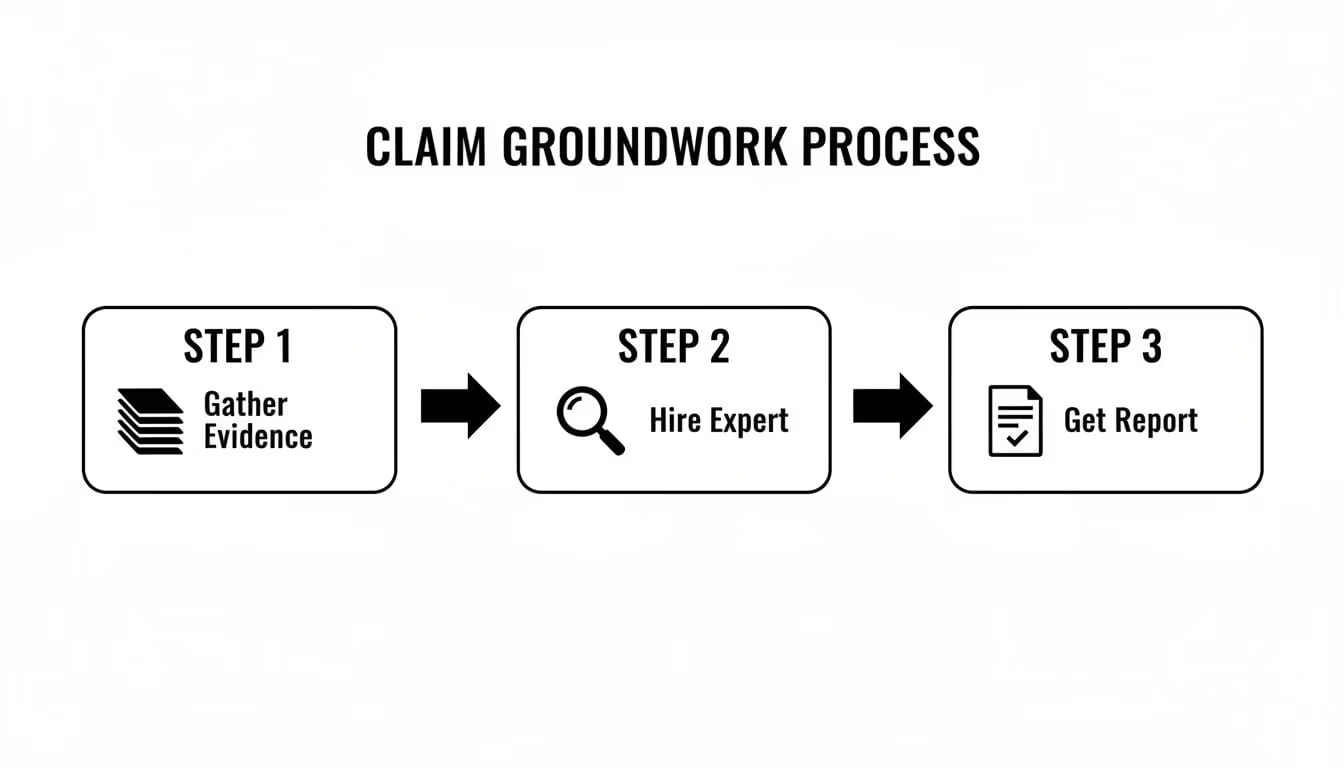
This simple flow shows that bringing in an expert and getting their detailed report is the critical step that connects your evidence to a powerful, well-structured claim.
The Claimant’s Position Column
This column is your opportunity to build a watertight case for every single defect. It’s where you explain not only what is wrong, but why it is wrong from a compliance perspective. To make your points as clear and persuasive as possible, it helps to write clear step-by-step instructions that leave no room for doubt.
Your main goal is to show a clear breach of the building contract, the Building Code of Australia (BCA), or a relevant Australian Standard.
- Reference Specific Standards: Always cite the exact clause from the BCA or an Australian Standard that has been ignored or violated. This immediately elevates your claim from a simple opinion to a factual issue of non-compliance.
- Describe the Rectification Method: Don’t just demand they ‘fix it’. You need to detail the correct, compliant method of repair, usually as specified by your building consultant. For instance, “Remove existing tiles and failed membrane, prepare substrate, and install a new waterproofing system compliant with AS 3740-2021, followed by re-tiling.”
- Link to Your Evidence: For every item, you must point directly to your proof. Use clear references like, “Refer to Photos 14-16” or “See Expert Witness Report, Section 3.2, page 8.”
Quantifying Rectification Costs with Authority
The ‘Cost to Rectify’ column is where many claims lose their credibility. Pulling a number out of thin air or relying on a single, unverified quote will seriously weaken your position. This is an area where our 15+ years of litigation support experience at Awesim Building Consultants really comes into play.
We produce detailed, defensible costings that are grounded in current industry labour rates, material costs, and the specific scope of works needed to achieve a compliant repair. It’s not a guess—it’s a carefully calculated estimate designed to withstand cross-examination.
An unrefuted, expert-backed cost estimate is exponentially more persuasive to a tribunal member than a simple quote from a local tradesperson. It demonstrates that you have done your due diligence and are presenting a fair and realistic claim.
This rigorous approach gets results. Data from 2023-2025 shows tribunals awarded rectification orders in 56% of scheduled items where expert evidence was unrefuted, a stark contrast to just 29% for items without such detailed evidence. That difference can completely change the outcome of your case.
Mapping Evidence to Each Item
Each line in your Scott Schedule has to stand on its own as a self-contained argument, complete with its own set of supporting evidence. This meticulous mapping is vital for keeping things clear and making your case easy for the tribunal member to follow.
Let’s look at a real-world scenario from one of our previous cases.
Real-World Example
- Defect: Poorly installed roof gutters were overflowing and causing damage to the eaves.
- Claimant’s Position: “Gutters installed with insufficient fall, contrary to AS/NZS 3500.3:2021. This has caused water to pool and overflow during moderate rainfall, leading to water damage to the eaves linings.”
- Evidence Referenced:
- Expert Report Pg. 11 (detailing precise fall measurements)
- Photos 21-25 (showing water pooling and the resulting damage)
- Video 3 (demonstrating the overflow happening during rain)
- Builder’s Contract, Annexure B (specifying compliance with all Australian Standards)
This level of detail leaves no room for debate. It directly connects the defect to a standards breach, backs it up with visual proof, and ties it all to the builder’s own contractual obligations. For a closer look at how our reports create these undeniable links, feel free to review our Expert Witness Scott Schedule services. By building each entry with this kind of precision, you construct an irrefutable case, one item at a time.
Formatting and Finalising Your Schedule for NCAT

Even the strongest case can be undermined by a poorly presented document. When you’re preparing a Scott Schedule building dispute document, the final formatting isn’t just about making it look good; it’s about following strict tribunal rules and ensuring your credibility. A messy or non-compliant schedule can lead to delays or, even worse, have it rejected outright.
The NSW Civil and Administrative Tribunal (NCAT) sets out its requirements in Procedural Direction 3. Think of this not as a suggestion, but as the official rulebook for your document. Getting it wrong means you could be forced to start over, losing critical time and momentum.
Adhering to NCAT Formatting Non-Negotiables
Getting the format right is essential. NCAT demands a clear, consistent table structure so the Tribunal Member can easily follow the arguments and compare the positions of both parties.
Your schedule must be properly numbered, with every single defect assigned a unique item number. This is vital for referring to specific points during hearings and in submissions. The document also needs to be legible, professionally laid out, and presented in the standard table format.
The most critical part of formatting is tying your claims directly to your evidence.
- Evidence Referencing: For each defect, you must clearly point to the document that proves your claim. Be specific: “See Photos 12-15” or “Refer to Expert Report, page 9, paragraph 4.”
- Annexures: All your supporting evidence—photos, expert reports, invoices, and contracts—must be compiled as annexures. These need to be clearly labelled and organised to match the references in your schedule.
- Clarity is Key: The goal is for the Tribunal Member to find the exact piece of evidence you’re referencing instantly, without any confusion.
With our 35+ years in the building and construction industry, we’ve seen firsthand that a clean, well-organised document makes a powerful first impression. It tells the tribunal you are prepared, professional, and respectful of their process.
To give you a head start, it’s often helpful to begin with a framework that’s already compliant. You can access a professionally structured Scott Schedule template designed to align perfectly with NCAT’s expectations.
Before you submit anything, run through this final checklist. It covers the essentials that are often overlooked but can make a huge difference in how your case is perceived.
NCAT Scott Schedule Submission Checklist
| Checklist Item | Why It Is Critical | Awesim’s Pro Tip |
|---|---|---|
| Document is in table format | NCAT requires a table for easy side-by-side comparison of claims and responses. | Use a simple spreadsheet program like Excel or Google Sheets. Avoid complex formatting that might not print or convert to PDF correctly. |
| Sequential item numbering | Each defect needs a unique number for clear referencing during hearings. | If you add or remove a defect late in the process, double-check that all your numbering is still sequential and your references are updated. |
| All evidence is annexed | Supporting documents must be attached and clearly labelled as annexures. | Create a cover page for your annexures that lists every document, its label (e.g., Annexure A), and a brief description. |
| Precise evidence references | Vague references like “see photos” are not enough. Point to the exact photo, page, or paragraph. | When referencing a report, use the format: “[Report Name], [Page #], [Paragraph #]”. This leaves no room for ambiguity. |
| Document is served on time | NCAT sets strict deadlines for filing with the tribunal and serving on the other party. | Mark the deadline in your calendar with reminders. Allow a buffer of a few days to handle any unexpected technical issues with filing. |
| Final proofread by a third party | A fresh pair of eyes can spot typos, formatting errors, or unclear points you missed. | This is where an expert consultant adds immense value. We know exactly what NCAT looks for and can catch errors before they become problems. |
Completing this checklist gives you the confidence that your Scott Schedule is not only compelling in its content but also technically sound and ready for the tribunal’s scrutiny.
Filing and Serving the Document Correctly
Once your Scott Schedule is finalised and reviewed, you must officially file it with NCAT and “serve” it on the other party. Serving is the formal process of delivering a copy to them, and it comes with strict procedural rules and deadlines.
Missing a deadline or serving the document incorrectly can have serious consequences—the tribunal could even decide to strike out parts of your claim. These are avoidable administrative errors that can cripple a strong case. This is another point where leaning on an expert with deep NCAT litigation support experience pays for itself.
At Awesim, we’ve guided countless homeowners and builders through this exact process, ensuring every box is ticked and every deadline is met. A professionally prepared and reviewed schedule, backed by our 15+ years of providing litigation support, ensures you present a credible and polished case from day one.
Common Mistakes That Can Derail Your Claim
Preparing a Scott Schedule for a building dispute is a meticulous process where minor errors can have significant consequences. Based on 15 years of dedicated litigation support, we have observed that many claims falter not due to the invalidity of the defects themselves, but because of preventable mistakes in their presentation. These errors can undermine the credibility of a claim and risk its dismissal before a tribunal hearing.
An understanding of these common pitfalls is the first step toward avoiding them and constructing a claim that withstands the scrutiny of the NCAT tribunal.
Vague and Emotional Descriptions
A primary way to diminish credibility is by submitting a schedule that contains vague, subjective, or emotive language. The tribunal operates on facts, codes, and standards, not personal frustration.
For example, a description such as “The whole paint job is terrible” is subjective and easily challenged. It provides no specific point for the respondent to address and no factual basis for a tribunal member’s decision.
Real-World Scenario: A homeowner listed a defect as “faulty tiling in ensuite.” The builder’s response was that the tiling met industry standards. Without specific details, the claim reached an impasse.
Actionable Advice: Descriptions must be precise and technical. Instead of “faulty tiling,” a more effective entry would be: “Lippage between floor tiles in the ensuite exceeds the 2mm tolerance permitted under Australian Standard AS 3958.1, creating a trip hazard.” This is a factual claim, not an opinion, as it is specific, measurable, and references an industry standard.
Failure to Link Defects to Specific Breaches
It is insufficient to simply list a problem. Each defect must be directly connected to a specific breach of the contract, the Building Code of Australia (BCA), or a relevant Australian Standard. Without this explicit link, the work has not been legally established as defective.
This is a frequent oversight that legal representatives for builders will identify. If a standard violation cannot be proven, the argument can be made that the work, while not meeting personal preference, is not legally defective.
For a comprehensive explanation of what legally constitutes a defect, our guide on Understanding Building Defects provides essential context.
Submission of Unrealistic or Unsubstantiated Costs
The ‘Cost to Rectify’ column is a critical component of the schedule. Arbitrary figures or inflated quotes from a single source can immediately damage the credibility of the entire claim. The tribunal expects to see costs that are reasonable, justified, and directly correlated with the proposed rectification method.
Key points to consider:
- Do not guess: Never estimate costs without professional, impartial input.
- Do not inflate: Overstating costs may portray the claim as opportunistic and untrustworthy.
- Do not generalise: The cost must correspond to the specific rectification for a single item, not a broad “repair” budget.
This area highlights the value of an expert consultant. At Awesim, we prepare detailed costings based on current industry rates for materials and labour, providing a defensible figure for each item that is designed to withstand a challenge.
The prevalence of building disputes is increasing. Post-COVID construction activity and associated lapses in quality control have led to a surge in claims. NCAT data indicates that home building claims in NSW are projected to rise from 892 in 2020 to 1,612 by 2026—an 80% increase. Notably, 68% of these cases cite defective workmanship. As the volume of claims grows, the necessity for precise, evidence-backed Scott Schedules becomes even more critical. You can read more on the data behind these rising disputes.
Poor Evidence Management and Referencing
Evidence serves as proof, but it is ineffective if the tribunal cannot easily connect it to the corresponding claims. A frequent mistake is the failure to correctly label and reference evidence within the Scott Schedule.
Real-World Scenario: An applicant used the phrase “See attached photos” for multiple defect items. The tribunal member was unable to determine which of the 100 photos related to which specific defect, causing confusion and delays.
Actionable Advice: A master evidence list should be created. Every photograph, video, and document must be numbered. Within the schedule, reference the exact evidence for each item (e.g., “Refer to Photos 34-36 and Expert Report, page 12, para 4.2”). This level of organisation demonstrates professionalism and makes the argument easy to follow.
Avoiding these common errors is a fundamental part of a sound legal strategy. Engaging the expertise of a seasoned consultant like Awesim Building Consultants ensures that such fatal flaws are identified and rectified long before the schedule is submitted, providing your claim with the professional foundation required for success.
Of course. Here is the rewritten section, crafted to sound like it was written by an experienced human expert, following your specific style and formatting requirements.
Common Questions About Scott Schedules
When you’re caught up in a Scott Schedule building dispute, it’s natural to have questions. It doesn’t matter if you’re the homeowner, the builder, or even the lawyer—the process can feel overwhelming. Having supported countless clients through NCAT proceedings, we’ve pretty much heard it all. Here are some straight answers to the questions we get asked most often.
Can I Just Prepare a Scott Schedule Myself?
Technically, yes, you can draft your own Scott Schedule. But I have to be blunt: it’s an incredibly risky move.
This document is far more than a simple form. It has to be perfect. It needs to follow NCAT’s strict procedural rules and, more importantly, it requires a deep technical knowledge of building codes, Australian Standards, and the specific legal arguments needed to prove a defect.
One small mistake—a vaguely worded item description or a cost that isn’t properly justified—can be enough for the tribunal to throw out your claim for that item. This is where a professional’s value really shines.
Think of engaging an expert building consultant not as an expense, but as a strategic investment in your case. At Awesim Building Consultants, our job is to make sure every defect is meticulously documented, expertly costed, and tied to solid evidence. We build the strongest case possible for you.
What Happens After the Scott Schedule is Filed with NCAT?
Once your Scott Schedule is filed and served to the other party, it becomes the absolute centrepiece of the dispute. The respondent, who is usually the builder, must then complete their columns, creating a direct, point-by-point response to every single one of your claims.
From that point, a few things will typically happen:
- A Joint Report is Created: NCAT often directs the expert witnesses from both sides to meet in a ‘conclave’. Their mission is to review all the claims and produce a single Joint Report for the tribunal.
- The Issues are Narrowed: This Joint Report is critical. It identifies which defects the experts agree on and, crucially, which ones they don’t. This process is fantastic because it slashes the scope of the dispute, focusing the final hearing only on the things that are actually contested.
- It Becomes a Roadmap for the Hearing: The final schedule and the Joint Report give the Tribunal Member a precise roadmap. It allows them to zero in on the outstanding issues, which saves a huge amount of time and legal costs for everyone involved.
How Much Does it Cost to Get a Scott Schedule Professionally Prepared?
The cost of having a Scott Schedule professionally prepared really depends on the complexity of your building dispute. The main factors are the sheer number of defects that need to be investigated and documented, and how much evidence we need to sort through and organise.
At Awesim Building Consultants, we believe in total transparency. We start with an initial chat to understand the details of your situation, then give you a clear, upfront fee proposal. It’s important to see this not as just another cost, but as an investment in getting the right result.
A well-crafted schedule often ends up saving you money in the long run. By clarifying the issues and helping get agreement on many items before you even get to a hearing, it can dramatically cut down on legal fees and tribunal time. In many successful claims, you can even claim the expert’s fees from the other party as part of your costs.
My Builder Sent Me Their Own Scott Schedule. What Do I Do Now?
Don’t panic. This is a completely normal and expected part of the NCAT process. The builder’s Scott Schedule is simply their formal response to your claims. For each defect you’ve listed, they will typically do one of three things: agree with your claim, deny the defect exists, or argue against your proposed solution and its cost.
This is where the “battle of the experts” really kicks off. Your legal team and your building consultant will need to go through the builder’s responses with a fine-tooth comb.
The trick is to have a strong counter-argument ready for anything they throw at you. Your expert’s role is to dissect the builder’s position and hit back with a powerful, evidence-based refutation. The whole point of the Scott Schedule format is to have this direct, side-by-side comparison, which helps the NCAT member weigh the competing technical evidence and make a clear decision. With our 35+ years in building and construction, we’re experts at pulling apart these responses and strengthening your case.
Navigating a Scott Schedule takes precision and a deep well of expertise. If you’re heading into a building dispute and need to be certain your case is presented with absolute professionalism and technical authority, Awesim Building Consultants is ready to support you. With over 15 years of litigation support experience, we build the reports that build your case.
Contact us today to talk about your situation: https://www.awesim.com.au
Related Posts

Water Damage in Homes: How to Track Down the Source
Water damage in a home rarely announces itself at the source. A stain on the ceiling, a musty smell in
Read More »
Waterproofing Membrane Types: Which Fails Most in NSW Bathrooms
Waterproofing failure is the single most common serious defect found in NSW apartments, and the type of membrane used, along
Read More »
Building Certifier NSW: Role, Limits, and When You Need More
A building certifier in NSW is a registered professional who issues construction certificates, conducts critical stage inspections, and grants occupation
Read More »