
Dispute Resolution in Construction: A Practical NSW Guide

Construction disputes in NSW are rarely solved by the loudest email or the thickest bundle of documents. They are usually resolved when the parties identify the real issue, preserve the right evidence and choose a pathway that matches the commercial and legal risk.
For homeowners, builders and solicitors, dispute resolution in construction is not one single process. It can involve direct negotiation, NSW Fair Trading, mediation, NCAT, court proceedings, security of payment adjudication, expert determination or a negotiated settlement supported by independent technical evidence.
This practical guide explains the main NSW pathways, what evidence usually matters, and how an independent building consultant can help turn a messy dispute into issues that can be assessed, priced and resolved. It is general information only, not legal advice.
What construction dispute resolution really means
A construction dispute is rarely only about workmanship. It may involve scope, time, money, access, variations, certification, compliance, incomplete work, alleged defects or unpaid progress claims. Good dispute resolution starts by separating these issues instead of treating the whole project as one argument.
In practice, the goal is to answer three questions:
- What does the contract, quote, specification or approved plan require?
- What work was actually done, and how does it compare with the required standard?
- What is the fair and evidence-based way to rectify, value or resolve the difference?
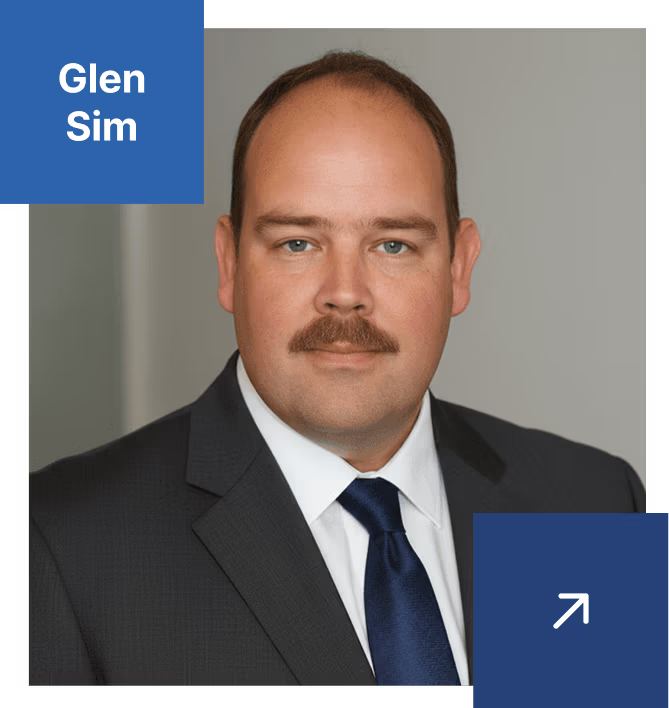
Glen Sim, owner and director of Awesim Building Consultants, approaches construction disputes from that evidence-first position. Before a matter reaches NCAT or a court, the parties usually need more than opinion. They need clear findings, defensible reasoning and a practical schedule of issues that a decision-maker, solicitor or opposing party can understand.
Start with the dispute type before choosing the forum
Many people rush to ask where they should file a claim. A better first question is what kind of dispute they actually have. The answer influences the process, the evidence and the urgency.
| Dispute type | Typical issue | Evidence that usually matters |
|---|---|---|
| Defective work | Work allegedly fails to meet the contract, NCC, Australian Standards or acceptable trade practice | Site inspection, photographs, plans, specifications, expert opinion and rectification scope |
| Incomplete work | A builder or contractor has not finished part of the scope | Contract, progress claims, site records, completion evidence and valuation of incomplete items |
| Variations | Extra work is disputed or was not properly approved | Written instructions, emails, site directions, invoices, rates and proof of benefit |
| Payment dispute | A party says money is owed or overclaimed | Contract sum, progress claim, payment schedule, bank records, quantity assessment and valuation evidence |
| Delay or disruption | Completion has moved beyond the expected date | Programme, extension of time notices, weather records, access records and causation evidence |
| Quantum meruit | Reasonable value of work is claimed where the contract price does not answer the issue | Scope evidence, market rates, labour and material records, valuation methodology and expert quantum opinion |
This early classification helps homeowners avoid spending money on the wrong process, helps builders respond within strict timeframes, and helps solicitors brief experts on the questions that actually matter.
Step 1: Preserve your position with clear communication
Most NSW construction disputes begin with a breakdown in communication. That does not mean every conversation needs to become a legal notice, but once a dispute is emerging, loose messages can create problems.
Homeowners should record the defects or incomplete items they are concerned about, then give the builder a reasonable opportunity to inspect and respond where appropriate. Builders should respond in writing, clarify what they accept or dispute, and avoid vague assurances that later appear inconsistent with their position.
If the contract contains notice requirements, follow them carefully. This is especially important for variations, extensions of time, payment claims, termination, liquidated damages and access issues. A party can have a genuine complaint but weaken its position by failing to comply with contractual procedure.
The most useful early records are often simple: dated photographs, videos, emails, site diaries, delivery dockets, invoices, approved plans, specifications, certificates and records of who was on site. Keep the original documents and avoid editing photographs in a way that could later be challenged.
Step 2: Get independent technical evidence early
A construction dispute can quickly become a contest of opinions. The homeowner says the work is defective. The builder says it complies. The solicitor needs to know which allegations are worth pursuing. That is where independent technical evidence becomes important.
A building consultant can inspect the work, compare it with the relevant contract documents and standards, identify likely causes, comment on rectification and help quantify disputed items. For matters heading towards NCAT or court, the expert report must be more than a list of complaints. It should explain the reasoning behind each opinion.
Awesim Building Consultants provides independent building consultant services for NSW disputes, including expert witness reports, Scott Schedules, quantum meruit reports and building defect assessments. Those services are particularly useful when the dispute has moved beyond informal complaint handling and the parties need evidence that can stand up to scrutiny.
For solicitors, early expert involvement also helps refine pleadings, identify weak issues and reduce the risk of running a case that is emotionally compelling but technically unsupported.
NSW dispute resolution pathways at a glance
There is no single best pathway for every construction dispute. The right process depends on the contract, the type of work, the amount in dispute, urgency, statutory time limits and whether the parties need a binding decision.
| Pathway | Best suited to | Key point |
|---|---|---|
| Direct negotiation | Lower-value disputes, early defects, scope misunderstandings and practical rectification discussions | Works best when both sides have clear records and a realistic scope of resolution |
| NSW Fair Trading | Many residential building complaints before tribunal action | Fair Trading can assist with complaint handling and inspection processes, but it is not a substitute for legal advice or expert evidence |
| Mediation or conciliation | Parties who want commercial resolution without a hearing | Useful when the facts are sufficiently clear and both sides understand litigation risk |
| NCAT | Many NSW residential building disputes within jurisdictional limits | Often requires organised evidence, expert reports and clear schedules of defects or amounts claimed |
| Court proceedings | Higher-value, complex or legally difficult matters | Usually solicitor-led and may require expert evidence compliant with court rules |
| Security of payment adjudication | Fast payment disputes under NSW security of payment legislation | Strict timeframes apply, and some residential owner-occupier situations need careful legal advice |
| Expert determination | Technical or valuation issues where the contract allows it or parties agree | Can be efficient where the dispute is narrow and specialist opinion is needed |
| Arbitration | Contractual or agreed private dispute process | More formal than mediation and often used in commercial contexts |
For official guidance, NSW homeowners and builders can review NSW Fair Trading building dispute information and NCAT home building information. Payment claim issues may also involve the Building and Construction Industry Security of Payment Act 1999 (NSW).
Residential building disputes in NSW: Fair Trading, NCAT and time limits
For residential building work, many disputes begin with a complaint to NSW Fair Trading. Depending on the circumstances, Fair Trading may help the parties communicate, arrange an inspection or issue a rectification order. This can be useful where the relationship is strained but the project can still be brought back under control.
If the dispute cannot be resolved, NCAT is a common forum for residential building claims in NSW. NCAT can deal with many claims involving defective or incomplete residential building work, payment disputes and statutory warranty issues, subject to jurisdictional and time limit requirements. Current thresholds and filing rules should always be checked before lodging.
Statutory warranties under the Home Building Act are central to many residential disputes. In general terms, proceedings for major defects must be commenced within 6 years, while other defects have a 2-year period. If the defect becomes apparent in the final 6 months of the relevant period, there may be a further 6 months to commence proceedings. Because limitation issues can decide whether a claim survives, homeowners and builders should get legal advice early if time is close to expiring.
For a deeper explanation of the tribunal process, Awesim has a dedicated guide to NCAT building disputes in NSW. The important point here is that NCAT outcomes depend heavily on preparation. A party who turns up with scattered photos and general frustration is usually in a weaker position than a party with a structured report, a clear claim table and evidence tied to each allegation.

Payment disputes and security of payment
Payment disputes require special care because deadlines can be short. The NSW security of payment regime is designed to help contractors and subcontractors recover progress payments quickly. It can involve payment claims, payment schedules and adjudication applications, with strict timeframes that should not be ignored.
Builders, subcontractors and principals should treat any document that may be a payment claim seriously. If a payment schedule is required, failing to serve it in time can have serious consequences. Legal advice should be obtained urgently where there is uncertainty.
Technical and quantum evidence can still matter in payment disputes. For example, if a progress claim includes disputed quantities, alleged incomplete work, defective work or variations, a building consultant can help assess the value of work performed and the cost of rectification. The expert does not decide legal entitlement, but can provide a reasoned valuation that assists negotiation, adjudication or litigation.
Quantum meruit disputes also need careful handling. These claims usually focus on the reasonable value of work rather than simply the amount claimed in an invoice. A defensible quantum meruit report should explain the work performed, the basis of valuation, the evidence relied on and any assumptions or exclusions.
Scott Schedules turn complex disputes into manageable issues
When a construction dispute involves many defects, incomplete items or variation claims, a Scott Schedule is often one of the most useful tools. It breaks the dispute into rows, with each item showing the allegation, location, response, evidence, proposed rectification and claimed amount.
A good Scott Schedule helps all sides see what is really in dispute. It can also narrow the matter before a hearing. If the builder accepts some items, rejects others and disputes the cost of the rest, the schedule records that clearly. If the homeowner has photos, expert findings and cost evidence for each item, the claim becomes much easier to assess.
In NCAT and court matters, the Scott Schedule should align with the expert report. If an expert identifies a waterproofing defect, the schedule should identify the same issue, the same location and the same rectification logic. Inconsistency between the report, pleadings and schedule can create avoidable problems.
Awesim has also explained the Scott Schedule format for NSW building cases in more detail for parties preparing evidence.
How homeowners, builders and solicitors should approach resolution
Each party has different risks, but the same principle applies: resolve what can be resolved, prove what must be proved, and avoid turning every disagreement into a hearing issue.
| Audience | Practical approach | Main risk to avoid |
|---|---|---|
| Homeowners | Document concerns early, allow reasonable inspection where appropriate, obtain independent defect evidence and keep the claim organised | Relying only on emotion, photographs without context or inflated rectification claims |
| Builders | Respond promptly, separate accepted items from disputed items, keep site and payment records, and obtain technical support where allegations are serious | Ignoring complaints, missing notice deadlines or treating all allegations as baseless |
| Solicitors | Identify legal issues, brief the expert with precise questions and align pleadings, evidence and schedules | Briefing an expert too late or asking for opinions outside the expert’s technical role |
For homeowners, independent evidence can prevent overclaiming and help focus on defects that genuinely require rectification. For builders, it can identify whether allegations are technically justified and whether rectification can be limited to a proportionate scope. For solicitors, it helps separate legal entitlement from technical proof.
Why expert independence matters
In construction dispute resolution, expert evidence is not advocacy dressed up as technical opinion. An expert witness has a duty to assist the tribunal or court, not simply to support the party who pays the invoice. That independence is what gives the report weight.
A strong expert report should identify the documents reviewed, explain the inspection method, refer to relevant standards where applicable, state assumptions and limitations, and give reasons for each opinion. It should also avoid making legal findings that belong to the tribunal or court.
This is where Glen Sim’s role as owner and director of Awesim Building Consultants is important. Awesim’s work is focused on independent building dispute support across NSW, including expert witness reports, Scott Schedules, NCAT dispute reports, building defect assessments and quantum meruit reports. The value is not just technical knowledge. It is the ability to present technical findings in a way that lawyers, decision-makers and opposing parties can use.
Common mistakes that make construction disputes harder to resolve
Many disputes become more expensive because of avoidable missteps. The earlier these are corrected, the better the chance of a commercial outcome.
- Letting limitation periods or payment claim deadlines drift while negotiating informally.
- Terminating a contract without legal advice.
- Rectifying alleged defects before photographs, inspection notes and expert evidence are obtained.
- Making broad allegations without identifying the location, standard breached or rectification required.
- Refusing reasonable access for inspection or rectification without a documented reason.
- Mixing defects, variations, delay and payment claims into one unclear demand.
- Using estimates that are not connected to the actual scope of work required.
A dispute does not need to be perfect before expert input is sought. In fact, early expert review often reveals which issues are worth pursuing and which should be abandoned or compromised.
Settlement should be specific, not vague
Many construction disputes settle before a final hearing. That is usually a good outcome if the settlement is clear. A vague agreement to fix the defects or pay the balance can create another dispute within weeks.
A proper settlement should specify the items to be rectified, the required standard, who will do the work, access arrangements, timing, payment terms, GST treatment, releases and what happens if the agreed work is not completed. If insurance, licensing, warranties or certificates are involved, those matters should be addressed expressly.
Where solicitors are involved, a deed of settlement or consent orders may be appropriate. Where the dispute is technical, the settlement schedule should reflect the expert evidence and be practical enough for the parties to implement.
Frequently Asked Questions
What is the best method of dispute resolution in construction in NSW? The best method depends on the dispute. Early defects may be resolved by negotiation or Fair Trading. Residential building claims often proceed to NCAT. Fast payment disputes may involve security of payment adjudication. Complex or high-value disputes may require court proceedings and expert evidence.
Do I need an expert report before going to NCAT? Not every matter requires an expert report, but building defect and quantum disputes are often difficult to prove without independent technical evidence. A report can help identify defects, causation, rectification scope and reasonable cost.
Can a builder use an expert report to defend a claim? Yes. Builders often use independent reports to respond to alleged defects, challenge rectification scope, assess incomplete work and value variations or payment claims. The report should remain independent and evidence-based.
What is a Scott Schedule in a building dispute? A Scott Schedule is a table that breaks a dispute into individual items. It usually records the allegation, response, expert opinion, rectification scope and amount claimed. It is commonly used in NCAT and court building disputes.
When should a solicitor brief a building consultant? A solicitor should consider briefing a building consultant when the case turns on technical defects, incomplete work, construction standards, rectification cost, valuation of work, quantum meruit or the preparation of an expert witness report.
Need independent construction dispute support in NSW?
If a building dispute is becoming difficult to manage, the next step is to make the issues clear, technical and evidence-based.
Awesim Building Consultants, led by Glen Sim, provides independent NSW building dispute support for homeowners, builders and solicitors, including expert witness reports, Scott Schedules, quantum meruit reports, NCAT dispute reports and defect assessments.
To discuss independent evidence for a current matter, contact Awesim Building Consultants.
Related Posts

Building Handover Inspection: What to Check Before You Sign
A building handover inspection, also called a practical completion inspection (PCI), is your last chance to identify defects before you
Read More »
Retaining Wall Defects: Inspection, Evidence, and NSW Claims
Retaining wall defects range from visible cracking and leaning to hidden drainage failures that build dangerous hydrostatic pressure. In NSW,
Read More »
Building Maintenance Schedule: What Owners Must Document
A building maintenance schedule must document every asset, its required service frequency, the person responsible, and a timestamped record from
Read More »