
What Is NCAT NSW: Building Disputes Explained 2026
You’ve just been told the work is “finished”, but the bathroom leaks into the hallway, the slab crack wasn’t there before, or the final invoice arrived with surprise extras no one agreed to. That’s the moment when individuals begin asking what NCAT NSW is, because they don’t need legal theory, they need a way to get the dispute sorted without wasting months arguing over text messages and half-finished repairs.
For homeowners and builders in New South Wales, NCAT, the New South Wales Civil and Administrative Tribunal, is often the place where that argument ends up. It’s not a courtroom in the usual sense, but for many building and tenancy disputes it’s the forum that decides what happens next, what gets fixed, and who pays.
Facing a Building Dispute in NSW
A building dispute usually starts subtly. One side thinks the defects are minor and will be fixed later, the other side sees worsening damage, missed deadlines, or costs that keep climbing. By the time both parties are trading emails instead of solving the problem on site, the dispute has already moved from construction management into evidence.
That’s why people searching what is ncat nsw usually aren’t asking out of curiosity. They’re trying to work out whether their problem belongs in NCAT, whether they need expert evidence, and whether the matter can still be resolved before it turns into a formal application. In practice, the sooner the dispute is framed properly, the easier it is to avoid filing the wrong claim with the wrong documents.
Practical rule: if the issue is still just a conversation, keep talking. If the issue is now about defects, money, repairs, or responsibility, start organising evidence as though a tribunal member will read every line.
The hard part is that building disputes rarely stay simple. A defect can be a workmanship issue, a contract issue, or both. A delay can turn into a cost dispute. A repair promise can become a question of whether the work was ever compliant in the first place.
That’s where NCAT matters. It gives NSW property owners and builders a formal place to resolve the dispute without having to turn every matter into a Supreme Court-style fight. For many people, that is the first realistic step toward a decision that alters what happens on site.
What Exactly Is NCAT
NCAT stands for the New South Wales Civil and Administrative Tribunal, and it began operating on 1 January 2014 as explained by NCAT. Its formation brought together 22 former tribunals into one entry point for specialist tribunal services in NSW. That consolidation is what people usually mean when they ask what is ncat nsw. It was set up to make tribunal access more direct, more organised, and less fragmented than the older system.
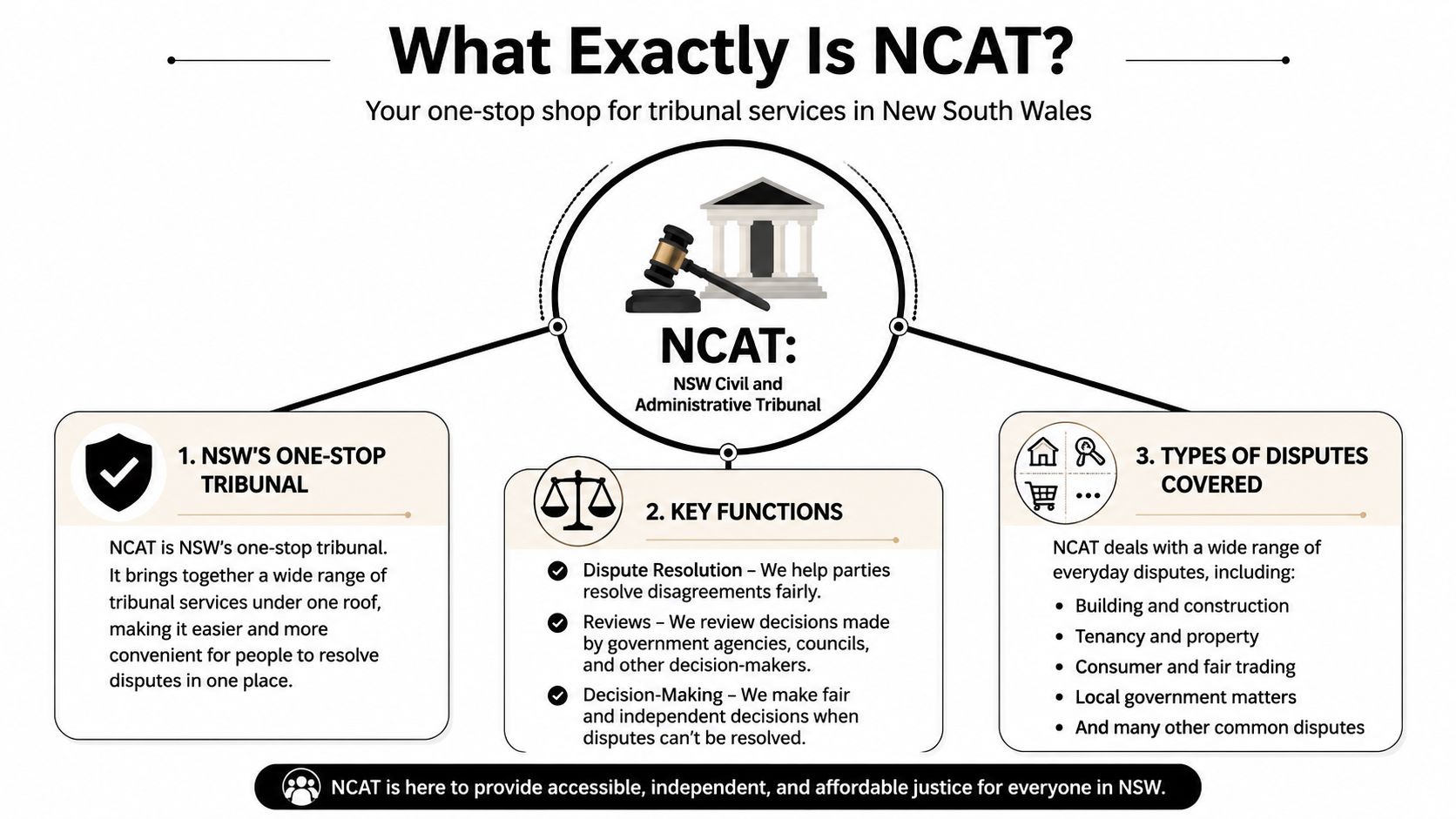
NCAT works as a central gateway, not a single-purpose court. It deals with different kinds of NSW disputes through specialist lists, so the person hearing the matter is working within the right legal framework from the outset. For building disputes, that matters because the decision-maker has to deal with contracts, defects, variations, and repair obligations, not just the tension between the parties.
This practical NCAT overview from Awesim is useful because it matches the questions clients ask after a dispute breaks down. They want to know where the matter goes, what evidence matters, and what happens if the other side refuses to cooperate. NCAT exists to deal with those questions in a tribunal setting, rather than through a full court process.
The trade-off is clear. NCAT is more accessible than a traditional court, but that does not make the case any easier to run properly. The less courtroom formality there is, the more important the paperwork, timeline, and evidence become, because the tribunal must work from what is filed and explained.
NCAT is meant to be accessible, but accessibility does not remove the need for proof. It shifts the burden onto the party seeking an order to present the facts clearly.
NCAT Divisions and Building Dispute Jurisdiction
Building disputes in NSW usually sit inside NCAT’s Consumer and Commercial Division. That’s the part of the tribunal that handles the everyday commercial and property conflicts people run into when a project goes wrong. In practical terms, that’s where most residential building arguments land when the dispute is about defects, incomplete work, or contract performance.
NCAT’s reach isn’t just Sydney-based either. Its Consumer and Commercial Division operates through five regional registries in Liverpool, Newcastle, Penrith, Tamworth, and Wollongong, alongside the central Sydney registry as noted in a tribunal introduction paper. That regional footprint matters. A dispute in NSW isn’t automatically a city dispute, and the tribunal’s structure reflects that.
Why jurisdiction has to be checked early
A lot of people assume that if the job went wrong, NCAT will hear it. That’s not always true. The matter still has to fit the right head of jurisdiction, and in building disputes there can be prerequisites, time limits, monetary limits, and dispute-specific steps before the tribunal will deal with it as flagged in specialist NCAT guidance.
That’s why the first practical question isn’t “who’s right?” It’s “is this the kind of dispute NCAT can deal with, and have the necessary steps been taken already?” If the answer is unclear, the wrong filing can waste time and give the other side an opening to argue about procedure instead of the defect itself.
For building matters, that usually means checking the contract, the complaint history, and whether the dispute belongs in the tribunal’s building and construction pathway. It also means separating what’s a technical defect from what’s a pure commercial disagreement. Those are not always the same thing, even when the same bad workmanship caused both.
Navigating the NCAT Process Step by Step
A building dispute in NCAT usually moves in a sequence, and the sequence matters. If a homeowner turns up without the right documents, or a builder waits too long to organise expert evidence, the hearing becomes harder before it even starts. The process is less confusing when it’s treated like a file that gets built stage by stage.
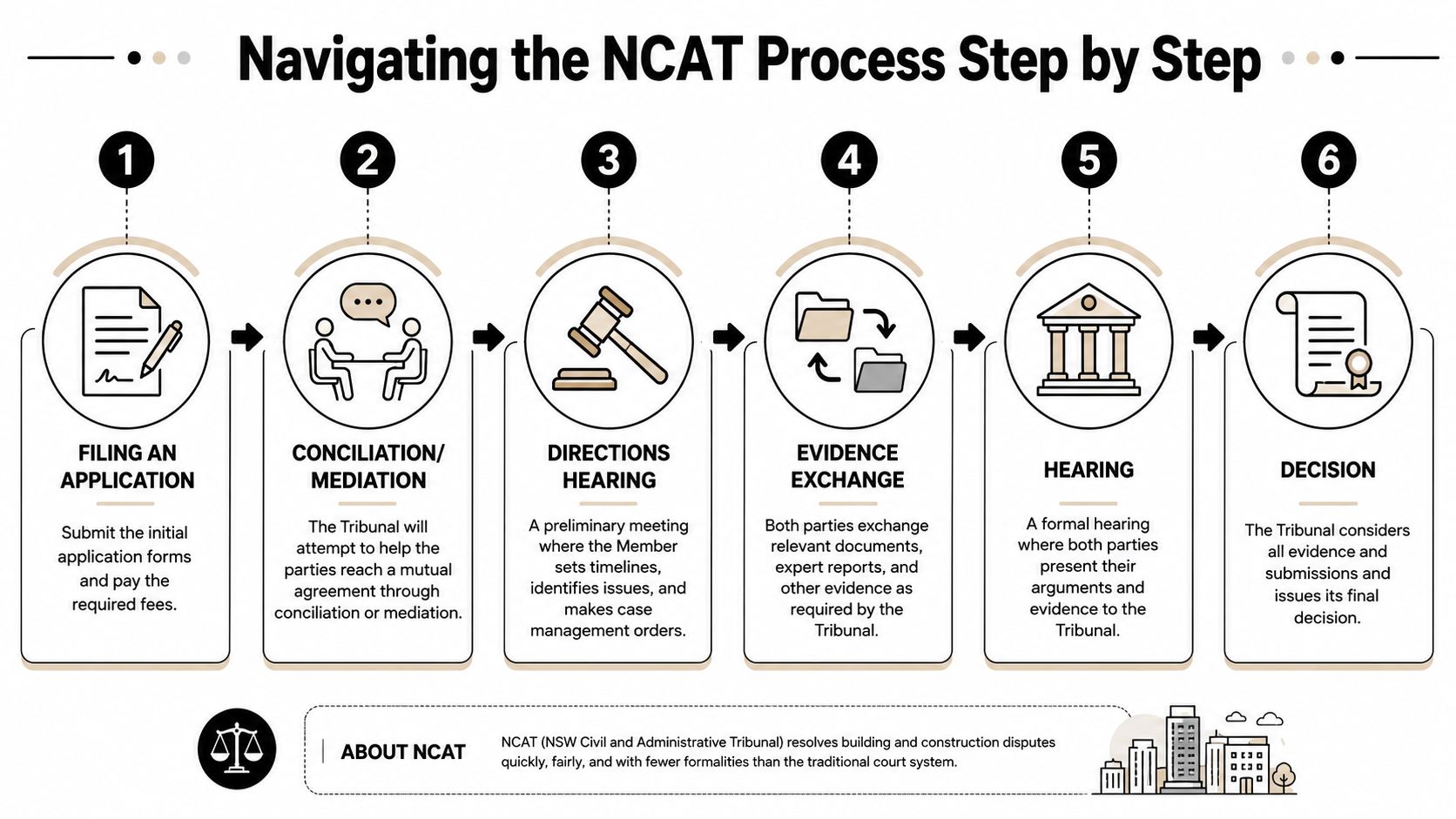
The first step is filing the application. That sounds basic, but the application has to describe the dispute clearly enough that the tribunal understands what order is being sought and why. The second step is usually a directions hearing, where the tribunal sets the timetable and identifies what needs to happen before the case can progress.
After that comes the evidence stage. During this stage, parties exchange material, organise technical reports, and prepare the Scott Schedule if the matter needs one. Then there’s the settlement conference, where the parties try to resolve the dispute without going all the way to hearing. If settlement fails, the matter moves to final hearing and decision.
The timeline is not instant. One NSW guidance source says the total duration from application to final hearing commonly ranges from 6 to 12 months, with 9 months being common, while the settlement conference itself is usually a 2 to 4 hour session as set out in procedural guidance. That timing matters because people often prepare as if the dispute will be finished in a few weeks. It usually isn’t.
What this means in practice
If you’re a homeowner, the early months are for documentation, not just frustration. If you’re a builder, they’re for organising the records that show what was agreed, what changed, and what work was completed. Either way, the dispute gets decided on evidence that is prepared early, not on whatever gets mentioned at the last minute.
Awesim’s step-by-step NCAT guide for homeowners is worth reading if you want the process mapped to real building disputes rather than generic legal language.
The Role of Expert Evidence and Scott Schedules
NCAT does not decide building disputes by asking who sounds most annoyed. It decides them on records, measurements, photographs, contract documents, and expert opinions that explain the defect in plain English. Without that structure, even a genuine problem can become hard to prove.
An expert witness report has to do more than say something looks wrong. For NSW building disputes, the report structure should identify the expert’s qualifications and experience, confirm they’ve read the expert code of conduct, state the issues referred, the facts and assumptions relied on, the reasons for each opinion, whether each issue is inside or outside expertise, and the examinations, tests or investigations relied upon as described in Awesim’s expert report guide. That structure matters because the tribunal needs to know not just what the opinion is, but how it was reached.
A proper report is also built from the right source material. The same guide points to the building contract, approved variations, architectural plans, engineering drawings, emails, site diary entries, and prior inspection reports or quotes as common inputs. If those materials are missing, the opinion can lose force fast.

Why the Scott Schedule is so useful
The Scott Schedule Scott Schedule explained for NSW tribunal disputes is the tribunal’s way of forcing structure onto a dispute. In NSW building matters, it is an itemised dispute matrix, and the Awesim guide says it is mandatory for home building disputes exceeding $30,000 under NCAT Procedural Direction 3 (2025) Scott Schedule guidance. It typically starts with four core columns, Item Number, Contract requirement, Applicant’s comments, and Estimate of Loss.
That format helps because it stops the dispute from drifting into broad complaints. Each defect gets listed, each party’s position is separated, and the alleged loss is linked to a specific item. For builders, that can expose unsupported allegations quickly. For homeowners, it can turn a chaotic file of photos and messages into a tribunal-ready case.
This point is where technical evidence takes over from argument. A well-prepared Scott Schedule and expert report can make the difference between a dispute that feels emotional and a dispute that is actionable. Awesim Building Consultants prepares site investigations, Building & Construction Expert Witness Reports, and Scott Schedules for this exact kind of tribunal work.
If the defect can’t be explained clearly on paper, it’s much harder to make NCAT act on it.
Common NCAT Outcomes and Enforcing Orders
A lot of people focus on getting the hearing, then forget to think about the order itself. That’s a mistake. The primary question is not just whether NCAT agrees with you, but what the tribunal can make the other party do next.
For NSW tenancy and building-related disputes, NCAT’s decisions are legally binding, even though it is not a formal court as explained in a tenants’ factsheet. That legal effect matters because it gives the orders practical force. In building disputes, orders can deal with repairs, money, and other remedies that change what happens after the dispute is decided.
What an order can look like
A work order can require a party to perform specific rectification work. A money order can require payment of compensation or costs. A declaration order can clarify rights or obligations where the dispute turns on interpretation. If the order is ignored, the enforcement path can involve registering the order through the Local Court so it can be pursued like a court judgment.
That enforcement reality is why evidence quality matters so much. A tribunal member is far more likely to make a practical order when the technical material is tight, the defect is described clearly, and the requested remedy matches the evidence. Weak reports tend to produce vague outcomes. Clear reports can produce orders that are easier to enforce.
The best approach is to prepare as though compliance matters from day one. If the other side has a history of delay, denial, or non-response, the evidence should already be organised in a way that supports an enforceable result. That means contract records, photographs, expert findings, and a Scott Schedule that ties the complaint to a specific remedy.
Preparing Your Case and How Awesim Can Help
Strong NCAT preparation comes down to three things, documentation, clarity, and timing. If the records are incomplete, the dispute becomes harder to prove. If the issues are described loosely, the tribunal has less to work with. If expert evidence is left too late, the case often turns into catch-up work under pressure.
The safest path is to treat the dispute like a technical file, not a complaint diary. Keep the contract, variations, site photos, emails, inspection notes, and any repair quotes together. If the matter is likely to become a tribunal case, the evidence should be organised before the arguments harden, not after.
For homeowners, builders, solicitors, and insurers, that’s where Awesim Building Consultants fits naturally. With 35+ years in Building & Construction and 15+ years providing litigation support to homeowners, builders, and lawyers, Awesim provides site investigations, Building & Construction Expert Witness Reports, and Scott Schedules that align with NCAT’s practical demands. If the dispute needs technical support, that kind of documentation can keep the matter focused on the core issue, the work itself.
The important thing is to get advice early enough to shape the evidence properly. A poorly framed application can be expensive to fix later. A well-prepared file gives the tribunal something concrete to decide.
A CTA for Awesim Building Consultants. If you need help with a building dispute, email admin@awesim.com.au or call 1800 293 746.
Related Posts

Water Damage in Homes: How to Track Down the Source
Water damage in a home rarely announces itself at the source. A stain on the ceiling, a musty smell in
Read More »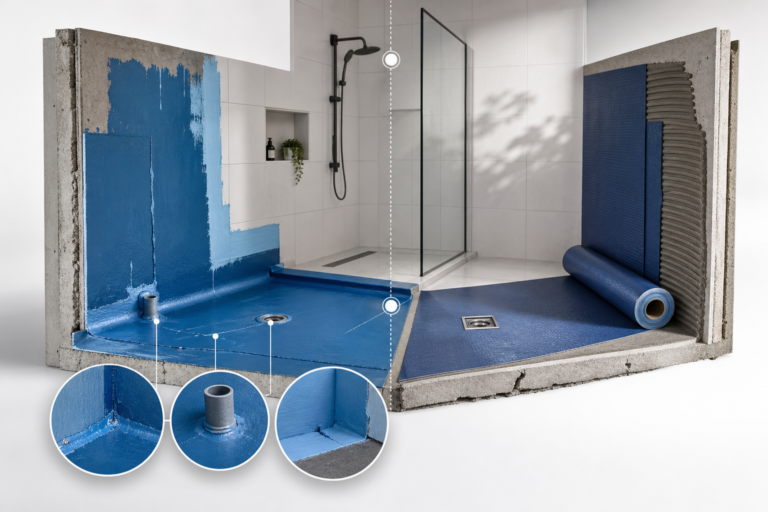
Waterproofing Membrane Types: Which Fails Most in NSW Bathrooms
Waterproofing failure is the single most common serious defect found in NSW apartments, and the type of membrane used, along
Read More »
Building Certifier NSW: Role, Limits, and When You Need More
A building certifier in NSW is a registered professional who issues construction certificates, conducts critical stage inspections, and grants occupation
Read More »